
My first interaction with The Twilight Zone (Rod Serling’s 1959-1964 version) was in 6th grade. One 2026-11-28 20:31:31 Author: catchingphish.com(查看原文) 阅读量:16 收藏
My first interaction with The Twilight Zone (Rod Serling’s 1959-1964 version) was in 6th grade. One of my teachers would show episodes during lunch for students who were interested. Having grown up watching Goosebumps and Are You Afraid of the Dark? I was immediately hooked to this less juvenile program.
I like to try and find parallels throughout history to put AI’s impact into perspective, not only technologically but also sociologically and psychologically. This has led me to rewatch The Twilight Zone episodes that address themes at the forefront of debate and anxiety now such as automation, job loss, and human-machine relationships.
If you haven’t watched these episodes before I highly encourage you to watch them first so you can formulate your own opinion and experience your own emotional reaction.
- The Lonely (1959), S1E7
- The Mighty Casey (1960), S1E35
- A Thing About Machines (1960), S2E4
- The Lateness of the Hour (1960), S2E8
- I Sing the Body Electric (1962), S3E35
- In His Image (1963), S4E1
- Steel (1963), S5E2
- The Old Man in the Cave (1963), S5E7
- Uncle Simon (1963), S5E8
- From Agnes—With Love (1964), S5E20
- The Brain Center at Whipple’s (1964), S5E33
The Brain Center at Whipple’s
One episode in particular stood out to me: The Brain Center at Whipple’s. Below is a summary courtesy of The Twilight Zone Wiki:
In 1967, Wallace V. Whipple, owner of a vast manufacturing corporation, decides to upgrade his plant to increase output by installing a machine named the “X109B14 modified transistorized totally automated machine”, which leads to layoffs. Some former employees try to convince him that the value of a man outweighs the value of a machine, but their protests fall on deaf ears. Soon after, Whipple fires all of his working replacing them with machines. As a result the same machines turn on him by repeating his employees parting spiteful words back at him causing him to go insane.
Eventually, the board of directors find him neurotically obsessed with machines and retire him. Whipple joins his former plant manager Hanley at the bar opposite his factory (which, amazingly, is still open) and expresses deep sorrow at his misfortune. (“It isn’t fair, Hanley! It isn’t fair the way they…diminish us.”) Hanley for his part remains silent deciding that Whipple suffered enough already seeing that without any friends or family to turn to, the factory was the only thing Whipple had. A robot (Robby the Robot) now runs his office twirling his keys similar to how Whipple did.
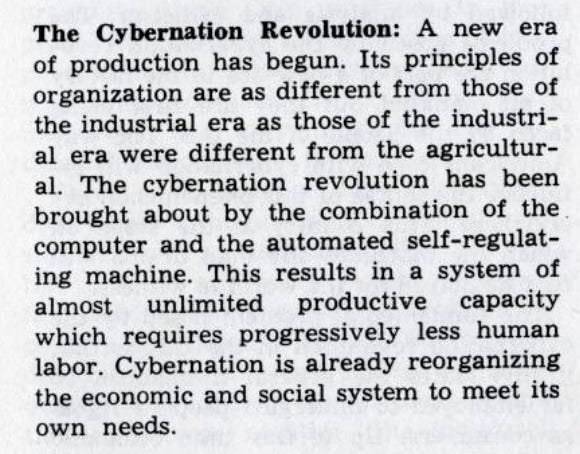
The episode opens with Mr. Whipple and Hanley watching a taping of a soon to be released 1967 year-end report to employees and shareholders. This episode first aired in May 1964, the near-future date makes the story feel only a few years away, a plausible extrapolation of automation. Viewers of this episode during this time period would be familiar with fears around job loss as a result of automation. In February 1962, during a news conference, JFK was asked by a reporter how urgent he views the problem of automation that the Labor Department estimated would replace 1.8 million people every year. JFK responded that “[automation] places a major burden upon our economy and on our society” and “I regard it as a very serious problem.” Additionally, in 1964, prominent intellectuals and civil rights leaders sent a memorandum to President Lyndon B. Johnson warning of the “Cybernation Revolution”.

One other thing I want to highlight is the scale of Whipple’s current workforce, which is stated as being “close to 283,000 personnel”. In 1964, this would have made the W.V. Whipple Manufacturing Corporation one of the largest employers in the country, larger than IBM, Sears, and General Electric.
As Mr. Whipple continues his crusade into automation, there are several pan shots of the empty parking lot and cafeteria that once were bustling with employees. These images are quite eerie, dare I say liminal.
In one of the most enduring scenes, an ex-worker (Dickerson) breaks into the factory with the intention of destroying the machines. Thus begins a dialogue that I believe sums up the business perspective of AI-layoffs contrasted with the pleas of the replacee.
Whipple: Shall I tell you the difference, Mr. Dickerson, between you and it? That machine costs two cents an hour for current. It lasts indefinitely. It gets no wrinkles, no arthritis, no hardening of the arteries. That one machine is a lathe operator, a press operator. Two of those machines replace 114 men that take no coffee breaks, no sick leaves, no vacations with pay. And that, in my book, Mr. Dickerson, is worth considerably more than you are.
Dickerson: They should have stopped you a year ago! Somebody ought to have held you down and put a bit in your head and poured in some reminders that men have to eat and work. And you can’t pack them in cosmoline like surplus tanks! Or put them out to pasture like old bulls! I’m a man, Mr. Whipple! You hear me? I’m a man! And that makes me better than that hunk of metal, you hear me? Better!
The episode finishes with Whipple entering a bar across the street from the factory, he too has been replaced by a machine. He laments that he was displaced in his “prime”. A repercussion of the very automation he implemented. Rod Serling’s final narration states “in the case of Mr. Whipple, he can create himself right out of existence.”
Purpose is a powerful thing, the lack of which can cause depression and anxiety. AI has and will continue to cause impact, the extent of that impact from a labour perspective remains to be seen.
“There is nothing permanent except change” said Heraclitus. It is a fool’s errand to guess what our world will look like in a year, I choose to keep refining the skill I feel is timeless; inquisitiveness.
如有侵权请联系:admin#unsafe.sh