
The man who leads the world’s most valuable chip company spent Sunday apologising to his wi 2026-11-9 11:1:56 Author: thecyberexpress.com(查看原文) 阅读量:3 收藏
The man who leads the world’s most valuable chip company spent Sunday apologising to his wife, his children and tens of thousands of employees. Hours earlier, Nvidia’s board had announced an independent inquiry into reports that Jensen Huang was the target of a foreign intelligence effort. The Nvidia board investigation has raised a set of questions that go well beyond one executive’s personal life: who the woman at the centre of the reports is, whether any secrets were exposed, and whether the board could actually remove a founder who has led the company for more than three decades.
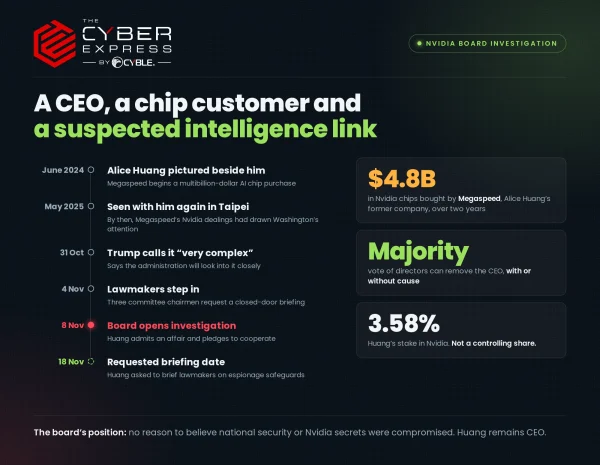
The inquiry follows reporting by The New York Times about Huang’s relationship with Alice Huang, a former executive at Singapore-based data centre company Megaspeed.
What Triggered the Nvidia Board Investigation
According to the newspaper, US intelligence officials suspected she was gathering information for China. She is not related to Jensen Huang.
On November 8, Nvidia said a committee of independent directors, assisted by outside counsel, would oversee the investigation.
The board said it “has no reason to believe that either national security or NVIDIA secrets were compromised,” but that its inquiry would examine all available information. It added that it has confidence in Huang and his leadership team.
Who Is Alice Huang?
Alice Huang, who also goes by Huang Le, is a Chinese citizen. A profile in a Chinese private-fund database describes her as a former television reporter with Hunan TV and state broadcaster CCTV. It also lists roles at HSBC’s private banking division and as vice president at CITIC Securities. However, The New York Post reported that a Hunan TV executive said he had never heard of her, and it found no profile for her on CCTV’s website.

It is unclear when she and Jensen Huang first met. She was photographed sitting beside him at a bar in Taipei in June 2024, and seen again standing behind him outside a Taipei restaurant in May the following year.
Why the Megaspeed Link Matters
This is where the story moves from personal to commercial. Around the time of the first photograph, Megaspeed began a multibillion-dollar purchase of advanced AI chips, according to the Times. The company bought more than $4.8 billion worth of Nvidia chips over two years, making it one of Nvidia’s biggest customers in Southeast Asia.
Megaspeed had also faced scrutiny over suspicions that it helped Chinese customers obtain processors restricted under US export restrictions. Those controls are designed to limit China’s access to advanced computing, and Nvidia’s own filings acknowledge they have affected its ability to sell to Chinese customers. Reports say US authorities later found that Megaspeed’s boss was passing information to Beijing.
That combination explains why this is being treated as a national security matter. A suspected intelligence asset was reportedly close to the CEO of a company whose products sit at the heart of US export policy, while her company was buying billions of dollars of those products.
What Jensen Huang Said
Huang had previously described his interactions with Alice Huang as normal business dealings. In Sunday’s email to staff, he admitted to an extramarital affair. “I was unfaithful to my wife. My actions hurt her and our children. There is no excuse for what I did,” he wrote.
He told employees, partners, and shareholders that “you deserve better from me,” said he supports the investigation and will cooperate fully, and asked for privacy for his family.
Can the Nvidia Board Investigation Lead to Huang’s Removal?
Legally, yes. Nvidia’s bylaws, filed with the SEC in March 2024, allow any officer to be removed “with or without cause” by a majority vote of directors. The CEO is listed as an officer. Being co-founder offers no exemption.
His shareholding does not protect him either. Huang owned about 3.58% of Nvidia’s stock as of March, according to the company’s May 2026 proxy statement. That is significant, but it is not a controlling stake.
There is one important distinction. Removing Huang as CEO and removing him from the board are separate decisions. Removing a director requires a shareholder vote: a majority of voting power with cause, or two-thirds without cause. The board could take away the CEO role, but not his board seat on its own.
Having the power is not the same as planning to use it. The board has expressed confidence in Huang and has announced no plan to replace him.
Does an Affair Break Company Rules?
Not automatically. Nvidia’s proxy statement requires directors, officers and employees to avoid activities that conflict, or appear to conflict, with the company’s interests. The investigation could look at confidential information, customer relationships and policy compliance, but Nvidia has not said Huang breached any of these.
Past cases show why the details matter. Intel’s Brian Krzanich resigned in 2018, and McDonald’s dismissed Steve Easterbrook in 2019, after relationships with employees that broke company policy. Huang’s case involves a former executive at an outside customer, which makes the situation materially different.
How Washington and Seoul Are Reacting
President Donald Trump called the situation “very complex,” said he had always found Huang “very aboveboard,” and added that the administration would look into it “very closely.” Secretary of State Marco Rubio said he could not comment. On November 4, three Republican congressional committee chairmen requested a closed-door briefing from Huang on November 18 about the allegations and Nvidia’s safeguards against foreign espionage.
In South Korea, Vice Minister of Science and ICT Ryu Jemyung said 10,000 Nvidia GPUs funded under a 2025 budget had already arrived, and that contracted deliveries for 2026 were expected to proceed without disruption. Separately, a planned visit to South Korea by Huang’s daughter Madison Huang, an Nvidia senior director, was cancelled around the same time the controversy broke.
For now, Huang remains chief executive. The outcome hinges on what the independent investigators find, particularly whether any confidential information or customer dealings were affected, and on what Huang tells lawmakers on November 18. The board has said it will share updates as appropriate.
如有侵权请联系:admin#unsafe.sh