
Stablecoins in circulation reached a record of about $322 billion in May 2026, roughly twelve times 2026-10-8 13:43:15 Author: hackernoon.com(查看原文) 阅读量:3 收藏
Stablecoins in circulation reached a record of about $322 billion in May 2026, roughly twelve times their size at the end of 2020, while the value of tokenised real-world assets such as Treasuries and private credit quadrupled in a year to $26.4 billion. Every one of those dollars sits on ledgers where balances, counterparties and transaction amounts are visible to anyone who cares to look, which is the opposite of how banks, asset managers and payment companies are used to working. Soda Labs, which builds privacy infrastructure for financial activity on public blockchains, has raised a $3 million seed round to close that gap, with the Luxembourg venture firm NextBlock funding the entire round.
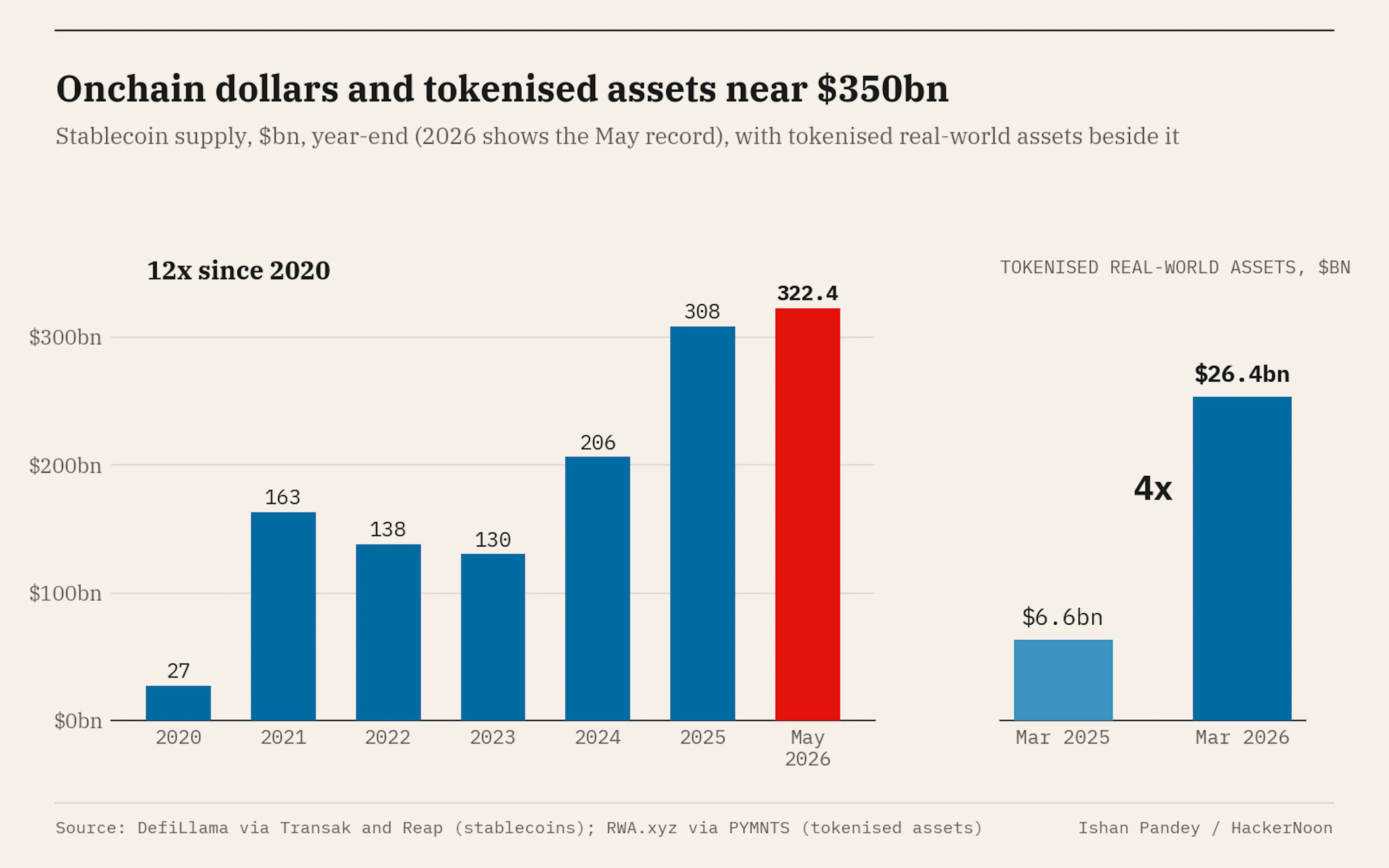 Stablecoin supply has grown roughly twelvefold since 2020 to a May 2026 record of $322.4bn, while tokenised real-world asSources: DefiLlama via Transak, Reap and RWA.xyz via PYMNTS
Why Public Ledgers Stop Institutions at the Door
Traditional markets have always kept the details of who is trading what and in what size hidden from the rest of the market. More than half of US equity volume now trades away from the public exchanges on off-exchange venues and dark pools, according to Nasdaq data cited by 21Shares, while the more than $100 trillion of US securities held at DTCC sits in accounts that competitors cannot inspect. A public blockchain reverses that arrangement, because a treasury desk moving stablecoins or a fund rebalancing a tokenised portfolio broadcasts its size, timing and counterparties to every observer, including the bots that profit from front-running. The same 21Shares research puts the value extracted from users through this kind of maximal extractable value, or MEV, at about $1.7 billion between 2022 and 2025.
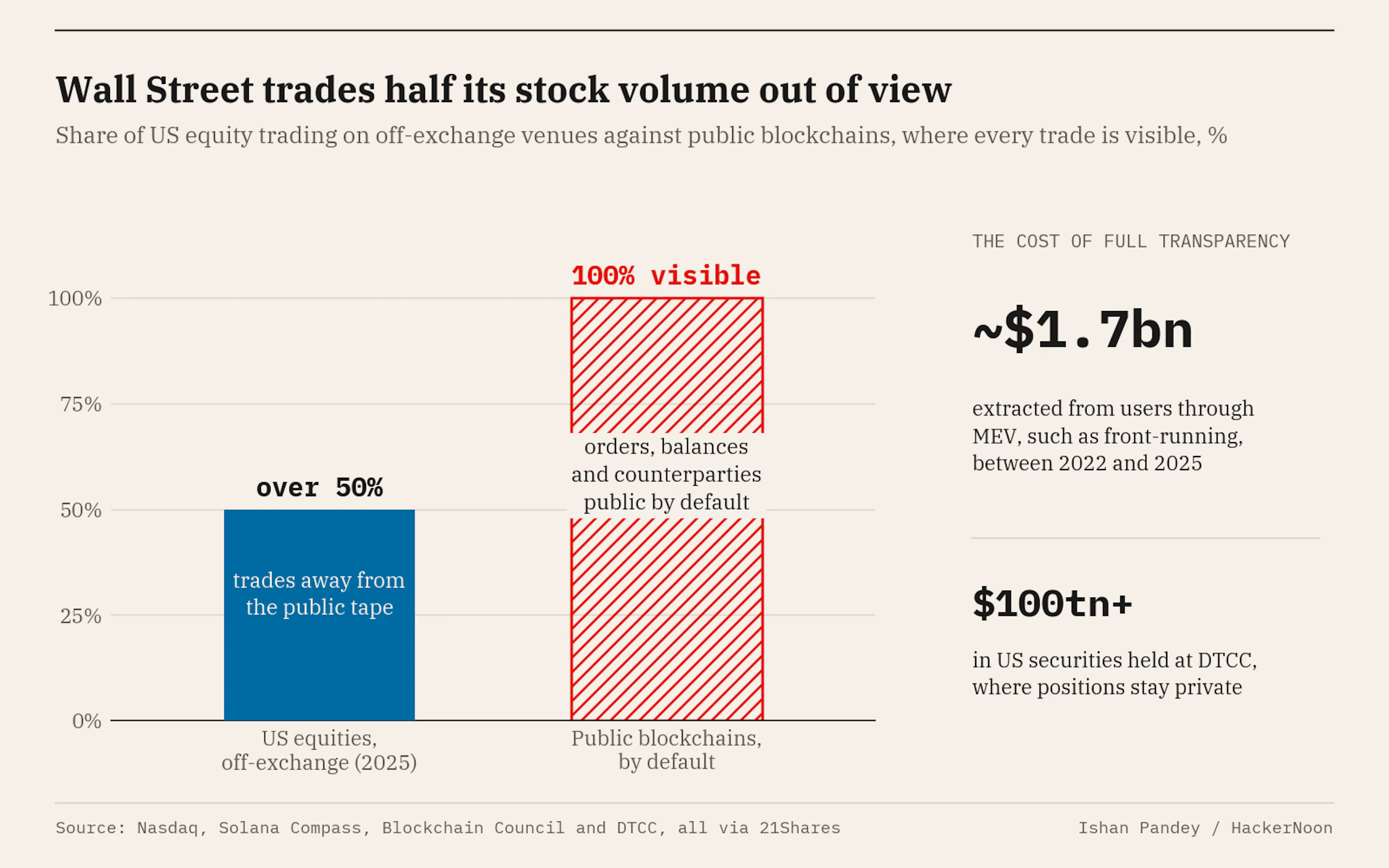 More than half of US equity trading happens on off-exchange venues where orders stay out of view, while trades on public blockchains are visible by default, a gap that has cost users about $1.7bn in MEV between 2022 and 2025.
Demand for privacy onchain is already showing up in market prices and in how holders choose to store their coins. The combined value of privacy-focused tokens rose from about $6.2 billion to about $30 billion in the year to September 2026, according to 21Shares, while the share of Zcash supply held in its private shielded pools climbed from about 9% in September 2023 to roughly 28%. Those figures describe retail and crypto-native demand, which is a useful signal for the larger institutional market that Soda is targeting, where the requirement is privacy that can still be disclosed to a regulator or auditor on request.
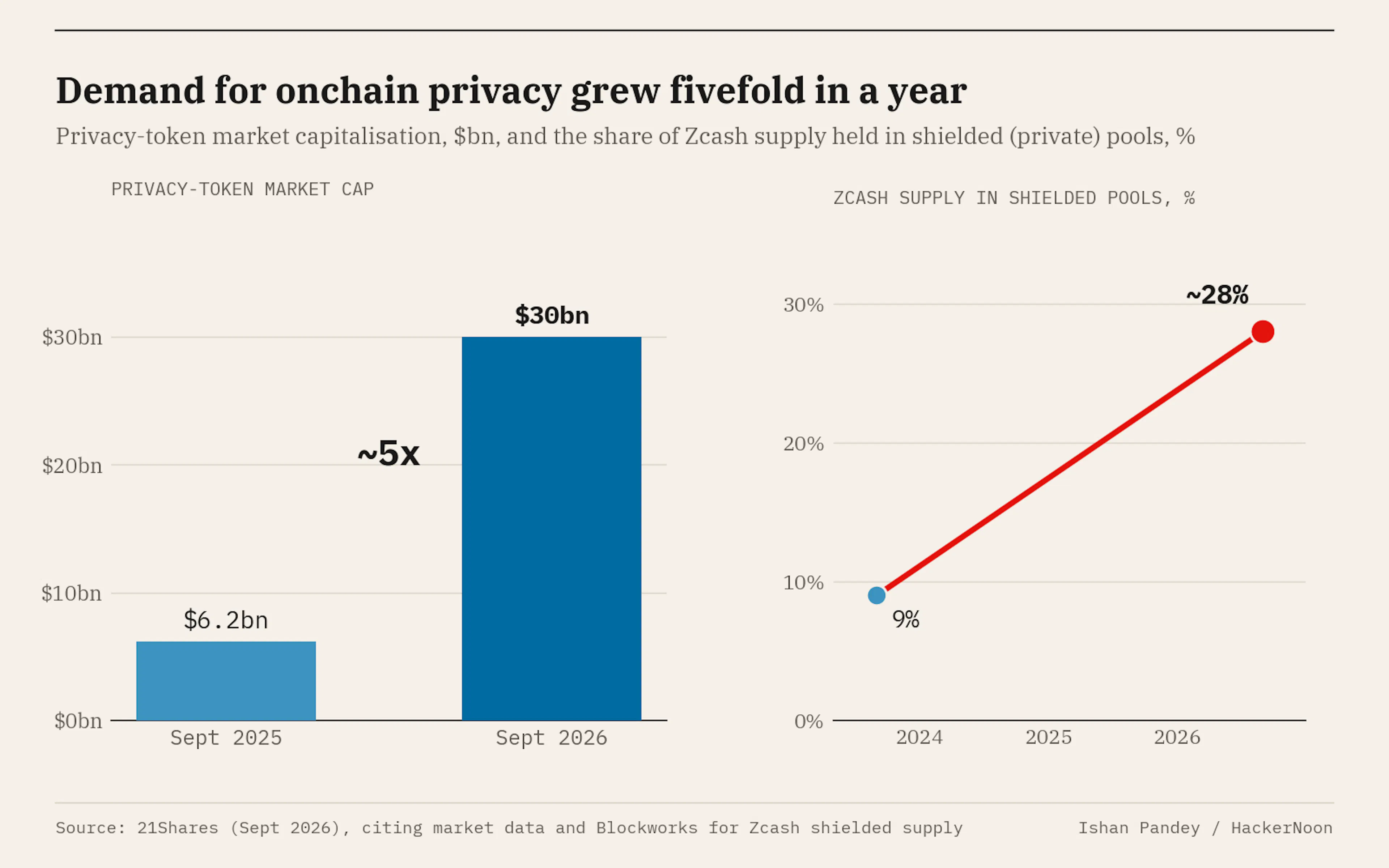 Privacy-token market capitalisation rose about fivefold to $30bn in the year to September 2026, while the share of Zcash supply held in shielded pools roughly tripled from 9% to about 28%.
How Garbled-Circuit MPC Works
Soda's approach combines two ideas that have been studied in academic cryptography for decades. Garbled circuits, first described in the 1980s to solve the so-called millionaires' problem of two people learning who is richer without revealing their wealth, let a computation run on encrypted inputs, while multiparty computation splits sensitive data across independent nodes so that no single party ever holds the full picture. The result is that a smart contract can check a balance, settle a trade or apply a compliance rule without the underlying numbers ever being published onchain or decrypted during the computation.
The design choices behind the engine matter a great deal to a bank or payment company weighing it up. Soda relies on long-established standards such as AES and SHA-256 rather than newer cryptographic assumptions, while its engine runs on ordinary cloud CPUs instead of the specialised hardware that fully homomorphic encryption and trusted execution environments often require. Applications stay connected to the public chains they already use, while an onchain access list lets authorised parties such as auditors or regulators request scoped decryption of specific data, which is the controlled disclosure that regulated institutions need.
The Founder Thesis
Soda Labs was founded by Avishay Yanai, its chief executive and a PhD in cryptography, together with Meital Levy, its chief technology officer and a PhD in algorithms, with more than 20 years of combined experience in security between them. The team has spent the past two and a half years building the technology, first as gcEVM, a privacy layer for Ethereum's Layer 2 networks that has run on the COTI mainnet since March 2025, then as Soda Bubble, a chain-agnostic coprocessor that processes developer-defined workloads from different blockchains without exposing the private data publicly or to Soda Labs itself. The company says it holds three granted US patents and that its stack has been audited by Hacken.
Yanai's thesis rests on the view that public blockchains have already won on liquidity, users and financial applications, so the missing piece is a way for regulated money to move without showing everyone everything. In his framing, Bubble gives banks, payment companies and tokenisation platforms privacy with controlled disclosure on the chains they already use, which means they do not have to choose between the reach of a public network and the confidentiality their clients expect. The new round, in his words, is what takes the product from pilots to production.
A Bubble Validator Network lets participants verify mathematically that computations involving private data were carried out faithfully, which addresses the obvious question of how anyone can trust a calculation they cannot see. Bubble is live on Ethereum, Polygon, Arbitrum, Base and COTI, expansion to Solana and other non-EVM networks is under way, while the Soda website lists Optimism, BSC, Avalanche and XDC as next. Through COTI the technology has also reached central-bank work, since COTI was named a pioneer in the European Central Bank's digital euro innovation platform and presented a pilot for confidential transactions.
Traction on Live Networks
Soda's technology has processed more than 100 million transactions on the COTI network, where it supports applications including the tokenisation platform Zoniqx and the perpetuals exchange PriveX. PriveX launched in June 2025 with trades encrypted by default so that positions and liquidation points stay hidden, while its dashboard showed about $13 million in cumulative volume three weeks after launch. PriveX has since passed $20 billion in trading volume, roughly 1,500 times that early figure, while Zoniqx is onboarding issuers across several asset classes and jurisdictions.
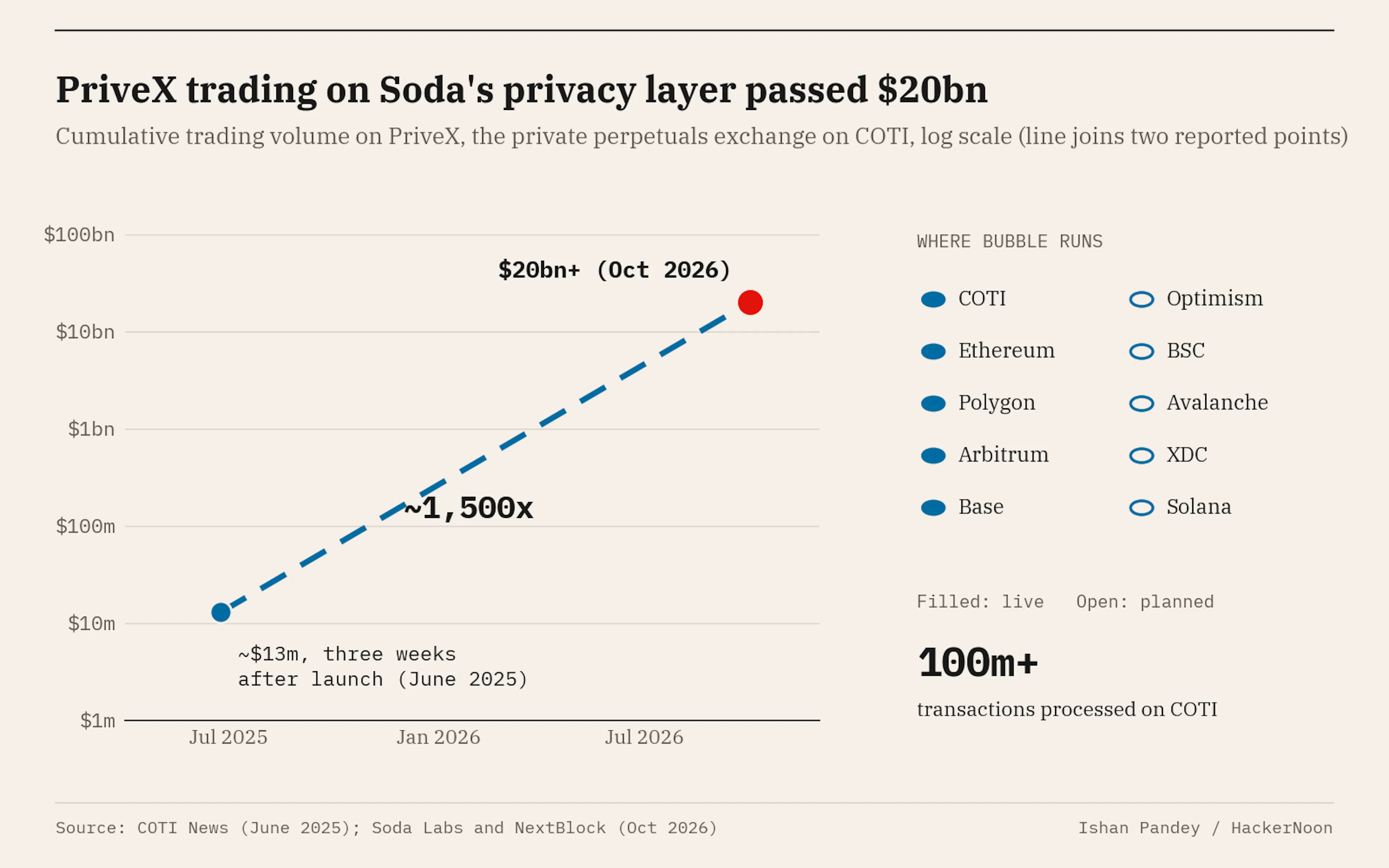 Cumulative trading volume on PriveX rose from about $13m three weeks after its June 2025 launch to more than $20bn by October 2026, while Bubble is live on five networks with five more planned.
Soda is also working with financial and infrastructure organisations on several pilots that it has not yet named, with the aim of converting them into production deployments. The company's website separately lists a Chainlink oracle pilot alongside its central-bank work through COTI.
Performance and Cost
Privacy technology has long struggled with speed and cost, which is why Soda measures its system end to end rather than in isolated cryptographic steps. Its published benchmark from July 2026, run on Arbitrum across 15,000 confidential transfers, recorded 500 confidential transactions per second sustained and 750 at peak, at a cost of about $0.14 per million transfers. The company says its latest testing, which covers the full lifecycle of encryption, MPC computation, consensus and settlement on the live Arbitrum network, shows a five- to tenfold improvement on that earlier benchmark, with the results due for publication in the coming weeks.
Soda also reports that its garbled-circuit architecture can deliver roughly 10 to 100 times more throughput and 100 to 1,000 times lower cost per transaction than currently available alternatives, all on standard cloud CPUs. Those comparisons are company figures until the new benchmarks are published and independently tested, although the direction is consistent with the broader argument for garbled circuits, which avoid the heavy computation that has historically slowed fully homomorphic encryption.
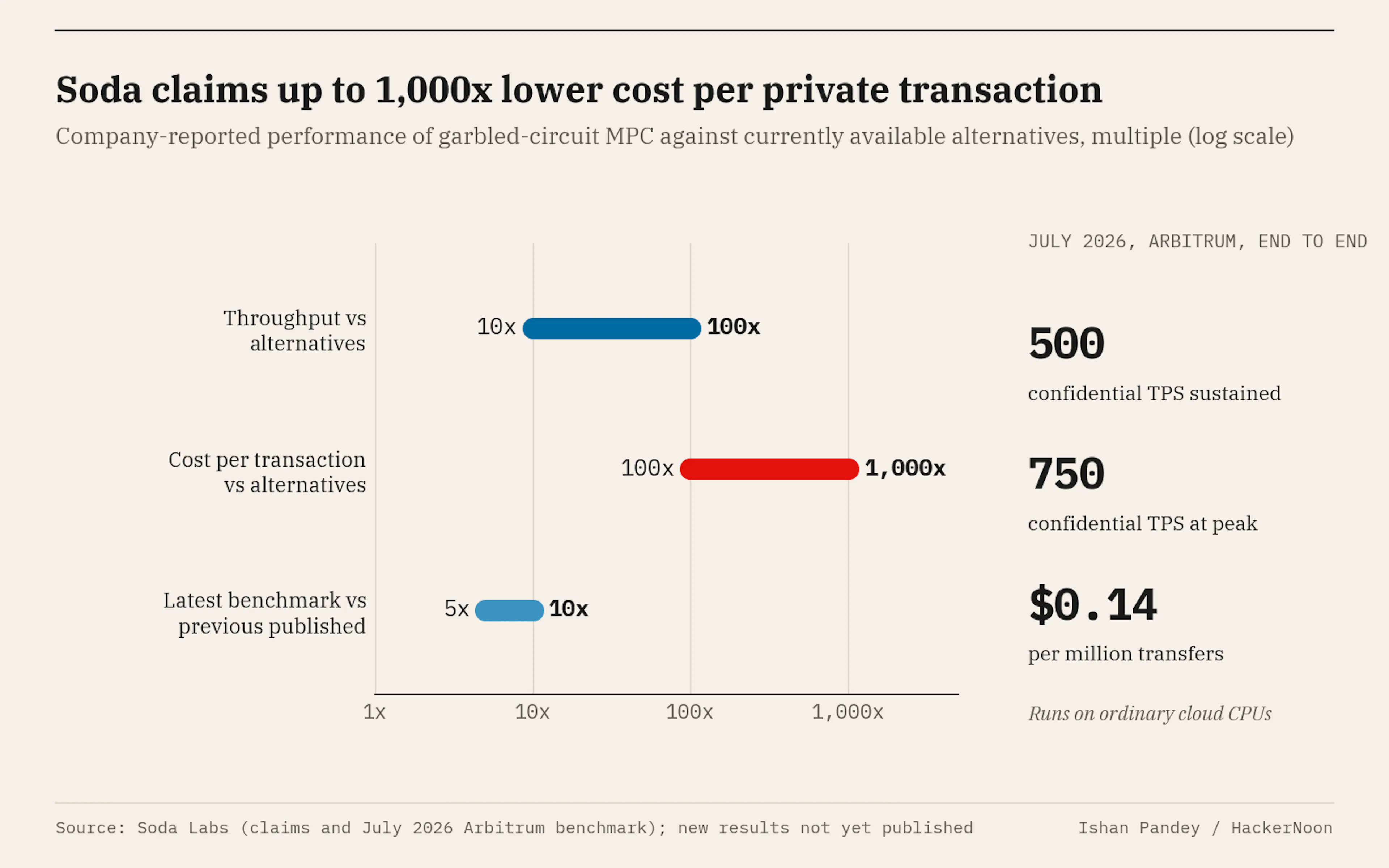 Soda reports 10 to 100 times higher throughput and 100 to 1,000 times lower cost per transaction than current alternatives, plus a five- to tenfold gain over its previous benchmark, with its July 2026 Arbitrum test recording 500 confidential TPS sustained at $0.14 per million transfers.
The Investor Thesis
NextBlock is a Luxembourg-based venture firm that invests at the intersection of blockchain and programmable cryptography, backing infrastructure for multiparty computation, garbled circuits, fully homomorphic encryption, zero-knowledge systems and post-quantum cryptography. In July 2025 it launched its first Luxembourg alternative investment fund, managed by a manager licensed by the CSSF to handle virtual assets, with initial commitments of $40 million and a target of up to $60 million, which makes funding an entire seed round a deliberate concentration rather than a syndicate allocation.
Pieter van Poecke, NextBlock's founder and general partner, has said that what drew the firm to Soda was not only the cryptography but its practicality for the financial workloads he expects to matter most onchain. His case rests on the fact that Soda already had a working product and paying customers when NextBlock invested, together with differentiated technical intellectual property, a deeply technical founding team and strong commercial instincts, which he sees as the foundation for the company's next phase. The wider market supports that reading, since Grand View Research forecasts confidential computing to grow from $5.5 billion in 2023 to $153.8 billion by 2030, while privacy specialist Zama became the first unicorn in fully homomorphic encryption with a $57 million Series B in June 2025.
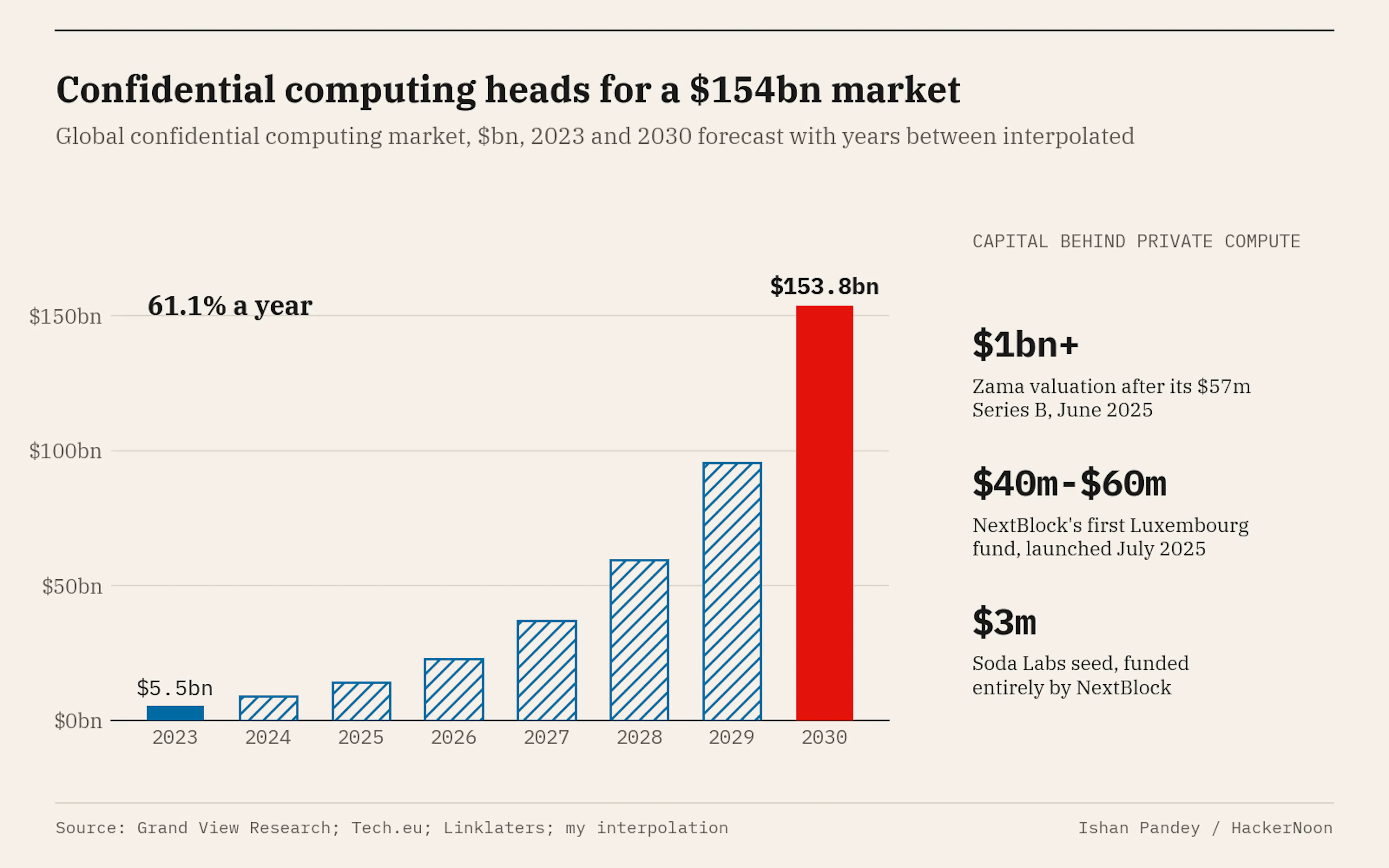 Grand View Research forecasts the confidential computing market to grow from $5.5bn in 2023 to $153.8bn by 2030 at 61.1% a year, as capital flows into private computation through rounds such as Zama's and funds such as NextBlock's.
What Comes Next
The capital gives Soda Labs room to focus over the next 12 to 18 months on commercial adoption and execution. It will fund the company's go-to-market strategy, a larger validator network, coverage of more blockchains, team growth and integrations with banks, payment companies, tokenisation platforms and other financial infrastructure providers, while the most important near-term milestone is publishing the new benchmarks and turning the undisclosed pilots into named production deployments. If that happens, Soda will have shown that institutions can use the liquidity of public blockchains without giving up the confidentiality they rely on today, which is the condition many of them have set before moving serious volume onchain.
Don’t forget to like and share the story!
Vested Interest Disclosure: HackerNoon has reviewed the report for quality, but the claims herein belong to the author. #DYOR.
如有侵权请联系:admin#unsafe.sh