American businesses were owed $7.48 trillion in trade receivables at the end of the first quarter of 2026-10-7 13:20:4 Author: hackernoon.com(查看原文) 阅读量:4 收藏
American businesses were owed $7.48 trillion in trade receivables at the end of the first quarter of 2026, according to the Federal Reserve, which is money already earned on goods and services delivered but not yet sitting in a bank account.
Stuut, a New York company whose AI runs the order-to-cash process for large enterprises, estimates that the global figure is closer to $16 trillion, so it has raised a $52.5 million Series B led by Insight Partners to go after it. Andreessen Horowitz, which led Stuut's Series A, returned for the round alongside Activant and M12, Microsoft's venture fund, taking total funding to $93 million barely ten months after the previous raise.
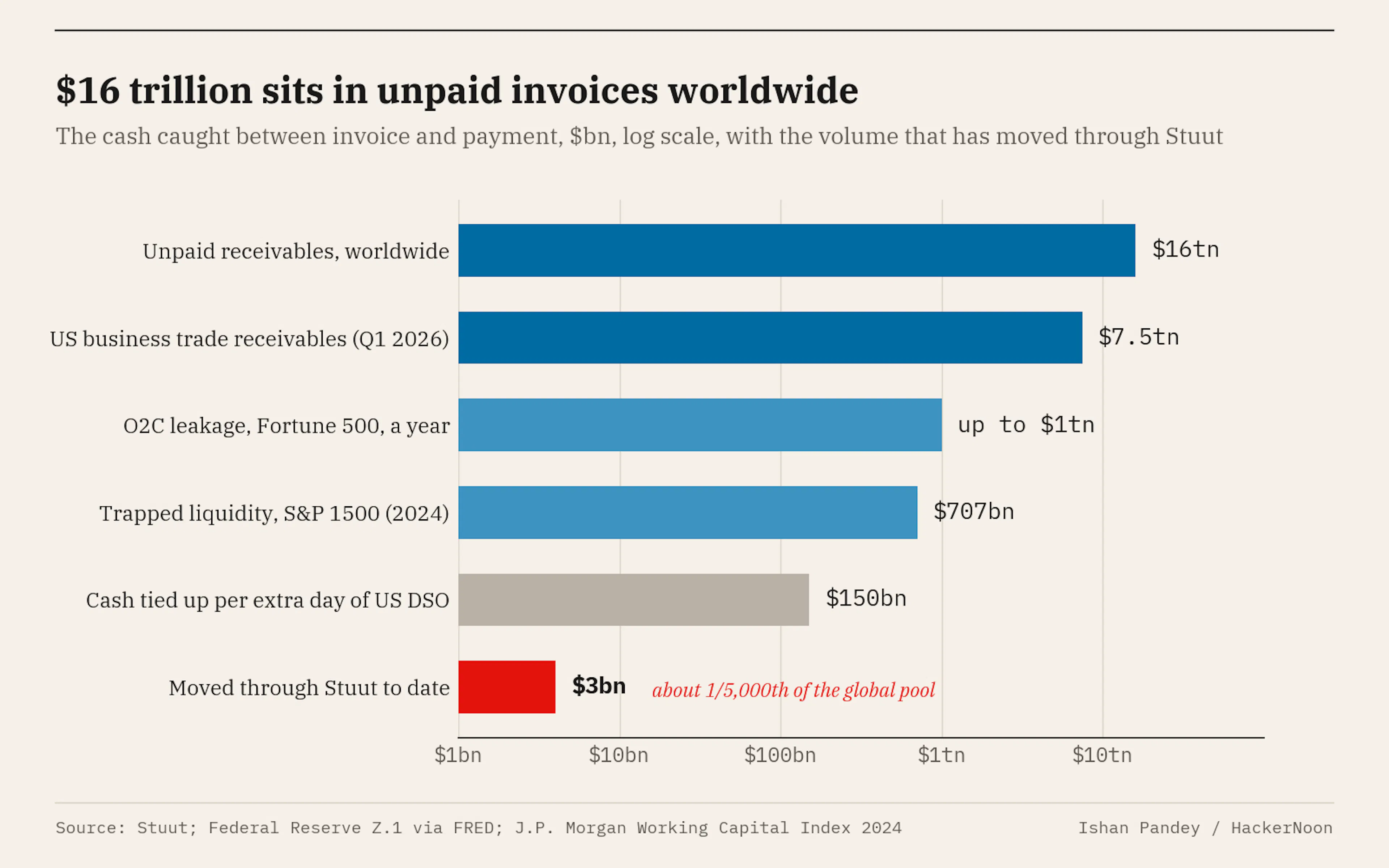 Stuut estimates unpaid receivables at about $16tn worldwide, US businesses held $7.5tn in trade receivables in the first quarter of 2026 and S&P 1500 companies carried $707bn of trapped liquidity in 2024, against the $3bn that has moved through Stuut so far. Sources: Stuut, Federal Reserve Z.1 via FRED and J.P. Morgan Working Capital Index
Why Getting Paid Is Still So Manual
Most late invoices are not arguments about money at all, which is what makes the problem so stubborn. A purchase order number is missing, the order data does not match what arrived at the loading dock or the invoice lands in the inbox of someone who left the customer months ago, while each of those small slips sets off weeks of emails, supplier-portal uploads and internal chasing between sales, finance and operations. Stuut estimates that broken order-to-cash processes cost companies as much as 5% of revenue, or up to $1 trillion a year across the Fortune 500, while its Series A announcement put the loss to manual receivables work at up to 5% of EBITDA for mid-market and enterprise companies.
Independent survey and banking data show just how widespread that friction has become across American business. The Atradius Payment Practices Barometer finds that US suppliers sell about 45% of their business-to-business volume on credit, that roughly 22% of those receivables are paid late and that between 1% and 2% are eventually written off, while about seven in ten US companies say their business customers pay late. The Working Capital Index published by J.P. Morgan adds that two-thirds of S&P 1500 companies reported longer DSO in 2024, leaving $707 billion of liquidity trapped in working capital.
The people who used to absorb that work are also in much shorter supply than they were before the pandemic. The Bureau of Labor Statistics counted 1.65 million accountants and auditors in the United States in 2022, almost 16% fewer than in 2019, after more than 300,000 left their jobs in the space of two years, while graduations in accounting fell 7.4% in a single academic year.
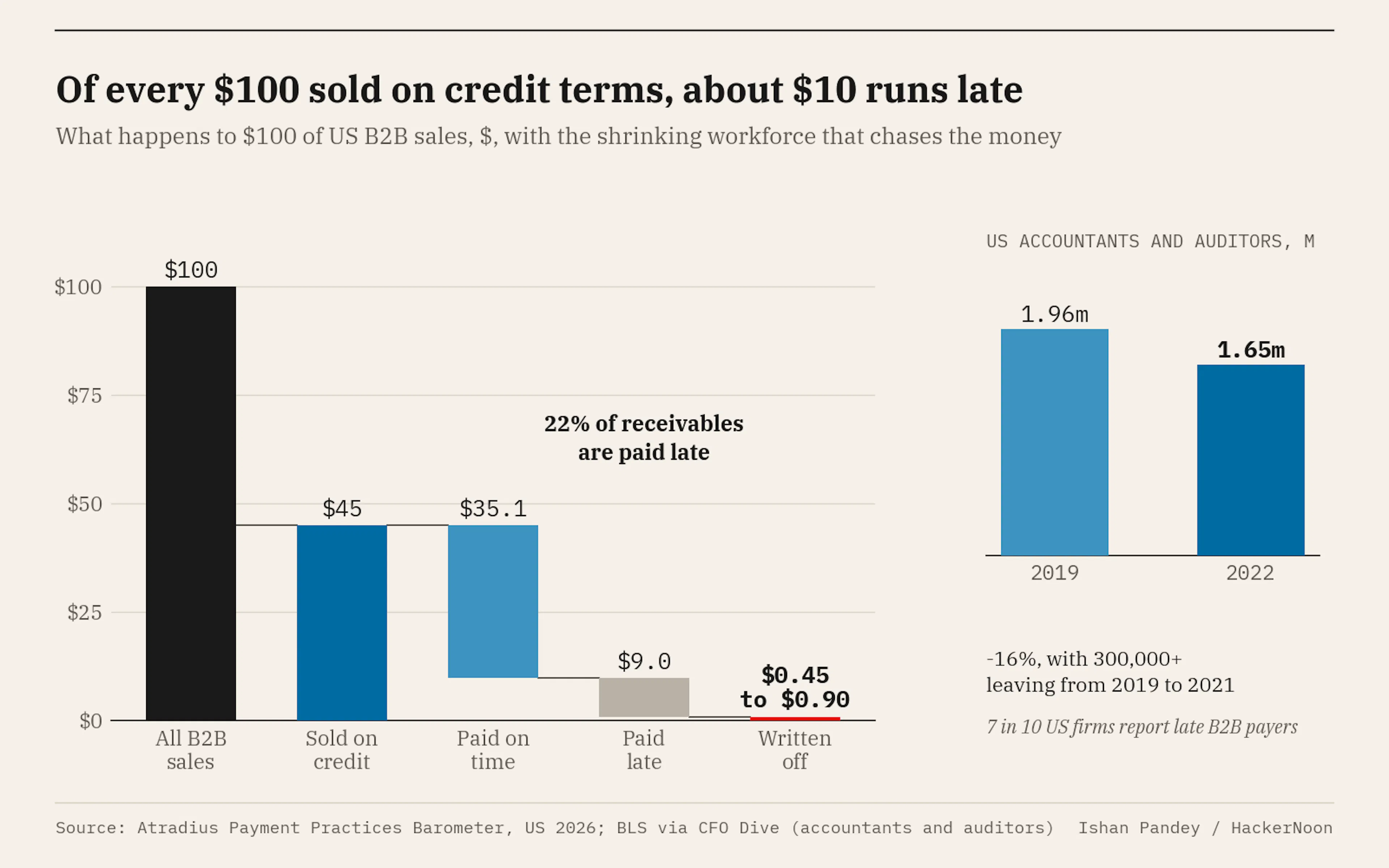 Of every $100 of US B2B sales, about $45 is sold on credit and roughly $10 of that arrives late, while the accountant and auditor workforce that chases those payments shrank 16% between 2019 and 2022. Sources: Atradius and BLS via CFO Dive
Days sales outstanding, the average number of days between sending an invoice and receiving the cash, is the number that turns this friction into a boardroom issue, which at some companies is tied directly to the CFO's pay. The arithmetic is unforgiving in both directions, because a company with $10 billion of annual revenue collects about $27 million a day, so removing 20 days from its collection cycle releases roughly $548 million of cash that it has already earned.
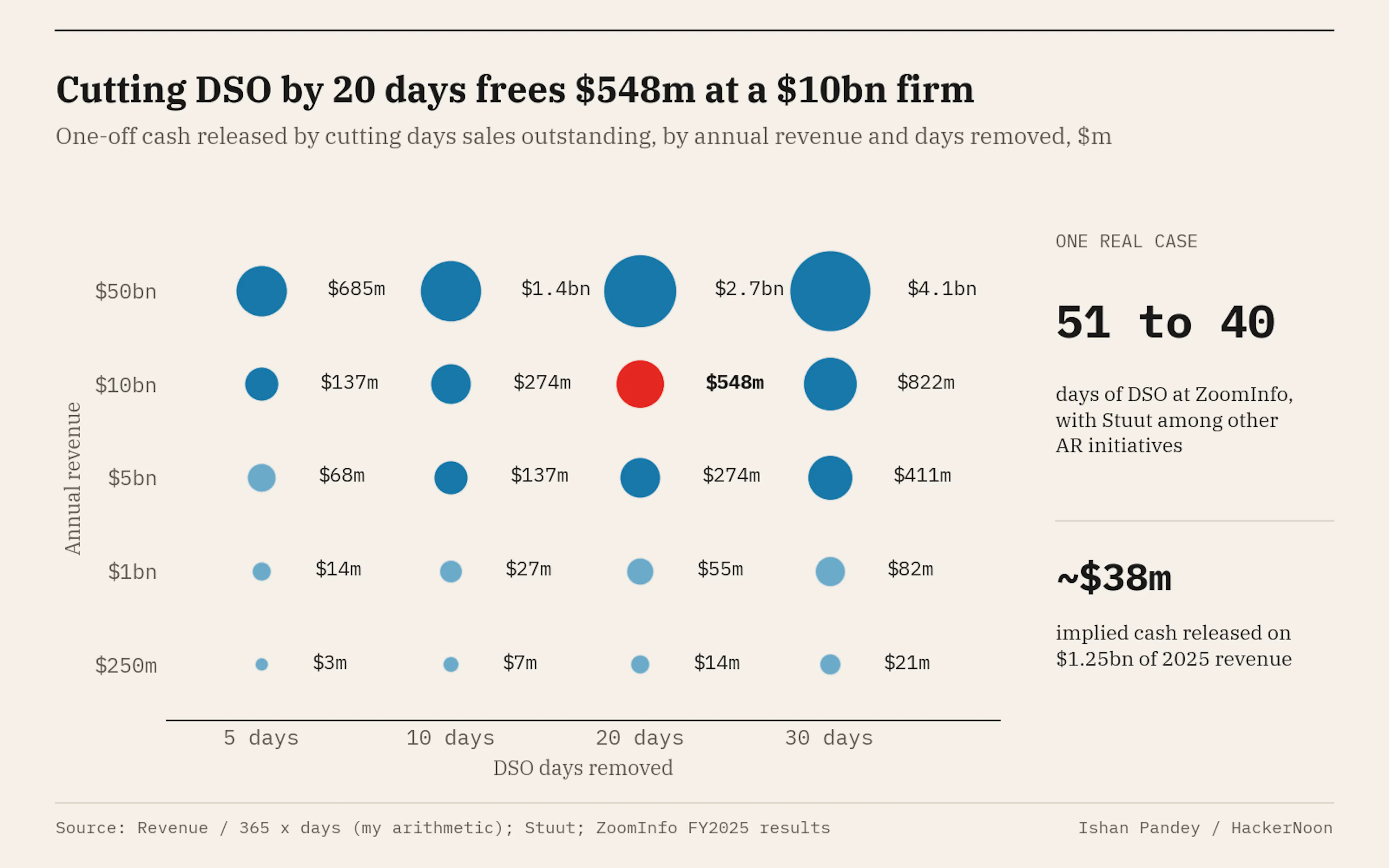 One-off cash released by removing days from DSO at different revenue levels, calculated as annual revenue divided by 365 and multiplied by the days removed, with ZoomInfo's reported fall from 51 to 40 days implying about $38m on its 2025 revenue of $1.25bn.
The Founder Thesis: Software That Finishes the Job
Tarek Alaruri, Stuut's chief executive, found the problem in freight rather than in finance software. He grew up in Michigan, wrestled at Indiana University and spent time at Total Quality Logistics, one of the largest freight brokerages in the United States, where he noticed that most past-due invoices traced back to clerical errors that took hours of manual work to unpick rather than to customers who could not pay. He went on to co-found the procurement software company Fairmarkit before starting Stuut in New York in late 2024 with Ben Winter and Adam Chaarwari.

The thesis the founders built on that experience rests on three observations about how large companies actually get paid. The first is that most customers want to pay, so the job is mainly about clearing the small obstacles that stop money from moving rather than applying pressure. The second is that collections work is conversational and messy, carried out over email, phone calls, text messages and supplier portals in much the same way it was done twenty years ago, which is why earlier receivables software could organise the queue without ever working it. The third is that every interaction teaches the system something, so software that does the work builds a memory of how each customer pays, which portals it uses and what usually breaks, a memory that compounds with every invoice.
In practice Stuut follows a problem from its first symptom to its resolution across thousands of invoices at once. A missing purchase order can turn into a rejected invoice, then a portal resubmission, then a short payment or a deduction, so Stuut contacts customers by text, email and phone, logs into accounts payable portals, reconciles the incoming cash and takes the next step without losing the thread. Finance teams can ask it what happened and why, every action is auditable and any change in its behaviour needs human approval, while the platform plugs into existing ERP systems, bank accounts, CRMs and payment tools and, according to the company, goes live in about three days.
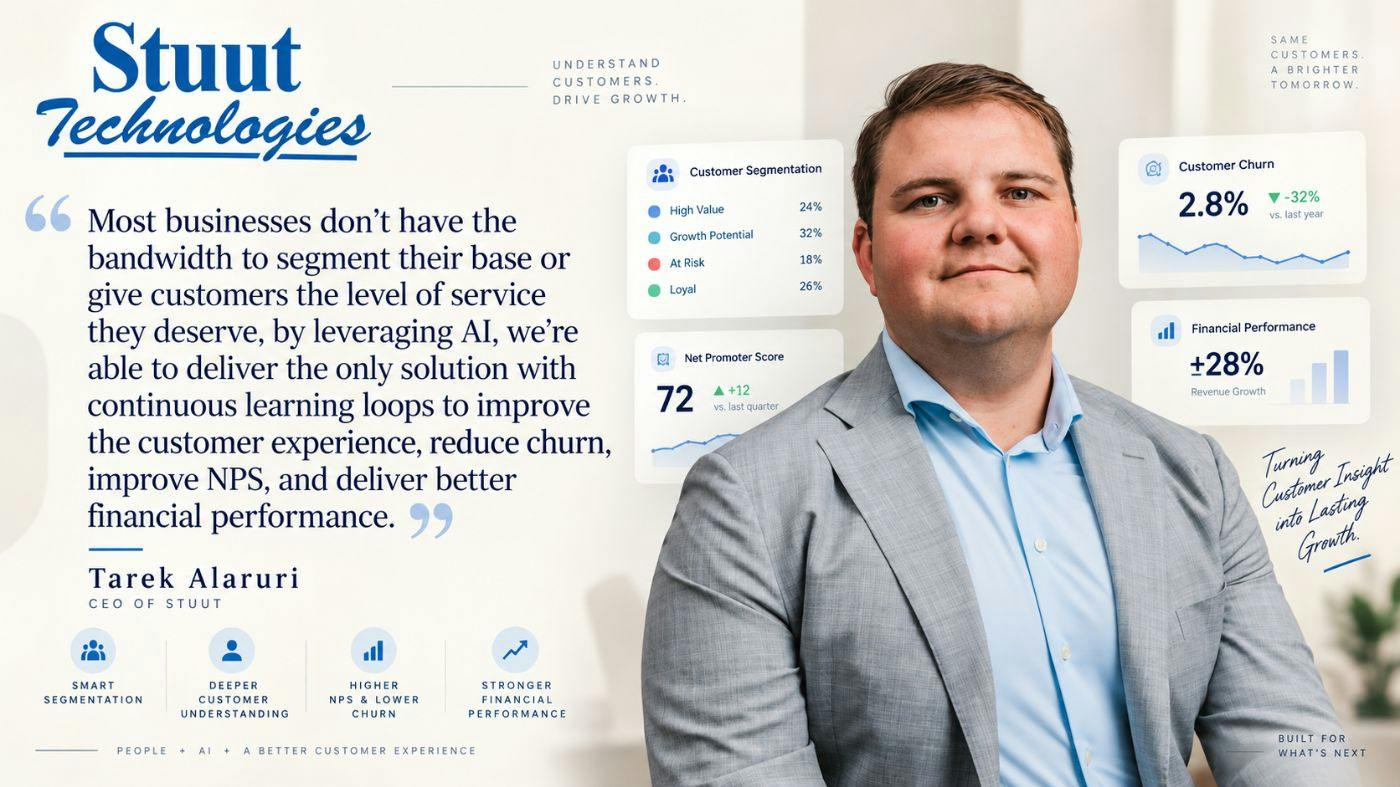
Alaruri frames the commercial case around customer service as much as around the cash itself. His argument is that most businesses lack the bandwidth to segment their customers and give each one the attention it deserves, while continuous learning loops let Stuut improve the customer experience, reduce churn and raise satisfaction scores while also improving financial results. He has also pointed out that many of Stuut's industrial and manufacturing customers have no venture reserves to fall back on and rely on collecting what they are owed to fund payroll, bonuses and hiring.
What Customers Report
The results that customers have published so far suggest the thesis holds up at genuine enterprise scale. Stuut says customers free up to 40% more cash flow and cut DSO by 47% on average, that 81.7% of its outbound collections activity now runs without human involvement and that 95% of incoming payments are matched to invoices automatically, which is roughly the point at which a finance team stops supervising software and starts reviewing its exceptions.
Bishop Lifting, which runs 45 branches across the United States and Canada, rolled Stuut out for collections, disputes and cash application, cutting overdue receivables by 35%, unlocking $3 million in working capital and lifting the number of accounts each employee manages by 50%, with 91% of outbound communication automated. At ZoomInfo, Stuut has collected $21.2 million and reduced the time to first contact on an overdue account by more than 90%, while DSO fell from 51 to 40 days and the receivables team shrank from 43 to 33 people through natural attrition. ZoomInfo's controller credits Stuut alongside other receivables initiatives for the DSO improvement, while the company has renewed for several years and expanded into disputes. Honeywell runs Stuut on top of a legacy SAP environment to reach the long tail of its customer accounts and is extending it into quote-to-cash.
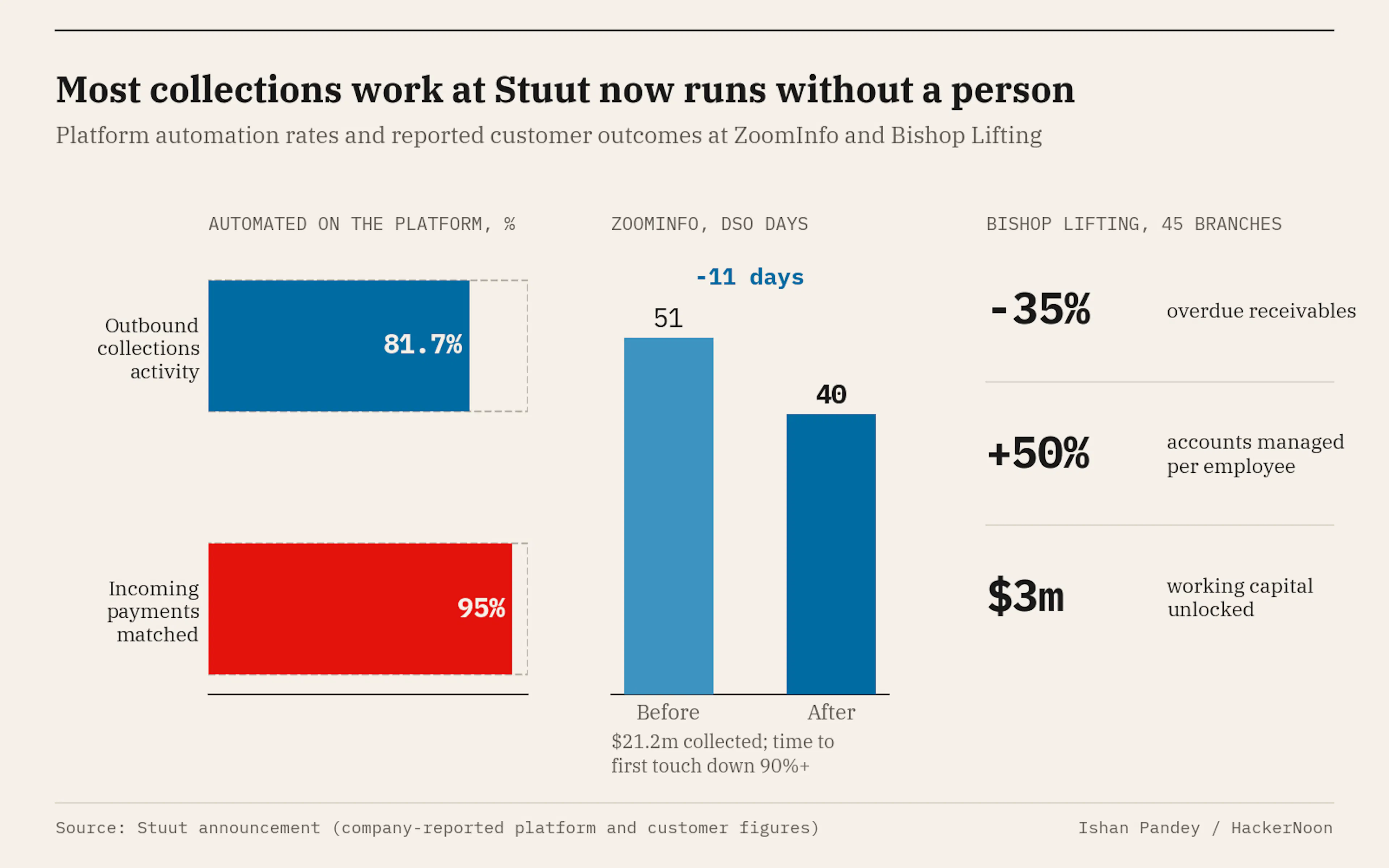 Stuut reports that 81.7% of outbound collections activity and 95% of payment matching run automatically, alongside published outcomes at ZoomInfo and Bishop Lifting. Sources: Stuut, ZoomInfo case study and Bishop Lifting case study
The Investor Thesis
Each of Stuut's backers has made a slightly different argument for the company, which helps explain why a Series B came together within a year of the Series A. Andreessen Horowitz partners Seema Amble, Joe Schmidt and Brian Roberts, who led the Series A, describe accounts receivable as the risk-bearing mechanism of modern supply chains, because payment terms of 30, 60 or 90 days exist precisely since immediate payment is impractical. In their view the work of managing those terms stayed manual because it happens on phone calls, in email threads and in personal text messages, which made it resistant to conventional software, whereas AI agents can now take on that repetitive and often confrontational work while capturing transaction data that was previously lost. The firm had known Alaruri and Winter for nearly two years before investing and describes Alaruri as one of the most talented leaders and sellers it has backed.
Insight Partners, which manages more than $90 billion in regulatory assets and has invested in more than 900 companies, over 55 of which have gone public, now leads the Series B. Julian Marcu, a vice president at the firm who joins Stuut's board, argues that many enterprises hold more cash in receivables than they realise, because one invoice error can trigger weeks of follow-up across teams and systems, so the value lies in agents that carry out the recovery and match cash to invoices inside the controls, workflows and systems finance teams already rely on. M12 gives Stuut a strategic investor with reach into the enterprise software buyers it sells to, while Activant, which has backed the company since its seed round, has now invested at every stage.
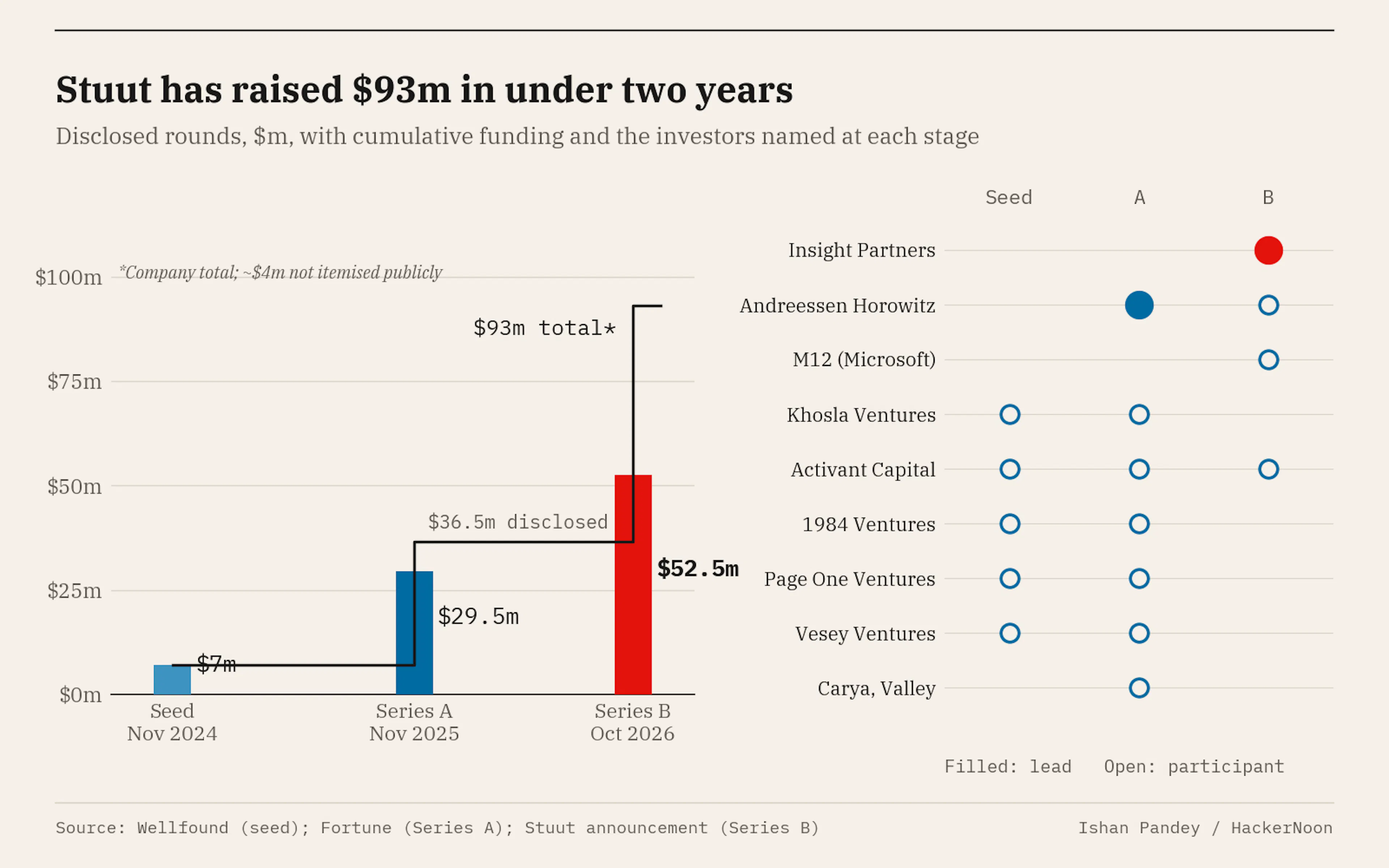 Stuut's disclosed rounds rose from a $7m seed in November 2024 to a $29.5m Series A in November 2025 and a $52.5m Series B in October 2026, with the company reporting $93m in total, while the matrix shows which investors led or joined each round. Sources: Wellfound, Fortune and Stuut
Behind the individual arguments sits a broader case that investors across this category are making, which is that the real market for AI in finance is the labour budget rather than the software budget. US accountants and auditors earned roughly $129 billion a year on 2022 BLS figures of 1.65 million workers at a median wage of $78,000, while Grand View Research values the global accounts receivable automation software market at $4.8 billion in 2025, rising to $12.9 billion by 2033. Software that completes the work rather than helping people do it can compete for a share of the much larger pool, which is why investors now judge companies in this space on execution rather than on dashboards.
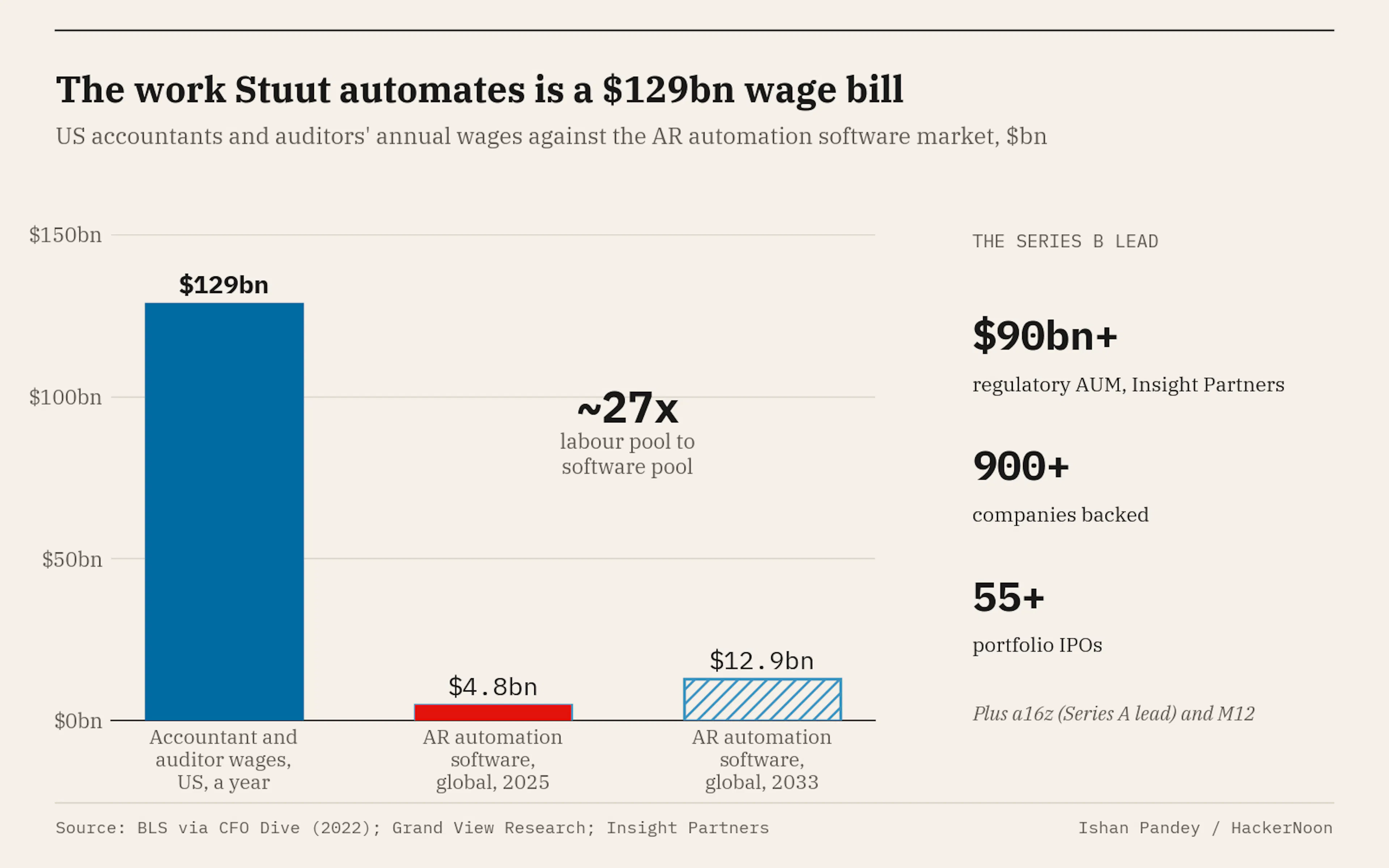 Annual wages paid to US accountants and auditors are roughly 27 times the size of the global accounts receivable automation software market, an illustrative comparison of the labour and software pools that AI order-to-cash platforms compete for. Sources: BLS via CFO Dive, Grand View Research and Insight Partners
Partners, Growth and What Comes Next
Stuut is also building distribution through firms that already sit beside CFOs on working capital, including Fiserv, EY, Altamont and HIG. In August Fiserv announced that it would combine Stuut's AI with its Commerce Hub and SnapPay products, at a time when Stuut had collected more than $2 billion of B2B invoices, while EY-Parthenon's US working capital leader Shawn Ryan has argued that order-to-cash performance has always been capped by how many accounts and disputes a team can work and that autonomous execution removes that ceiling without loosening the controls a global enterprise needs.
More than 150 customers now use Stuut, including Fortune 50 and Fortune 500 companies, the customer base has grown fivefold in a year and the figure for money moved through the platform has passed $3 billion, up from the $2 billion Fiserv cited two months earlier, while the company says revenue is growing more than 90% quarter on quarter. Stuut plans to use the new capital to meet that demand and to move deeper into the financial infrastructure around each transaction, from credit and lending to the movement of funds. Its longer ambition is to carry every sale from the moment a company decides to sell something, through each decision, document and payment, until the cash reaches the bank, which would make it less a collections tool than the system that decides how large companies get paid.
Don’t forget to like and share the story!
Vested Interest Disclosure: HackerNoon has reviewed the report for quality, but the claims herein belong to the author. #DYOR.
如有侵权请联系:admin#unsafe.sh