Gartner expects worldwide spending on AI-optimised cloud infrastructure to grow 96% to $42.3 billion 2026-10-6 13:4:12 Author: hackernoon.com(查看原文) 阅读量:0 收藏
Gartner expects worldwide spending on AI-optimised cloud infrastructure to grow 96% to $42.3 billion in 2026 while for the first time more of that money will go on running models than on training them. Antseed, an open peer-to-peer market for AI inference, has launched into that shift with a $2.4 million token round for the nonprofit Antseed Foundation led by Spark Capital, the firm that was an early investor in Anthropic. Collider, DCG, North Island Ventures, Reciprocal Ventures, Relay Capital and Venice.ai joined the round, which backs a simple proposition that developers should be able to buy model calls from whichever independent provider offers the best mix of price, speed and privacy.
Inference Is Becoming the Largest Line in the AI Budget
Gartner's August forecast puts AI-optimised infrastructure-as-a-service at $21.5 billion in 2025, $42.3 billion in 2026 and $66.1 billion in 2027, with inference taking $23.3 billion or 55% of the 2026 total and 59% of spending in 2027. The analysts attribute the shift to companies moving fine-tuned and domain-specific models from development into production, where they run continuously in customer-facing and operational systems rather than in periodic training jobs.
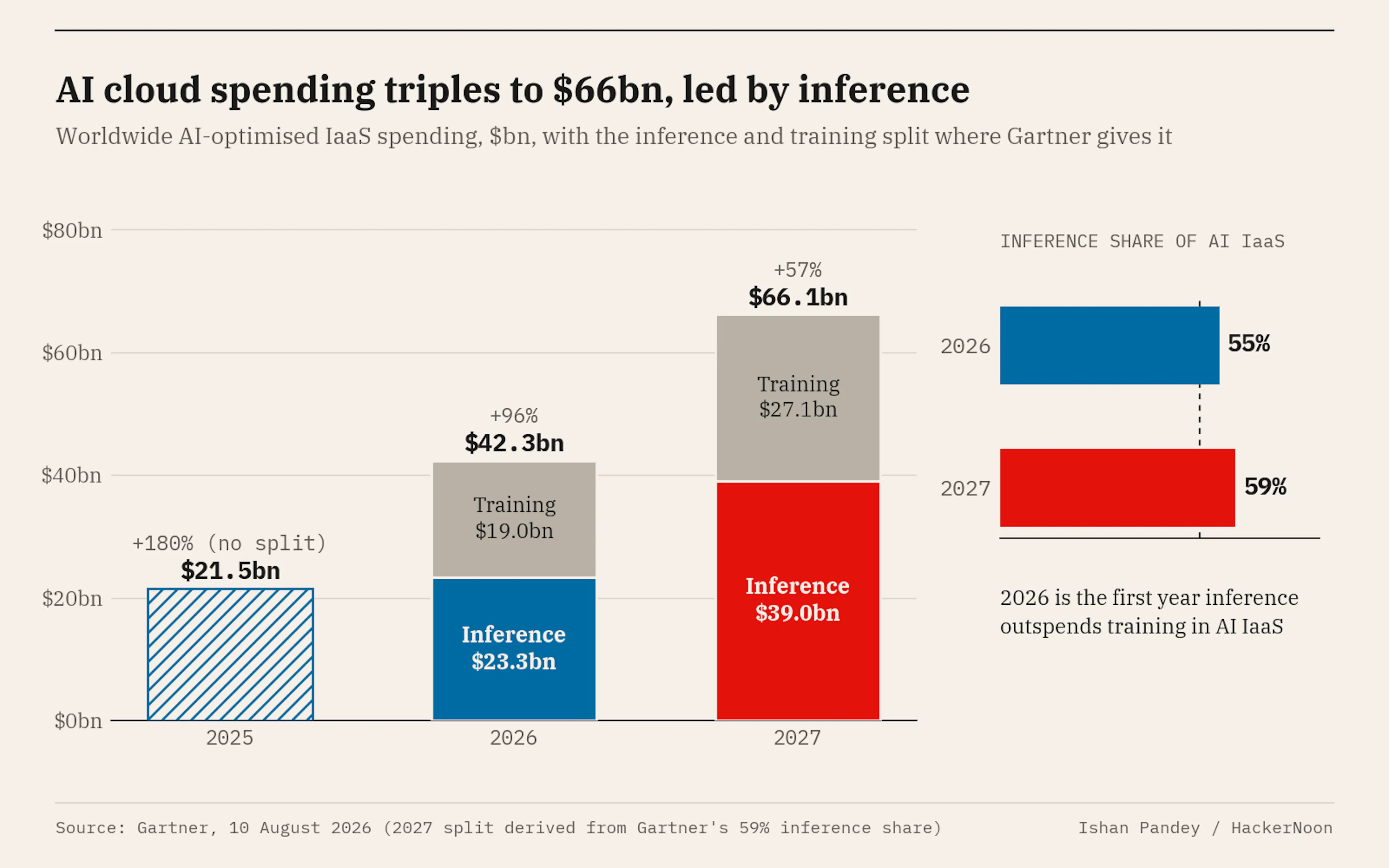
AI-optimised IaaS spending roughly triples from $21.5bn in 2025 to $66.1bn in 2027 while inference overtakes training as the larger share from 2026. Source: Gartner, with the 2027 split derived from Gartner's 59% inference share
Spark Capital's Santo Politi frames the economics through an airline comparison, arguing that inference is becoming for AI businesses what fuel is for airlines because it is a core operating cost that grows with every customer. In that framing the price of each model call matters as much as the quality of the model, which is why the structure of the market selling those calls has become an investment question in its own right.
[COMMENTARY IMAGE PLACEHOLDER: Santo Politi, Co-Founder and General Partner, Spark Capital]
Most Model Spending Flows Through a Few Providers
Enterprise demand for frontier models has consolidated quickly around a small group of model makers over the past two years. Menlo Ventures found that Anthropic, OpenAI and Google together accounted for 88% of enterprise LLM API spend at the end of 2025 against 69% in 2023, while the share left for every other provider fell from 31% to 12%. Concentration of that kind gives developers excellent models but few places to compare prices, which is the gap an open market is designed to fill.
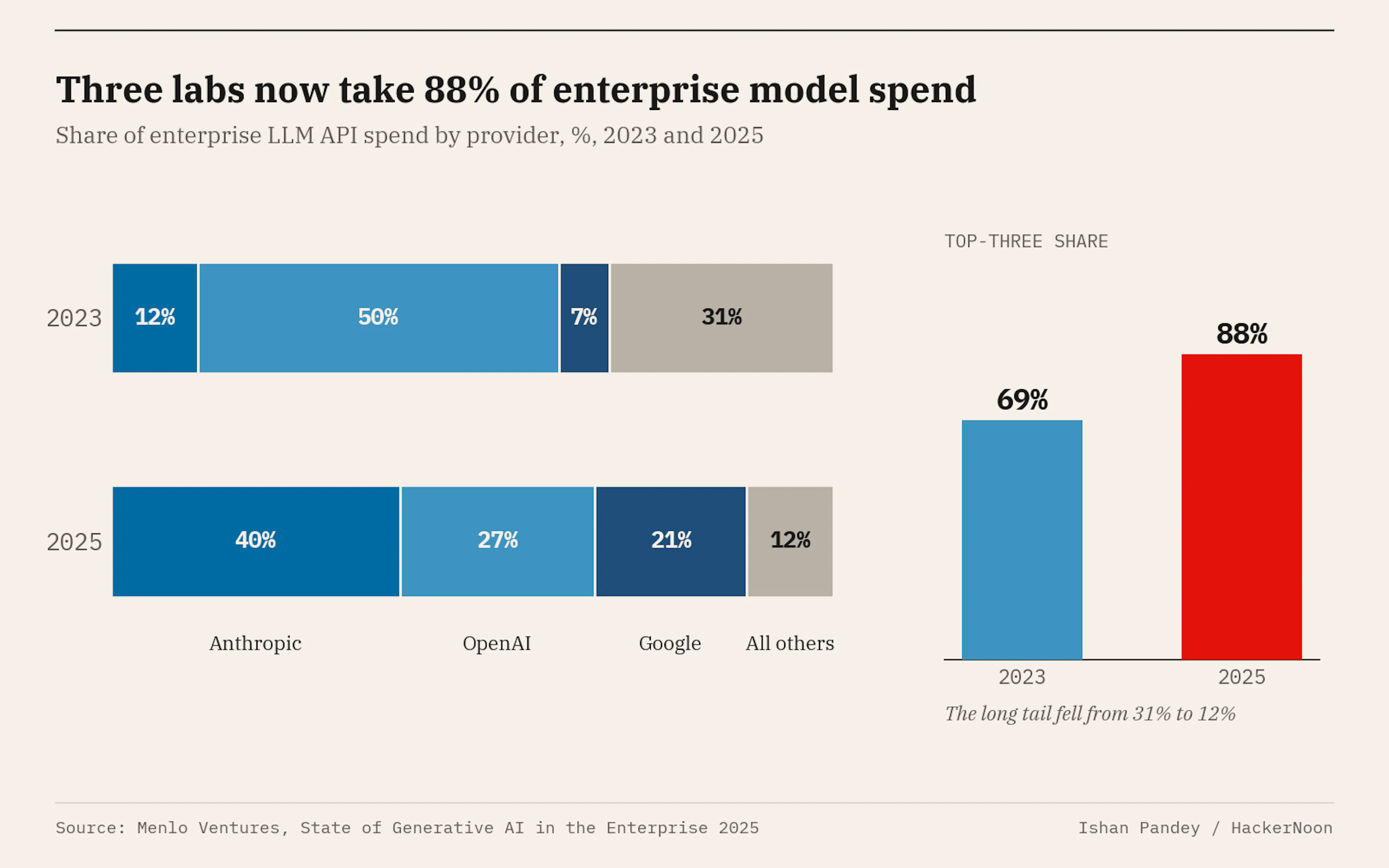
The top three model providers raised their combined share of enterprise LLM API spend from 69% in 2023 to 88% in 2025 as the long tail shrank from 31% to 12%. Source: Menlo Ventures via Yahoo Finance
At the same time the underlying cost of a given level of machine intelligence keeps falling at a remarkable pace. Epoch AI found that the cheapest price for a model matching GPT-4's March 2023 score on PhD-level science questions fell from $37.50 per million tokens to $0.18 by February 2025, a decline of roughly 40x a year, with declines across other performance thresholds ranging from 9x to 900x a year. When costs fall this fast, the providers that pass savings on first are often not the ones with the largest distribution, so a market that lets any of them compete for each request has a natural role.
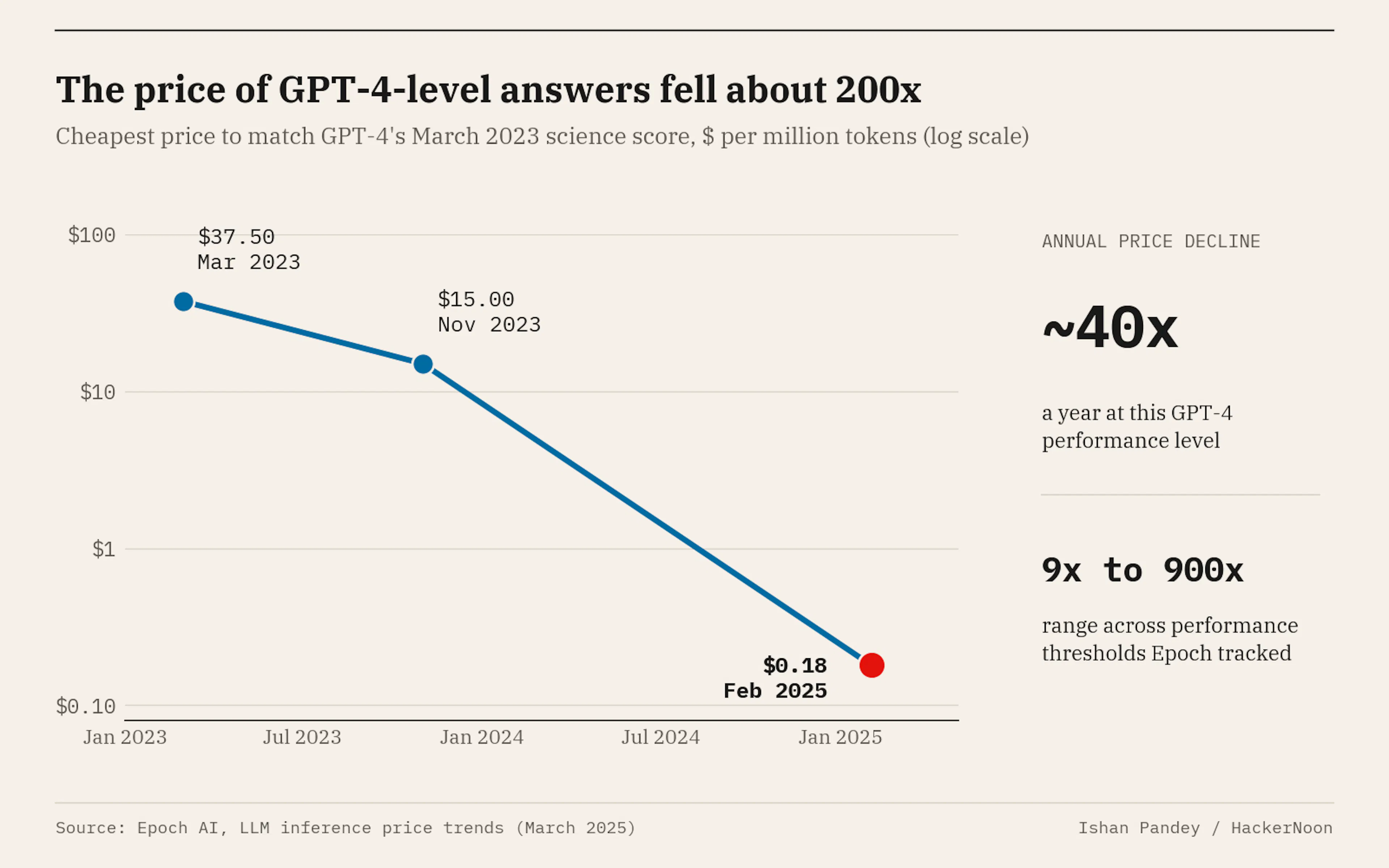
The price of GPT-4-level performance fell about 200x between March 2023 and February 2025, which Epoch AI estimates as a decline of roughly 40x a year at that threshold. Source: Epoch AI
How the Antseed Market Works
Antseed applies the open-market model that Web3 developers know from token exchanges to AI inference. Providers can run models on their own hardware or resell capacity they already hold, set their own prices and compete for demand on price, performance, reputation, model capability and privacy, while developers reach the network through a self-hosted local router that exposes a compatible endpoint. No central Antseed account or platform-issued API key is required, requests travel peer to peer and payment settles in USDC on Base directly to the provider's wallet.
Co-founder Amos Meiri compares the design to BitTorrent, arguing that the network removes both the central server and the single company that decides who gets access or what it costs. His reasoning is that agents will make far more model calls than people do, so developers will need a simple way to route each request according to their own priorities on price, performance, capability and privacy.
The Antseed website lists examples such as Qwen 3.7 Plus at $0.12 per million tokens against $0.32 at the official API, MiniMax M3 at $0.09 against $0.30 and Claude Fable 5 at $6.00 against $10.00, while the independent tracker AntSeedStats shows a median discount of 54% across 1,093 live peer and model listings. The company says leading models are available at up to 97% below their official prices, while each response is signed by the provider and matched against the model's fingerprint so that buyers can check what they received.
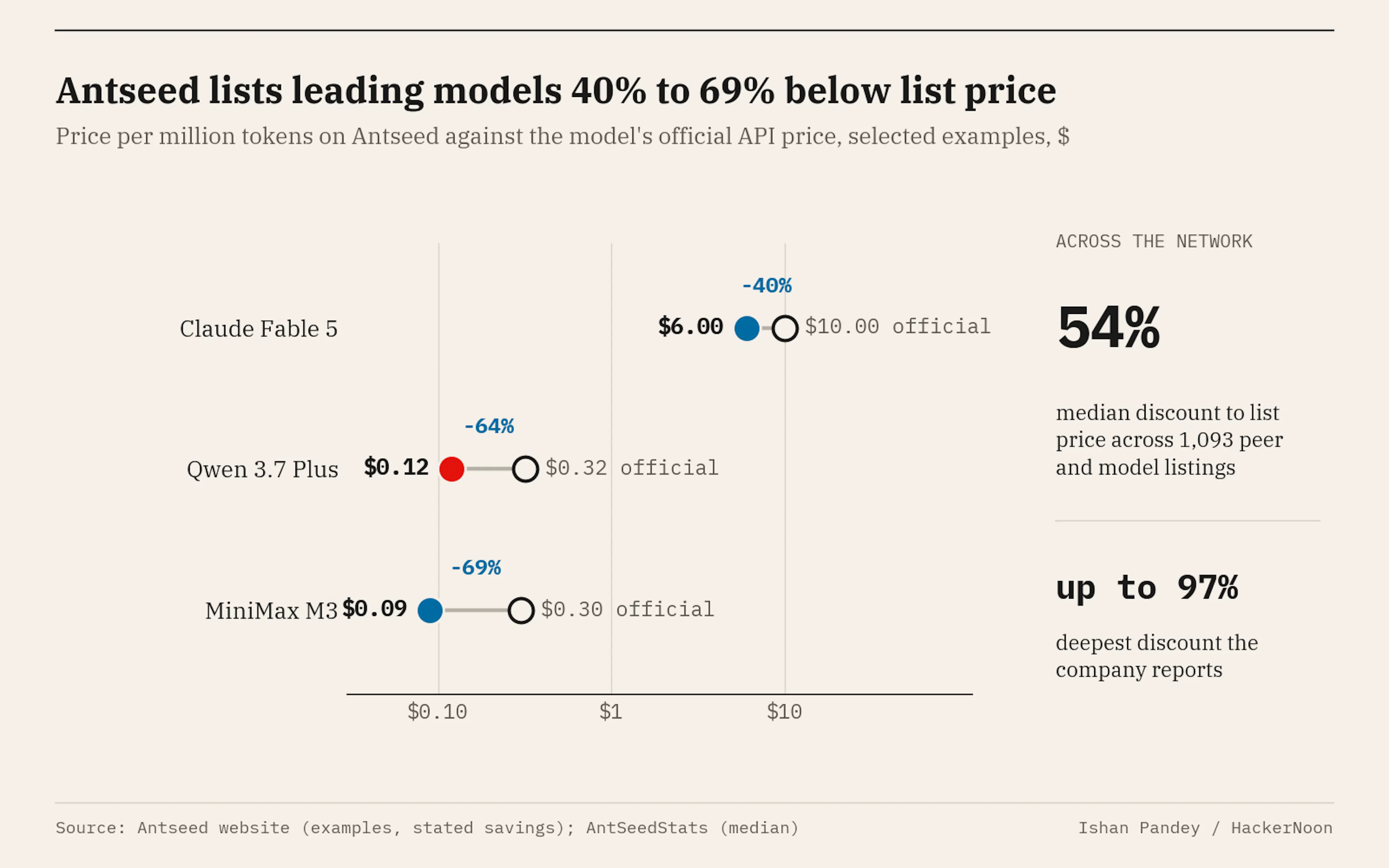 Selected Antseed listings sit 40% to 69% below official API prices while the median discount across all live listings is 54%, with the company citing discounts of up to 97% for some models. Sources: Antseed and AntSeedStats
Early Traction on Chain
Because payments settle on a public blockchain, anyone can check the network's activity independently of the company itself. As of September 2026 on-chain analytics show that Antseed has processed nearly 150 billion tokens across 202 active sellers, with more than $285,000 settled on Base. Those totals imply an average of roughly 743 million tokens and about $1,411 in settlement per seller, at an average settled price of around $1.90 per million tokens across the mix of models served.
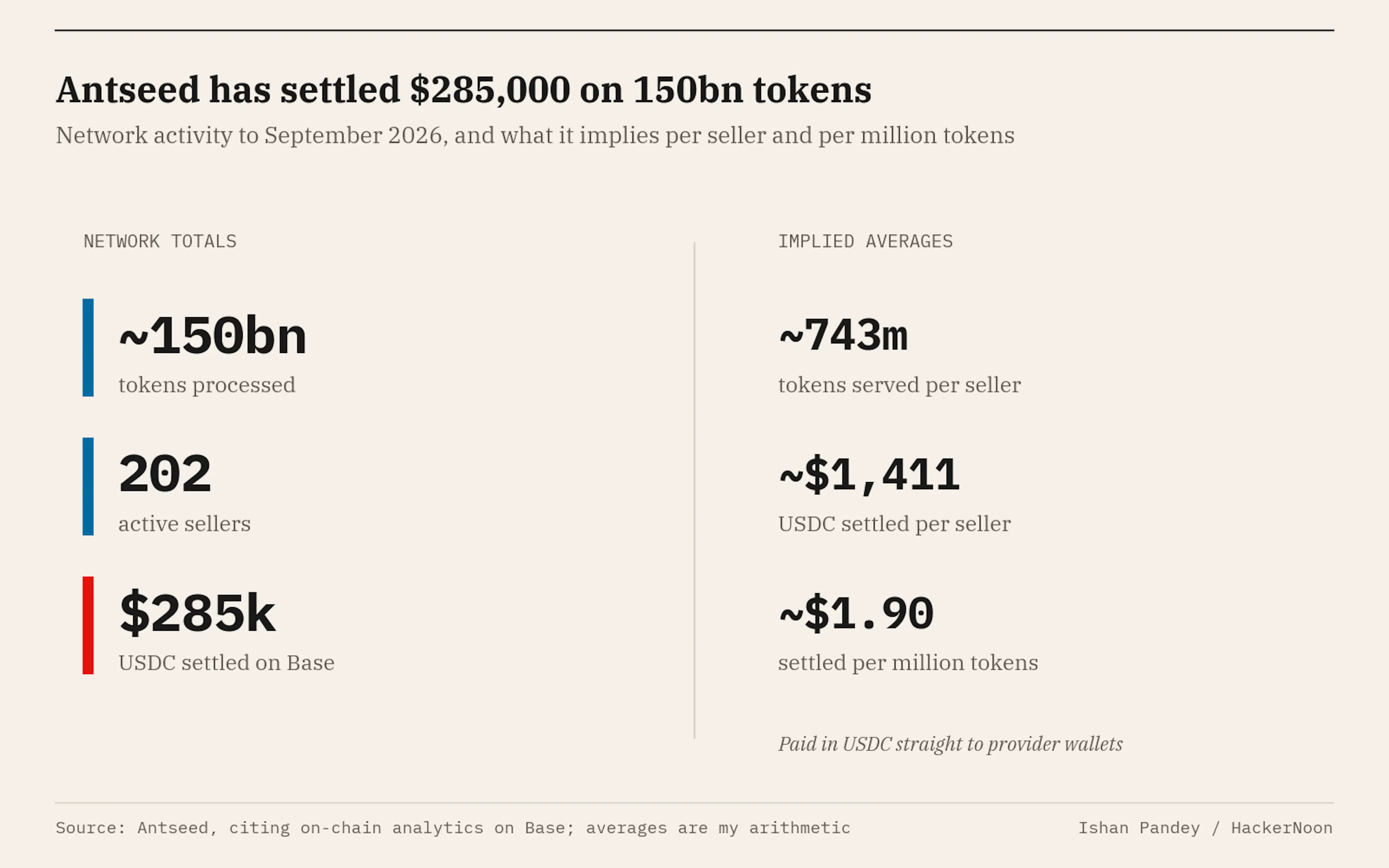 Antseed's on-chain totals to September 2026 and the per-seller and per-token averages they imply, which are Ishan Pandey's arithmetic on the company's figures. Source: Antseed, citing on-chain analytics on Base
The Token and the Thesis Behind the Round
The network's native token, ANTS, is designed to reward eligible usage and to let participants stake behind the providers they trust. Rewards rise with eligible usage and with staking commitments, so providers can earn more as they serve demand and attract stake while buyers earn rewards for their usage, which gives both sides a reason to bring liquidity to the market as it grows.
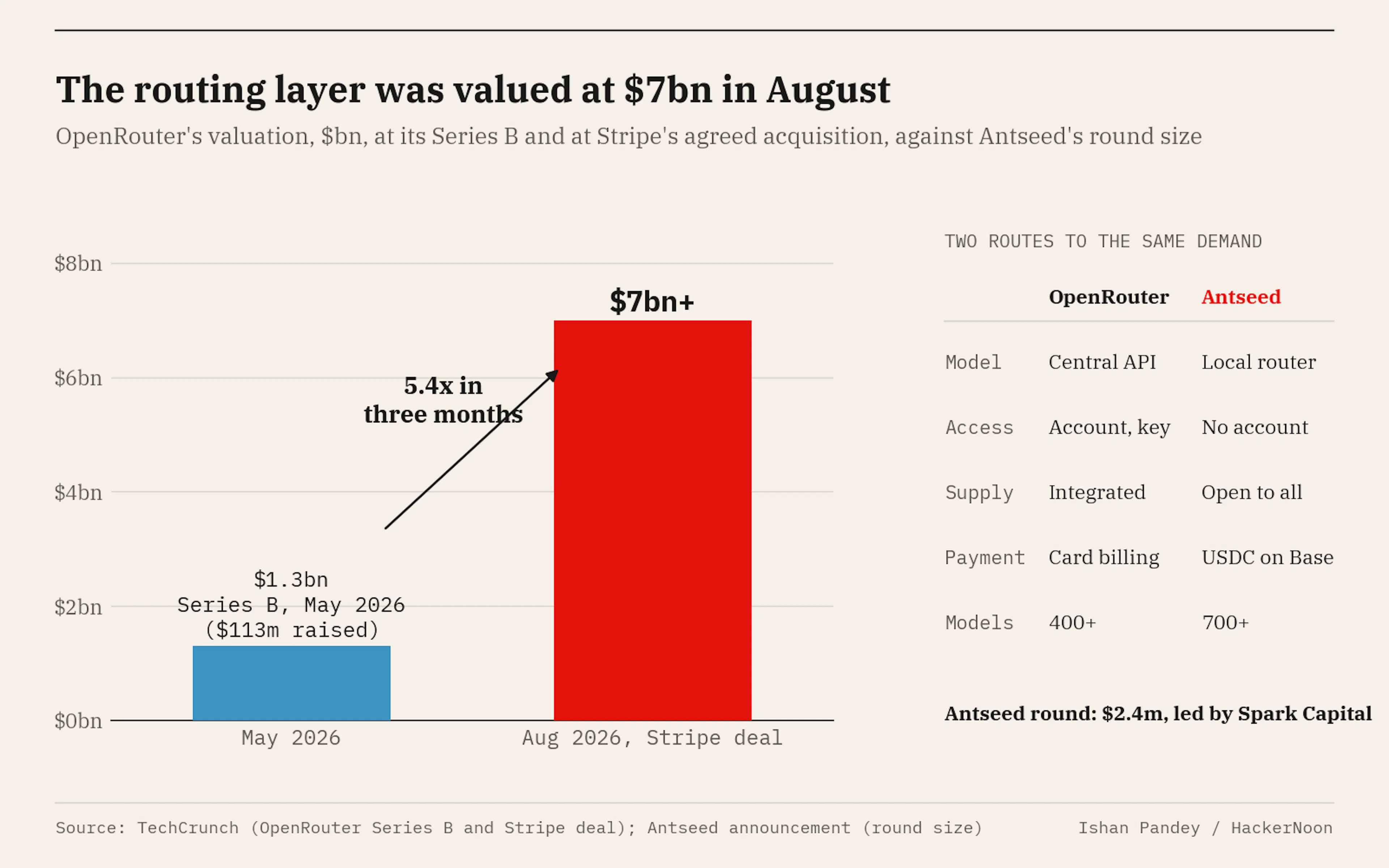 OpenRouter's valuation rose from $1.3bn to more than $7bn between May and August 2026, while Antseed pursues the same routing demand through a local router, open supply and on-chain settlement.
The investor case is clearest in what happened to the centralised version of the same idea. TechCrunch reported that OpenRouter, which gives developers a single API for more than 400 models, was valued at $1.3 billion in a $113 million Series B in May 2026 before Stripe agreed in August to acquire it for more than $7 billion. A 5.4x step in valuation within about three months shows how much value investors now place on the layer that decides where each model request goes, so Politi presents Antseed as the open counterweight to that layer because it gives developers a choice of supplier while giving providers a direct market in which to compete.
What Comes Next
Antseed's next test is depth, because a market becomes useful to developers when it holds enough independent sellers for every popular model that the router can always find a fast and cheap provider. With inference set to become the larger share of AI cloud spending and agents multiplying the number of model calls each product makes, the size of the opportunity is large enough that even a modest share of routed demand would make an open market a meaningful part of how AI compute is bought and sold.
Don’t forget to like and share the story!
如有侵权请联系:admin#unsafe.sh