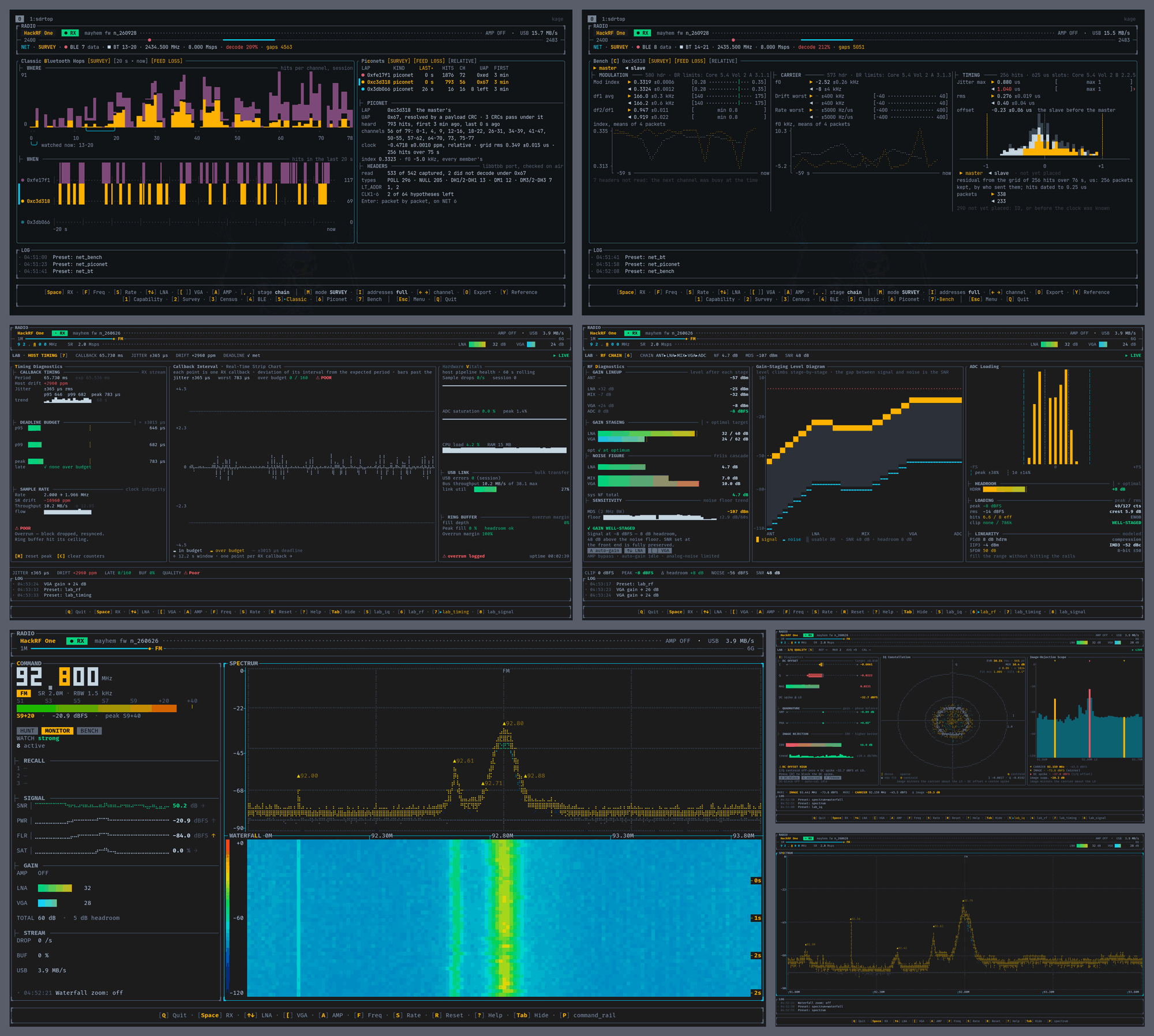
Thank you to Viktor László (MusiThang on GitHub), for writing in and sharing with us his new project called sdrtop. sdrtop is a terminal-based SDR tool that is compatible with the HackRF and RTL-SDR. Viktor writes:
I bought a HackRF because I was curious how SDR works and found the whole topic interesting.
Later I wanted to understand what was actually in the radio signals, and I ended up writing a terminal tool for that. Along the way it grew RTL-SDR support too.
sdrtop is a bench instrument in a terminal: spectrum, waterfall, gain and clipping, lab-style readouts, and digital demodulation for measurement, not for listening.
I started it to learn the signal path. What it turned into is a gap I kept hitting: cheap SDRs used for real measurements over SSH, in tmux, or on a cyberdeck, where a heavy GUI just slows you down.
No audio on purpose. If RX stops, the numbers go stale instead of looking fine forever.
I care about being able to trust the numbers, so the signal path is written in Rust from scratch rather than sitting on a DSP library. The only external piece in that chain is the FFT crate. (rustfft).
On RTL-SDR it has native full support (R820T, E4000, R828D): single tuner gain + AGC, spectrum, waterfall, and the measurement panels the dongle can actually back.
HackRF and tinySA are supported as well; Soapy is available in beta for other devices.Written in Rust, open source, one-person hobby project, and still very much in active development. Classic Bluetooth is in progress; spectrum and lab are what I use every day.
sdrtop reminds us of a few previous terminal-based SDR programs such as sdrrat, as well as terminal-based ADS-B radar displays such as radar-tui and coole-radar.