Vines don't have eyes. They find a tree by touch.When a tendril brushes a trunk, it registers the c 2026-10-3 17:0:4 Author: hackernoon.com(查看原文) 阅读量:3 收藏
Vines don't have eyes. They find a tree by touch.
When a tendril brushes a trunk, it registers the contact and starts to wrap. Come back two days later, and it's halfway around. Botanists call this thigmotropism: growth that follows touch.
AI is thigmotropic.
It doesn't grow toward truth or toward good intentions. It grows around whatever it touches. It found every book, every repo, and every forum thread we'd already written, and it wrapped itself around all of it. Inside a company, it does the same thing at a smaller scale: hand it your documents, and it grows around your documents, faithfully, quickly, and confidently.
The vine has no opinion about what it's holding. That part is on us. There are two ways this goes, and by the end you'll have a four-question test to tell which one you're planting.
The Cyberpunk Future: The Ghost Tree
In rainforests there's a tree that starts life as a hitchhiker. The strangler fig's seed lands high in another tree's canopy and sends roots down the trunk. Over years, it wraps the host completely and takes its light. Eventually, the original tree dies and rots away, and the fig stands on its own: a tree-shaped lattice with nothing inside. Ghost trees. You can climb up through the middle of one.
 Inside a hollow strangler fig, Costa Rica. Photo: Cephas, CC BY-SA 4.0, Wikimedia Commons
That's the fear, and it's a fair one.
A business points AI at its documentation. But almost every SOP (standard operating procedure) is fiction. Not dishonest, just incomplete. Before step one, the person doing the job has already checked three things, made four judgment calls, and ruled out two options that were never on the page. The document isn't the truth. It's a story about the truth.
The vine wraps the story. The people who carried the real version move on. The roots end up on someone else's servers. Ten years later, the company is still standing, still billing, and hollow where the judgment used to be.
That's the cyberpunk picture: high tech, low life. It's a zero-sum game. For one side to win, someone else has to lose.
We've already watched it happen. In Britain, the Post Office ran its branches on an accounting system called Horizon, built by Fujitsu. When the system showed money missing, the Post Office believed the software over the people running its branches. It took them sixteen years to take them to court. More than 900 were wrongly convicted of theft and fraud. Some went to prison.
Many lost their homes, and some took their own lives. A public inquiry later found that people at the top knew, or should have known, the system was faulty. The institution held onto its process and its pride, and the people it existed to serve paid for it.
That's the strangler fig with a human face: a system protecting someone's control instead of creating value for the people around it.
It doesn't take a scandal. When the chipmaker Broadcom bought VMware, the server software companies all over the world run on, some customers saw their bills go up more than tenfold. Once your roots are on someone else's ground, they decide what the ground costs.
Neither of these was AI. That's the point. They're what happens when software wraps around the wrong thing, and nobody can get it off. AI does the same thing, only faster and deeper, because it doesn't just store the process. It runs it.
The Solarpunk Future: The forest grows back.
There's another way a forest uses fast growth. After a storm drops a tree and lets the light in, quick pioneer plants move into the gap, vines among them. They hold the soil, shade the seedlings, and give the next generation of trunks something to grow up through. The forest comes back thicker than before.
That's the solarpunk picture: high tech, more life. The technology makes the place more alive, not less.
That future is available, and I think it's the likelier one. Not because I'm an optimist. Because of the record.
In 1900 the average person on Earth lived to about 32. Today it's past 73. Two hundred years ago, roughly eight in ten people lived in extreme poverty. Now it's fewer than one in ten. When the British Medical Journal asked over 11,000 readers, mostly doctors, to name the greatest medical advance since 1840, they didn't pick antibiotics or vaccines. They picked clean water and sewers, the plumbing behind every toilet, championed by a lawyer named Edwin Chadwick.
Technology didn't do that on its own. People chose to build it for everyone. A sewer doesn't win by someone else losing. Everyone it touches is better off, including the people who'll never think about it. That's win-win-win, and it's the pattern history keeps repeating whenever we choose it.
In a business, the solarpunk version looks like this: AI wraps around the ground truth instead of the story. Judgment that only ever lived in one person's head (the checks, the exceptions, the "I just know when it looks wrong") gets written down for the first time and put somewhere software can hold it. The expert stops being the bottleneck and becomes the source. The business runs at its best people's level without needing them in every room.
This isn't hypothetical. We built a tool that bottles how media buyers make their calls. It's now used by 3,500 media buyers across many businesses, and it took the work it handles from twenty hours a week to ten minutes a day. It wasn't a better model. It was the same judgment, finally given something true to grow on.
What decides it.
Not the model. The vine is the same in both futures.
Three groups decide it, and most of us belong to at least one. Creators, the people who write, film, and document what AI learns from, decide what it touches. Coders, whoever builds or buys the systems, decide where its roots go: owned and removable, or captured. Contributors, everyone who uses, corrects and maintains these systems day to day, decide whether anything checks the growth, or whether it runs wild into a monoculture of whatever grew fastest.
Creators carry one more lever, and it's bigger than any single company. The vine grew around everything we'd written, and since the 1980s the most famous stories we've told about the future have been cyberpunk: neon, surveillance, corporations that own everything. If that's the trellis, that's what it climbs. Writing the hopeful version isn't naive. It's planting something better for the vine to find.
Inside a business, start with the vines, and look in the culture before the code. Most stranglers aren't software. They're someone's hold on a process: the approval that only exists so one person stays in the loop, the report nobody reads but nobody's allowed to stop, the "that's how we do it here" that protects a position rather than creating anything. The software usually just wraps itself around those habits and makes them permanent.
How to farm it on purpose.
Farmers already know how to do this deliberately.
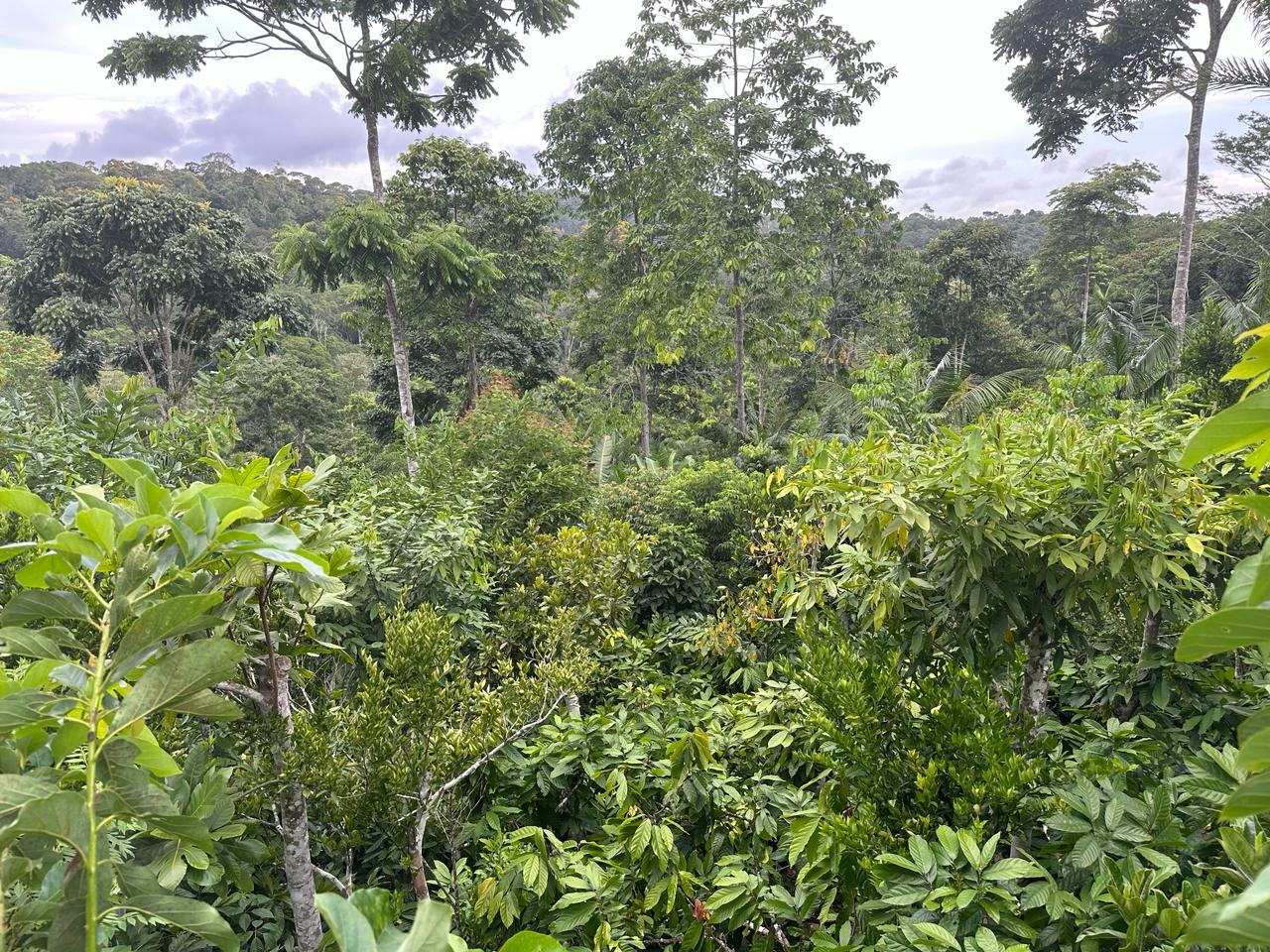
In the 1980s, a Swiss farmer named Ernst Götsch bought around 500 hectares of exhausted cattle pasture in Brazil and grew it back into productive rainforest. His method is called syntropic agroforestry. Instead of planting one crop and fighting everything else, you plant a whole succession at once. Fast pioneer species go in first to shade the ground and build soil. Slower, more valuable trees grow up through them. When the pioneers have done their job, you cut them back and drop them where they stand, and they become the soil the next layer feeds on. Every cycle leaves the ground richer than the last.
 Ernst Götsch's farm, Brazil, 2023. Photo: Ilonagotsch, CC BY-SA 4.0, Wikimedia Commons
"We are the giraffe." — Ernst Götsch, speaking to Mongabay
In the wild, browsing animals do the pruning, and every bite triggers new growth and feeds the soil. On a farm, the farmer plays the giraffe.
That's the job inside a business too. Find the strangler vines, the wasted hours, the dead processes, the tool you're paying for that nobody trusts, and chop and drop them. The waste becomes mulch for what you want to grow.
I've watched this happen in my own work. Every time I pull a way of thinking out of my head and give it somewhere to live, as a model or a checklist or a small piece of software, it starts doing the job without me. Then it helps build the next one. Week on week, the work gets easier and takes less effort. Nothing about that is zero-sum. The system feeds itself, and it feeds whoever else it touches.
That's how I think we work with this technology. The vine isn't the enemy. Left wild, it strangles. Planted deliberately, it's the pioneer layer. It holds the ground while the judgment that matters grows up through it. It's pruned every season so it keeps matching the truth, and it's designed to be cut back, so the builder can step away and the system keeps feeding the business instead of the other way round.
The Strangler Test
Before you plant anything, or renew anything, ask four questions of it:
- What is it wrapping around? How the work actually gets done, or the document that claims to describe it?
- Whose ground are the roots in? Is the code on your servers, with the keys in your hand? Could you remove the people who built it tomorrow and keep it running?
- What prunes it? Who notices when it drifts from the truth, and how often do they look?
- Does anyone have to lose for it to win? If the answer is yes, it's a strangler, however good the dashboard looks.
If all four answers point the right way, you've planted a pioneer. If they don't, you've found a vine worth cutting back.
Your judgment is the asset. Your presence is the constraint. The vine is already growing, so run the test on the first system you touch tomorrow.
如有侵权请联系:admin#unsafe.sh