The average American who uses AI now relies on three general-purpose assistants, up from 2.2 a year 2026-10-1 12:27:52 Author: hackernoon.com(查看原文) 阅读量:0 收藏
The average American who uses AI now relies on three general-purpose assistants, up from 2.2 a year earlier, while ChatGPT's share of worldwide generative AI web traffic has slid from 86.7% in January 2025 to 55.5% in August 2026 as Gemini climbed to 25.6% and Claude to 9.3%. Consumers have started spreading their questions across several models at once, which turns every new model release into a small decision about whether to stay with the assistant that already knows them or move to the one that is currently best.
Use.ai, a San Francisco company that sells access to more than 10 of the leading models through one subscription and one interface, has built its product around that decision and has now reached one million monthly active users less than a year after launch. Its workspace carries models including GPT, Claude, Gemini, Grok and DeepSeek in a single conversation, so a user can start a piece of research with one model and finish it with another without leaving the thread or losing the context built up along the way.
One Million Users in Under a Year
Use.ai describes itself as a consumer AI workspace that brings leading models into one interface with persistent context across conversations while the milestone gives that description its first hard number. Research, writing, planning and creation all happen in the same thread, with users able to bring in different models as the task changes, while the company's pricing page shows how the product is packaged: a free plan with everyday chat on the company's own Instant model and limited access to premium models, a Pro plan at $19.99 a month that lists models from Anthropic, OpenAI, Google, xAI and DeepSeek among others and a Max plan at $116.99 a month that multiplies the usage allowances by five.
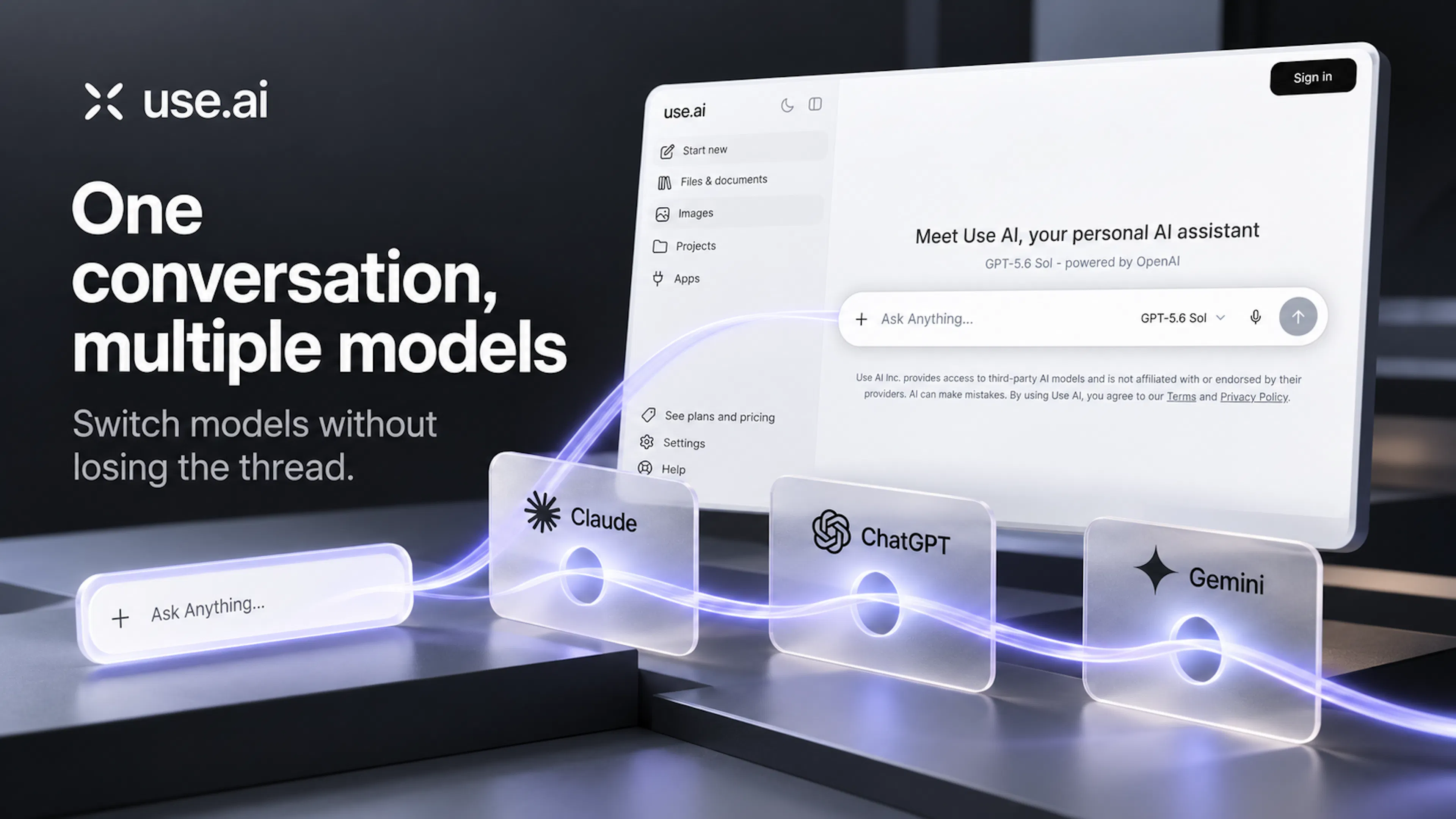
The free tier carries more weight than a typical entry plan because it is built around the company's Answer Engine, which runs on open-weights models that Use.ai configures and optimises itself, while the more advanced frontier models sit behind the paid subscription for tasks that call for deeper reasoning or more advanced capabilities
A Market Spread Across Assistants
The scale of the leading assistants explains why consumers end up juggling them, since ChatGPT counted 900 million weekly users and 50 million paying subscribers in February 2026 while the Gemini app grew from 750 million monthly users at the end of 2025 to 950 million by the second quarter of 2026. Similarweb's tracker of web traffic to generative AI sites shows how that growth has been shared out, with ChatGPT's share falling from 86.7% in January 2025 to 63.8% in January 2026 and 55.5% in August 2026, a loss of about 31 percentage points in 19 months, while Gemini rose from 5.7% to 25.6% and Claude from 1.9% in July 2025 to 9.3%. The tracker counts only visits to websites and therefore leaves out most mobile and desktop app usage, yet the direction matches what the user counts above imply, which is that no single assistant is absorbing the growth in AI use.
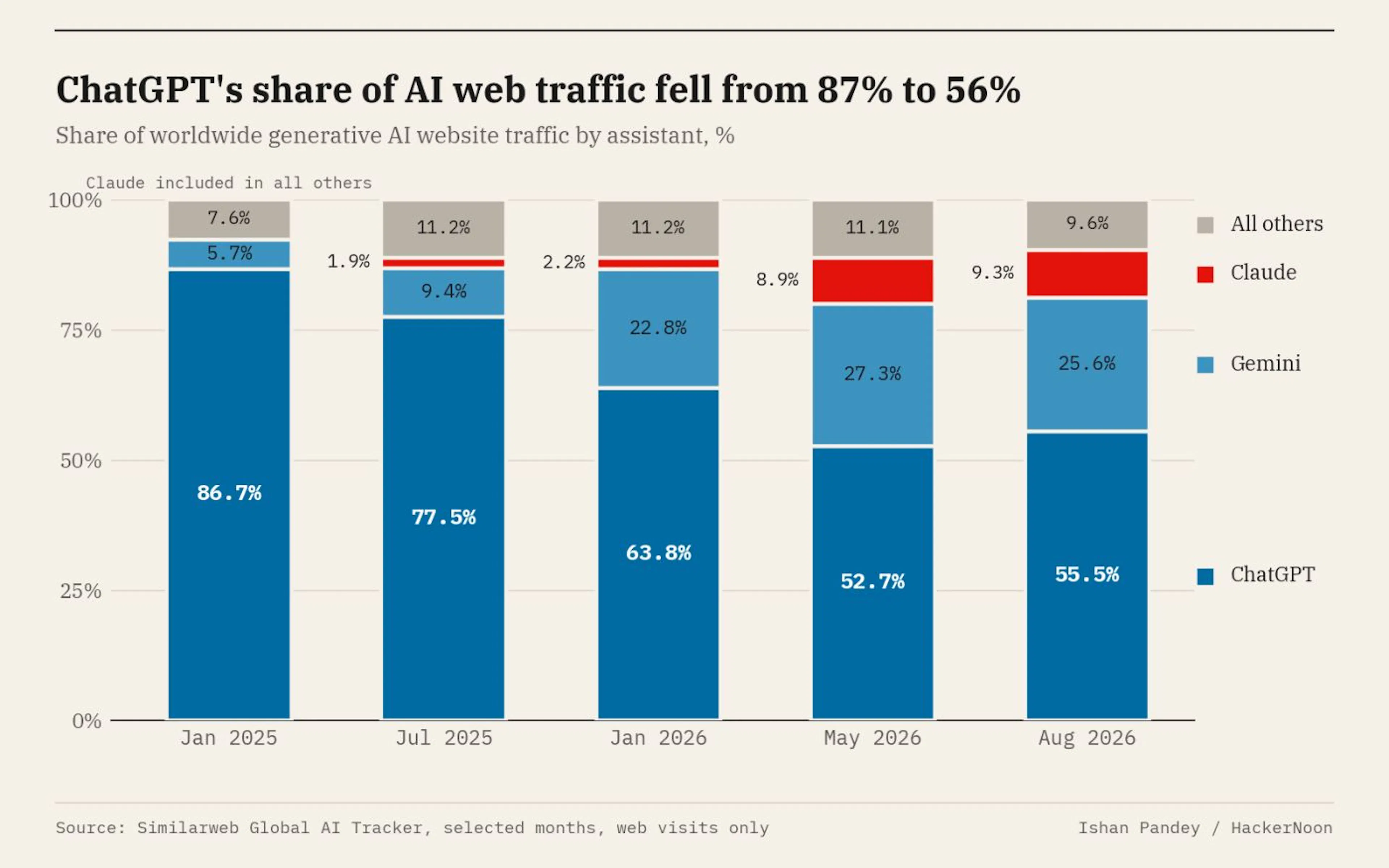 Share of worldwide generative AI web traffic by assistant, January 2025 to August 2026
ChatGPT's share of generative AI web traffic fell by about 31 percentage points between January 2025 and August 2026 while Gemini and Claude gained share, with Claude included in "all others" in January 2025 when it was not reported separately. Sources: Similarweb Global AI Tracker via Similarweb on X, January 2026, July 2026, The Decoder and PPC Land.
User surveys show the same pattern from the demand side, with Menlo Ventures' July 2026 survey of 5,067 US adults finding that 60% of AI users use ChatGPT, up from 45% a year earlier, while Gemini use rose from 36% to 58% and Claude use from 7% to 20%. Those three shares add up to 138% of AI users in 2026 against 88% in 2025, which is possible only because many people use more than one assistant while the survey puts the average at 3.0 general assistants per user. The same report estimates that consumer AI reached two billion users in 2026, about 24% of the world's population, so the habit of keeping several assistants is taking shape in a very large market.
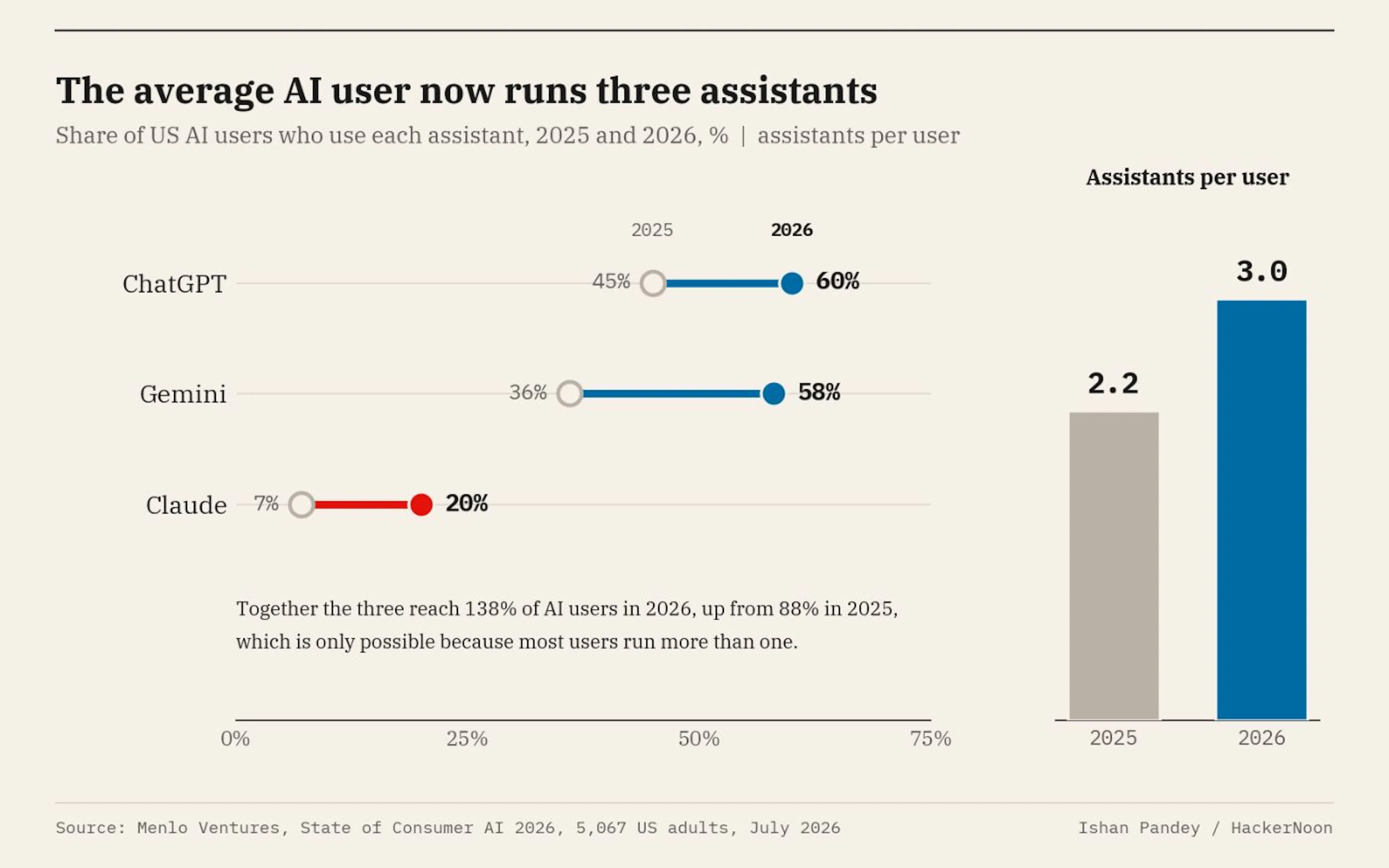
Among US AI users the share using each of the three leading assistants rose between 2025 and 2026, with the average user now running 3.0 general assistants against 2.2 a year earlier. The combined shares of 138% in 2026 and 88% in 2025 are the author's sums. Source: Menlo Ventures, State of Consumer AI 2026, a survey of 5,067 US adults conducted with Morning Consult in July 2026.
Context as the Switching Cost
Use.ai's co-founder Ihor Herasymov came to the problem as a heavy user, having first worked as an M&A and tech investment banker before launching seven businesses and building a technology company to more than 100 employees and $3 million in annual revenue within two years. After ChatGPT arrived, AI became central to how he researched, analysed and made decisions so he began testing models obsessively before finding that each one built up context he did not want to lose. He pays around $1,000 a month for premium subscriptions because those accounts hold years of his history, covering his preferences, his work and his life, which makes that accumulated history the main reason he stays with an assistant after a better model arrives.
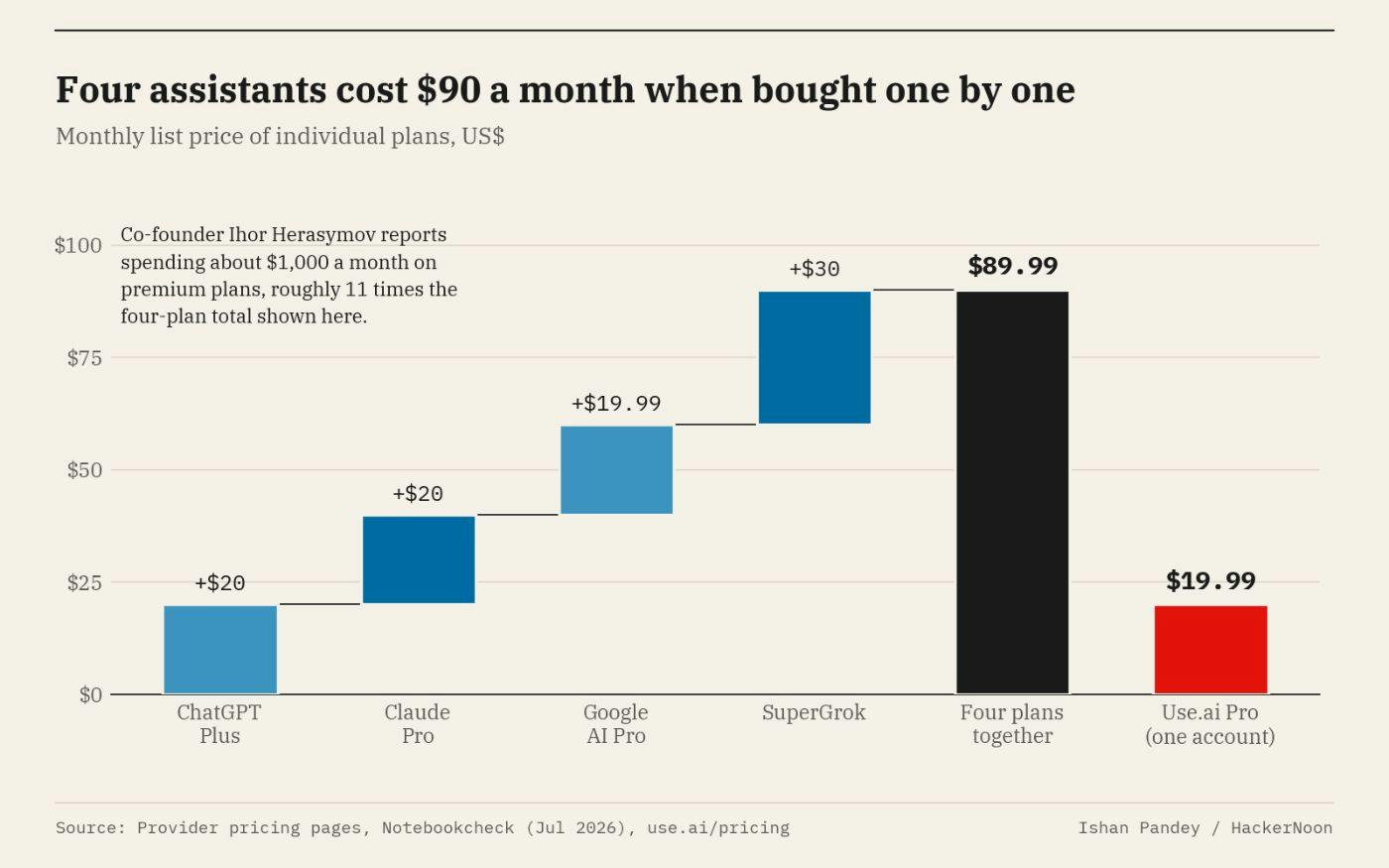
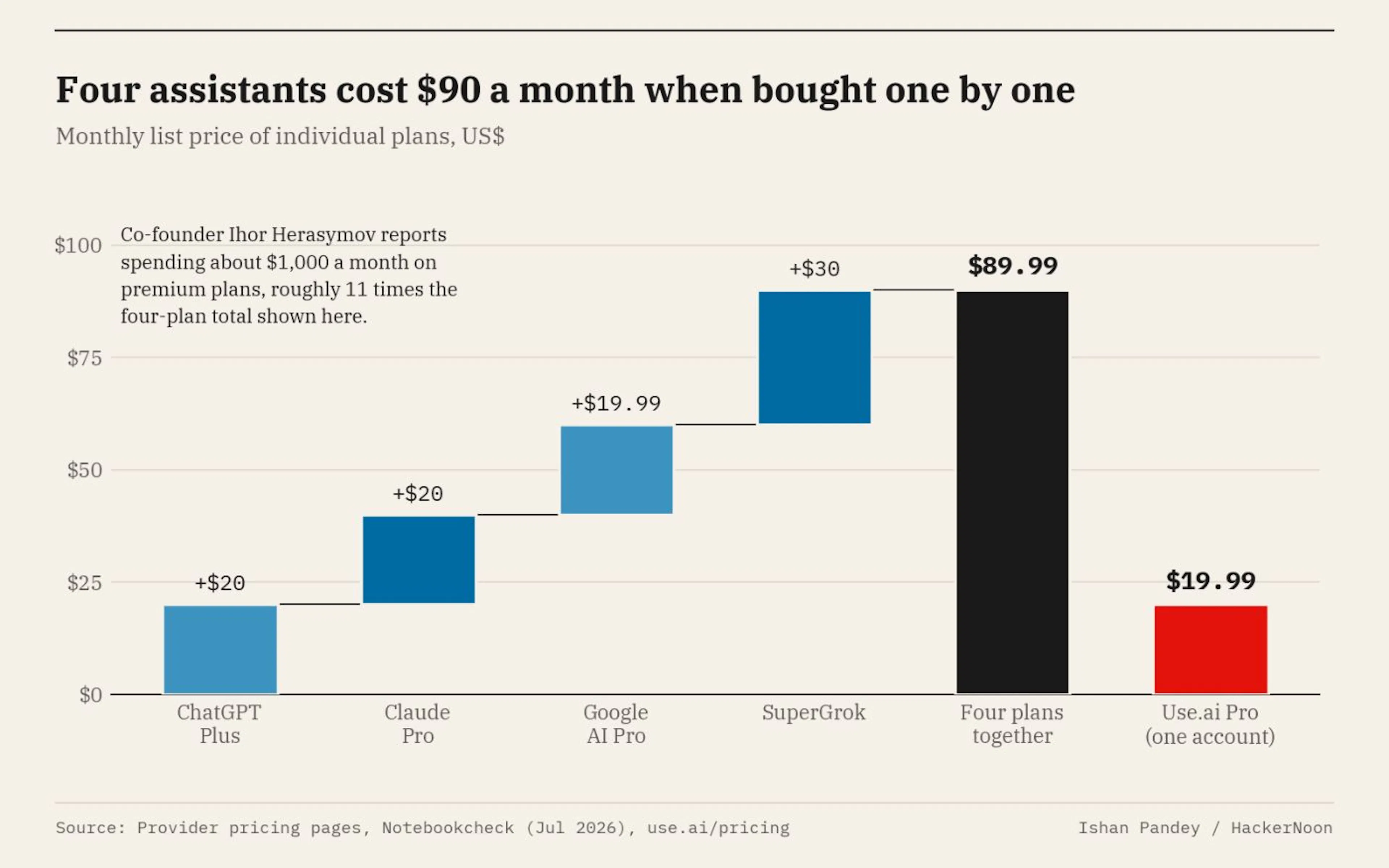 Monthly cost of four AI assistants bought separately versus Use.ai Pro
Buying ChatGPT Plus, Claude Pro, Google AI Pro and SuperGrok separately costs $89.99 a month at list prices, against $19.99 for Use.ai Pro, which sets monthly allowances for each model, with all prices as reported in July 2026 and subject to frequent change. Sources: Notebookcheck, Claude, Use.ai pricing.
The arithmetic of keeping several accounts is steep even for ordinary users because, at list prices, ChatGPT Plus costs $20 a month and Claude Pro costs $20 on monthly billing while Google AI Pro costs $19.99 and SuperGrok about $30, so holding all four comes to $89.99 a month or roughly $1,080 a year while Herasymov's reported spending is about eleven times that total. Menlo's survey shows the same instinct at scale, with more than half of AI users paying for at least one AI product and the top 14% of payers spending $100 or more a month, a group that accounts for roughly 60% of US consumer AI spending. Use.ai Pro lists models from the same providers at $19.99 a month with monthly allowances that differ by model, so the comparison in the chart below concerns what each subscription costs and does not imply identical usage limits.
What Use.ai's Users Report
Use.ai's own surveys give the clearest view of why people want a single workspace, starting with a survey of more than 5,000 users in which 42% said they switch models for better quality or deeper reasoning while 36.5% said they switch depending on the task, which means a large share of the base already picks a model to suit the job. One user went further by putting the same investment question to four models and using the points where they agreed and disagreed to decide which parts needed more research, a comparison that would otherwise need four separate apps and four separate histories.
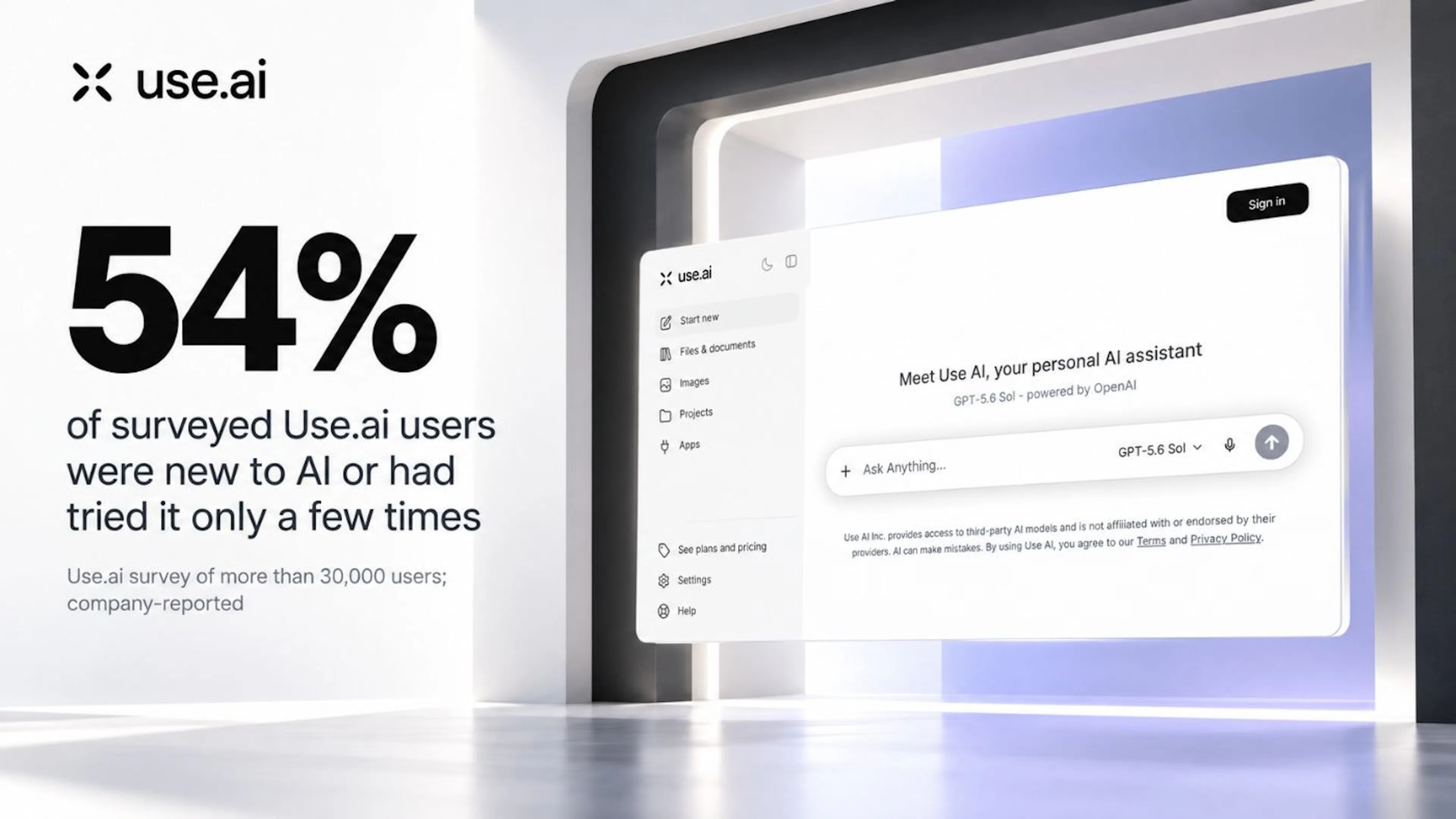
A second survey, covering more than 30,000 users, found that 54% were either using AI for the first time or had tried it only a few times, which places the company at the entry point for people who have yet to settle on a favourite assistant. For those users the product's main value is a single place where conversations, files and preferences accumulate while the models underneath keep changing, which is the case Use.ai makes for starting a person's AI history inside its workspace.
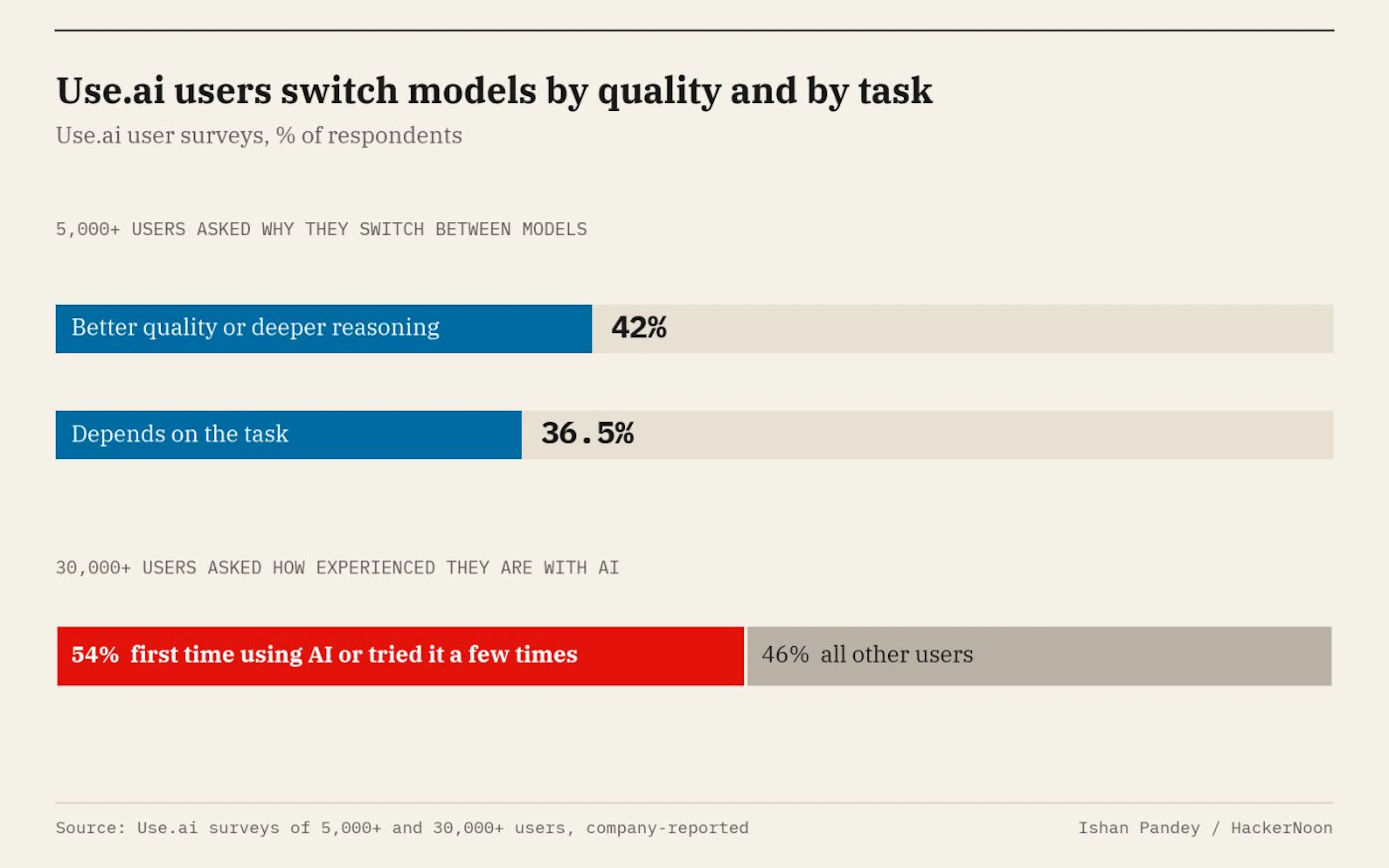 Use.ai survey results on switching reasons and AI experience
In Use.ai's surveys 42% of more than 5,000 users switch models for quality or deeper reasoning and 36.5% switch depending on the task, while 54% of more than 30,000 users were using AI for the first time or had tried it a few times, all of which are company-reported figures. Source: Use.ai.
The Economics of a Free Tier
A free Answer Engine works as a business only if the underlying models are cheap to serve because the cost curve has moved decisively in that direction. Andreessen Horowitz calculated that the price of language-model output at a fixed capability, measured as a score of 42 on the MMLU benchmark, fell from $60 per million tokens in November 2021 to $0.06 in November 2024, a drop of about 1,000 times in three years or roughly tenfold every year. Epoch AI's analysis of six benchmarks found that the price of reaching a given level of performance fell between 9 times and 900 times a year depending on the task, with the price of GPT-4's MMLU performance dropping from $37.50 per million tokens in March 2023 to $7.50 in May 2024.
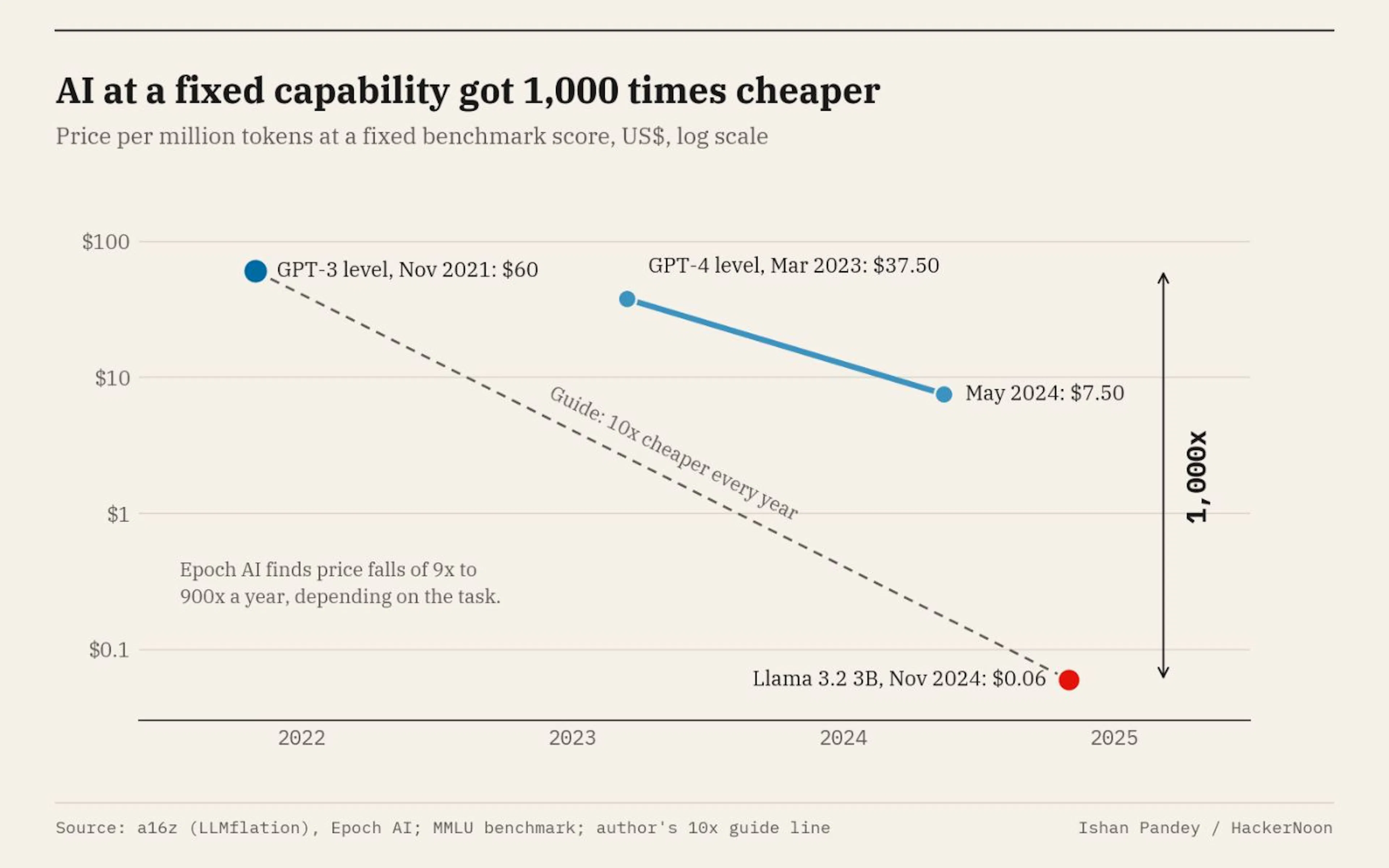 Price per million tokens at fixed benchmark scores, 2021 to 2024
At a fixed benchmark score the price per million tokens fell about 1,000 times in three years, in line with a tenfold-a-year trend, while the price of GPT-4-level performance fell fivefold in 14 months, with the 10x guide line drawn by the author. Sources: a16z, LLMflation, Epoch AI.
Cheaper models change who can afford to give AI away, because a company that configures open-weights models for everyday questions can serve a large free audience at a cost per answer that keeps falling and then reserve the expensive frontier models for the paid plan. The conversion figures show why a generous free tier matters, since OpenAI's 50 million subscribers against 900 million weekly users imply that only about 6% of the leading assistant's global weekly audience pays, a ratio that is the author's calculation from OpenAI's reported numbers. Epoch cautions that the steepest declines are recent and may not persist, yet even a slower decline leaves open-weights models far cheaper to serve than they were when GPT-3 first set the standard, which is the condition a two-tier product like Use.ai's depends on.
The Next Four Billion Users
The size of the audience still to be reached gives the milestone its larger meaning. Menlo Ventures puts consumer AI at two billion users in 2026, or roughly 24% of the world, while the International Telecommunication Union counts about six billion people online in a world of about 8.2 billion. Use.ai estimates that roughly four billion more people could become regular AI users over the next decade, a figure that added to today's two billion comes close to the entire online population of 2025 while the company's stated aim is to be the place where those newcomers build their AI context from day one.
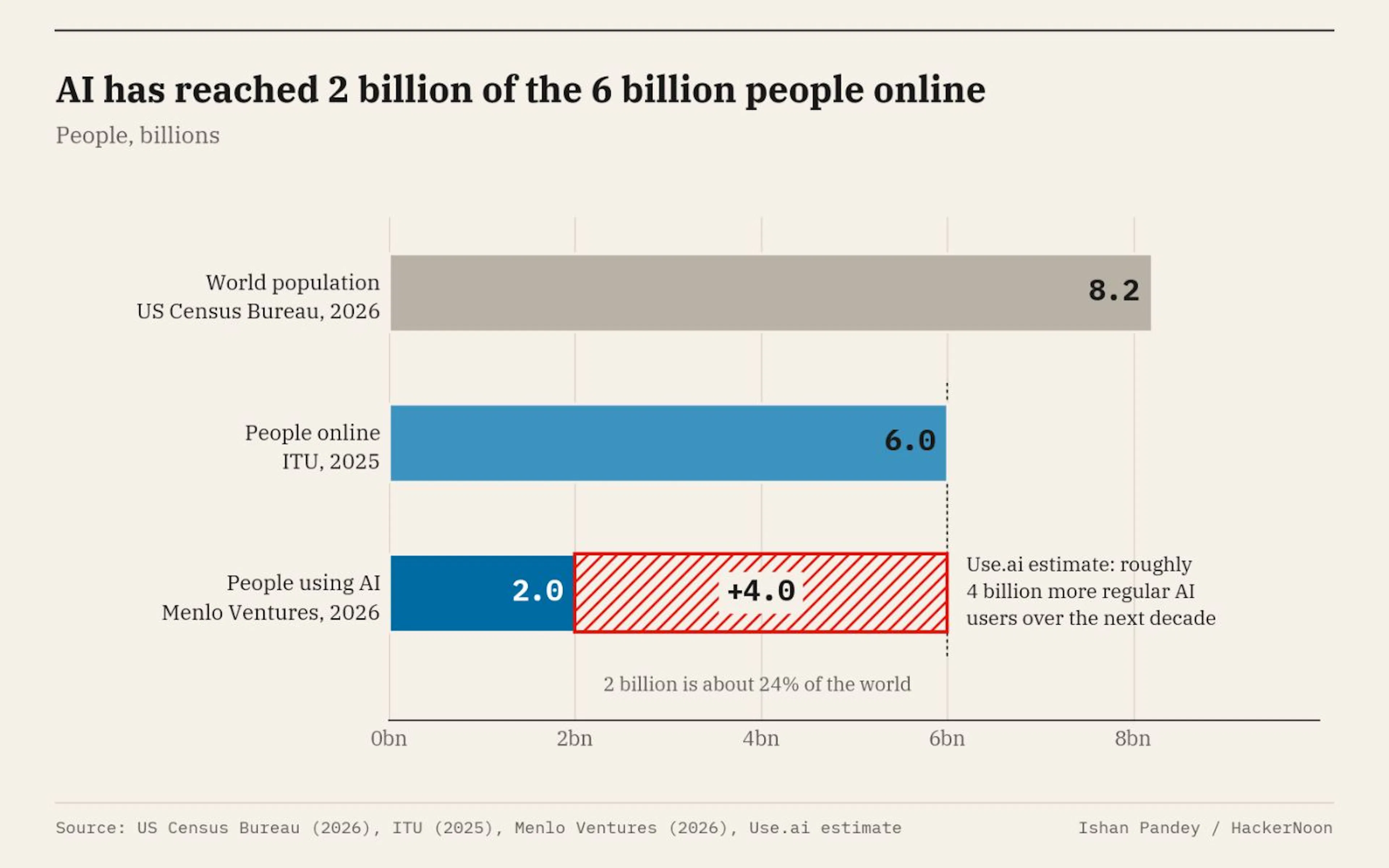 AI users against people online and world population, with Use.ai's estimate of future regular users
AI has reached about 2 billion people against roughly 6 billion online and 8.2 billion in the world with Use.ai estimating that roughly 4 billion more could become regular users over the next decade, with the hatched bar showing a company estimate and not a measured figure. Sources: Menlo Ventures, ITU Facts and Figures 2025, US Census Bureau, Use.ai.
Growth of that size has to come from people who are not yet comfortable with AI, which is why the newcomer share in Use.ai's survey matters. Menlo found that AI use among US adults reached 64% in 2026 from 61% a year earlier and that daily use rose from 19% to 25%, so the established markets are still adding users at a measured pace while the global base grew 11% in a year to two billion.
From Answers to Action
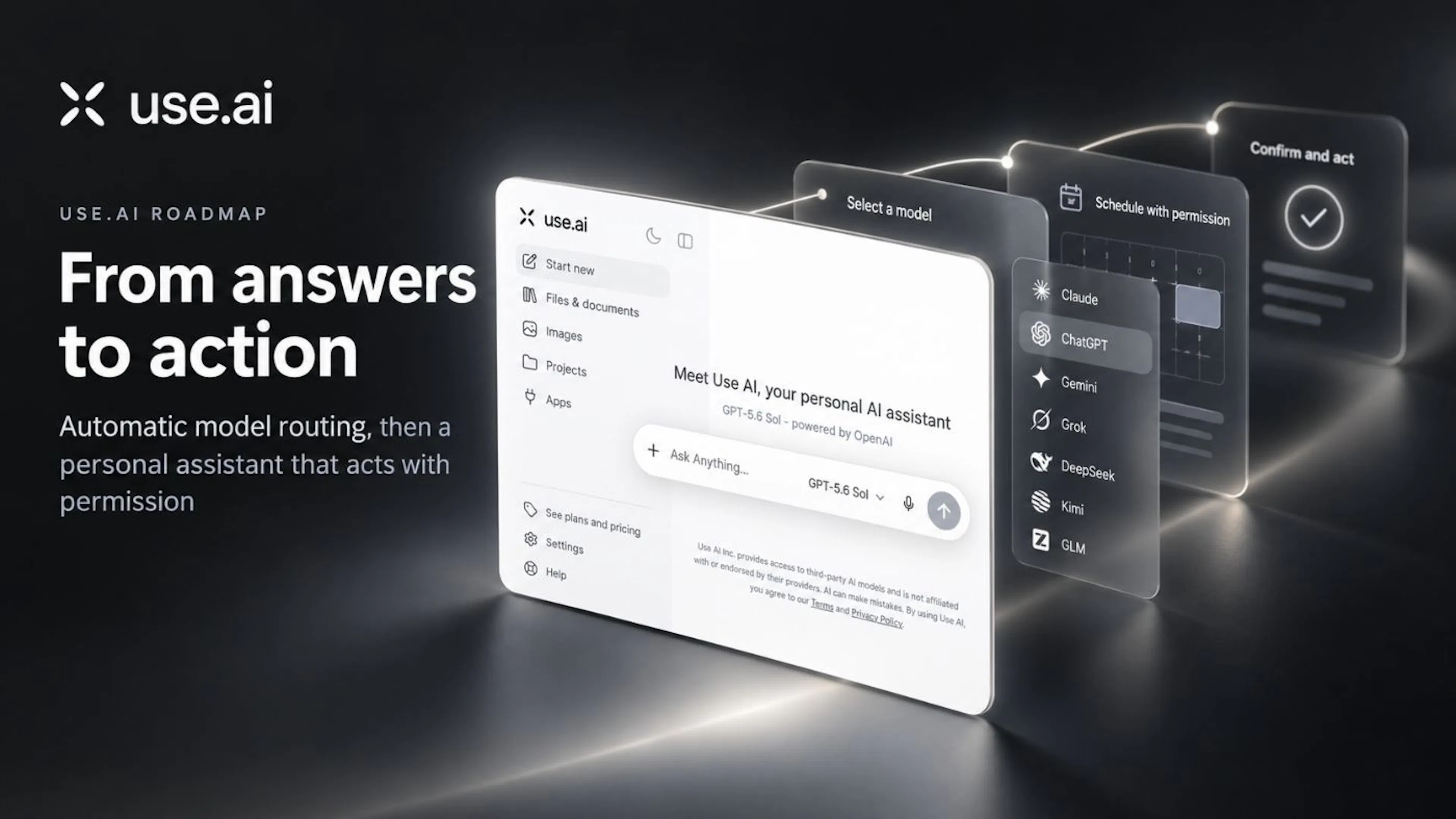
Use.ai's roadmap has two parts, the first of which is automatic orchestration that routes each task to the most suitable model so that users no longer need to follow model launches, study benchmarks or decide which AI belongs to which task. The second is a personal assistant that understands a user's preferences, routines, schedule and context before coordinating models and connected apps to complete tasks on their behalf.
The company illustrates the idea with everyday errands, such as a user asking for a haircut next week and giving the assistant permission to read their calendar, after which it could identify the usual salon, check available appointments against the schedule, make the booking, add it to the calendar and set a reminder. A shopper looking for new running shoes could ask it to research suitable models based on their preferences and training habits while comparing prices and availability across retailers, with the purchase completed only once the user confirms.
Consumers are already moving in that direction according to Menlo Ventures, whose July survey found that 41% of AI users have tried an AI agent and 24% use one regularly, with 92% of the consumers who use agents paying for AI. That is the audience a subscription product like Use.ai's already serves, which gives the company's shift from answers to action a base of paying users to build on.
Founder Thesis
Herasymov's thesis is that consumer AI should be built for consumers and not for developers, which in his account means that users should not have to follow model releases, compare benchmarks or work out which model is best for each task, because that work belongs to the platform. He frames Use.ai as the place where a person's AI relationship begins and stays regardless of which model wins next, a framing that assumes the lead among models will keep changing hands, as the Similarweb and Menlo data above indicate while placing the lasting value in the context a user accumulates.
His stated goal is to minimise the effort between needing something done and having it done, which explains why the roadmap runs from model switching to routing and then to a personal assistant that books, researches and buys on a user's behalf. His own history gives the position some weight, since he worked as an M&A and technology investment banker before launching seven businesses and growing one of them to more than 100 employees and $3 million in annual revenue within two years while he now runs a product that serves a million people a month.
Outlook
The numbers point in one direction, with about two billion people using AI and the average user already running three assistants while ChatGPT's traffic share has fallen by roughly 31 points in 19 months and the price of a fixed level of capability has been dropping about tenfold a year. The conditions that favour a product sitting above the individual models are all in place at once so Use.ai reaches one million monthly users in that setting with a free tier suited to newcomers, a paid tier that carries the leading models and a roadmap that extends from switching between them to acting on a user's behalf.
The test over the next year is whether Use.ai can hold the context its users build inside it as the number of available models keeps growing. If it does, the one million monthly users it has gathered in under a year become the starting position for a larger share of the four billion people its own estimate expects to adopt AI regularly while the workspace becomes the place where those new users keep their history whichever model leads next.
Don’t forget to like and share the story!
Vested Interest Disclosure: HackerNoon has reviewed the report for quality, but the claims herein belong to the author. #DYOR.
如有侵权请联系:admin#unsafe.sh