Stablecoins now hold more than $300 billion in supply after reaching a record $322.4 billion in May 2026-10-1 12:29:43 Author: hackernoon.com(查看原文) 阅读量:1 收藏
Stablecoins now hold more than $300 billion in supply after reaching a record $322.4 billion in May 2026 and the US GENIUS Act will take effect no later than January 2027 with a requirement that issuers have their reserves examined by a registered accounting firm every month, which makes the proof of what stands behind a token one of the most scrutinised pieces of data in finance. The difficulty is that reserve balances, fund valuations and collateral positions are information that institutions keep private, so a smart contract that needs to act on them has faced a choice between trusting an intermediary and asking the institution to open its books.
Flare, the blockchain for data, has now brought Flare Confidential Compute to Songbird, its canary network, so that private institutional data can be processed and returned as a signed result that smart contracts verify onchain while the underlying data stays private. The first application is a Proof of Reserves extension that Hex Trust's USDX is the first stablecoin to use, which gives a market of more than $300 billion a working example of showing that tokens are backed without publishing the balance sheet behind them.
What Flare Confidential Compute Does
Flare supplies smart contracts with public data through two enshrined protocols, the Flare Time Series Oracle (FTSO) for market prices and the Flare Data Connector (FDC) for verified facts from other blockchains and Web2 systems, both of which are run by a network that lists 100 data providers. Institutional data such as reserve balances, fund net asset values, collateral positions, credit information and compliance records often has to remain private, a gap that Flare Confidential Compute (FCC) fills by processing private inputs inside a registered Trusted Execution Environment (TEE), which is a hardware-isolated enclave, then returning a signed result that contracts can verify before relying on it, with only the aggregate conclusion published onchain.
FCC is initially live on Songbird following the acceptance of governance proposal STP.13 in July 2026, with the first TEE machines running on Google Cloud confidential computing and operated by the Flare Foundation under an architecture designed to support a broader set of operators and hardware vendors over time. A deployment on Flare mainnet will follow separately, which makes Songbird the live proving ground for a design that combines hardware-isolated execution with the same consensus among data providers that already secures Flare's price and data feeds.
A Market That Needs Verifiable Reserves
Stablecoin supply stood at about $27 billion at the end of 2020 and rose to roughly $163 billion a year later before settling between $130 billion and $138 billion through 2022 and 2023, then climbed to about $206 billion in 2024 and $308 billion in 2025 on the way to a record $322.4 billion on 17 May 2026. That is a rise of almost twelvefold in under six years, which has drawn the attention of lawmakers, since the GENIUS Act signed in July 2025 requires payment stablecoin issuers to hold one-for-one reserves in assets such as cash, insured deposits and short-dated US Treasury bills with monthly reserve reports that a registered accounting firm has examined and the chief executive and chief financial officer have certified, under a law that takes effect on the earlier of 18 January 2027 or 120 days after final regulations.
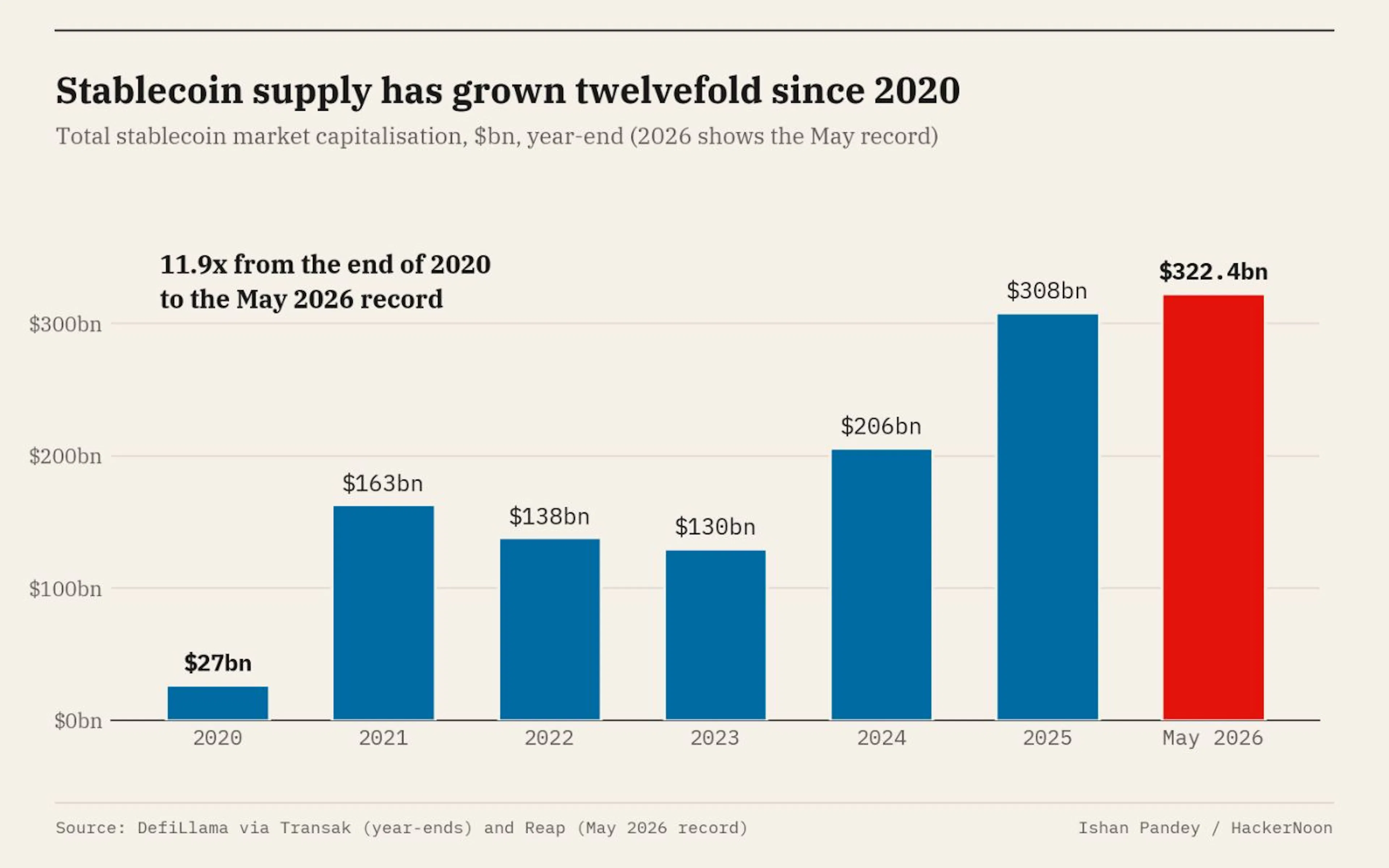 Stablecoin supply at year-end from 2020 to the May 2026 record
Stablecoin supply grew from about $27bn at the end of 2020 to a record $322.4bn in May 2026, a rise of 11.9 times by the author's calculation, with year-end figures rounded and different trackers varying by a billion or two. Sources: DefiLlama data via Transak and Reap.
Reserve proofs are the first of several private-data problems that grow with the market, because tokenised real-world assets tracked by RWA.xyz rose from about $6.6 billion to $26.4 billion in the year to March 2026, with private credit, commodities, US Treasuries, corporate bonds, non-US government debt and institutional alternative funds each above $1 billion. Every one of those categories depends on figures such as fund valuations, collateral coverage and credit performance that sit with the issuer and not on a public ledger, which is the kind of information FCC is designed to turn into a result that a contract can check.
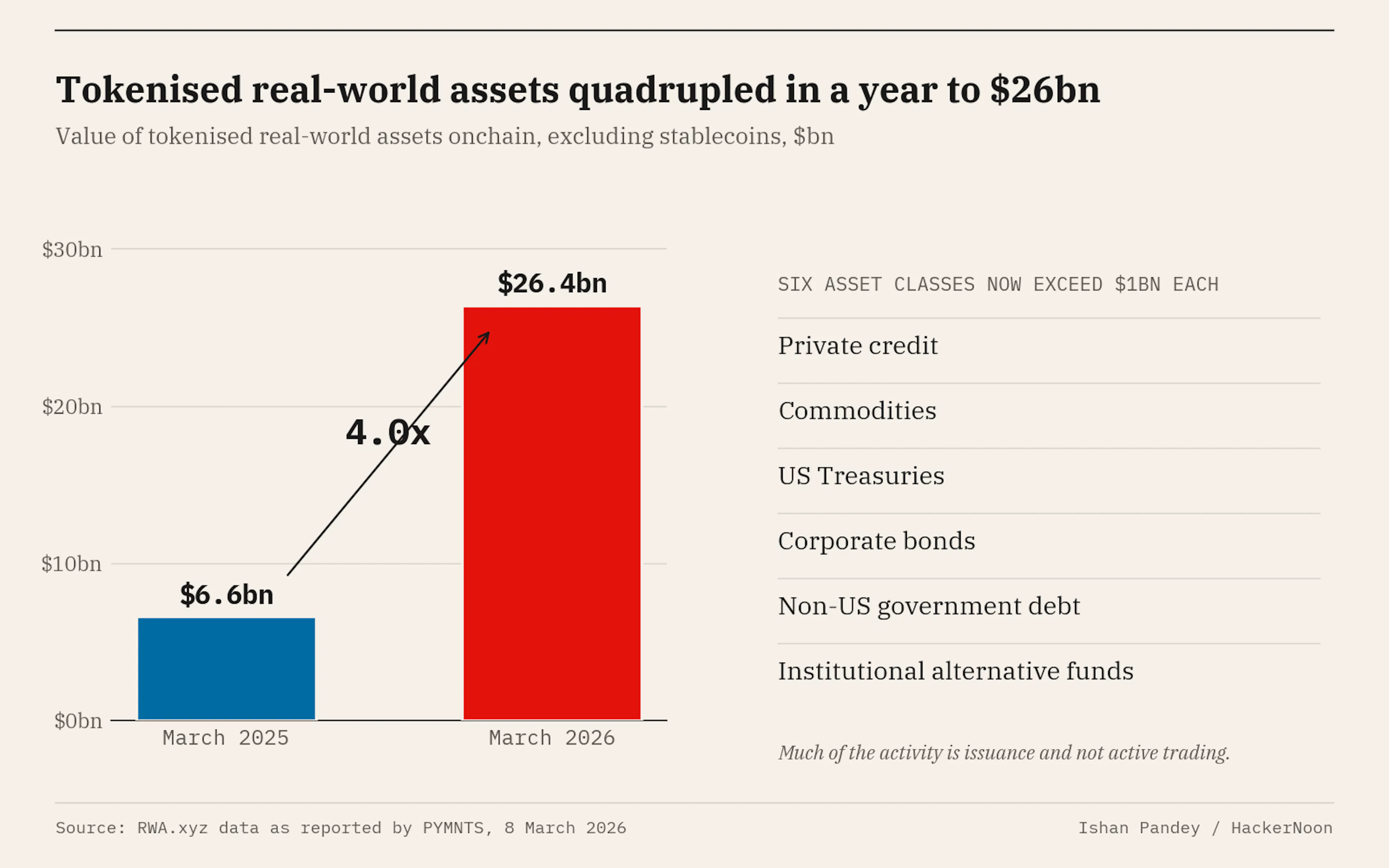 Tokenised real-world assets onchain, March 2025 and March 2026
Tokenised real-world assets excluding stablecoins rose from about $6.6bn to $26.4bn in a year, a rise of 4.0 times by the author's calculation, with six asset classes now each above $1bn and much of the activity still consisting of issuance and not trading. Source: RWA.xyz data as reported by PYMNTS, 8 March 2026.
The Data Stack Flare Has Built
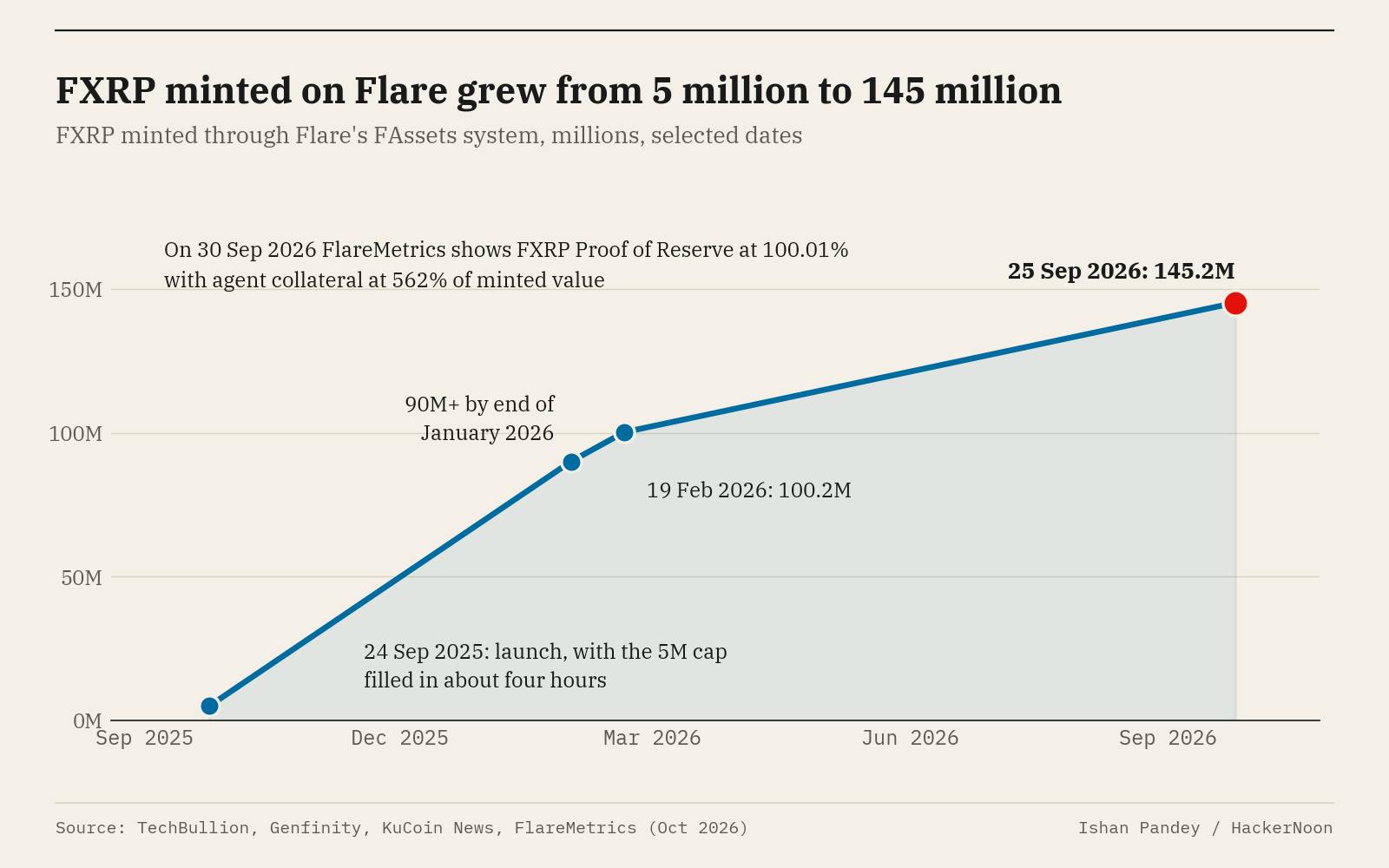
Songbird launched in September 2021 as Flare's canary network and the mainnet followed with its genesis in July 2022, since when the network has added the FTSO and the FDC along with the FAssets system, which lets assets such as XRP take part in smart contract applications while remaining connected to their native networks. FAssets has become the clearest production test of that data stack, because FXRP went live on 24 September 2025 with a 5 million cap that filled in about four hours and passed 100 million minted on 19 February 2026 before reaching 145.2 million on 25 September 2026, one year after launch.
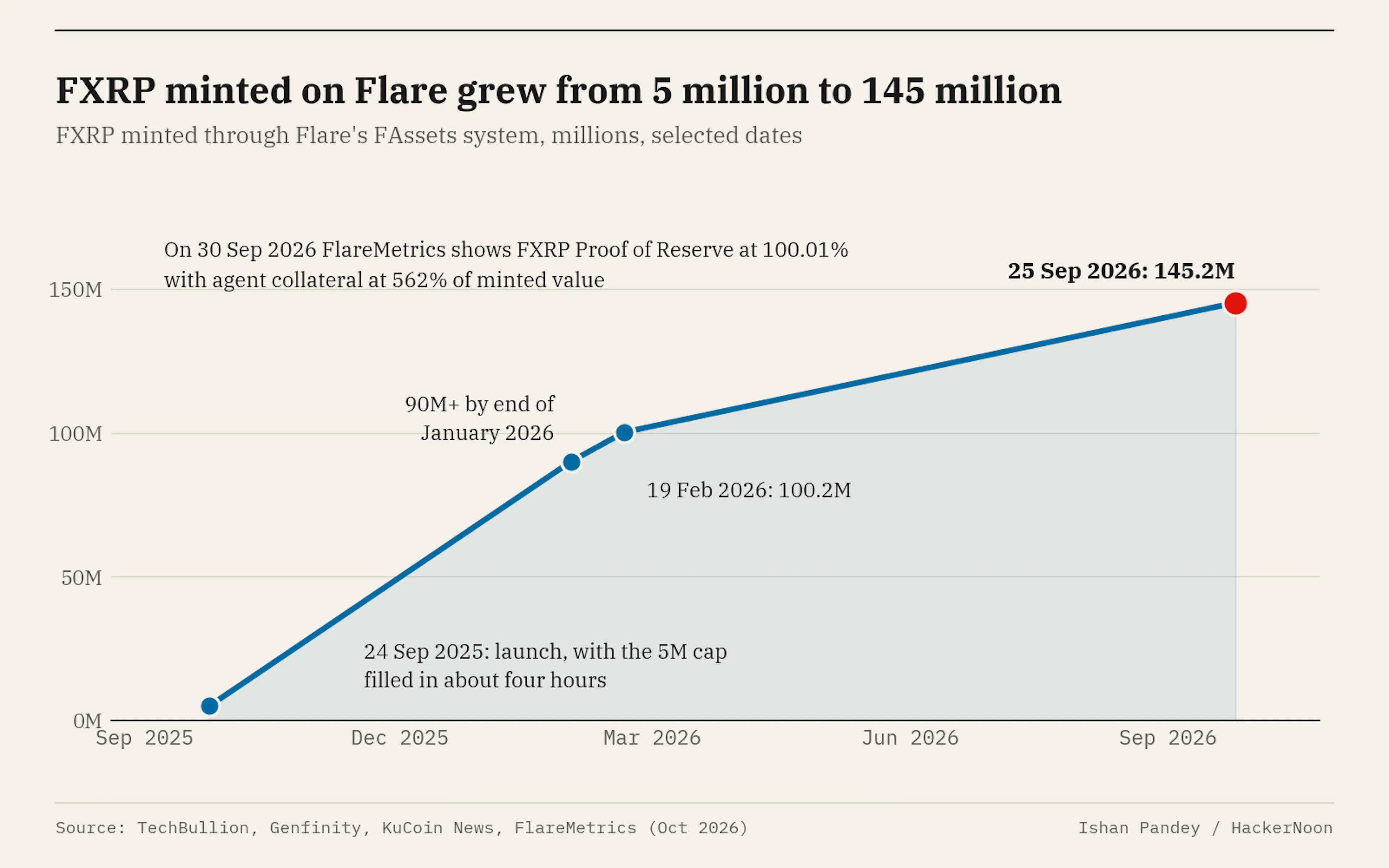 FXRP minted through Flare's FAssets system, September 2025 to September 2026
FXRP minted through FAssets rose from the 5 million launch cap on 24 September 2025 to 145.2 million on 25 September 2026, with the line joining selected dates and not the full daily series. Sources: TechBullion, Genfinity, KuCoin News, FlareMetrics.
FlareMetrics shows FXRP supply carrying a Proof of Reserve reading of 100.01% with agent collateral at 562% of minted value, so publishing verifiable backing figures is already part of how Flare's asset system reports on itself. FCC extends the same habit to backing that cannot be published in full, which is why a reserve proof for a stablecoin was the natural first application.
How the Verification Chain Works
FCC is designed so that a contract can verify not only a result but also the conditions under which that result was produced, through a chain of checks that begins with the data providers. Songbird's data providers relay and sign each instruction under Flare's signing policy while the TEE executes an instruction only after it carries a weighted majority of provider signatures, using the same provider set that operates the FTSO and the FDC.
Code is controlled as tightly as instructions, since each supported FCC code version is represented by the hash of a reproducible container image that has been approved onchain, so a machine running unapproved code cannot register with the network and any new version must pass the same approval process before it can be used, which turns every code upgrade into an onchain event. A TEE joins an extension by presenting a hardware attestation showing that it runs an approved code version, which is verified through the FDC and recorded onchain, while the machine's signing key is generated inside the enclave at boot and never leaves it.
The TEE then signs its output with its registered identity and a verifier contract known as the TEE registry checks that signature before the result can be stored or used by other contracts. For Proof of Reserves the calculation combines public reserve components, private reserve records and token supply in a single step under a coverage rule that can range from a single threshold to a multi-condition policy while the published conclusion carries none of the private figures that fed into it.
USDX and the First Proof of Reserves
Hex Trust, established in 2018 as a provider of regulated institutional digital asset custody, staking and markets services, launched USDX on 21 May 2024 as the first native stablecoin on Flare, a one-for-one dollar-referenced token whose reserves were described at launch as primarily one-to-three-month Treasury bills held at tier-one financial institutions. The Hong Kong-based group now provides USDX reserve data from two sources, a public reserves amount and a restricted cash reserves amount. The new extension reads both inside the TEE and checks the combined total against USDX supply across the network before signing a result that states whether the token is backed one for one or better.
Only that result is published, so the reserve balances stay out of view while the conclusion becomes available to any contract. The result also feeds into how USDX is used on Songbird, where it is a collateral asset in the FAssets system and where its feed is migrating to this reserve-based reference, with the same result giving decentralised exchanges a basis for pricing USDX and feed metadata showing at each update whether reserves meet the required coverage threshold.
Where Proof of Reserves Matters Most
Tether's USDT held about 59.1% of stablecoin supply and Circle's USDC about 23% in August 2026, which leaves the remaining 17.9% or roughly $55 billion of a $308 billion market spread across every other issuer. Issuers outside the two largest rely on the credibility of their reserves to win institutional users, which gives them a clear reason to adopt a proof that any contract or counterparty can verify onchain without waiting for a monthly report.
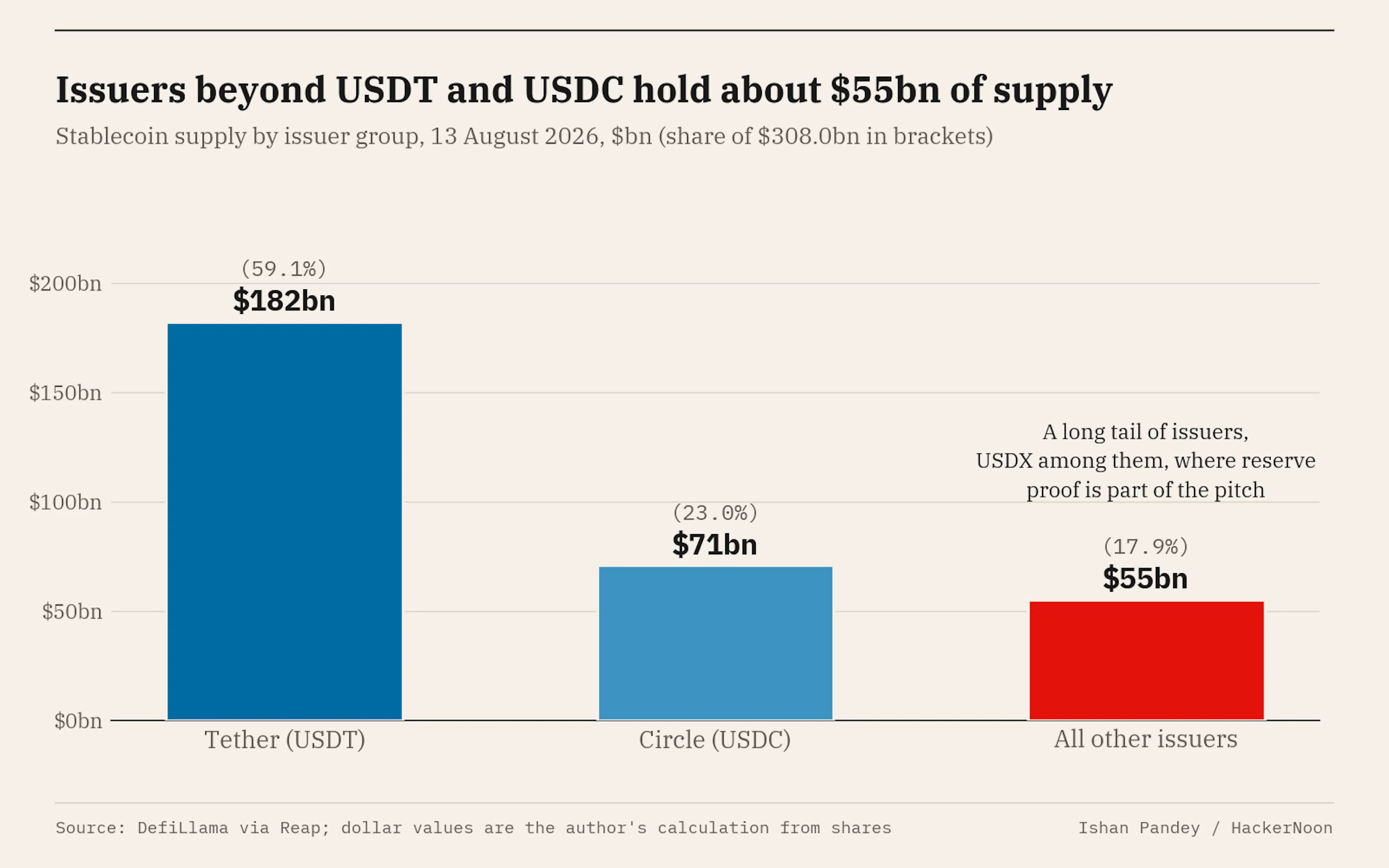 Stablecoin supply by issuer group, August 2026
Tether and Circle together held about 82% of the $308.0bn stablecoin market in August 2026, leaving about $55bn with all other issuers, with the dollar values being the author's calculation from the published shares. Source: DefiLlama data via Reap.
From Reserve Proofs to Tokenised Funds and Credit
The same framework applies to any data that institutions will not publish, with the applications named for FCC beyond Proof of Reserves including lending markets that combine public asset prices with private coverage information, tokenised funds that calculate verifiable net asset values from undisclosed holdings and credit or compliance applications that need a verifiable conclusion without exposing the underlying records. Confidential computing as a field is growing quickly, with Grand View Research valuing the global market at $5.5 billion in 2023 and forecasting $153.8 billion by 2030, a compound annual growth rate of 61.1% that places a blockchain-native implementation inside one of the faster-growing parts of enterprise security.
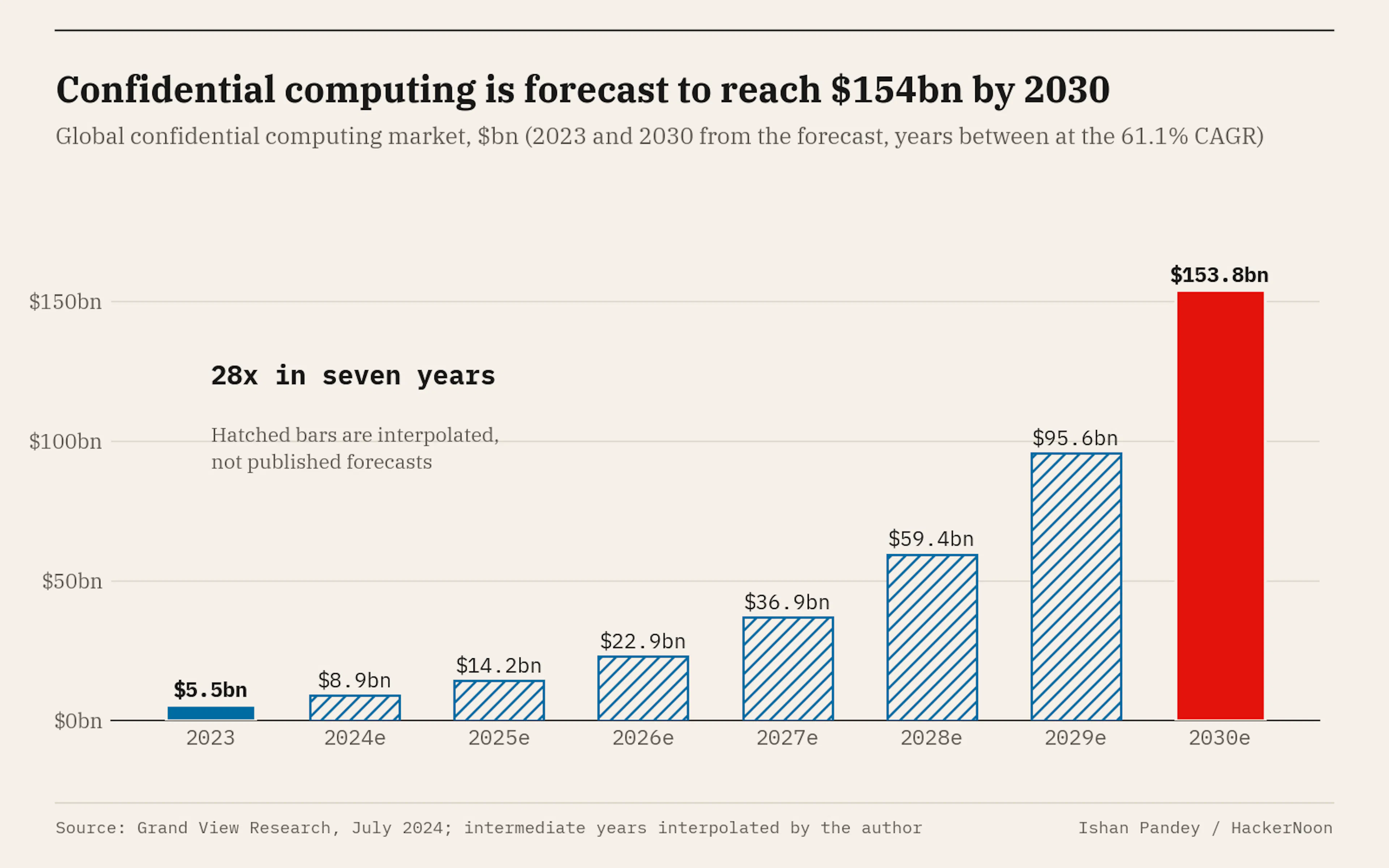 Global confidential computing market forecast, 2023 to 2030
Grand View Research values the confidential computing market at $5.5bn in 2023 and forecasts $153.8bn by 2030, with the years between interpolated by the author at the stated 61.1% growth rate and forecasts differing widely between research firms. Source: Grand View Research, July 2024.
Roadmap for Builders
The FCC extension framework will open to builders later in the bootstrap period while developer documentation covering the architecture, extension development, registration and onchain verification is already available through the Flare Dev Hub. The Flare Foundation operates the initial TEE machines on Google Cloud, with the design intended to support a broader distribution of operators and hardware vendors while a Flare mainnet deployment is planned to follow the Songbird launch separately.
The case for FCC rests on a gap that widens as onchain assets grow, with stablecoin supply up almost twelvefold since 2020 and tokenised real-world assets up fourfold in a year while regulators move toward monthly reserve examinations and the institutions that issue these assets keep their records private. Flare brings to that gap a data network that already serves public prices and cross-chain facts, a growing asset system in FAssets and now a way to return signed conclusions from private data. The Songbird launch with Hex Trust's USDX gives the approach a live test whose results will show how far the same model travels beyond reserves.
Don’t forget to like and share the story!
Vested Interest Disclosure: HackerNoon has reviewed the report for quality, but the claims herein belong to the author. #DYOR.
如有侵权请联系:admin#unsafe.sh