I used to think Digital Rights Management (DRM) was an unbreakable vault for live video. Wrap a stre 2026-10-1 05:15:2 Author: hackernoon.com(查看原文) 阅读量:2 收藏
I used to think Digital Rights Management (DRM) was an unbreakable vault for live video. Wrap a stream in encryption, lock the front door with login tokens, and you are totally safe- or so I thought.
Then I saw how quickly high-value live sports streams bypass DRM.
All an illegal restreamer needs is an HDMI capture card, a modified browser extension, or a simple screen recorder. These tools strip away the encrypted layer, grab pristine, unencrypted 1080p60 video frames, and re-encode them straight to an offshore IPTV server.
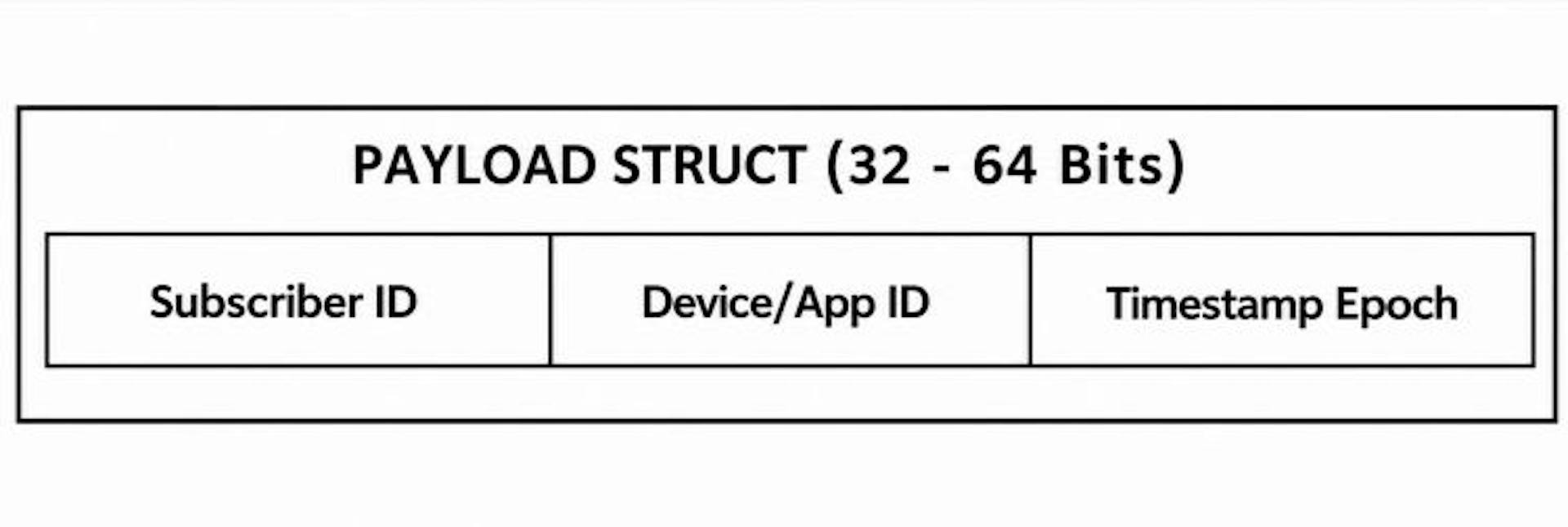
DRM prevents unauthorized downloads, but it cannot close the "analogue hole" once video frames decrypt and render on a display. That is why major broadcasters, from rights holders streaming Premier League matches to platforms delivering regional live sports packages and broadcast channels, rely on Dynamic Session Watermarking.
Here is how rights holders track down stolen live feeds in a matter of seconds, extract session tokens from raw pixel data, and kill pirate streams mid-match.
The Evolution: Static Watermarks vs. Invisible Forensic Watermarking
 How hidden pixel data traces a stolen live sports stream straight back to the user's account.
In the early days of OTT streaming, platforms tried burning visible account details directly into the video stream. You’ve probably seen these: a semi-transparent subscriber email or IP address floating across the screen every few minutes.
Pirates bypassed visible watermarks instantly using basic computer vision scripts:
- Cropping: Trimming the edges of the frame to remove static corner overlays.
- Blurring & Inpainting: Running open-source neural networks to detect floating text and blur out the pixels underneath.
- Collusion Attacks: Blending two or three separate streams so the overlays cancel each other out.
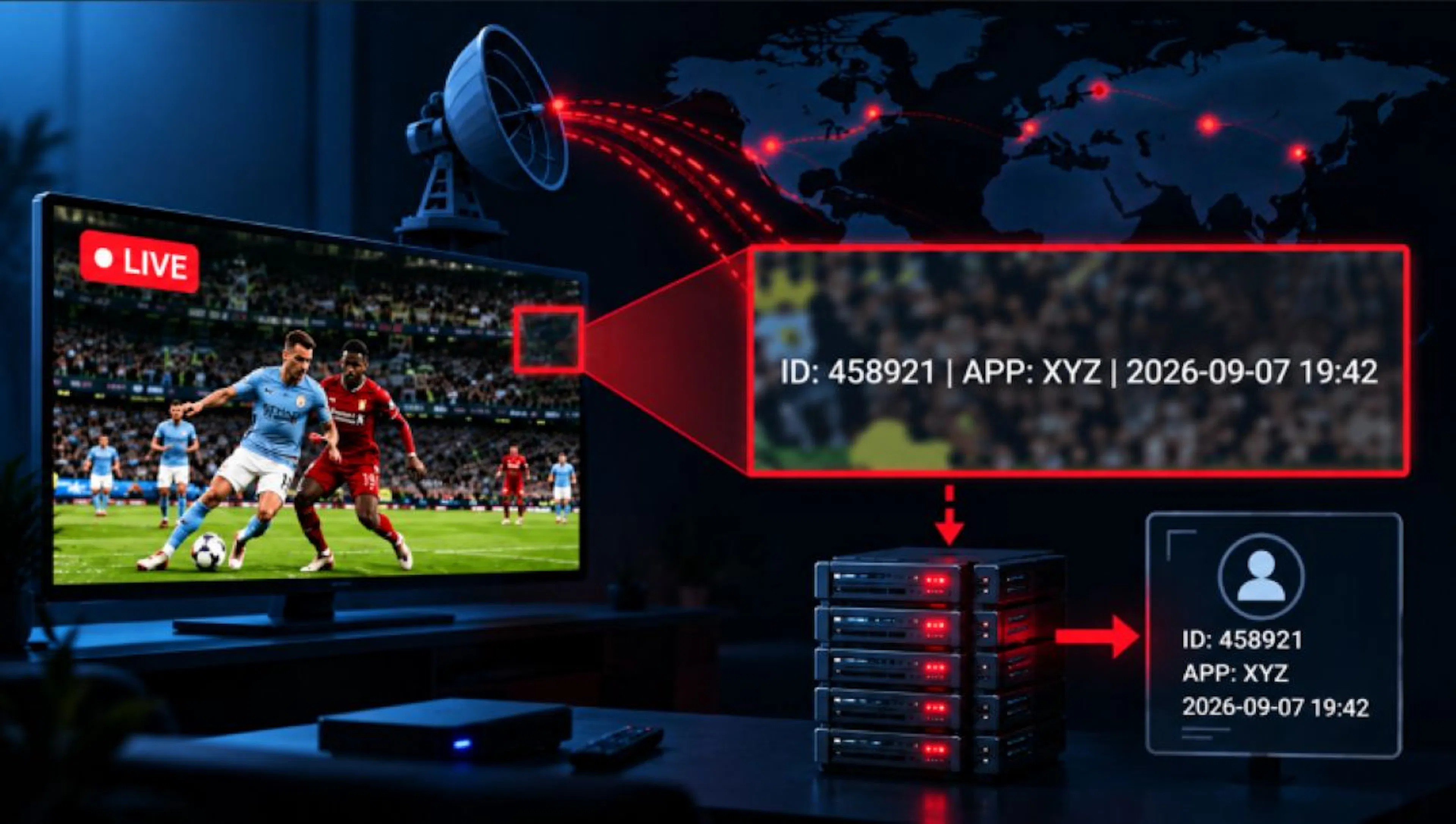
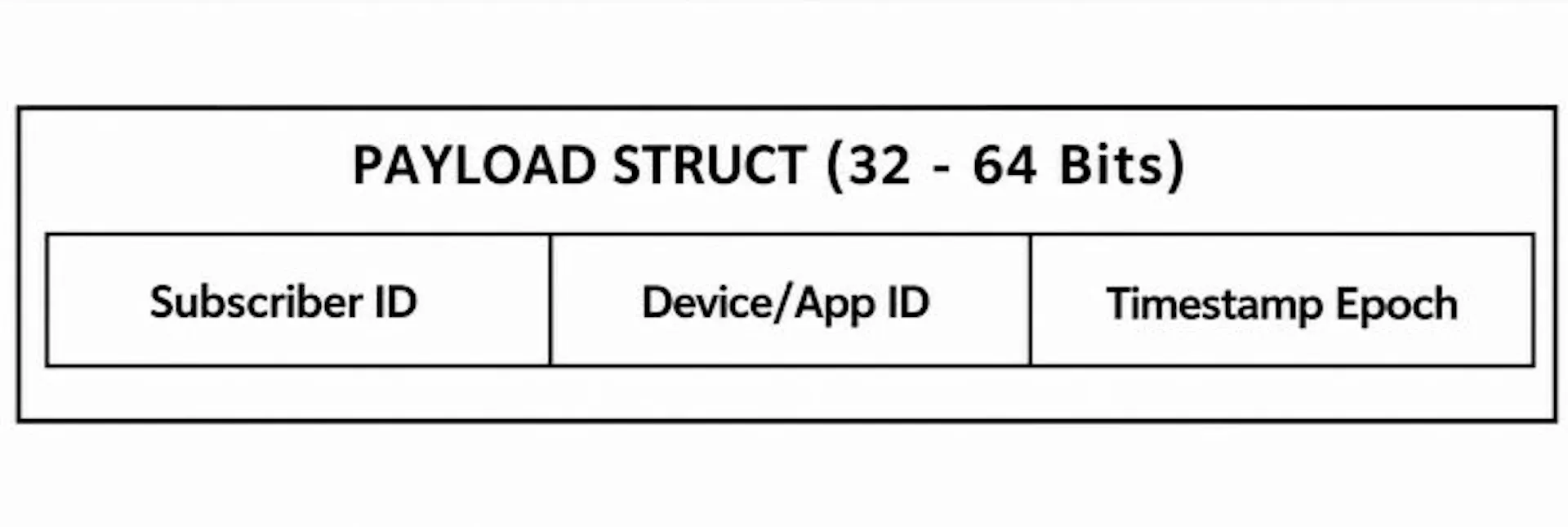 The structure of a hidden watermark payload: How 32 to 64 bits of data pack subscriber, device, and timestamp details into the video.
Modern Dynamic Forensic Watermarking works completely differently. It embeds an invisible, imperceptible binary payload (usually 32 to 64 bits) directly into the brightness or spatial frequency coefficients of the video signal itself.
The watermark is completely invisible to human eyes. It easily survives heavy video compression, colour tweaks, and camera screen recordings. Yet it carries enough data to trace a single stolen frame straight back to the exact user account that leaked it.
How A/B Variant Streaming Scales Watermarking to Millions
A common question from network engineers is:
“How can a server dynamically encode a unique, invisible watermark into a 4K 60fps stream for 500,000 concurrent viewers without blowing up transponder CPU limits?”
You don't re-encode the stream per user. Doing that would break every caching rule on your Edge CDN. Instead, the streaming industry uses Server-Side A/B Variant Watermarking (standardized via DASH-IF and ETSI TS 104 002.)):
[Ingest Encoder]
- └──> Variant A (Segment 101 - Bit 0)
- └──> Variant B (Segment 101 - Bit 1)
- Dual Segment Encoding: The primary encoder generates two slightly modified versions of every video segment: Variant A (representing binary 0) and Variant B (representing binary 1). The visual difference between A and B is completely imperceptible to human eyes.
- CDN Edge Manifest Assembly: When your device requests a stream playlist, the Edge CDN assigns your active session a unique binary sequence (like 101101001).
- Sequence Stitching: User #104 receives video segments in sequence A-B-A-A-B-A, while User #105 receives A-B-B-A-B-A.
Because a 32-bit sequence requires just 32 video segments (about 30 to 60 seconds of streaming time), a platform can give over 4.3 billion active users a unique, identifiable binary fingerprint while serving 99% of the video segments directly out of standard CDN edge caches.
The Automated Kill Loop: From Stolen Stream to Black Screen
So what actually happens when an illegal feed goes live during a major match, like the
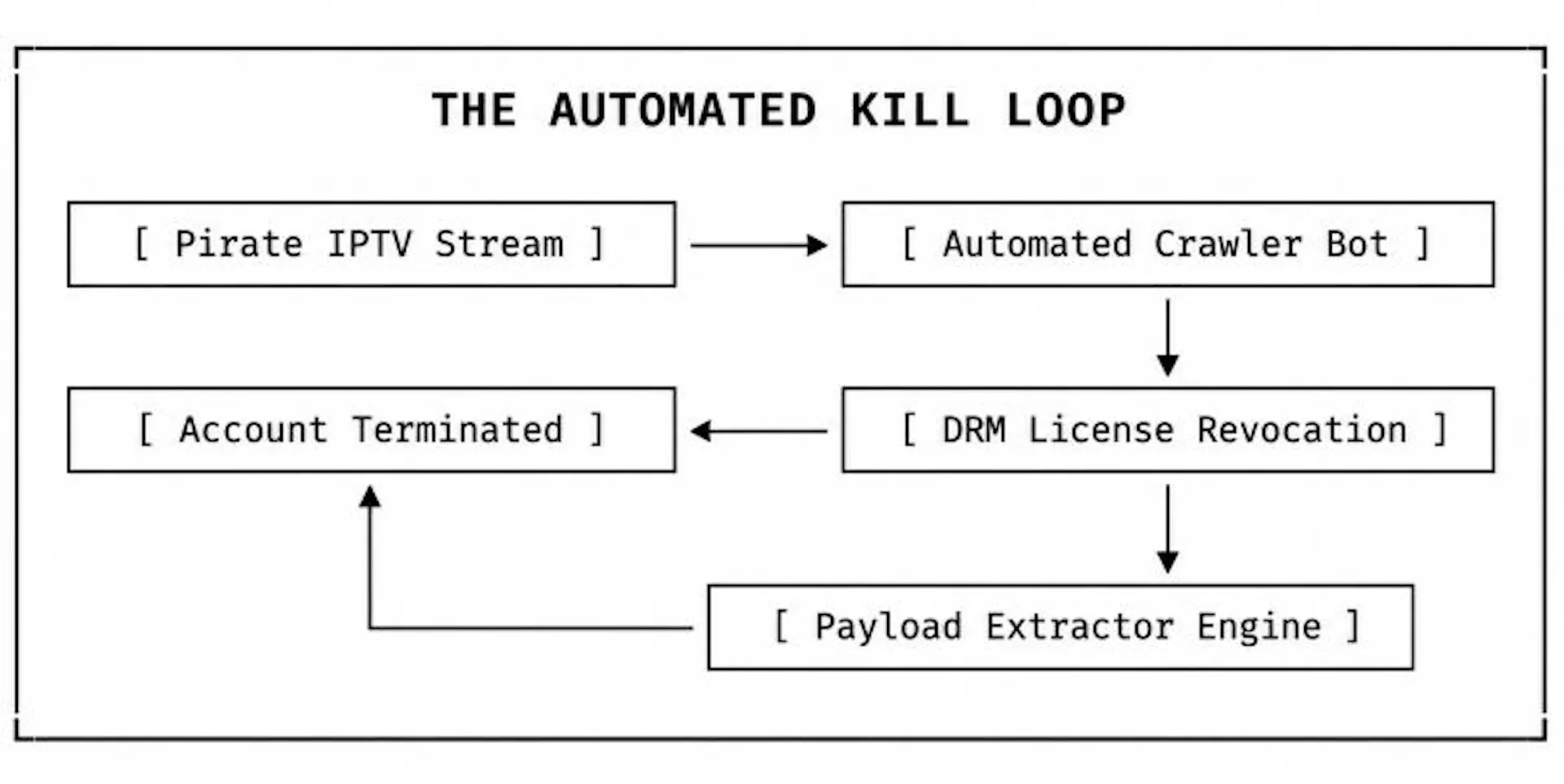 The automated kill loop: How crawler bots spot illegal streams, extract pixel data, and shut down user accounts.
- Automated Crawling: Web bots, Telegram scrapers, and video fingerprinting tools continuously scan illegal IPTV platforms, web players, and social media live feeds.
- Signal Extraction: : When a stolen feed is flagged, the crawler grabs 15 to 30 seconds of video and passes it to an extraction engine. The engine analyzes spatial pixel patterns and reconstructs the hidden binary A/B sequence.
- Session Matching: The extracted binary string is matched against the platform’s active session database to instantly identify the specific Subscriber ID, IP address, device profile, and payment account.
- Automated Kill-Switch: The platform backend sends an automated API call to revoke the subscriber's DRM license token and terminate their active connection.
Within two to five minutes of an illegal stream appearing online, the pirate's source player goes black.
Why Watermarking Drives Legal Cord-Cutting Infrastructure
Forensic watermarking changes how we think about online streaming. In the past, companies relied on slow court orders to take down illegal feeds.
Today, automated systems shut down stolen streams in real time. This makes illegal restreaming services completely unreliable for viewers.
This shift shows why official options are the best long-term choice. Reliable setups include free-to-air antenna systems (like Saorview and Freeview HD) alongside licensed streaming apps.
Illegal paywalls simply cannot last. It only takes a tiny, invisible pixel payload to bring down an illegal feed right in the middle of a game.
Pirates are already attempting to counter A/B variant watermarking using AI frame-interpolation and spatial noise generation.
However, next-gen forensic watermarks are moving deeper into the chrominance (colour) channels and motion-vector transforms.
This binds the watermark directly to the core video math, meaning any attempt to strip out the digital fingerprint completely destroys the video quality.
In modern video distribution, stopping piracy isn't just about building higher digital walls. It's about making every single pixel accountable.
如有侵权请联系:admin#unsafe.sh