A truck sits at a warehouse dock and cannot be loaded, because a Goods Receipt Note is printing the 2026-9-29 18:50:55 Author: hackernoon.com(查看原文) 阅读量:23 收藏
A truck sits at a warehouse dock and cannot be loaded, because a Goods Receipt Note is printing the wrong information, with the fault hiding somewhere between SAP, a Kinaxis supply-planning system and a piece of in-house warehouse software that three different teams maintain. Problems like this are ordinary inside large companies, where the software that runs finance, inventory and orders is never really finished. Dodge AI says enterprises now spend more than $600 billion a year simply keeping these systems running. The same system of record that a company installed a decade ago has usually collected thousands of company-specific rules, workarounds and customisations since, which means every incident starts with archaeology before anyone can write a fix.
Dodge AI, the San Francisco company that traced that warehouse fault across all three systems and delivered a fix within minutes, has raised $2.65 million to take on this work with AI agents. Its platform acts as a control plane over enterprise applications such as SAP, Salesforce, Microsoft Dynamics, Kinaxis and Oracle JDE, resolving incidents and change requests while recording the hidden logic that makes each company's setup unique, so that every fix leaves the system better understood than it was before and turns years of undocumented workarounds into a manual that engineers and AI agents can both work from.
The Round
The round was led by Accel and Google's AI Futures Fund, the investment programme Google launched in May 2025 to back startups building on Google DeepMind's models with early model access, Google Cloud credits and direct investment. New Build Venture Capital, Antler, Schema Ventures and a group of angel investors from the SAP ecosystem also participated, which gives the company backers who know the systems it works inside as well as the capital to scale.
Accel's conviction came early, since Dodge AI was selected for the firm's 2026 Atoms AI cohort, one of five companies chosen from more than 4,000 applications according to Tech Funding News, while Accel's Prayank Swaroop, who has invested with the firm since 2011 across SaaS, developer tools and cybersecurity, is the investor closest to the company. The new money arrives while the company is already working with more than a dozen enterprises, half of them publicly listed, so the capital goes toward scaling a product that customers already rely on in production. The company is using it to push deeper into the maintenance layer, meaning the exceptions, configurations and operational logic that define how each enterprise actually runs.
The Enterprise Maintenance Market
Enterprise technology budgets are growing faster than at any point in recent memory, with the forecasts still moving upward. Gartner's latest outlook puts worldwide IT spending at $6.37 trillion in 2026, up 14.2% on 2025, after the same firm had put the figure at $6.08 trillion in October 2025, so roughly $290 billion was added to the year's expected budget in nine months of revisions.
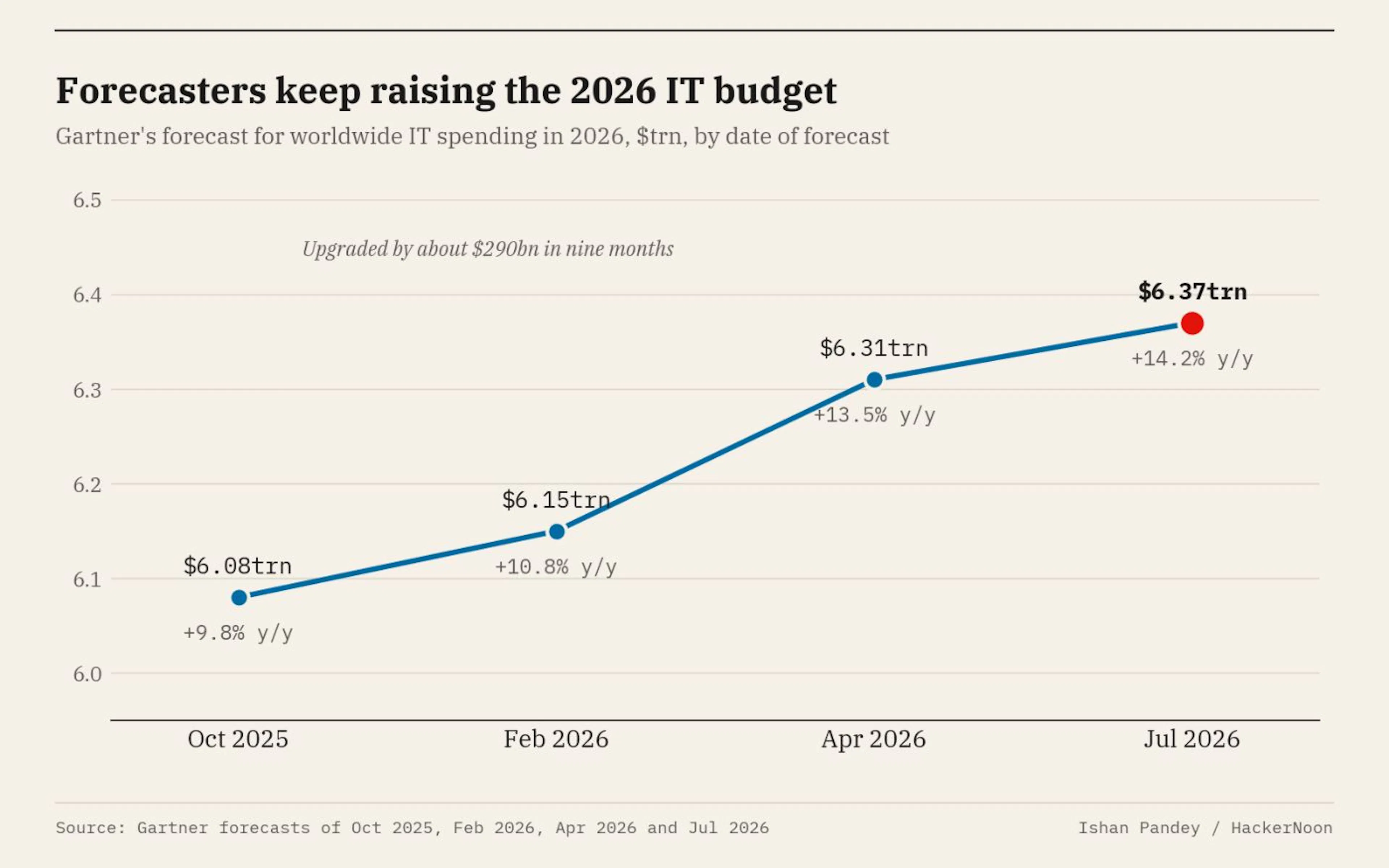 Gartner's forecast for 2026 worldwide IT spending, by date of forecast
Chart 1. Gartner raised its 2026 worldwide IT spending forecast four times in nine months, from $6.08trn to $6.37trn, as AI infrastructure spending accelerated. Sources: Gartner forecasts of October 2025, February 2026, April 2026 and July 2026.
IT services is the single largest part of that budget at about $1.57 trillion in 2026 before counting cloud infrastructure, with much of it paying for the application implementation and managed services that keep enterprise software alive. For decades that work has run through large system integrators such as Accenture, TCS and IBM, which typically place teams of 20 to 50 people offshore to handle incidents, change requests, background jobs and the daily operational fires of a single client, a model that keeps the lights on but grows with headcount rather than with software.
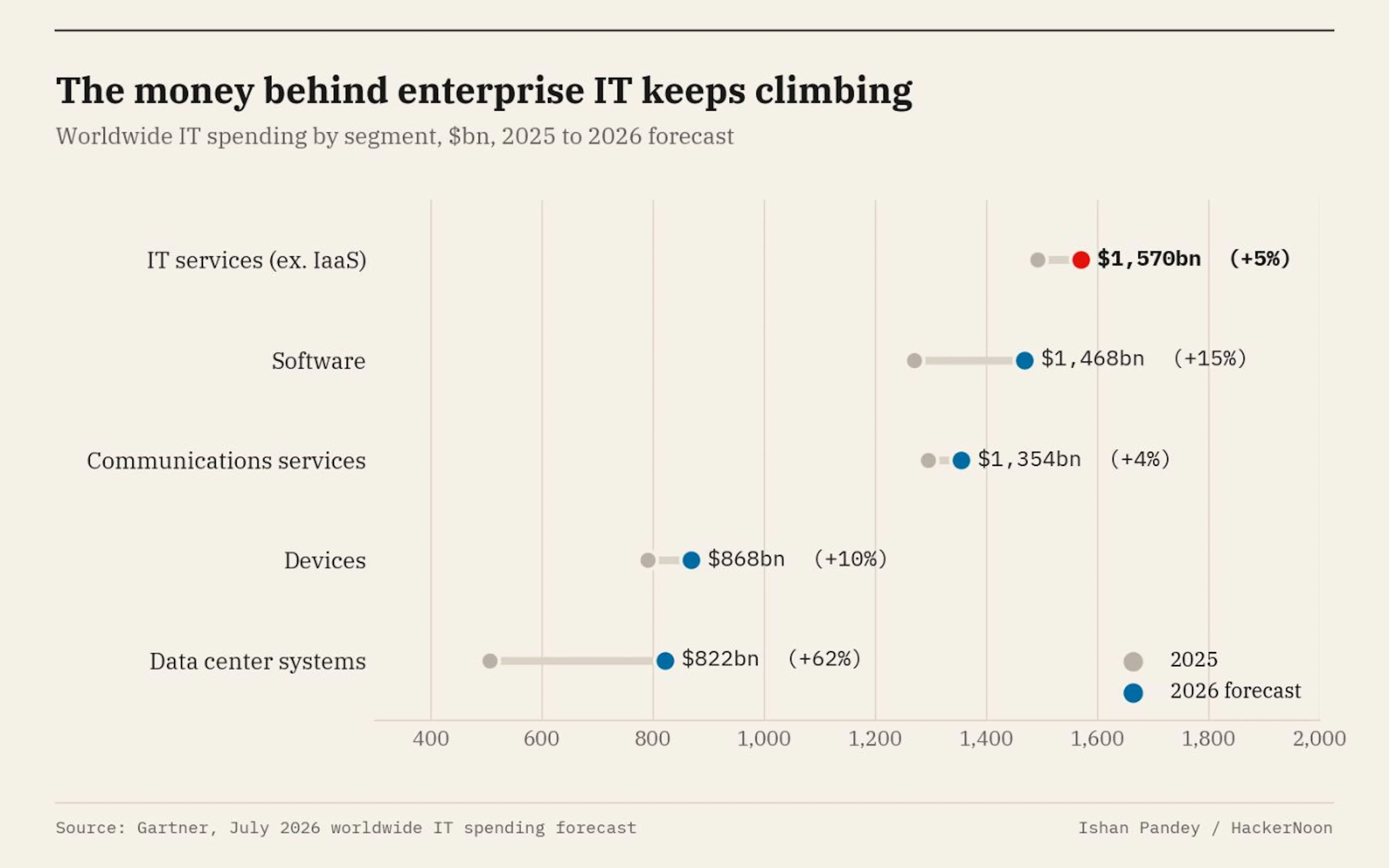 Worldwide IT spending by segment, 2025 to 2026
Chart 2. IT services remains the largest segment of enterprise technology spending, while software grows fastest among the core categories at 15%. The July 2026 forecast reports infrastructure as a service separately, so services here exclude it. Source: Gartner, July 2026.
Dodge AI's view is that this is the part of the budget where AI agents can make the fastest and most measurable difference, because the work is repetitive, well documented in tickets and expensive when it goes wrong.
Legacy Systems and Technical Debt
SAP alone shows how long enterprises live with the systems they already have, since Gartner estimates that SAP's older ECC platform has about 35,000 customers and that only 39% of them, roughly 14,000, had moved to the newer S/4HANA by the end of 2024, with nearly half expected to still be on ECC after 2027 and more than 13,000 projected to remain on it through 2030. Mainstream ECC support ends in December 2027 and a paid transition option runs to 2033, while Gartner says a migration can cost anything from $2 million to $1 billion for a large, complex installation and usually takes three to seven years, so tens of thousands of companies will spend the rest of the decade maintaining systems that are too important to switch off and too complex to replace quickly.
 SAP ECC customers, migrations and those still on ECC
Chart 3. Of roughly 35,000 SAP ECC customers, about 21,000 were still on the legacy platform at the end of 2024 and about 17,000 are expected to remain there after mainstream support ends in 2027. 2027 and 2030 figures are analyst projections. Source: Gartner and IDC estimates via CIO.com.
The cost of all that maintenance compounds as technical debt, the pile of quick fixes and undocumented changes that makes each future change slower and riskier than the last. CIOs surveyed by McKinsey estimated that tech debt makes up 20% to 40% of the value of their entire technology estate and that 10% to 20% of the budget meant for new products ends up diverted to dealing with it, while 60% said their debt had grown noticeably over the previous three years.
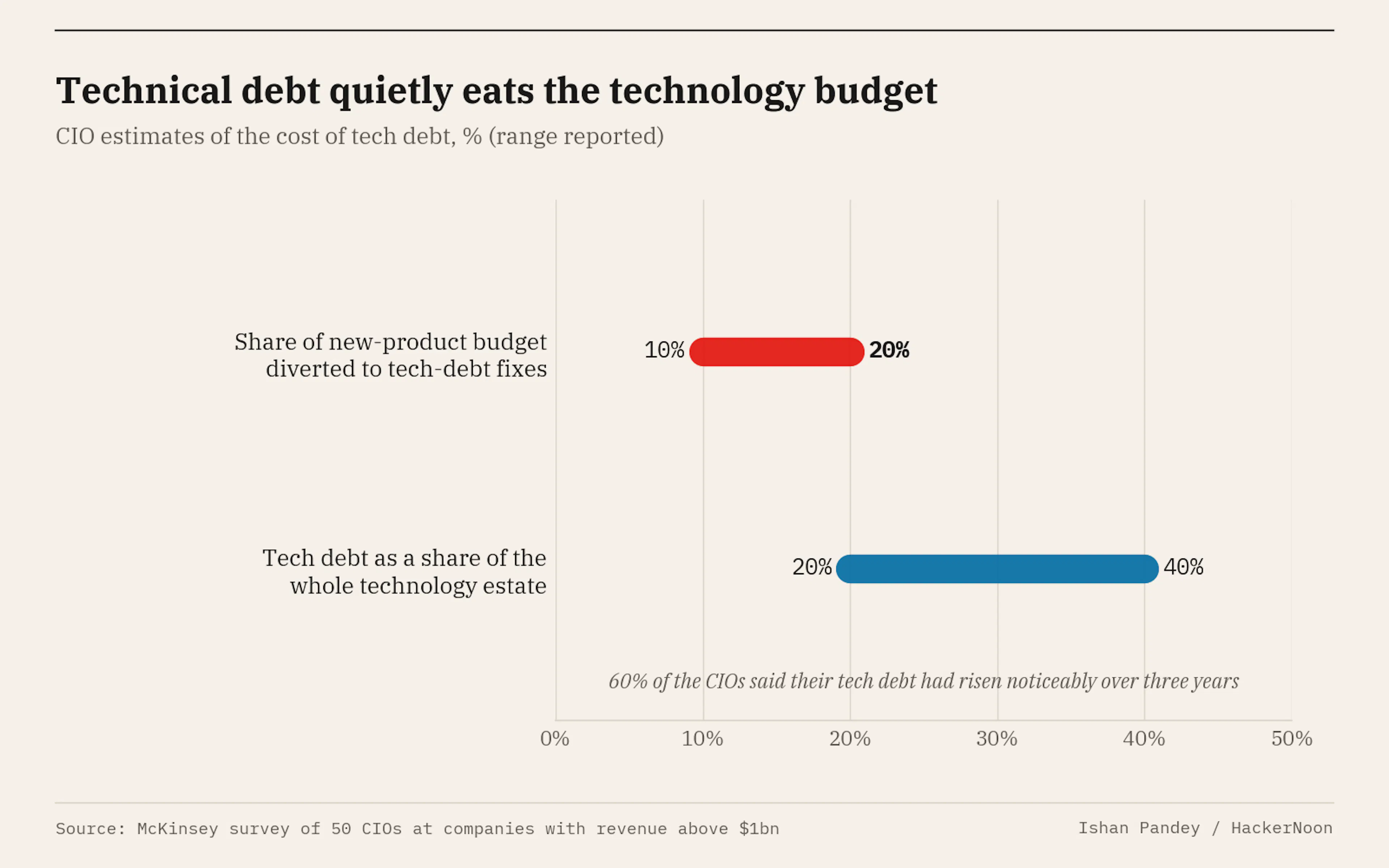 CIO estimates of the cost of technical debt
CIOs estimated that tech debt equals 20% to 40% of their technology estate and absorbs 10% to 20% of new-product budgets. Source: McKinsey survey of 50 CIOs at financial-services and technology companies with revenue above $1 billion.
Dodge AI's founders see the undocumented fix as the root of this problem, because when the knowledge of how a system really works lives across old tickets, departed consultants and configuration layers, every new incident has to be solved almost from scratch.
How Dodge AI Works
Dodge AI's platform connects to the systems where enterprise knowledge is scattered, including ERP platforms such as SAP S/4HANA, SAP ECC, Oracle Fusion and Microsoft Dynamics, planning and data tools such as Kinaxis, Snowflake and Databricks, plus the ticketing and collaboration tools where problems get reported, from ServiceNow and Jira to Slack, SAP Cloud ALM, Signavio and Celonis. According to the company's website, the work then runs in four stages, starting with unifying that scattered context and analysing root causes across business processes and customisations. The platform then resolves repetitive issues and routine first- and second-level tickets before turning larger change requests into implementation-ready code for SAP's own development formats.
Underneath sits what the company calls an exception intelligence context graph, which is a running map of the rules that make each enterprise different from the textbook version of its software. In practice that means capturing why one warehouse allocates inventory differently, why one pricing rule overrides another or why a background job only runs at night, knowledge that normally lives in someone's head until that person leaves. Every incident Dodge AI resolves adds to that map, which is how the platform turns maintenance work into documentation and makes the next fix faster, while the company holds SOC 2 Type II certification and GDPR compliance for customers who need both.
Customer Deployments
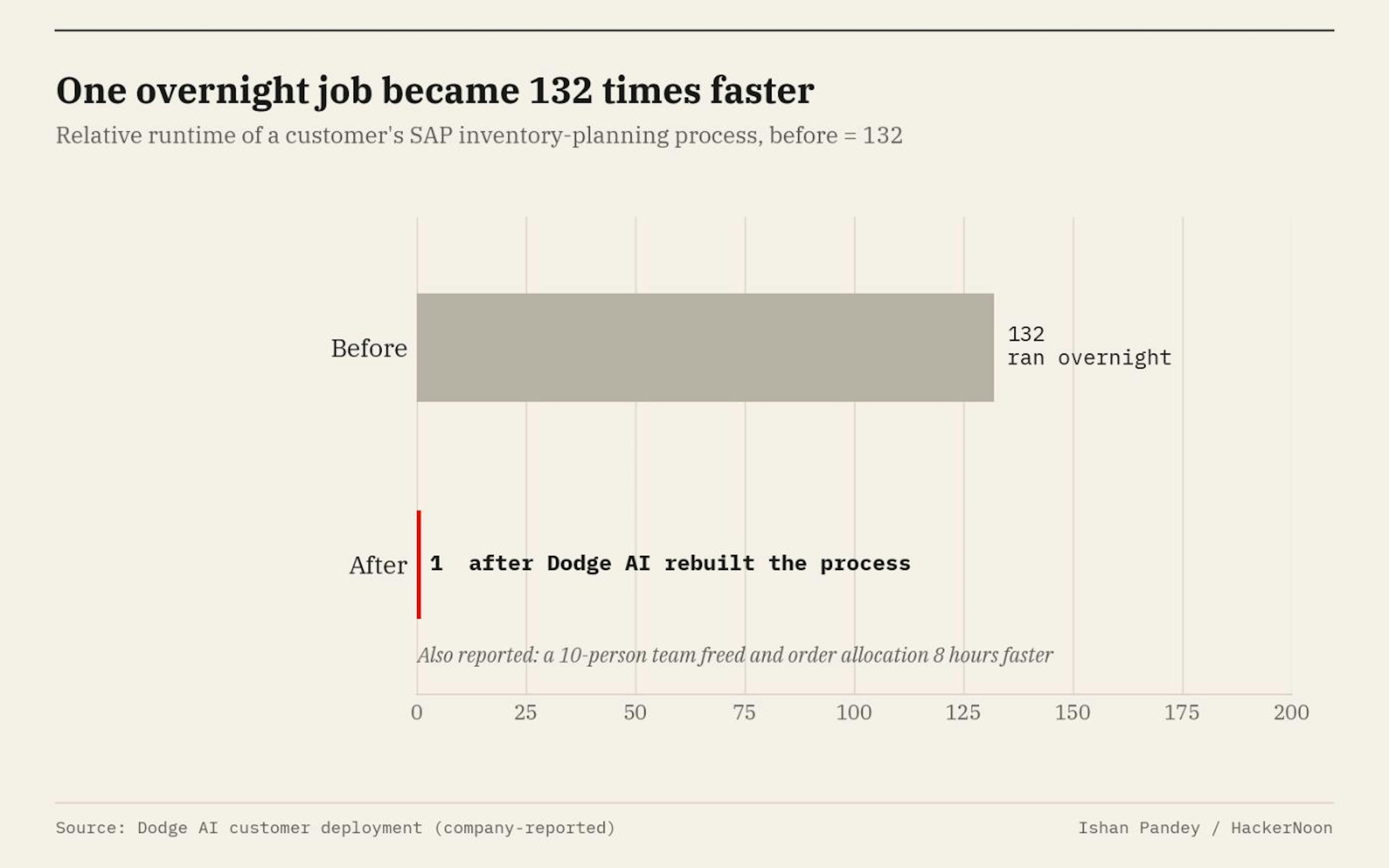
The results so far come from the kind of problems that usually consume a support team's week. In the warehouse case, Dodge AI followed the faulty Goods Receipt Note across SAP, Kinaxis and the customer's internal warehouse software and produced a fix within minutes. Another customer had been running its inventory-planning process overnight because SAP kept crashing when it ran in the morning. After Dodge AI modernised the process it ran 132 times faster, freed the team of 10 people who had been maintaining it and cut order allocation time by eight hours.
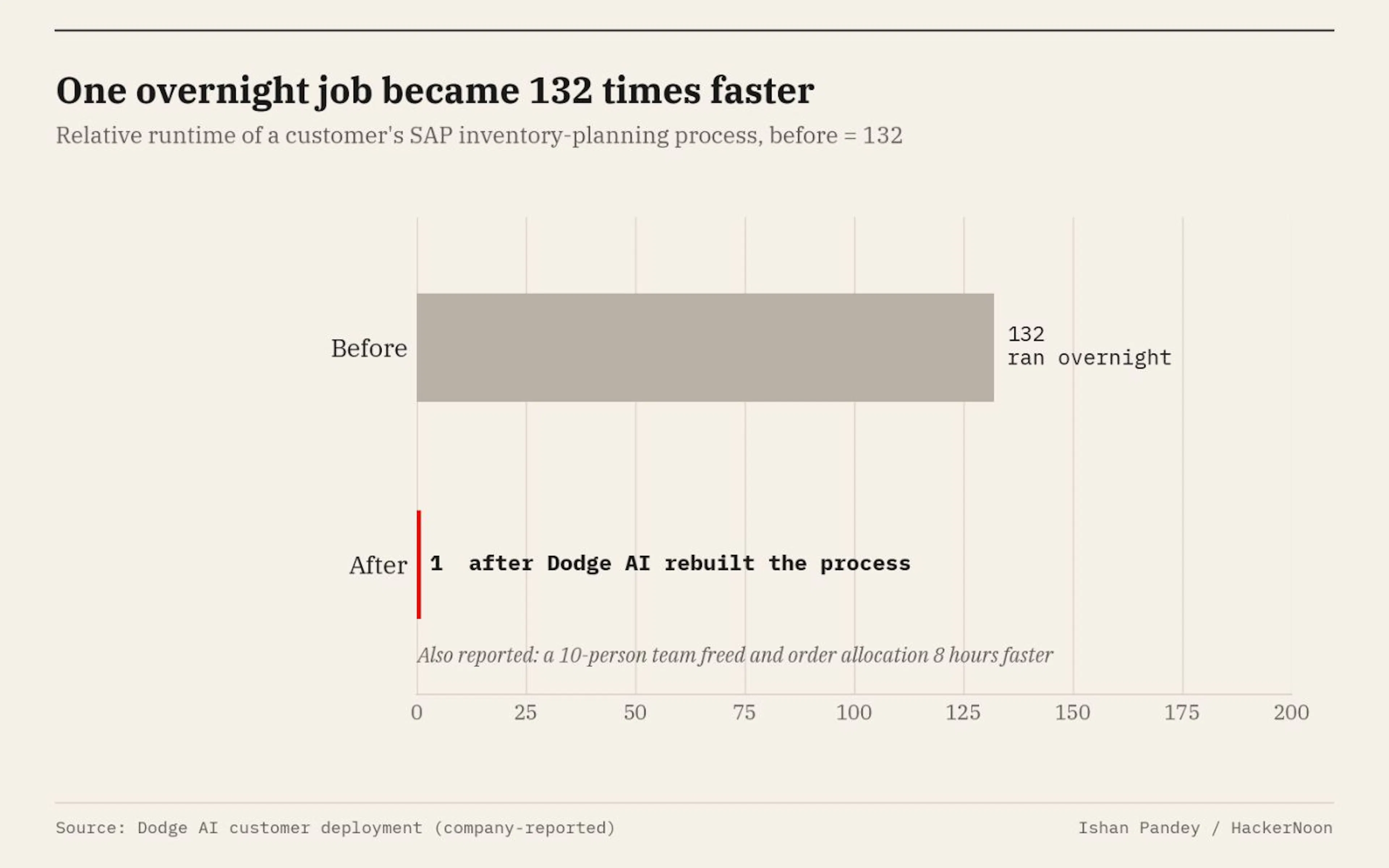 Relative runtime of a customer's SAP inventory-planning process
A customer's SAP inventory-planning job became 132 times faster after Dodge AI rebuilt the process, which also freed a 10-person team and sped up order allocation by eight hours. Source: Dodge AI, company-reported customer result.
The company's website lists further results across its customer base, including a Fortune 500 consumer goods brand that eliminated IDoc failures, the data-transfer errors that break the flow of documents between SAP and other systems before redeploying more than 12 team members, as well as a global skincare brand that cut its ticket volume by 25% once root causes were fixed. Across customers, Dodge AI reports removing about 7,000 tickets a quarter and eliminating 26,000 hours of application management work, while its platform now fields hundreds of queries every hour across stacks that include SAP, Kinaxis and Microsoft Dynamics.
Founder Thesis
Dodge AI was founded by chief executive Rebhav Bharadwaj and chief technology officer Aditya Thakur, who met at BITS Pilani, together with chief operating officer Aditya Patil. Bharadwaj saw the problem from inside the industry, having worked at his mother's enterprise systems integration consultancy where he grew frustrated by how long simple IT changes took, according to Forbes, before building browser agents for consumer brands and turning that experience toward the enterprise systems he knew best.
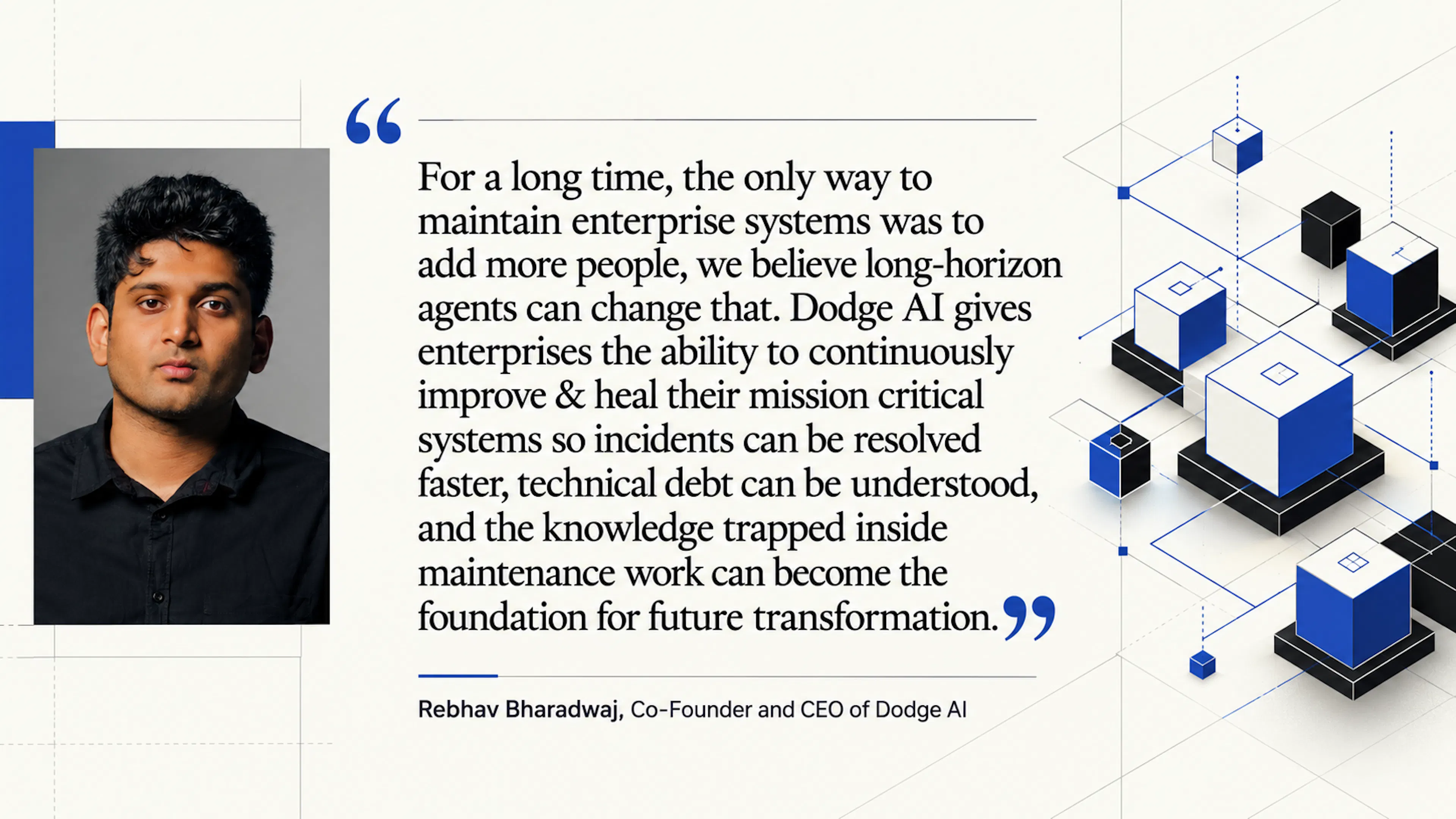
The founders' thesis starts from a simple observation, which is that the only way enterprises have known to maintain these systems is to add more people, while long-running AI agents can now do much of that work continuously. Bharadwaj describes the goal as giving enterprises the ability to keep improving and healing their mission-critical systems, so incidents are resolved faster, technical debt becomes visible and the knowledge trapped inside maintenance work becomes the foundation for future transformation. Thakur's view is that frontier AI models are already highly capable but still need the rules and exceptions of each business before they can be trusted inside it, which is exactly the context Dodge AI collects while it fixes today's problems. Patil adds that customers usually feel the maintenance burden lift within days of starting, which frees their teams to focus on the bigger modernisation picture.
Investor Thesis
Accel's case rests on the size and age of the category, which Swaroop describes as one of the largest and least modernised in all of enterprise technology. In his view Dodge AI is taking on the work that keeps the world's most important systems running every day while building the context layer that enterprises will need before AI agents can safely operate in production.
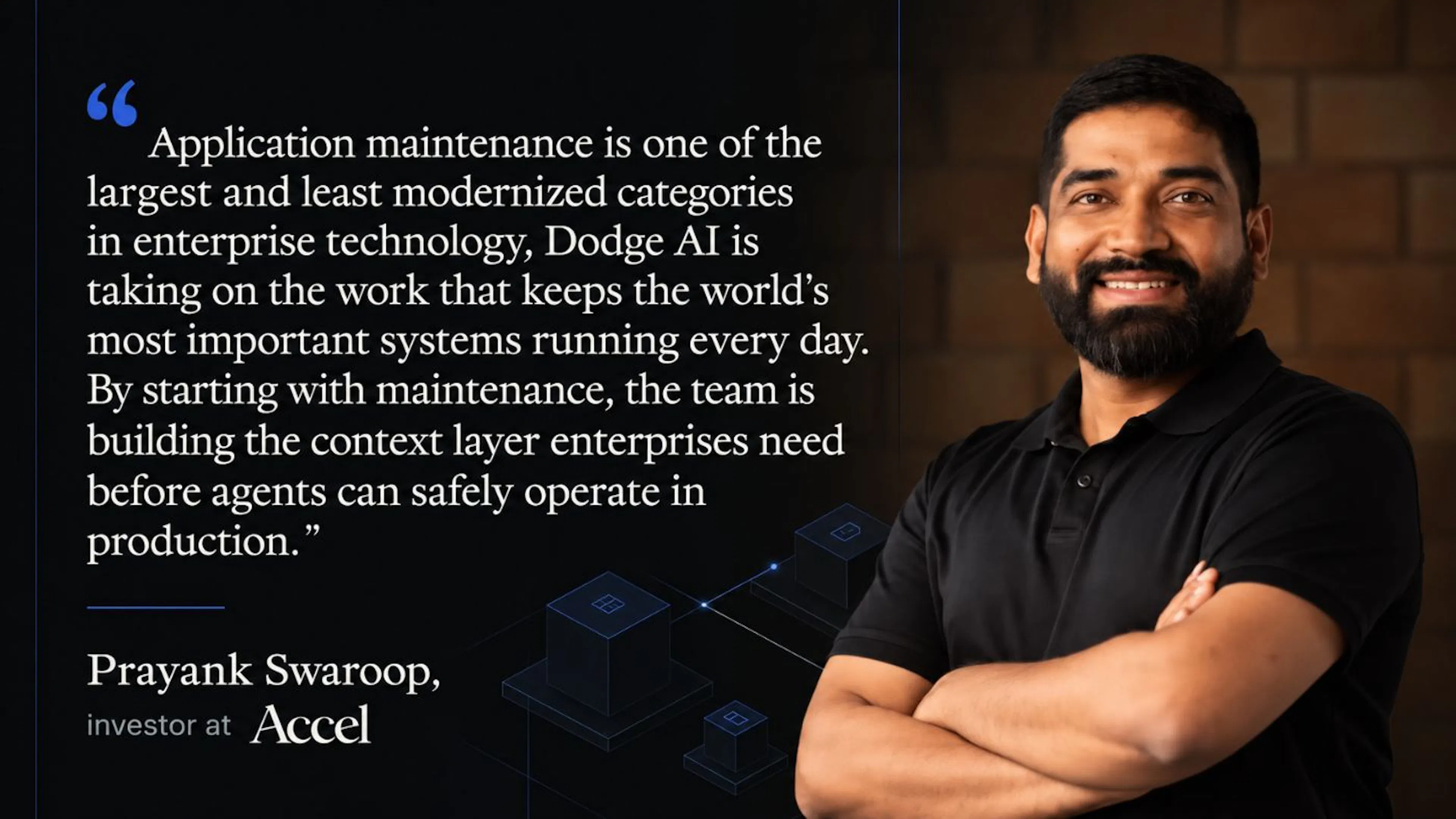
The logic follows a pattern Accel has backed before, since Swaroop's portfolio includes companies such as ProjectDiscovery and Doctor Droid that apply automation to the operational work engineering teams struggle to staff.
The timing matches where enterprise software is heading, because Gartner expects 40% of enterprise applications to include task-specific AI agents by the end of 2026, up from less than 5% in 2025, adding that agentic AI could account for about 30% of enterprise application software revenue by 2035, more than $450 billion in its best-case scenario.
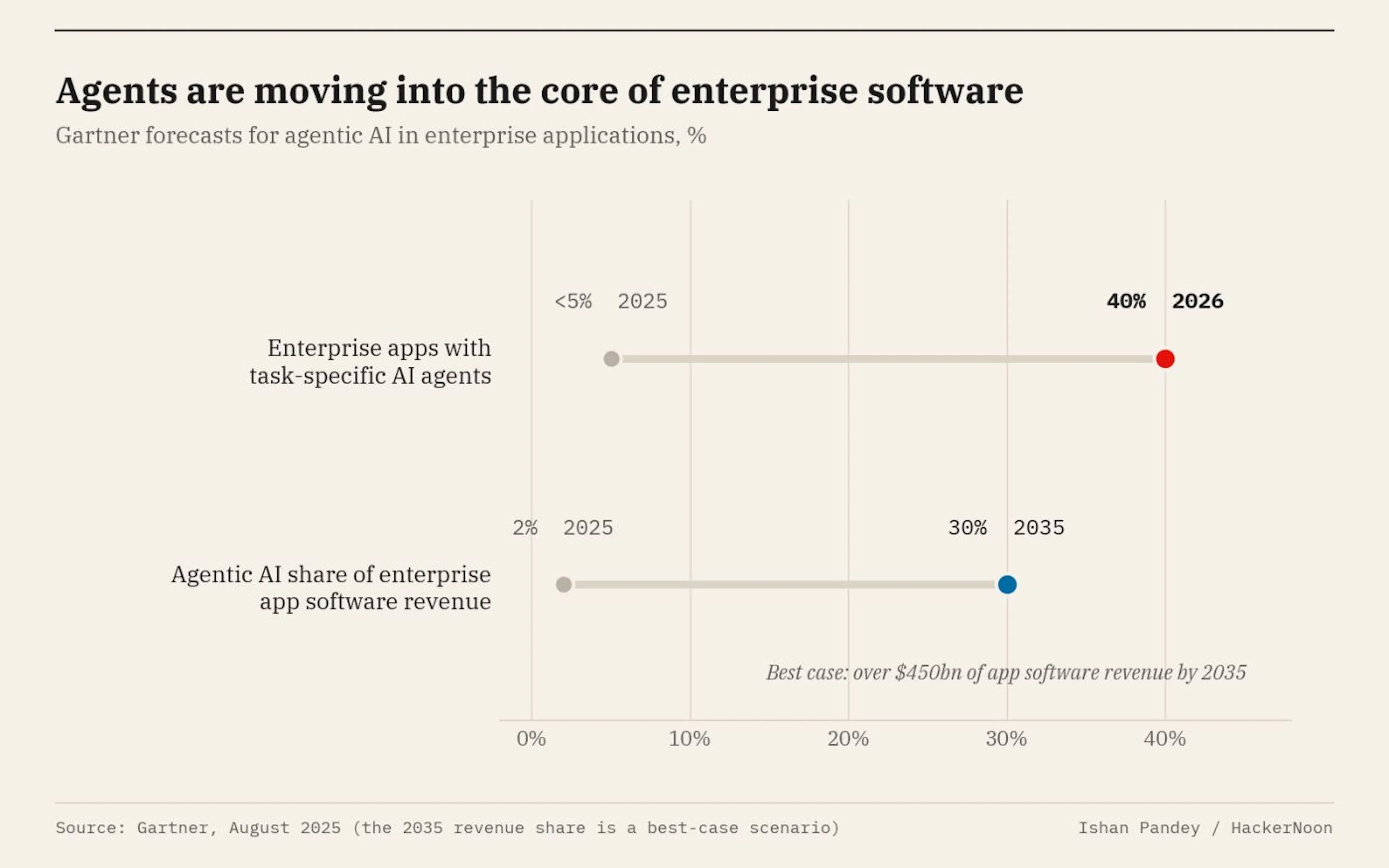 Gartner forecasts for agentic AI in enterprise applications. Gartner expects the share of enterprise apps with task-specific AI agents to rise from under 5% to 40% in a single year, with agentic AI reaching about 30% of enterprise app software revenue by 2035 in its best case. Source: Gartner, August 2025.
Those agents will need to understand the exceptions inside each company's systems before they can act on them safely, which is why a company that learns those exceptions through everyday maintenance is well placed as the market moves from assistants to agents.
Maintenance as the Path to Modernisation
Dodge AI treats maintenance as the entry point to a much larger change in how enterprise IT works. CIOs want to modernise, yet they cannot risk breaking systems that already run the business, while their budgets are consumed by the daily incidents that those same systems produce, so every hour an agent takes off the support queue is an hour a team can spend on the migration or redesign it has been postponing. The same exception intelligence that resolves an incident today is what will let production agents operate safely inside those systems tomorrow, which is how the company connects its first product to its long-term ambition of becoming the operating manual for the agents that run enterprise IT.
Enterprise software will keep growing more customised as businesses change, while tens of thousands of companies will run legacy platforms through the end of the decade while they plan their next move, so the demand for faster, cheaper and better-documented maintenance is only going to rise. With $2.65 million from Accel and Google's AI Futures Fund, a place in Accel's selective Atoms cohort and measurable results at more than a dozen enterprises already on record, Dodge AI starts that journey from the one place every large company has in common, which is a queue of tickets that its systems of record keep producing and a growing need for software that can fix them on its own.
Don’t forget to like and share the story!
Vested Interest Disclosure: HackerNoon has reviewed the report for quality, but the claims herein belong to the author. #DYOR.
如有侵权请联系:admin#unsafe.sh