AIX Global’s quantum-computing claim and the earlier Six Birds Theory program started from opposite 2026-9-29 14:38:29 Author: hackernoon.com(查看原文) 阅读量:2 收藏
AIX Global’s quantum-computing claim and the earlier Six Birds Theory program started from opposite ends. They may have met at the same architecture: richer computation, compact certificate, ordinary proof.
The most interesting part of a paper claiming to solve all six remaining Clay Millennium Problems with a quantum computer is not the quantum computer. It is the word “six.”
When researchers say that the Riemann Hypothesis, Yang–Mills, Navier–Stokes, the Hodge Conjecture, Birch–Swinnerton–Dyer, and P versus NP all yield to one repeated pipeline, a deeper question appears:
What could six problems from six mathematical worlds possibly have in common?
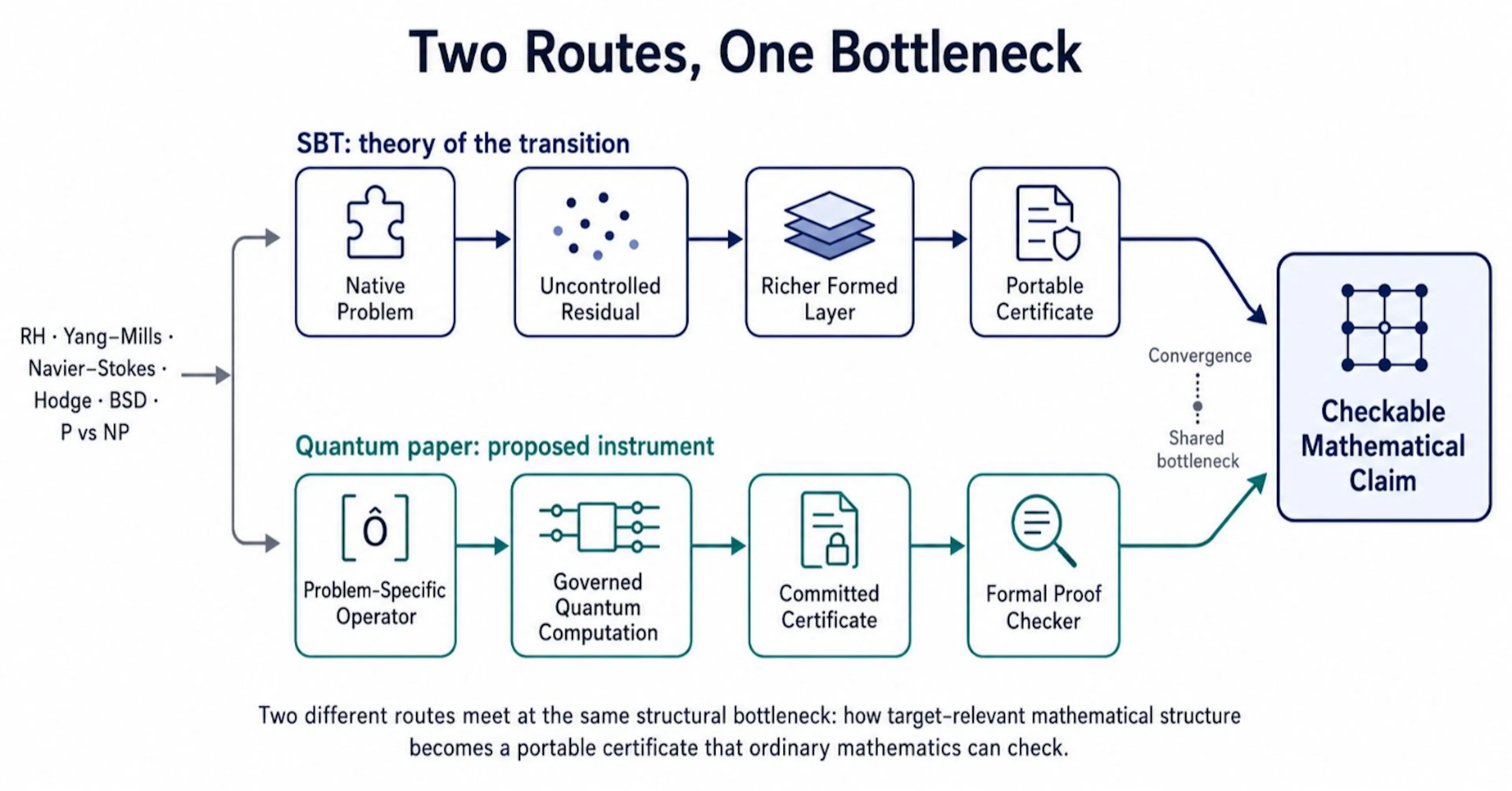
AIX Global’s Denise Holt and Denis Ovseyenko answer that question in “Demonstrating Quantum Value by Solving the Six Remaining Clay Millennium Problems.” Their paper reports a common workflow: identify a problem-specific operator or invariant, run governed spectral computation on IBM Heron hardware, commit a certificate at a fixed point, and pass that certificate into Lean 4 for formal verification.
The paper reports 27 Lean theorems, 10 hours and 24 minutes of QPU time, and about $59,900 in hardware cost. Those are the authors’ claims and require the scrutiny that any proposed Millennium solution would demand. Yet even before the verdict on the six proofs, the architecture is worth examining.
More than two months earlier, another research program had arrived at a related structural thesis from the opposite direction. My June 17 paper, “One Meta-Theory, Three Clay-Problem Closures,” compared Six Birds Theory treatments of Navier–Stokes, the Riemann Hypothesis, and P versus NP. It did not claim one equation solved the three, and its conclusions are explicitly conditional under SBT’s closure assumptions. It argued that the problems share a grammar of target, representation, unresolved obstruction, imported content, bridge, and audit.
One team started with a general theory of emergence and moved toward hard problems. The other says it started with the problems separately and discovered one computational pipeline.
They do not offer the same proof. They appear to have found the same kind of bottleneck.
The Bottleneck, in Software Terms
For a software reader, the closest analogy is an API boundary.
A system exposes some objects, operations, logs, and queries. You can optimize endlessly inside that interface, but you cannot recover a distinction the interface never exposes. If two underlying states produce the same record while requiring different outputs, no post-processing of that record can separate them. You need a new sensor, a richer representation, or a theorem proving the missing distinction irrelevant.
Six Birds Theory treats a mathematical layer similarly. A layer has a vocabulary, admissible operations, observables, completion rules, and an audit. Once work inside it is saturated, repeating the same kind of completion is not automatically a new source of reach. A strict extension changes what the system can represent, distinguish, or lawfully use.
The central issue is not “more data.” It is target-relative adequacy.
The SBT paper “Adequacy Residuals and Blind-Spot Currency” defines a positive residual measuring the part of a target-facing readout not explained by the probes already available in a carrier. Adding a relevant probe can shrink the residual. Adding redundant information cannot.
This captures a familiar engineering failure. A service may emit terabytes of telemetry while omitting the correlation ID needed to reconstruct one transaction. The observable interface is inadequate for the target question.
Hard mathematics can exhibit an analogous structure. The object may be fully defined, yet the representation used by a proof attempt may not expose the invariant needed to control every case.
Why Quantum Could Be an Instrument, Not Just an Accelerator
The weakest popular explanation of quantum computing is that a quantum machine “tries all answers at once.” That slogan is misleading and does not explain why a theorem would emerge.
The stronger possibility is structural.
A quantum processor instantiates a different operational layer: different states, observables, dynamics, and encodings of global relationships. It does not need to print an exponentially large state vector. It needs to expose a target-relevant invariant the receiving mathematical layer can use.
That is how the AIX proposal is organized. Its private layer is the governed quantum computation. Its public layer is the certificate that enters Lean. In principle, the classical verifier does not reproduce the physical search; it checks whether the exported object is sufficient for the theorem.
This resembles certificate-producing computation. A SAT solver can perform a difficult search and emit a proof trace that a smaller checker validates. The discovery path may be expensive or difficult to replay while the warrant is compact and public.
SBT’s “Why Mathematics Even Works” studies a more general version of this asymmetry. A richer supporting structure may not descend into the original theory in full, while a consequence formed with its help does. The receiving layer gets the boundary result, not a reconstruction of everything that produced it.
The machine does not need to bring the whole hidden structure back. It needs to bring back the part that makes the theorem follow.
One Grammar Does Not Mean One Formula
The six Clay problems are not secretly identical.
The Riemann Hypothesis asks for confinement of every nontrivial zero to the critical line. Yang–Mills asks for a rigorously constructed theory with a positive mass gap. Navier–Stokes asks whether smooth initial data can develop a finite-time singularity. Hodge compares topological and algebraic descriptions. BSD compares arithmetic rank with analytic order of vanishing. P versus NP asks whether efficient verification and efficient solution coincide.
Even the AIX paper uses different decisive objects: a spectrum, a gap, a depletion integral, a defect operator, a rank equality, and a proof-size lower bound with a transfer bridge.
So the commonality is not one number. It is one passage:
Native problem → richer operational structure → target-strength invariant → portable certificate → checked conclusion
SBT adds another layer of discipline. It asks whether the native representation was actually inadequate, whether the extension adds a relevant distinction, whether the invariant controls the entire target, and whether the bridge preserves enough structure to justify the final claim.
“Computed something spectral” is not enough. An exact eigenpair may tell you one fact about one state while the theorem requires completeness over an operator, a family, a continuum limit, or all inputs. A stable fixed point can be the wrong fixed point. A proof assistant can verify a term while the formalization still misses a condition from the intended theorem.
Formal verification is powerful, but it does not eliminate the interface problem. It moves scrutiny to the statement, certificate, and bridge.
There is one place where the comparison becomes more than philosophy.
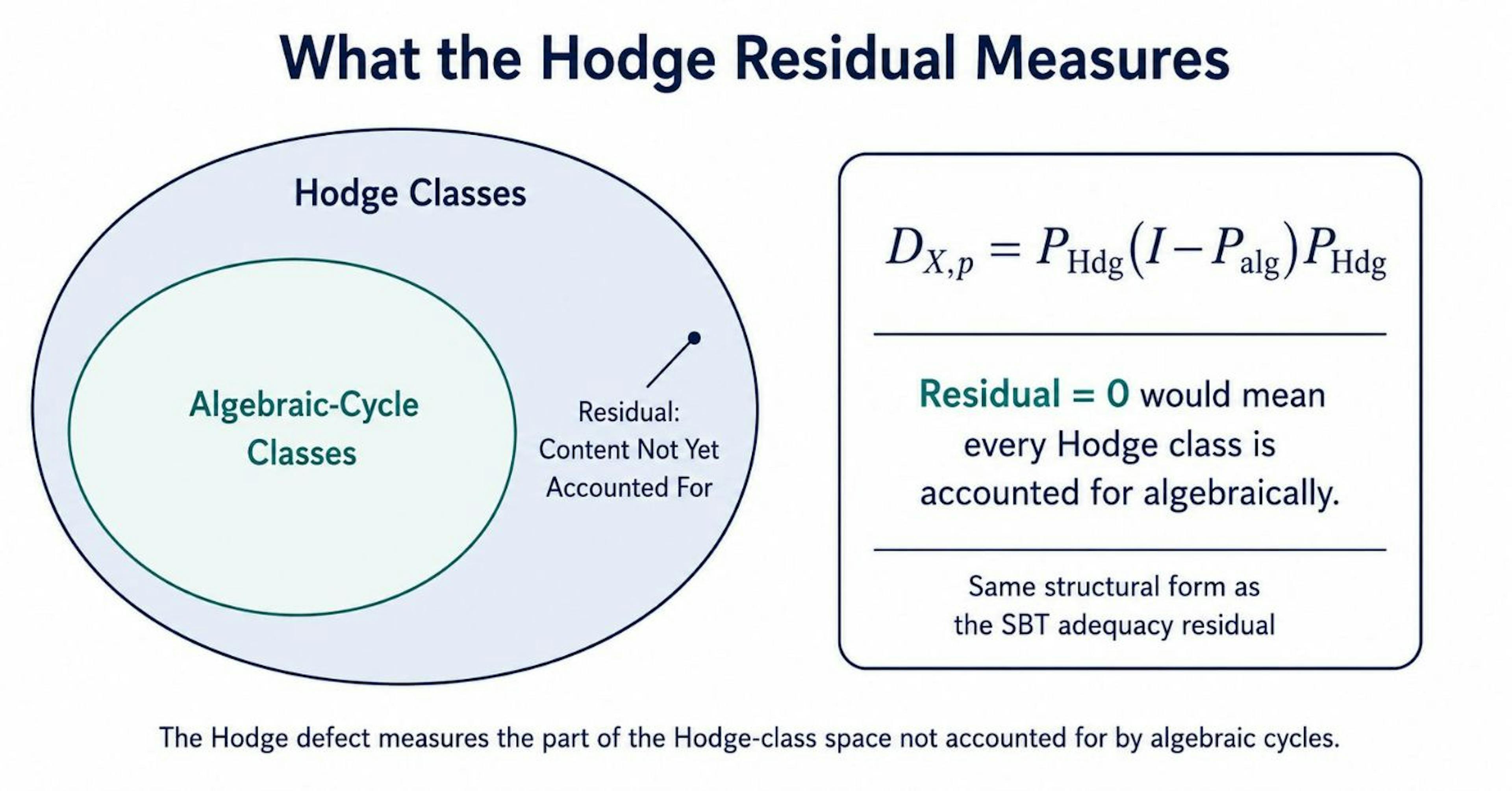
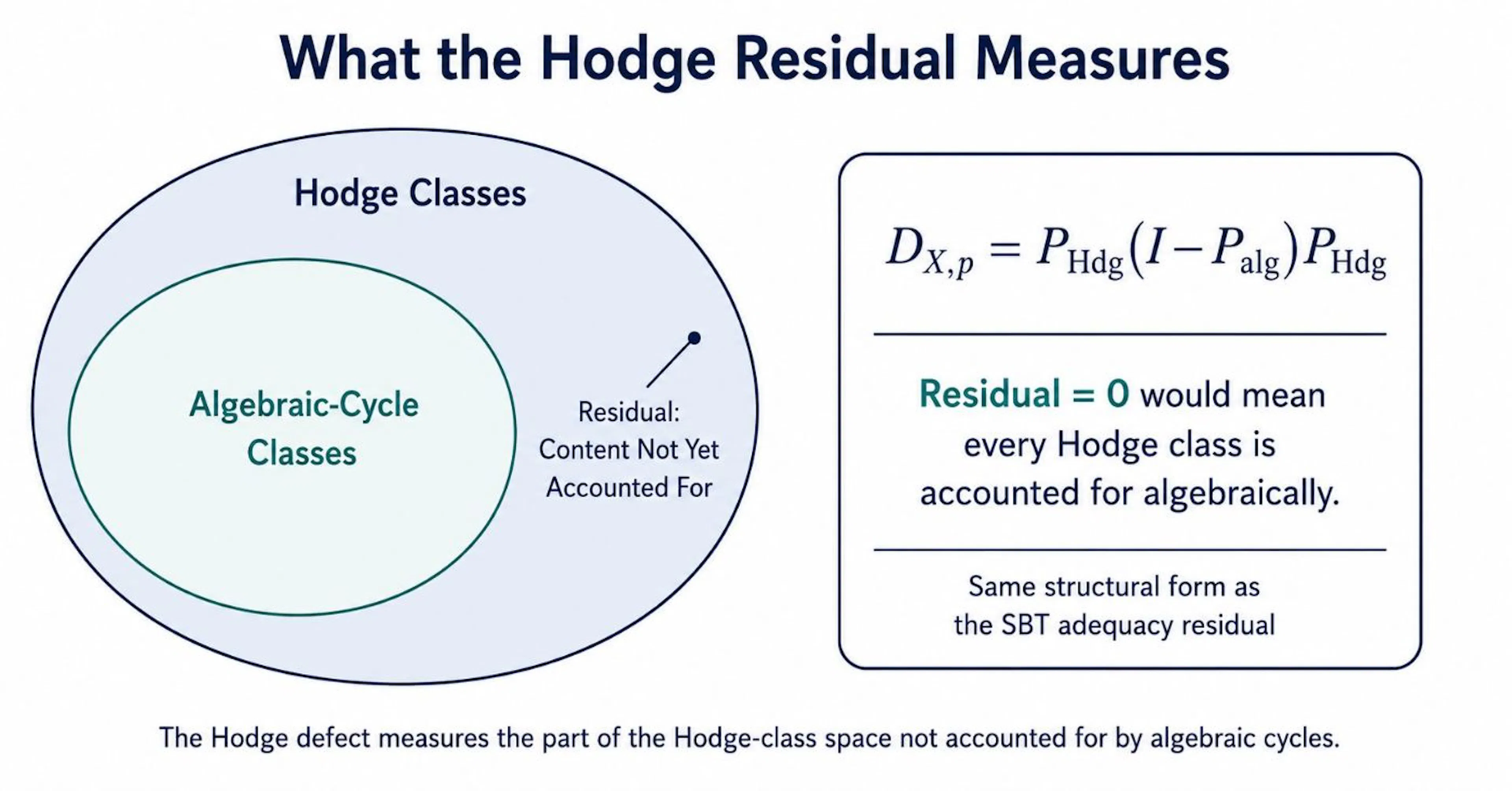
In its treatment of the Hodge Conjecture, the AIX paper introduces a mathematical object designed to measure the gap between two descriptions of the same underlying cohomological content: the space of Hodge classes and the part of that space accounted for by algebraic cycles.
In plain language, the construction asks: after we account for everything the algebraic description can explain, is there anything left over?
That “leftover” is the Hodge defect. If nothing remains, then the two descriptions coincide in the precise sense required by the conjecture.
This is closely aligned with the role of an adequacy residual in Six Birds Theory. In the earlier SBT paper “Adequacy Residuals and Blind-Spot Currency,” a residual measures the part of a target-facing structure that is not explained by the probes or descriptions already available in a given layer.
The important point is not that both papers happen to use projection operators. That mathematics is classical. The deeper connection is functional: in both cases, the object is built to measure what one representation fails to account for in another.
So the Hodge construction in the quantum paper occupies exactly the structural role SBT assigns to an adequacy residual.
That does not show that AIX used SBT, and it does not by itself prove that the Hodge defect vanishes universally. But it gives a concrete mathematical example of the broader convergence: both programs isolate the unresolved part of a problem as a measurable remainder, then ask what richer structure is needed to eliminate or control it.
Why “Governed” May Matter as Much as “Quantum”
AIX calls its method Governed Fault-Tolerant Quantum Computation. Whether its claims hold is a question for independent reviewers, but “governed” points to a real issue.
A long computation is not trustworthy merely because it returns a stable value. The operator must remain the intended operator. The state must stay in the admissible sector. Intermediate steps must compose lawfully. The final output must carry the property the proof consumes.
In distributed-systems language, the data plane is not enough; the control plane determines whether the operation remains valid end to end.
SBT’s “Audited Operational Realisability” studies this kind of closure-completion problem for carriers with audit data. Its concern is whether sources, transformations, residuals, status claims, and nonclaims remain accounted for throughout the route.
That does not prove AIX’s governance stack satisfies SBT. It explains why governance cannot be decorative. If the computation is the promoted layer supplying missing access, maintaining its admissibility is part of the handoff.
What the Convergence Does — and Does Not — Establish
The public chronology is straightforward. “One Meta-Theory, Three Clay-Problem Closures” and the SBT adequacy work were public on June 17, 2026. The AIX paper is dated August 30, and Holt’s public essay “What Else Have We Computed? The Six Remaining Millennium Prize Problems” appeared on August 31.
The record shows different starting points, different methods, and an earlier public SBT structural treatment. It does not establish what either team had read, and it does not show one program was derived from the other.
The convergence also does not establish that all six problems are solved, that a quantum computer is necessary, or that every hard problem has a spectral solution.
What it establishes is a serious research question: can multiple hard problems share a structural failure mode even when their mathematics is unrelated?
The SBT answer is yes, in a typed and conditional sense. Different substrates can share a pattern in which a native carrier leaves a target-relevant residual, a richer layer exposes or constrains it, and a boundary object carries the result back.
The AIX paper makes the bolder operational claim: that governed quantum computation performed this transition for all six remaining Clay problems.
Why Developers Should Care
This architecture extends beyond pure mathematics.
AI agents perform long, opaque searches and return outputs that are difficult to trust. Scientific workflows combine simulation, learned models, and symbolic reasoning. Distributed systems make decisions across layers with different observability. In every case, “the system produced an answer” is weaker than “the system produced a portable artifact that independently warrants the answer.”
The design principle is simple:
Do not demand that the receiving layer reproduce the entire discovery process. Demand that the discovery layer export the smallest sufficient certificate, together with an auditable bridge to the target claim.
The most interesting proposition is not that all hard problems are quantum. It is that the route by which a consequence becomes accessible can be structurally different from the form in which that consequence is ultimately proved.
Disclosure: I developed Six Birds Theory and lead Automorph Inc. This article presents a structural comparison. It is not an independent verification of the AIX paper’s six proof claims.
This article was published under HackerNoon's Business Blogging program.
如有侵权请联系:admin#unsafe.sh