For two decades, quality engineering (QE) rested on a comfortable assumption: given the same input, 2026-9-28 16:2:2 Author: hackernoon.com(查看原文) 阅读量:1 收藏
For two decades, quality engineering (QE) rested on a comfortable assumption: given the same input, a system produces the same output, and a test either passes or fails. Data pipelines, machine learning (ML) models, and large language models (LLMs) break that assumption at a fundamental level. As AI moves from experimental notebooks into production systems that make decisions, generate content, and act autonomously, quality engineers are being asked to validate systems that are inherently non-deterministic, statistically defined, and constantly drifting. This shift is not an extension of traditional QA — it is a distinct discipline that borrows from data engineering, statistics, and ML operations while keeping the QE mandate of building trust before release.
Why Traditional QA Breaks Down for AI Systems
Traditional software testing relies on deterministic assertions: a given input maps to one correct output, and deviation is a bug. AI systems invert this logic. The same prompt sent to an LLM twice can yield two valid but differently worded answers, and a classification model's "correctness" is a statistical property measured across a distribution of cases, not a single pass/fail check. Microsoft's LLM evaluation guidance explains that LLM evaluation is not straightforward and has no single unified measurement approach.
Quality engineers testing AI systems face several structural challenges that have no equivalent in conventional testing:
- Non-deterministic outputs mean identical inputs can produce different (yet equally acceptable) results, making classic pass/fail assertions unreliable.
- There is often no single "expected output" to assert against, only a range of acceptable answers judged on relevance, tone, factuality, and other use-case-specific criteria.
- Model behavior depends on training data quality and distribution, so bias and data drift become testing concerns, not just engineering ones.
- Models degrade silently over time as real-world data shifts away from training data, a phenomenon known as model or concept drifts.
- Traditional automation frameworks built around fixed UI locators or API contracts do not map cleanly onto probabilistic, natural-language outputs.
Industry commentary frames this reframing succinctly: QA is now frequently tasked with testing the AI itself, meaning the "system under test" is a probabilistic model rather than deterministic code. This requires QE teams to adopt statistical and semantic evaluation approaches rather than exact-match assertions.
An End-to-End View of the AI Quality Pipeline
 An End-to-End View of the AI Quality Pipeline
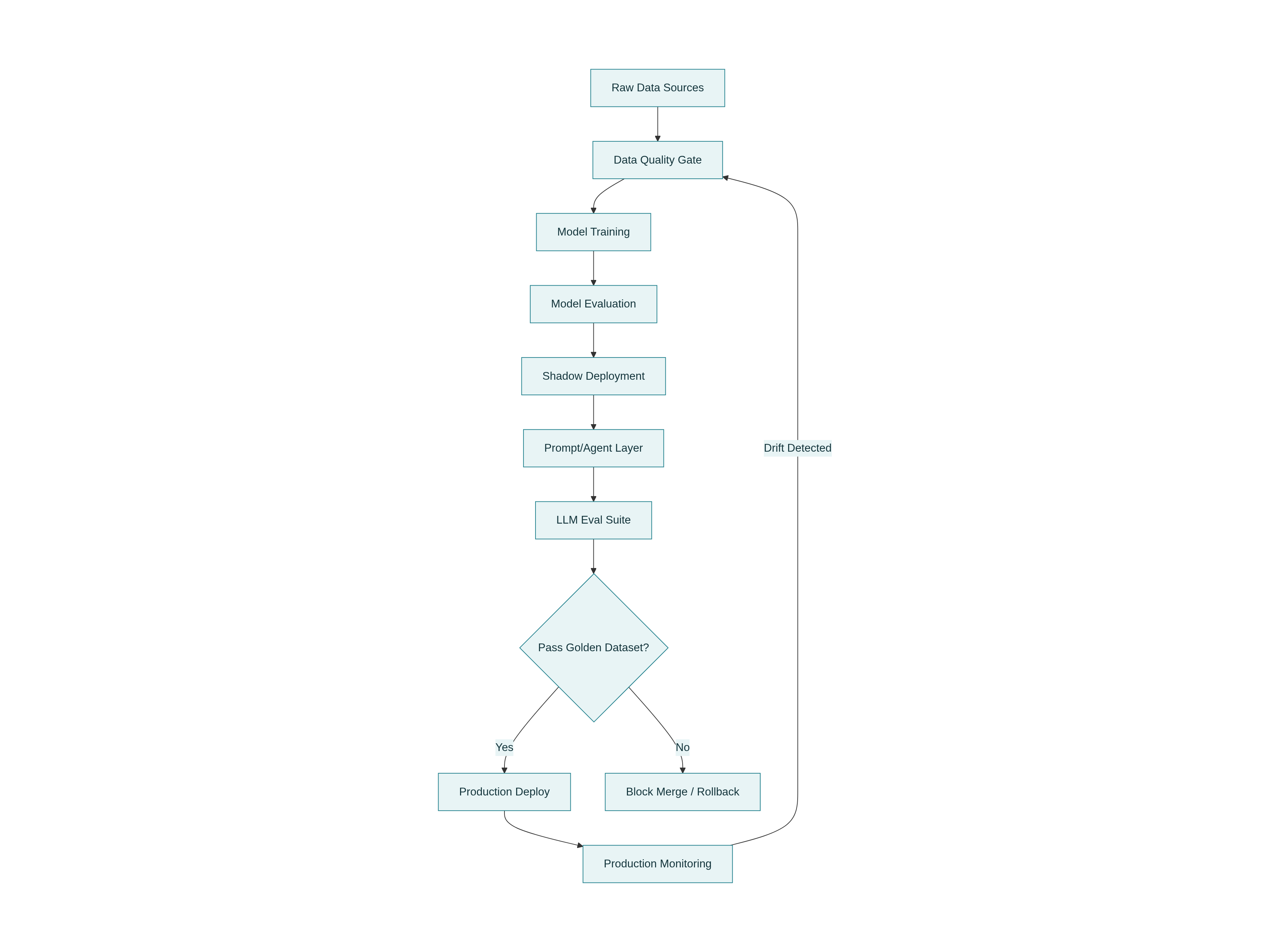
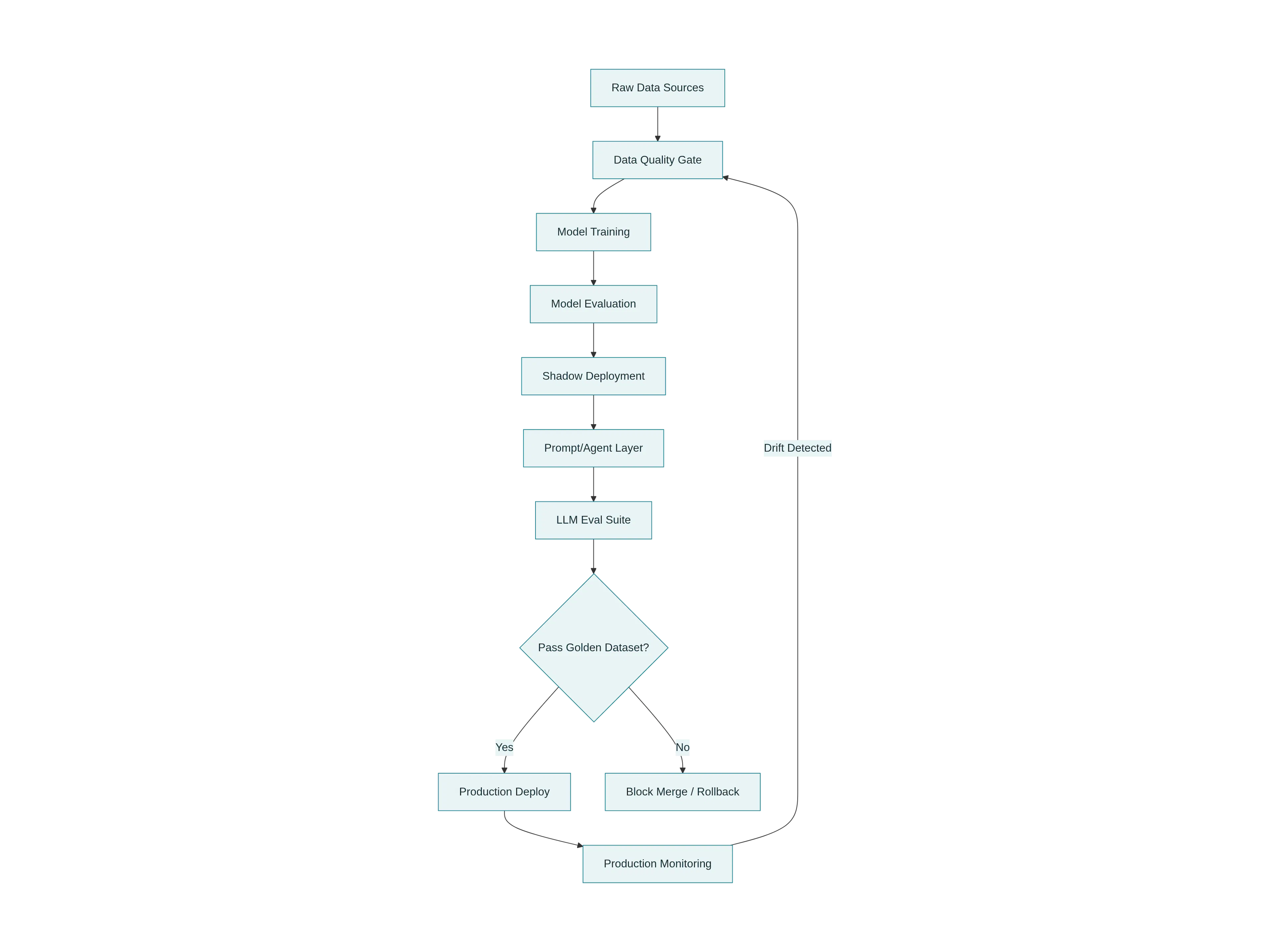
Before diving into each layer, it helps to see how data quality, model evaluation, prompt/agent testing, and production monitoring fit together as a single continuous loop rather than isolated checkpoints. The diagram below shows how a change at any stage — new training data, a modified prompt, or a detected drift signal in production — feeds back into the earliest quality gate rather than being treated as a one-time release event.
The critical design point in this loop is the feedback arrow from production monitoring back to the data quality gate. Unlike a conventional software release pipeline, an AI pipeline is never "done" after deployment —drift detected in production should automatically re-trigger data validation and, where needed, retraining and re-evaluation, closing the loop rather than waiting for the next scheduled release cycle.
The Three Layers of AI Quality: Data, Model, and Prompt/Agent
A useful mental model for quality engineers entering this space is to separate AI quality into three interdependent layers, each with its own testing discipline: the data layer, the model layer, and the prompt/agent (LLM application) layer.
|
Layer |
What is tested |
Representative techniques |
|---|---|---|
|
Data |
Schema, completeness, distribution, bias in training and input data |
Expectation-based validation, profiling, anomaly detection |
|
Model |
Accuracy, robustness, fairness, generalization of the trained model |
Train/validation splits, cross-validation, holdout testing, A/B testing, shadow deployment, perturbation testing. |
|
Prompt/Agent |
Output quality, faithfulness, safety, and behavior of the deployed LLM application or agent |
LLM-as-judge scoring, RAG triad metrics, regression suites, agentic end-to-end testing. |
Data Quality: The Foundation Layer
Every AI failure traced back far enough is usually a data problem. Quality engineers increasingly own or co-own data quality gates, using frameworks such as Great Expectations to define declarative "expectations" — assertions about schema, null rates, value ranges, and distributional properties that data must satisfy before it moves downstream. A typical pattern separates pipeline stages into write, audit, and publish steps, running data quality checks in the audit stage and only promoting data to consumer-facing tables once it passes validation. This "shift-left" approach to data prevents garbage-in-garbage-out failures from ever reaching a trained model, and it mirrors how QE has long advocated testing early in the software development lifecycle. Databricks' own guidance similarly emphasizes expectation-based validation and reusable test suites as the backbone of platform-independent data quality frameworks.
Mocking data sources for integration tests, building unit tests for ingestion logic, and treating data pipelines with the same testing rigor as application code are increasingly standard QE practices for ML-adjacent teams. In practice, this often looks like a lightweight, declarative expectation suite that runs as part of a scheduled or event-triggered pipeline job:
import great_expectations as gx

context = gx.get_context()
validator = context.sources.pandas_default.read_csv("customer_features.csv")

validator.expect_column_values_to_not_be_null("customer_id")
validator.expect_column_values_to_be_between("age", min_value=18, max_value=100)
validator.expect_column_values_to_be_in_set(
    "account_status", ["active", "suspended", "closed"]
)
validator.expect_column_proportion_of_unique_values_to_be_between(
    "customer_id", min_value=0.99, max_value=1.0
)

results = validator.validate()
if not results["success"]:
    raise ValueError("Data quality gate failed — halting pipeline before model training")
This snippet illustrates the core QE mindset shift: instead of writing assertions about application behavior, the quality engineer writes assertions about the data feeding the model, and fails the pipeline just as they would fail a broken build.
Model Testing: Beyond Accuracy Scores
Testing a trained model is not simply checking a single accuracy number against a threshold. Practitioners describe a layered evaluation strategy that includes training/validation splits, k-fold cross-validation to detect overfitting, holdout testing on unseen data, and A/B testing to compare candidate models against production baselines. Two techniques deserve particular attention from quality engineers:
- Shadow deployment (online testing) runs a candidate model in parallel with the production model on live traffic without affecting user-facing results, allowing teams to compare real-world performance before cutover.
- Perturbation testing validates model stability by introducing small, controlled changes — noise, missing values, adversarial edits — to input data and checking whether outputs shift in a reasonable, bounded way.
Fairness and bias testing sit alongside these techniques as first-class concerns, particularly for models influencing decisions in credit, hiring, or healthcare, where explainability of a model's basis for output is itself a testable property. Community discussion among testers converges on a related point: QA of ML models overlaps heavily with how data science teams already run verification, and the QE contribution is often to harden that process with edge cases, corner-case data, and variance tracking across repeated runs.
A simple perturbation test that a QE engineer can add to a model's test suite looks like this:
import numpy as np

def test_model_stability_under_noise(model, X_test, noise_level=0.01, tolerance=0.05):
    baseline_preds = model.predict_proba(X_test)[:, 1]
    noise = np.random.normal(0, noise_level, X_test.shape)
    perturbed_preds = model.predict_proba(X_test + noise)[:, 1]

    max_shift = np.max(np.abs(baseline_preds - perturbed_preds))
    assert max_shift < tolerance, (
        f"Model output shifted by {max_shift:.3f} under small input noise, "
        f"exceeding tolerance of {tolerance} — possible robustness issue"
    )
This test does not check whether the model is "correct" — it checks whether the model is stable, which is often the more actionable quality signal for production ML systems.
LLM and Agent Testing: Evaluating Language, Not Just Logic
LLM-powered applications add another layer entirely, because the artifact under test is unstructured language rather than a numeric prediction. Evaluation frameworks generally combine several categories of metrics:
- Reference-based metrics such as BLEU and ROUGE compare generated text against a known-good reference using n-gram overlap.
- Reference-free and LLM-based evaluators use another model as a "judge" to score answer relevancy, task completion, and correctness against ground truth, without needing an exact reference string.
- One commonly used framework for evaluating retrieval-augmented generation systems is the ‘RAG triad’: context relevance, groundedness, and answer relevance.
- Robustness and safety checks probe whether outputs stay coherent and non-harmful under adversarial or edge-case prompts.
Confident AI's G-Eval guidance recommends a mix of one to two custom, use-case-specific metrics (often built with tools like G-Eval) alongside two to three generic system-level metrics tuned to whether the application is RAG-based, agentic, or conversational. This mirrors classic QE test-pyramid thinking — a small number of deeply tailored tests plus broader, reusable coverage — translated into a probabilistic context.
A layered evaluation strategy is explicitly recommended by practitioners: no single method suffices, so mature teams combine automated deterministic checks, LLM-as-judge evaluation, and targeted human review for nuanced or high-stakes cases. Test data curation matters as much as the metrics themselves; effective suites blend real user queries, synthetically generated edge cases, and adversarial examples deliberately designed to probe model limitations.
A minimal LLM-as-judge test case, structured the way a QE engineer would slot it into an existing pytest suite, looks like this:
def test_faithfulness_of_rag_response(rag_pipeline, judge_model):
    query = "What is our refund policy for digital products?"
    context, answer = rag_pipeline.query(query)

    judge_prompt = f"""
    Context: {context}
    Answer: {answer}

    On a scale of 0 to 1, score how faithfully the Answer reflects
    only information present in the Context. Respond with a number only.
    """
    faithfulness_score = float(judge_model.generate(judge_prompt).strip())

    assert faithfulness_score >= 0.8, (
        f"Faithfulness score {faithfulness_score} below threshold — "
        "response may include hallucinated content not grounded in retrieved context"
    )
This pattern generalizes across most LLM applications: replace the deterministic assert output == expected with a graded assertion backed by a judge model or semantic similarity score, and set a threshold based on acceptable risk rather than exact match.
Worked Example: A Refund-Policy Failure
The following illustrative example shows a complete evaluation cycle: a failure is detected, the underlying retrieval and prompt behavior is changed, and the full test set is rerun to verify the improvement. The example is deliberately small so the method is easy to reproduce; its figures are not presented as production benchmark results.
What the evaluation caught
Assume the approved digital-products policy states:
- An un-downloaded digital product is refundable within 14 days.
- A downloaded digital product is not refundable for change of mind.
- A defective digital product may be refunded even after download.
- A request outside 14 days is not refundable unless the defect exception applies.
A customer asks:
I downloaded the e-book yesterday, but I changed my mind. Can I get a refund?
The baseline RAG application answers:
Yes. Purchases made within 14 days are eligible for a refund.
The response is fluent and repeats a genuine policy rule, but it ignores the downloaded-product restriction. The evaluation flags the response because the eligibility decision is wrong and the answer is incomplete even though part of it is grounded in the retrieved text. Microsoft recommends evaluating RAG responses across dimensions including groundedness, completeness, relevance, and correctness.
The QE team turns the failure into a four-case regression set:
CASES = [
    {
        "id": "undownloaded_within_14_days",
        "facts": {"downloaded": False, "days": 2, "defective": False},
        "expected_eligible": True,
    },
    {
        "id": "downloaded_change_of_mind",
        "facts": {"downloaded": True, "days": 1, "defective": False},
        "expected_eligible": False,
    },
    {
        "id": "downloaded_but_defective",
        "facts": {"downloaded": True, "days": 20, "defective": True},
        "expected_eligible": True,
    },
    {
        "id": "undownloaded_after_14_days",
        "facts": {"downloaded": False, "days": 20, "defective": False},
        "expected_eligible": False,
    },
]

BASELINE_OUTPUTS = {
    "undownloaded_within_14_days": {"eligible": True},
    "downloaded_change_of_mind": {"eligible": True},   # incorrect
    "downloaded_but_defective": {"eligible": False},  # incorrect
    "undownloaded_after_14_days": {"eligible": False},
}


def evaluate(outputs):
    failures = []
    for case in CASES:
        actual = outputs[case["id"]]["eligible"]
        if actual != case["expected_eligible"]:
            failures.append({
                "case": case["id"],
                "expected": case["expected_eligible"],
                "actual": actual,
            })
    return failures


assert evaluate(BASELINE_OUTPUTS) == [
    {
        "case": "downloaded_change_of_mind",
        "expected": False,
        "actual": True,
    },
    {
        "case": "downloaded_but_defective",
        "expected": True,
        "actual": False,
    },
]
The evaluation catches two related failures rather than only the reported customer case: the model overlooks the downloaded-product restriction in one direction and the defect exception in the other.
What changed
Trace inspection shows that the first request retrieved only the general 14-day clause, while the second retrieved only the downloaded-product restriction. The team makes two changes:
- Retrieval expands from one chunk to the top three relevant policy chunks and retains policy-version and section metadata.
- The system prompt requires the model to evaluate the purchase window, download status, and defect exception before returning a structured decision.
Determine refund eligibility only from the retrieved policy.
Evaluate all three factors before answering:
1. days since purchase,
2. whether the product was downloaded,
3. whether the product is defective.

Return JSON with:
- eligible: boolean
- reason: concise explanation
- policy_sections: list of supporting section IDs

If retrieved sections conflict or a required factor is missing,
return eligible as null and request human review.
This change addresses the failure's cause rather than merely adding the original question as a special case.
How the improvement was verified
The revised pipeline returns these decisions:
pythonIMPROVED_OUTPUTS = {
    "undownloaded_within_14_days": {
        "eligible": True,
        "policy_sections": ["14-day-window"],
    },
    "downloaded_change_of_mind": {
        "eligible": False,
        "policy_sections": ["14-day-window", "downloaded-products"],
    },
    "downloaded_but_defective": {
        "eligible": True,
        "policy_sections": ["downloaded-products", "defect-exception"],
    },
    "undownloaded_after_14_days": {
        "eligible": False,
        "policy_sections": ["14-day-window"],
    },
}

assert evaluate(IMPROVED_OUTPUTS) == []
On this illustrative four-case set, deterministic eligibility accuracy moves from 2/4 to 4/4. Verification does not stop with the originally reported prompt: every policy combination is rerun to check for collateral regressions, and the supporting section IDs make source use inspectable.
Before a production rollout, the QE team would expand the dataset with real and adversarial queries, run repeated trials, inspect retrieval traces, compare explanation quality with human judgments, enforce latency and cost budgets, and use a shadow or canary deployment. OpenAI recommends continuous evaluation on every change and expanding evaluation datasets with newly discovered failures.
Building CI/CD Pipelines for Prompts and Models
Perhaps the most practical shift for quality engineers is learning to treat prompts, model versions, and agent configurations as first-class deployable artifacts that need the same regression discipline as application code. Modern "prompt CI/CD" pipelines apply familiar QE mechanics to a new artifact type:
- A developer opens a pull request modifying a prompt or agent configuration
- A CI job automatically triggers and runs the new configuration against a curated "golden dataset" of representative inputs
- The pipeline asserts on outputs using deterministic checks (format, required keywords, valid JSON), semantic checks (LLM-graded meaning alignment), and safety checks (harmful content, data leakage).
- Performance budgets for latency and token cost are evaluated, with violations blocking the merge just like a failed unit test.
- A reviewer compares evaluation results against the current production baseline before approving promotion.
- Production monitoring tracks inputs, outputs, latency, cost, and error rates per prompt version, enabling rollback if a regression surfaces post-deployment.
This is functionally identical to how QE has long gated code merges with automated test suites — the difference is that "assertions" now include semantic similarity scores and LLM-judged grades rather than only exact string matches. TestQuality's guidance on LLM regression pipelines reinforces this pattern, describing "continuous prompt regression" as a gatekeeper that automatically re-runs the full evaluation suite whenever system instructions, retrieval chunking strategies, or model versions change. Evaluation gold sets — curated input/output pairs serving as ground truth — function as the AI-era equivalent of a golden regression suite.
A simplified GitHub Actions job that a QE engineer might own for this purpose:
name: LLM Prompt Regression

on:
  pull_request:
    paths:
      - "prompts/**"
      - "agent_config/**"

jobs:
  eval-suite:
    runs-on: ubuntu-latest
    steps:
      - uses: actions/checkout@v4
      - name: Install dependencies
        run: pip install -r requirements.txt

      - name: Run golden dataset evaluation
        run: python run_eval.py --dataset golden_set.jsonl --threshold 0.85

      - name: Check latency and cost budget
        run: python check_perf_budget.py --max-latency-ms 2000 --max-cost-usd 0.02

      - name: Fail build on regression
        run: |
          if [ -f eval_failures.json ]; then
            echo "Evaluation regressions detected, blocking merge"
            exit 1
          fi
Open-source and commercial tooling has matured quickly around this workflow. Command-line utilities let teams define prompts with variable placeholders, write test cases in YAML with plain-language success criteria, and run the suite from CI using an evaluation model to judge alignment with expectations. Dedicated regression platforms for prompt testing now recommend a phased rollout: a 30-day period to identify prompts and log baseline metrics, 60 days to integrate pipelines and enforce guardrails, and 90 days to scale usage across teams with ongoing monitoring.
The AI testing tool landscape has consolidated into a handful of clear categories by 2026. Understanding this landscape helps QE teams decide where to invest.
|
Category |
Purpose |
Example tools |
|---|---|---|
|
Data quality validation |
Enforce data contracts and detect anomalies before data reaches models |
Great Expectations, Databricks Expectations |
|
LLM/prompt evaluation |
Score generated text on relevance, faithfulness, correctness |
DeepEval, custom G-Eval metrics, LLM-as-judge frameworks |
|
Agentic test automation |
AI agents that author, execute, and maintain end-to-end test suites autonomously |
Mabl, Sauce Labs AURA, Tricentis AI Workspace, TestMu AI KaneAI, Functionize Studio |
|
Visual and self-healing UI testing |
Detect visual regressions and auto-adjust to UI changes |
Applitools, Testim, Katalon |
|
Conversational/agent behavior testing |
Validate accuracy, latency, and context preservation in chat and voice agents |
Cekura, Botgauge |
A notable industry signal: Gartner projects that by the end of 2026, 40% of enterprise applications will include task-specific AI agents, up from less than 5% in 2025.
This is a sharp acceleration that quality engineers should plan for now rather than react to later. Applitools' 2026 testing strategy analysis adds an important nuance: as AI-assisted development increases the sheer volume of code being produced, the real bottleneck shifts from execution speed to signal-to-noise — teams need testing systems that surface trustworthy, explainable failures rather than simply running more tests faster.
Agentic AI Testing: A New Testing Paradigm
The most recent evolution in this space is agentic AI testing, where an AI agent — rather than a human or a fixed script — executes an entire testing job end to end. A tester provides a goal or a human-curated test plan, and the agent drives a real browser or application, decides what to interact with dynamically, and reports results with supporting evidence. This differs meaningfully from earlier "AI test generation" tools that simply produced static scripts for a human to run; agentic tools make runtime decisions the way a human manual tester would. Named products shipping in this category by mid-2026 include Sauce Labs AURA, Functionize Studio, mabl's Agentic Tester, and TestCollab's QA Agent Directory, which offers ten job-scoped agents covering regression, smoke, API, performance, security, accessibility, and compliance testing.
This has direct implications for the QE role itself. Rather than being replaced, quality engineers are shifting toward designing test strategy, curating evaluation datasets, defining acceptance criteria for probabilistic outputs, and supervising agent-driven execution — a move from "test executor" to "quality architect." Machine learning is also being applied in the reverse direction, back into traditional software testing: ML algorithms now analyze code patterns to auto-generate test cases and detect flaky tests, improving both coverage and suite efficiency independent of whether the system under test is itself an AI product.
Common Pitfalls Quality Engineers Should Avoid
Teams moving into AI quality engineering tend to repeat a predictable set of mistakes, most of which stem from applying deterministic-era habits to probabilistic systems:
- Reusing exact-match assertions from legacy test suites against LLM outputs, which produces constant false failures on semantically correct but differently worded responses.
- Testing a model once at release and treating it as permanently validated, ignoring the fact that data and concept drift can silently degrade accuracy weeks or months later.
- Evaluating only the model in isolation without testing the retrieval, prompt template, and orchestration logic around it, which are frequently the actual source of hallucinations in RAG systems.
- Under-investing in golden dataset curation, leading to evaluation suites that are too small or too narrow to catch regressions in edge cases.
- Ignoring cost and latency as quality dimensions, even though a slower or more expensive model version is a legitimate regression in production systems.
- Delegating all AI quality ownership to data science teams instead of embedding QE practices (regression suites, CI gates, monitoring) directly into the ML/LLM development.
Practical Recommendations for Quality Engineers
Based on the evidence above, quality engineers moving into this space should prioritize a few concrete shifts in practice:
- Treat data validation as a testing discipline, not a data-engineering afterthought, by defining explicit expectations for schema, distribution, and completeness before data reaches any model.
- Replace single-metric acceptance criteria with layered evaluation: combine deterministic checks, LLM-as-judge scoring, and targeted human review for high-stakes outputs.
- Build golden datasets and evaluation gold sets early, and version them alongside the prompts and models they validate, so every change has a stable regression baseline.
- Integrate evaluation suites into CI/CD with explicit performance budgets for cost and latency, not just correctness, since a technically accurate but slow or expensive model change is still a regression.
- Monitor production continuously for model and data drift, since AI systems degrade silently between releases in a way traditional software does not.
- Invest in understanding agentic testing tools now, given the projected jump to 40% enterprise CI/CD adoption of AI agents by the end of 2026.
The intersection of data, ML, and LLM systems with quality engineering is not a temporary trend to wait out — it is becoming the default shape of the QE discipline. Teams that adapt their testing philosophy from deterministic pass/fail thinking to statistical, evaluation-driven quality gates will be the ones capable of shipping trustworthy AI products at the pace the market now demands.
如有侵权请联系:admin#unsafe.sh