Three numbers from the Texas grid, all from calendar 2025, that only mean something together.The in 2026-9-28 09:33:22 Author: hackernoon.com(查看原文) 阅读量:2 收藏
Three numbers from the Texas grid, all from calendar 2025, that only mean something together.
The installed battery fleet grew by almost 80%, to
A market where battery supply nearly doubles, the quantity bought does not move and price collapses is not behaving strangely. It is behaving exactly as it should. What makes it worth explaining is that the same grid is forecast to need considerably more flexible capacity over the decade that follows.
The revenue consequence was immediate. Revenue per unit of battery capacity fell 37% in a year, and
How ERCOT decides how much ancillary services to buy
The instinct is to assume this corrects itself. A bigger grid needs more reserves, a bigger reserve market creates more opportunity, and battery revenues recover. But that is not how the requirement is set.
ERCOT determines how much of each ancillary service to procure through statistical analysis of historical variability, principally net load forecast error, calculated by month and hour and reviewed annually. The requirement is sized by uncertainty, not by demand. A grid twice as large does not need twice the operating reserves. It needs enough to cover how wrong the forecast might be.
The 2024-25 data shows the mechanism at work. The total requirement barely changed, even as its composition shifted for reasons unrelated to storage growth. Contingency reserves fell more than 19% after ERCOT changed a risk adjustment, while regulation and non-spinning reserves increased as forecast errors grew. None of those changes depends on the size of the storage fleet. ERCOT already procures more operating reserves than any other US grid operator, yet the total requirement across all five products remains in the single-digit gigawatts. The storage fleet alone now exceeds 17 gigawatts.
The Independent Market Monitor goes further than the arithmetic requires. Potomac Economics writes that ERCOT's procurement practices
One change is worth separating from the sizing question. Real-time co-optimization went live in December 2025, allowing ERCOT to optimize energy and reserves together in real time. It changed how ancillary services are dispatched and priced, but not how much ERCOT procures.
Revenue streams including ancillary services and beyond
There are three revenue streams for battery storage projects that are usually discussed as a single stack: ancillary services, intraday spread capture and scarcity rent. They behave differently, and that difference is the underwriting problem.
First, ancillary services have already saturated. That is history rather than forecast: the requirement did not scale with the fleet, the fleet outgrew it, and prices fell.
Second, intraday spread capture self-limits. Storage arbitrages the gap between cheap hours and expensive ones, and a fleet doing that compresses the gap it is arbitraging.
Third, scarcity rent depends on conditions rather than volume. ERCOT's
Vicente Garrido, chief financial officer at GoodPeak, a Texas energy platform focused on power infrastructure and powered land, puts the sequence this way:
"The ancillary services market saturated because a fleet that kept growing met a requirement that was never designed to grow with it. That part is arithmetic, not forecasting. What it changes is which parts of the revenue stack you can actually underwrite."
Underwriting and financing merchant revenue in ERCOT
The shift over roughly two years has been toward putting more weight on downside resilience alongside a project's expected returns. The downside case now plays a more central role in determining how the financing is structured.
"Two years ago, you could underwrite the base case and then stress-test the downside," Garrido says. "Now lenders want to see that the downside case can support debt service on its own. That changes how you think about the revenue stack and how much value you assign to the upside."
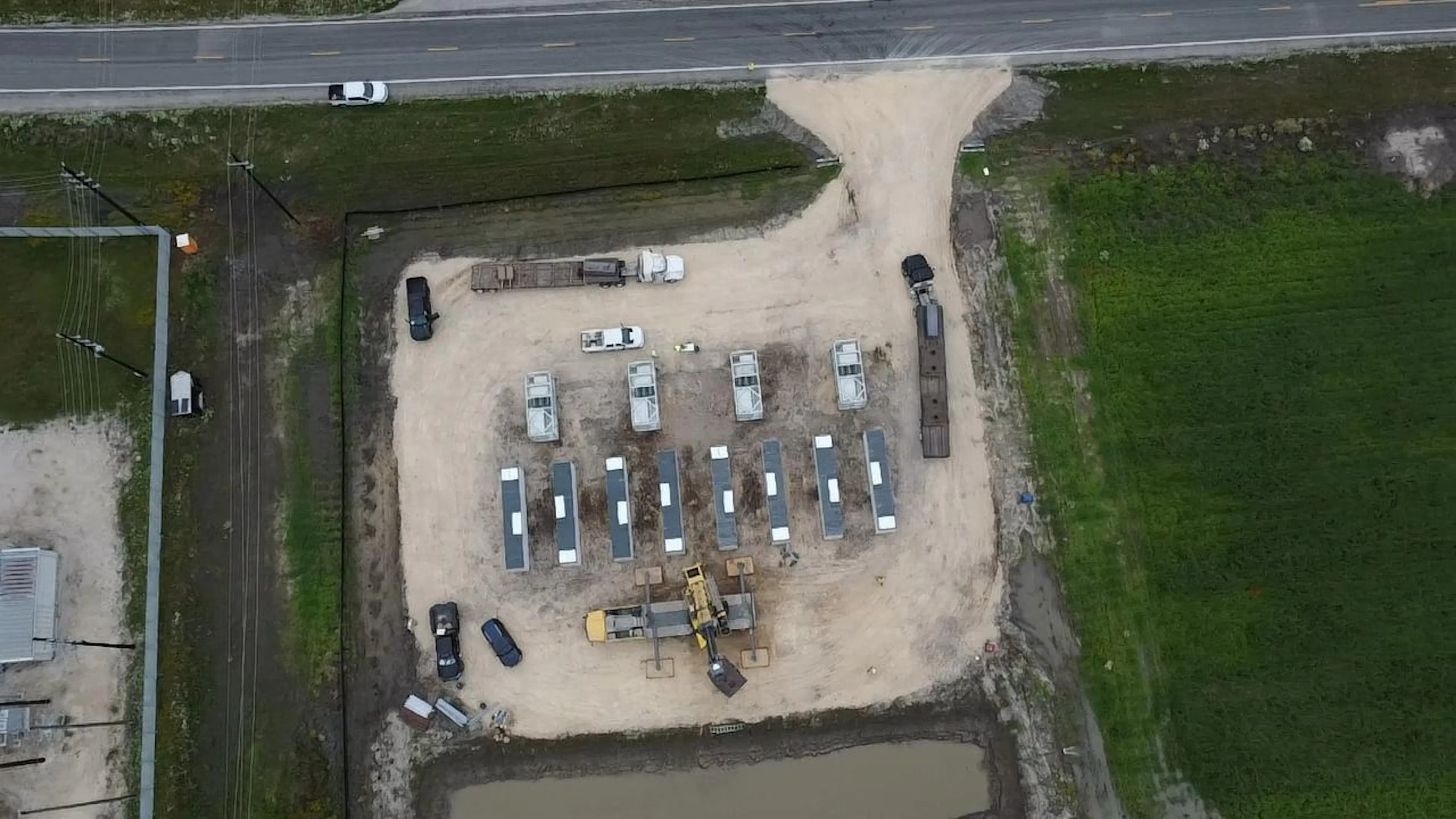 Merchant BESS facility under construction. Photo: © GoodPeak
Several things follow. Independent revenue forecasting became a core underwriting requirement rather than a market-study formality, with a defensible floor scenario expected alongside the base case. Debt service reserves, the period over which revenue is genuinely visible, and the existence of any contractual floor moved from secondary terms to threshold questions. In program-backed structures, considerations of that kind can become explicit eligibility conditions rather than negotiated points.
The line that matters is not solar against storage. It is merchant against contracted. A merchant asset of any technology is underwritten against a distribution of outcomes; a contracted one is underwritten against a payment. As the most predictable line in the storage stack shrank, more projects ended up on the merchant side of that line than their sponsors had assumed.
None of that describes a market in distress. It describes a market adapting to a changing revenue profile, and none of it is specific to Texas or batteries. Any merchant asset earns across several revenue streams, each with a different degree of visibility. In a maturing market the first underwriting question stops being what an asset can earn and becomes how much of what it earns can be seen far enough forward, with enough confidence, to carry debt.
Possible changes in ERCOT remain in progress
The natural assumption is that a market not paying for something the grid needs will eventually be redesigned to pay for it. Two facts make that unlikely in Texas on a relevant timescale.
ERCOT has no capacity construct. Its Independent Market Monitor puts it plainly: "ERCOT does not have a capacity construct and relies almost exclusively on energy and ancillary markets to facilitate investment in new resources to help achieve resource adequacy."
The second fact concerns a product the legislature directed ERCOT to develop that has not yet been implemented. Real-time co-optimization launched in December 2025, but the dispatchable reliability reserve service did not. The latter is a new ancillary service for resources able to run for at least four hours and start within two.
So, the requirement is sized by a methodology unrelated to load, the product ordered in 2023 has not shipped, and a capacity construct is not on the table.
Where a revenue floor actually comes from
If the market does not pay a broad premium for being available, a floor has to be built.
It is not the case that nothing prices availability in advance. Tolling agreements have financed Texas peaking capacity for two decades: a counterparty takes dispatch rights and pays for availability, and the project finances against the payment rather than the market. Merchant floor products and traded spread indices price the same risk in different wrappers. And since December 2025 ERCOT has virtual ancillary service positions, which are financial hedges on the real-time reserve price.
The constraint is not that instruments do not exist. It is depth and tenor: how many counterparties will write them, at what price, and for long enough to match the life of a debt facility. A contracted asset with a predictable output profile finances on terms a merchant one does not, whatever it is made of.
"In an energy-only market, there isn't a broad capacity payment simply for being available," Garrido says. "A revenue floor can instead come through a bilateral contract with a counterparty that values that availability. Tolling agreements have played that role in Texas for years. The open question is whether large loads increasingly become those counterparties themselves."
Realized large load in ERCOT may change the need for flexible capacity
ERCOT's negative reserve margins are planning scenarios, not predictions of operating conditions. ERCOT also
Demand flexibility can also reduce some of that pressure. Texas now requires large loads to be curtailable as a condition of interconnection and has created a demand-response service for the largest of them, and ERCOT's planning already assumes data centers are fully curtailable from 2027. A material share of a peak problem can be managed by reducing load rather than building new capacity.
And scarcity pricing is politically fragile. Texas has intervened in its own market design repeatedly. Two summers of visible scarcity rents flowing to generators while consumers see higher bills is the sequence that produces legislative intervention. Any thesis resting on sustained scarcity pricing rests on political tolerance for it, which is not a market variable.
Clarity on revenue forecasts remains essential
ERCOT expects Texas to need significantly more flexible capacity by 2028, but how much load arrives and how the market supports that investment remain open questions.
What is clearer is how the market has changed. Ancillary services did not grow with the storage fleet, and real-time co-optimization did not change that. Earlier Texas storage projects were financed when ancillary services represented a larger and more visible share of revenue.
The underwriting question is now simpler: how much of an asset's revenue can be seen far enough ahead, and with enough confidence, to support debt.
This story was distributed as a release by Jon Stojan under HackerNoon’s Business Blogging Program.
如有侵权请联系:admin#unsafe.sh