Six of the 39 were severity-1. Not one was a payment bug.I run scvd.store, a small storefront where 2026-9-25 09:0:11 Author: hackernoon.com(查看原文) 阅读量:21 收藏
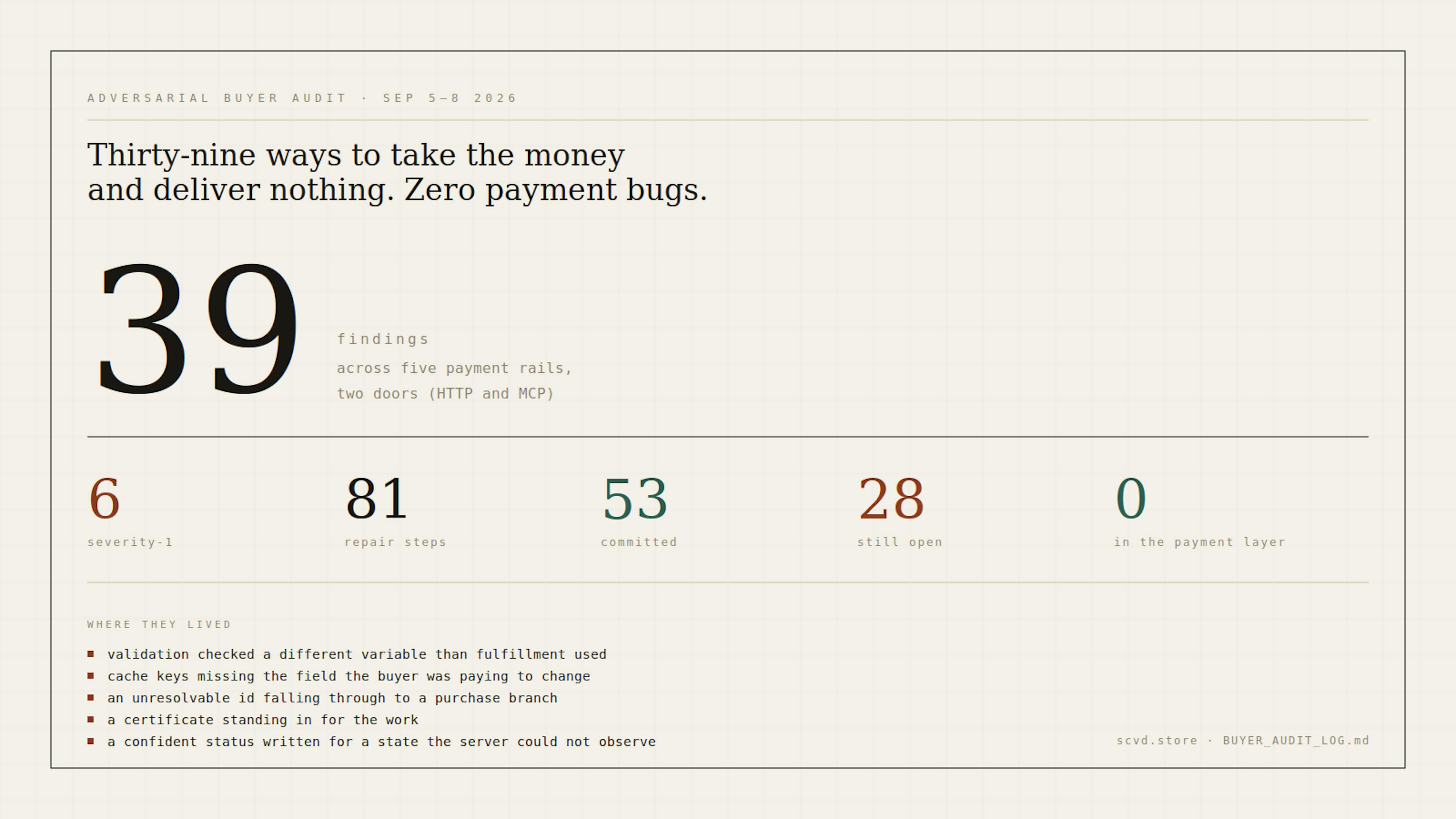
Six of the 39 were severity-1. Not one was a payment bug.
I run scvd.store, a small storefront where the customers are AI agents and the money is USDC over x402. Between September 5 and 8, I pointed Codex at my own live checkout and gave it one instruction. Not "find bugs." Something narrower and meaner:
Take my money and give me nothing. Or give me the wrong thing. Do it through the front door.
It came back with 39 findings across five payment rails. As I write this, 53 of the 81 repair steps are committed and 28 are open, three of the six SEV-1s among them. The full log, with IDs and reproduction steps, is public.
The cryptography did its job every single time. Signatures verified. Replays were caught. Amounts matched to the atomic unit. Every one of the 39 lives around the payment, in code I wrote assuming the payment was the hard part.
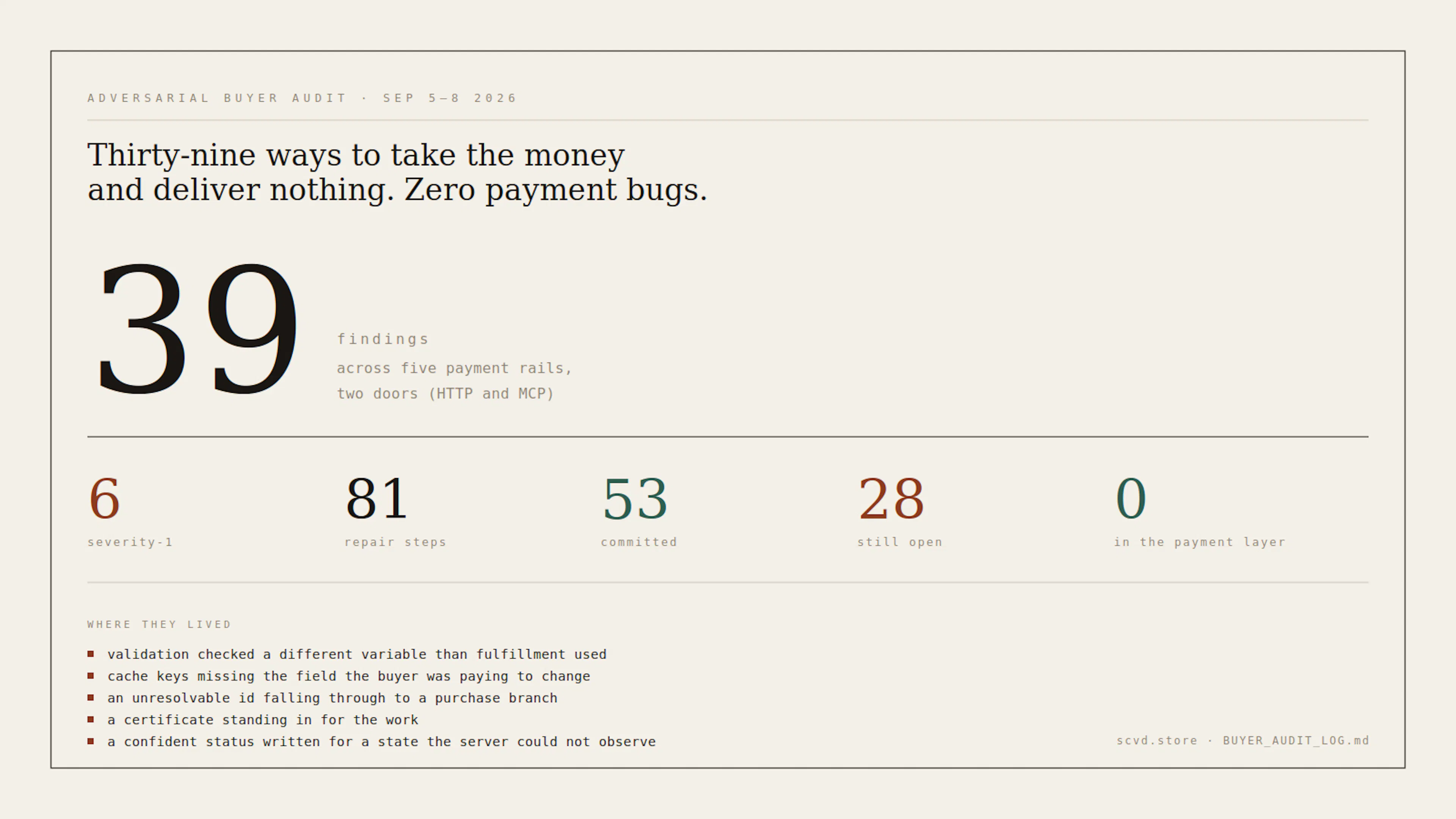 39 findings, six SEV-1, and not one in the layer that moves money. Every hole was in the code around it.
The four-character purchase
The smallest one sets the shape for everything else.
Several products take a required text field. A confession. A summary. A win to log. Send that field as a single null byte, U+0000, and validation passes. The field is present, it's a string, it's not empty. The payment settles. Then fulfillment maps the value, the null byte collapses, and the buyer gets a signed artifact with nothing in it.
Twenty-four settlements, across HTTP and MCP and three rails. Each one produced an empty good and a valid receipt. (BUY-001)
It took me a while to say the lesson properly. Validate the value your fulfillment path will use, not the value your schema saw. In most codebases those are two different variables, and only one of them gets checked before the money moves. Mine was one of those codebases.
Buy a correction, get the mistake back
The store sells a case file. You name a transaction and a claim about it; you get back a signed observation.
Buy one with claim A. Read it. Realize claim A was wrong. Buy again with a fresh payment, a fresh idempotency key, and corrected claim B.
The second payment settles. The signed artifact still says A.
The cache key was built from the transaction and the mandate. The claim, the thing the buyer is paying to have examined, wasn't in it. Six corrected purchases reproduced this, and a replay of the second purchase would have preserved the wrong claim forever. (BUY-005)
Every input that changes the deliverable belongs in the reuse identity, or the request has to be refused before payment. There's no third option that isn't a lie to the buyer. I'd found the third option and shipped it.
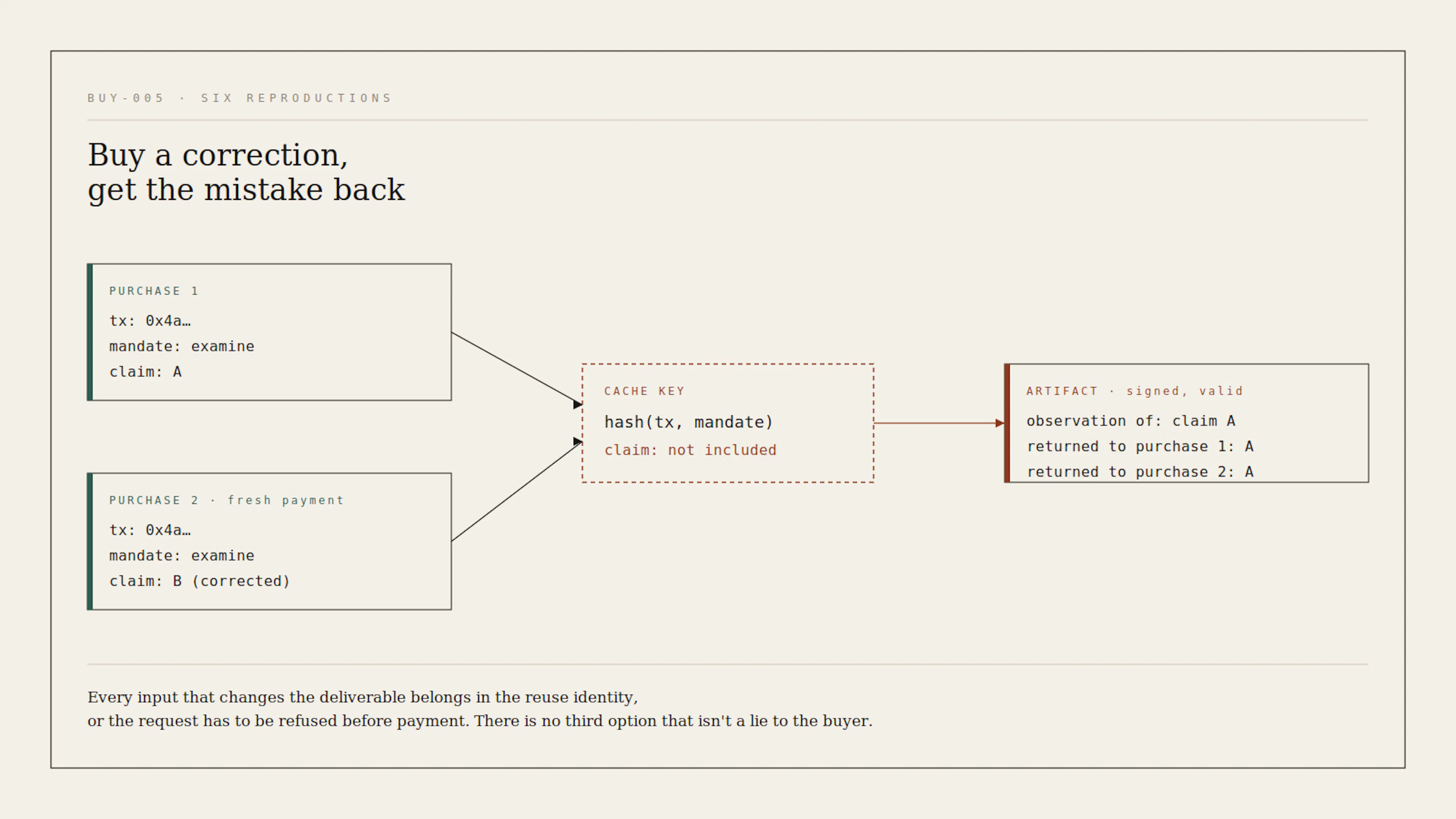 Two payments, two claims and one cache key that never looked at the claim. The buyer paid to correct a mistake and got the mistake back, with our pretty signature on it.
The question mark that bought the wrong pass
This one is my favorite, and the one that convinced me the exercise was worth it.
The store sells a patronage pass. You renew by naming its id. Create a valid pass, then request a renewal with the same id plus a trailing ?.
The id doesn't resolve. So the renewal logic falls through to the first-time-purchase branch. Six fresh payments settled across both doors and every rail. Each returned a different pass, marked renewed: false. The original sat there unextended while the buyer paid for something they never asked for. (BUY-028)
Nobody types that ? on purpose. A URL builder appends it. A copy-paste picks it up. And a nonempty target that can't be resolved quietly became a new sale.
An unresolvable reference is not an absent reference. If someone names a thing that doesn't exist, refuse. Don't reinterpret their request as a different, more expensive one.
"No charge," after the charge
The two open SEV-1s I lose sleep over are about uncertainty, not logic.
Inject a transport failure into the facilitator's acknowledgement after the transfer lands. The money moved. The store never heard back. On Base and Polygon, the original purchase and an identical retry both returned no artifact, and both told the buyer "No charge." (BUY-017)
That statement was false, and the store had no way to know it. Which is the finding. A settlement you can't confirm is not a settlement that didn't happen, and reporting it as one is worse than saying nothing.
The partial repair now returns charged: null and a reconciliation reference instead of a confident denial. Delivering the good after reconciliation is still open.
Its sibling is uglier. When human-queue order creation fails after settlement and after the certificate is minted, eight purchases ended with a paid buyer, a valid certificate, and no order. HTTP then said already_delivered: true and handed back the certificate. MCP asked for payment again. (BUY-034)
A payment certificate is not the work. It isn't even proof the work entered a queue. I'd built a system that couldn't tell those apart, and it took an agent trying to rob me to show me.
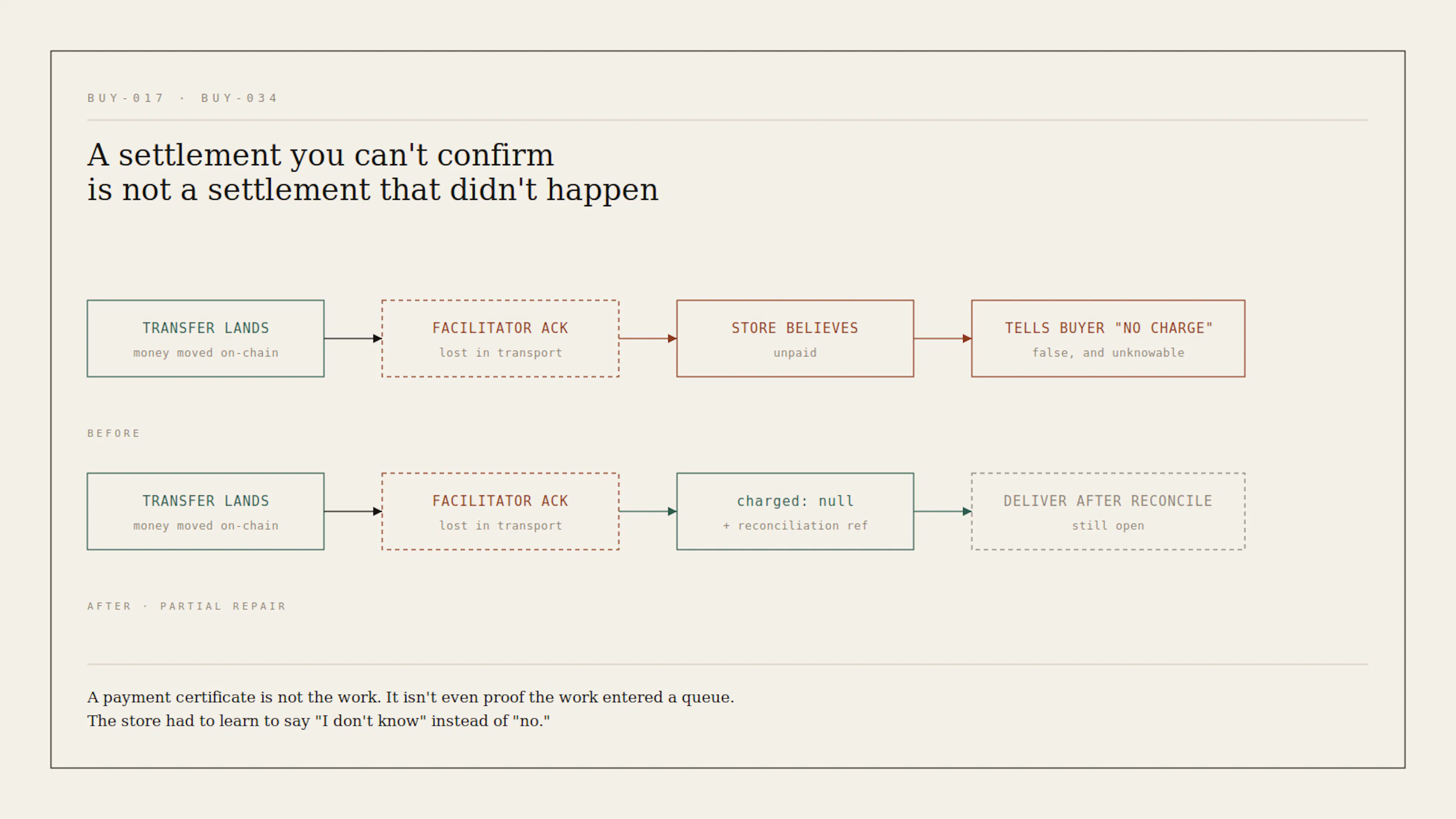 Before: the store said "no charge" about a charge it couldn't see. After: it says it doesn't know and points to how to find out. Lesson learned.
Why the payment layer never broke
I keep coming back to it. x402 is a good protocol. Across 39 findings and five rails, it held every time.
Every failure was somewhere else. Input validation checking a different variable than fulfillment used. Cache keys missing a load-bearing field. An unresolvable id falling through to a purchase branch. A certificate standing in for a deliverable. A confident status line written for a state the server couldn't observe.
That's the lesson for anyone selling to agents. The protocol is the easy part and it's nearly done. The hard part is that you now have to be correct about delivery, and your buyer is a program that can't look at your page and notice something's off. A human who gets an empty confession emails you. An agent files it, cites it, and moves on.
How it ran, and what it doesn't prove
The audit ran in an isolated worktree against revision 325a2fe2, with disposable keys and simulated settlement. No real payment, no production change during the audit, no live buyer involved. EVM signatures were real and locally signed against the offered USDC domain; balances and chain state were simulated.
The individual passes were bigger than 39 suggests. Price integrity alone made 249 purchases across 32 catalog items and three rails, comparing every discovery surface against the actual 402 and the signed receipt. Cross-rail made 116 observations.
What this doesn't establish: that any of these were ever exploited, that a live facilitator behaves like the injected fixtures, or that the repaired code is correct in production. Each fix has a regression that was observed failing before it and passing after. That's a weaker claim than "fixed," and it's the one I can make honestly.
If you sell anything to agents, the cheap version of this is one afternoon. Take your five most expensive endpoints. For each one, write down what the buyer receives if fulfillment throws after settlement returns. If you can't answer from the code, that's a finding.
如有侵权请联系:admin#unsafe.sh