A startup that wants to patent an invention in the United States today pays a law firm $18,000 to $4 2026-9-23 18:16:35 Author: hackernoon.com(查看原文) 阅读量:7 收藏
A startup that wants to patent an invention in the United States today pays a law firm $18,000 to $40,000, waits about a quarter for the draft and then joins a queue at the United States Patent and Trademark Office where the average wait for a first examiner decision reached about 22.5 months in fiscal 2025, against a target of 14 months written into the patent statute itself. Law firm rates rose about 7 percent in 2025 on top of that, according to Thomson Reuters.
Fearn, which launched today with $5.5 million in seed funding, is a law firm designed so that a founder can go from describing an invention to a review-ready application in as little as 24 minutes, have a provisional on file within three business days and pay a fixed $9,000 for the full application, with the firm's own fee at risk if the examiner allows nothing.
The Round Behind the Future of AI Driven Law Firms
Kindred Ventures led the $5.5 million seed round, which closed in June, three months before the firm that money was meant to build opened its doors. Steve Jang's San Francisco fund has a habit of writing early cheques into companies that go on to define their category, with Uber, Coinbase and Perplexity on its record. a16z speedrun came in alongside it. The Andreessen Horowitz programme takes a cohort of founders twice a year, puts up to $1 million into each and exists to get products to market faster, which makes a law firm that files patents in three days an easy fit. Designer Fund, an early investor in Stripe, Notion, Linear and Framer, backs companies where the product experience is the moat. Essence VC, Tim Chen's Seattle fund, invests in developer tools and infrastructure, which is what FearnOS is once you look past the law firm sitting on top of it.
What the four bought in June was a software company selling patent drafts at a flat $2,000 apiece, according to the round's announcement. What they own today is a law firm that charges $9,000, puts its own attorneys on every filing and refunds the fee if the examiner allows nothing. That is a bigger business with a harder problem, since every application still needs a qualified human, but it is also the only version of the idea in which the client sees the savings on the bill. It is the version the money was raised to prove.
A $14 Billion Market Built on the Billable Hour
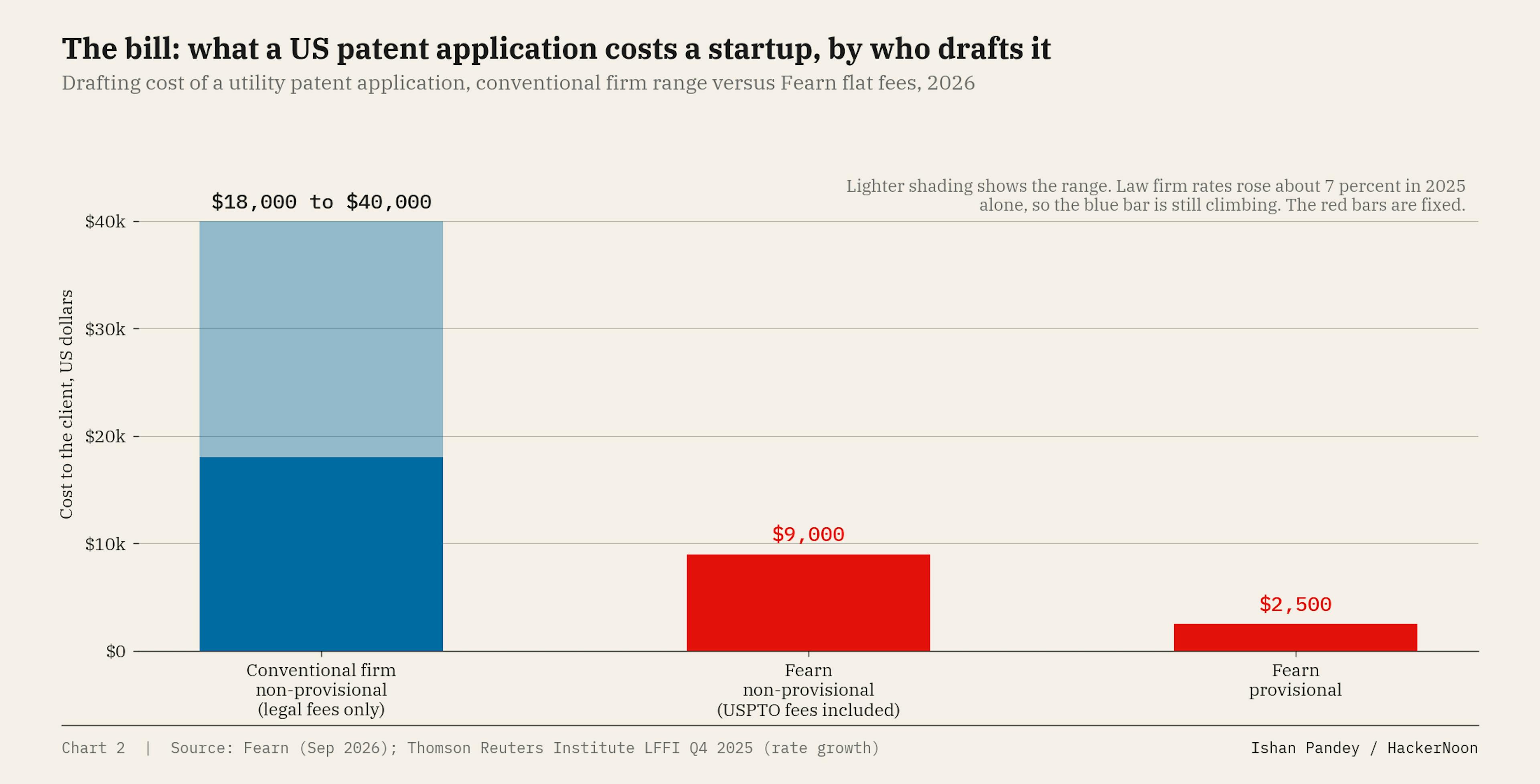
Patent services are a $14 billion a year business worldwide, a figure Fearn cites and Forbes reports alongside a projection past $20 billion by 2035. That is a small slice of a global legal services market that Grand View Research puts on course for $1.38 trillion by 2030, but it is the slice with the most measurable output in the whole profession.
 Annual spend on legal and patent services, US dollars, log scale.
A contract can be argued over for years. A patent application either gets its claims allowed by an examiner or it does not, which is what makes it possible for a firm to sell a refund guarantee that no litigation practice ever could. Half of the $14 billion is spent by early-stage companies filing about 150,000 new applications a year, which means the segment Fearn is built for is the one with the least budget, the most time pressure and the clearest verdict on whether the work was any good.
The Problem With Patent Law Today
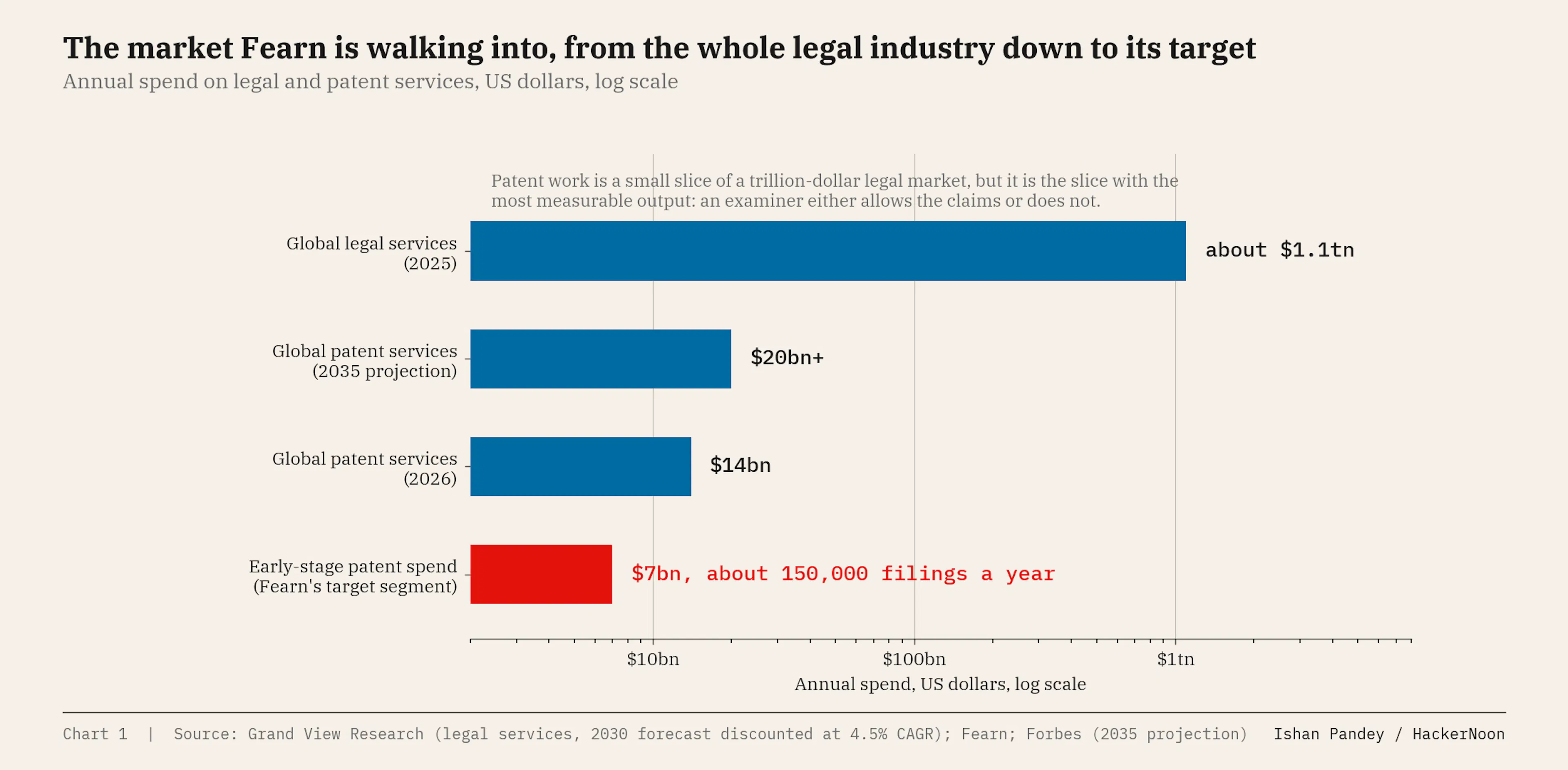
The cost problem is the easiest to see. A non-provisional utility application, the full filing that can become an enforceable patent, runs $18,000 to $40,000 in legal fees at a conventional firm before the USPTO's own charges are added. Fearn's price for the same filing is $9,000 with government fees included. A provisional, the cheaper placeholder that locks in a filing date for twelve months while the company keeps building, is $2,500. At the bottom of the conventional range Fearn is half the price; at the top it is less than a quarter. Since the conventional figure is an hourly rate multiplied by 30 to 40 hours of attorney time, it moves with the rate. Rates went up about 7 percent last year. Fearn's figure is a list price.
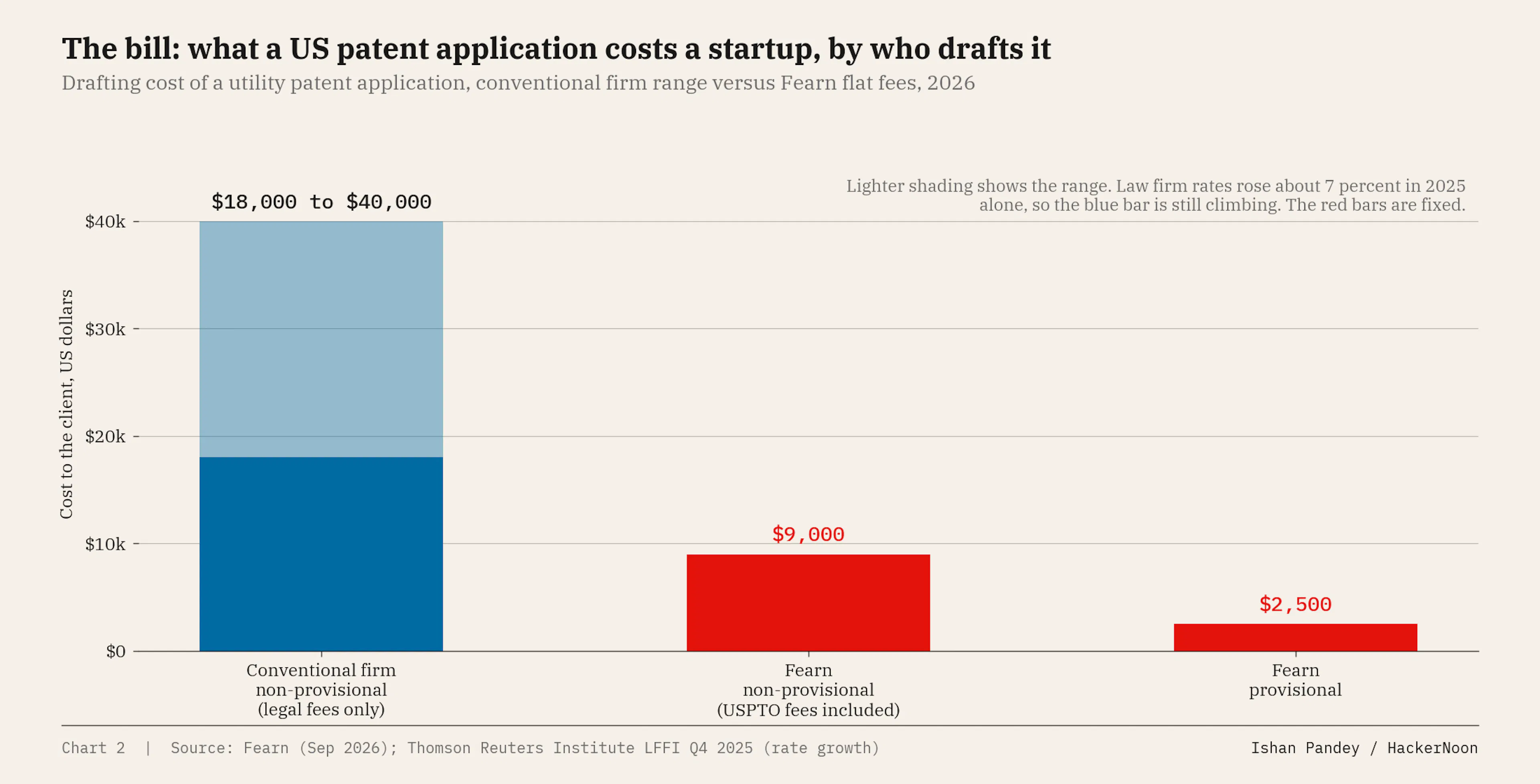 Drafting cost of a utility patent application, conventional firm range versus Fearn flat fees, 2026. Source: Fearn; Thomson Reuters Institute.
The time problem is worse than the cost problem. Most of it sits with the patent office rather than the law firm. The USPTO took 14.8 months on average to issue a first examiner action in fiscal 2020, 16.9 months in 2021, 20.5 months in 2023 and 19.9 months in 2024, by its own figures, then about 22.5 months in fiscal 2025 according to IPWatchdog. The queue behind that number peaked at 837,928 unexamined applications in January 2025 and still held 776,995 in April 2026, the office reported. US patent law works on a first-to-file basis, so whoever files first owns the priority date and anything published before it, including the company's own demo day or launch post, can be used against the application. A founder who spends a quarter getting a draft out of a traditional firm has given a competitor a quarter's head start and pushed their own place in a two-year queue back by the same amount.
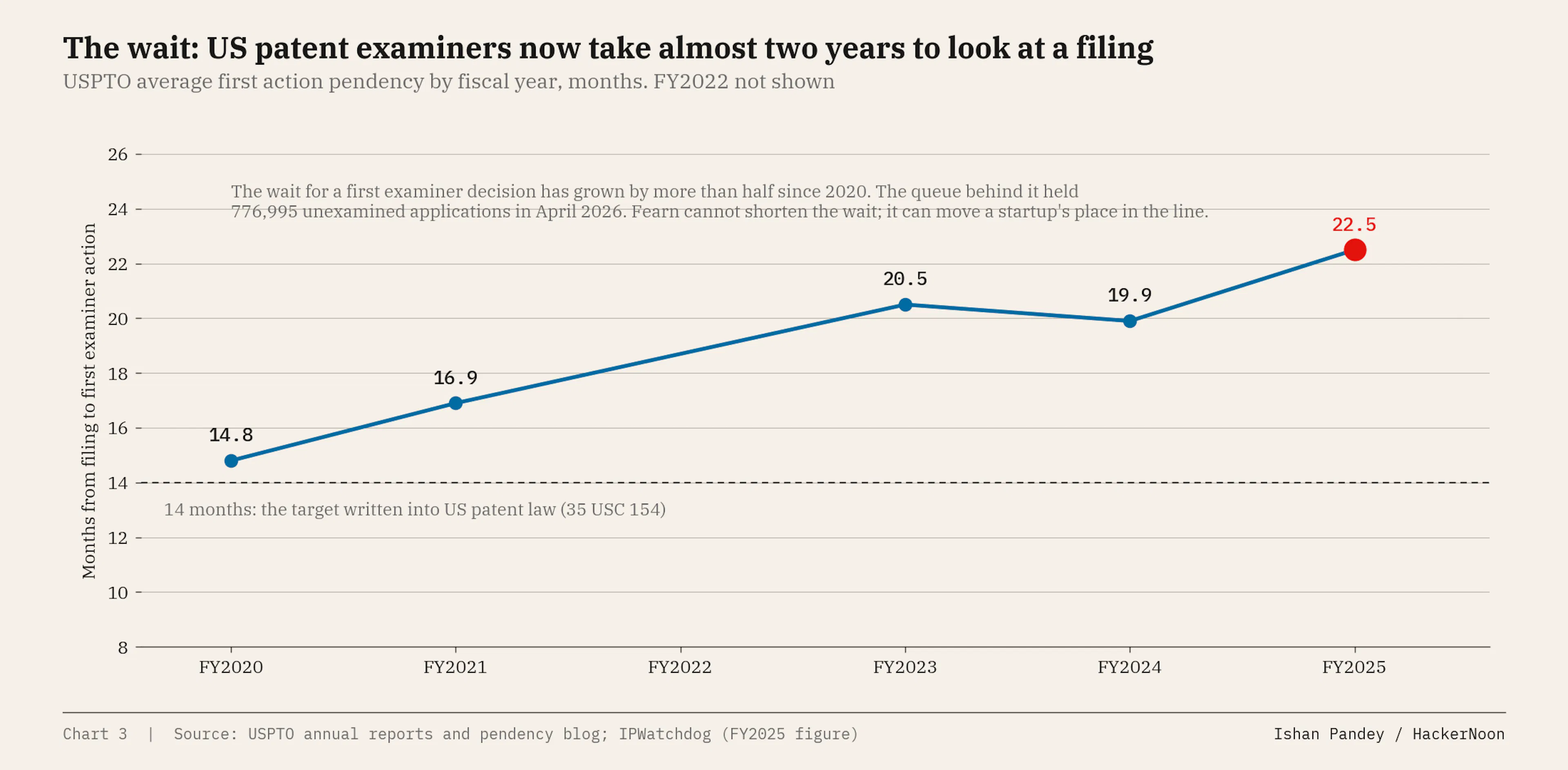 USPTO average first action pendency by fiscal year, months. Source: USPTO; Patent Docs; IPWatchdog.
The third problem is the one that keeps the first two in place. A law firm that bills by the hour loses money when its tools save time, so the incentive to adopt drafting software runs the wrong way. The material in a pre-filing application is also the most sensitive document a startup owns, since publishing it early destroys the very novelty it is meant to protect, which is why most firms will not run it through a third-party model. The result is a profession that has had access to language models for three years and has barely changed its price list.
What a First Patent Is Worth to a Startup
The reason speed matters so much at seed stage is that the first patent is not paperwork. Economists Joan Farre-Mensa, Deepak Hegde and Alexander Ljungqvist studied 34,215 first-time applications by US startups between 2001 and 2013 and used the effectively random assignment of applications to strict or lenient examiners as a natural experiment.
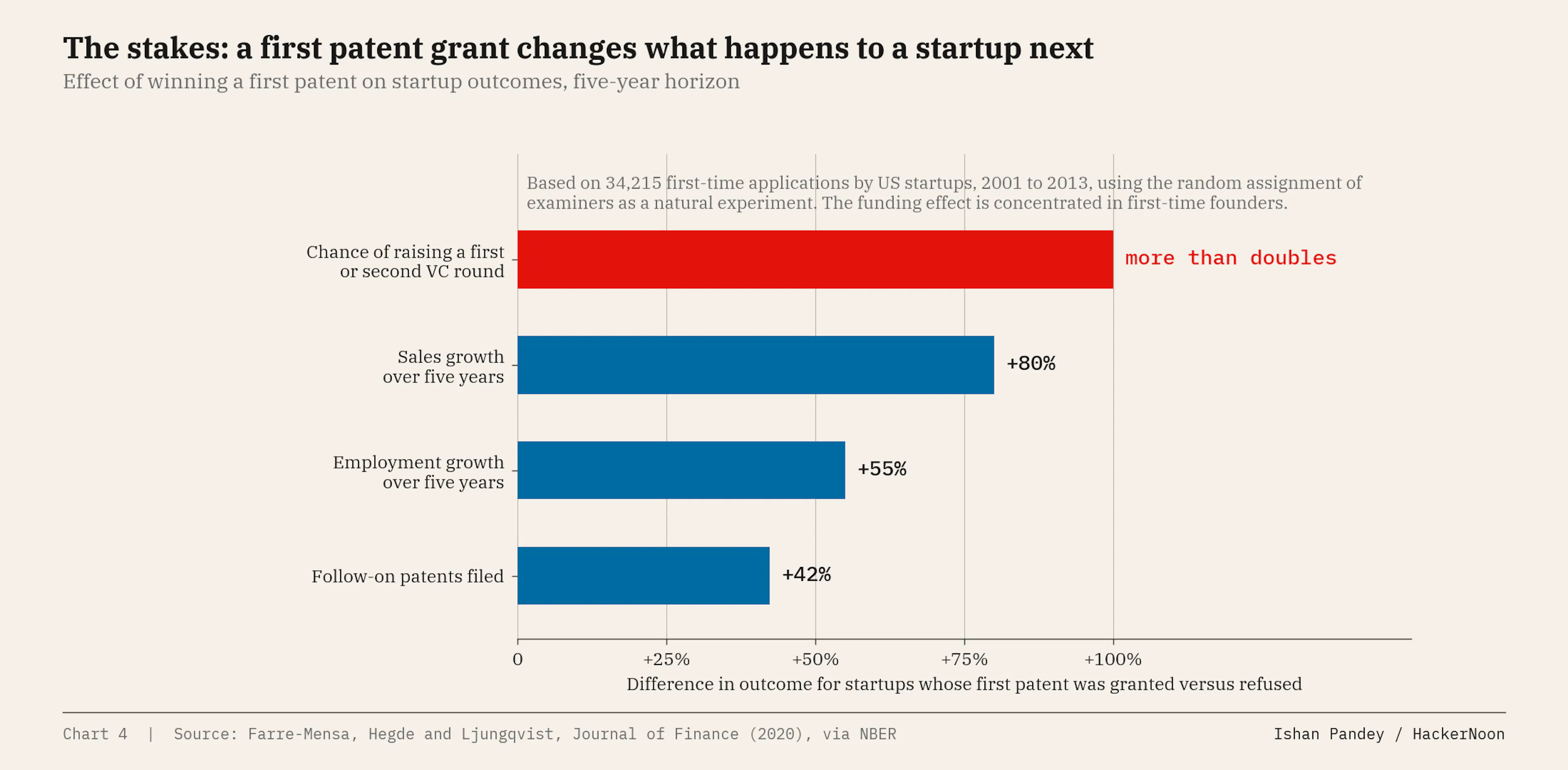 Effect of winning a first patent on startup outcomes, five-year horizon.
Startups whose first application was granted had 55 percent higher employment growth and 80 percent higher sales growth five years later, filed 42 percent more follow-on patents and were more than twice as likely to raise a first or second round of venture capital, according to the paper published in the Journal of Finance. The funding effect was concentrated among first-time founders, who are exactly the people a $30,000 legal bill prices out. The USPTO's own internal studies put the value of a single week of reduced pendency at about $35,000 for the average US company.
The Founder Thesis
Han Kim and Angela Gao arrived at the same problem from opposite directions. Kim prosecuted patents at Morrison & Foerster, one of the largest patent practices in the United States, where he watched what 30 to 40 billable hours per application looked like from inside. Gao earned a PhD in computer science and AI at Caltech, where the two met. Their first company sold drafting software to patent law firms. That experience produced the thesis Fearn is built on: better tooling cannot fix a business model in which time saved is revenue lost, nor can it be deployed safely on pre-filing IP unless the firm controls the whole stack. The only way to pass the savings to the client was to be the law firm.
At the centre of the firm is FearnOS, a drafting and client management system that treats a patent application as a graph rather than one long document. Each claim is linked to the passages of description, the figures and the technical material that support it. When an attorney edits a section, the system keeps the edit, records where it came from and checks that the claims and the description still agree, so a later generation pass cannot silently overwrite human work. That structure lets Fearn pair language models with deterministic checks, for example that every claim term appears in the description and every figure is referenced, while a former Big Law patent attorney reviews every application before it is filed. Clients run their whole portfolio in the same system, with per-patent access control, a full version history and connections to the places where their technical documentation already lives.
The economics follow from the technology. Fearn says an application that takes a conventional firm 30 to 40 attorney hours takes about 30 minutes of attorney time on FearnOS. At $9,000 a filing, that is roughly $18,000 of client revenue per hour of attorney time, against $450 to $1,333 an hour at a conventional firm working from the ranges Fearn cites. Model and engineering costs sit below that line. The firm reports gross margins above 80 percent. Those margins are what fund the guarantee: if Fearn drafts a non-provisional, carries it through examination and the examiner allows no claims at all, it refunds the $9,000. An hourly firm cannot offer that because it is paid for the hours whether or not the patent issues.
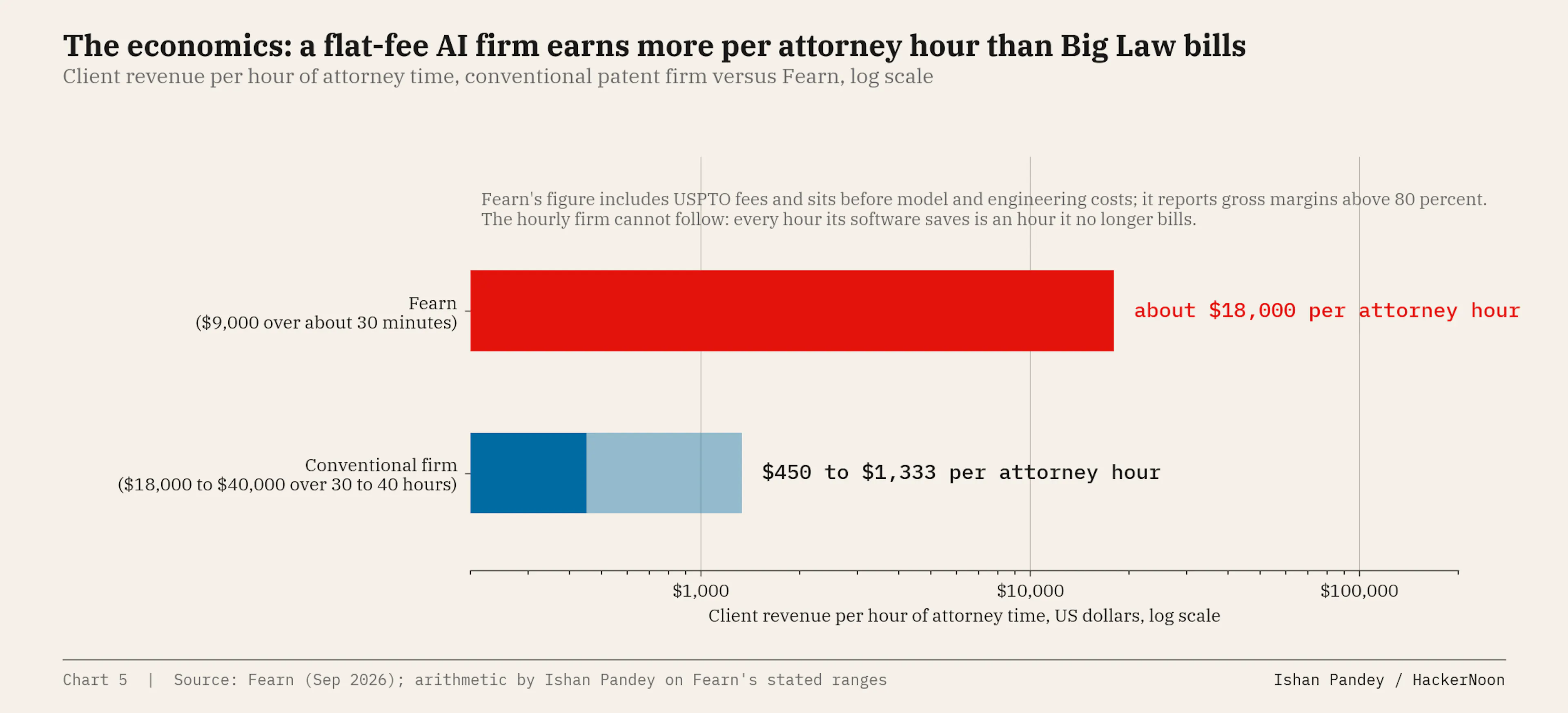 Client revenue per hour of attorney time, conventional patent firm versus Fearn, log scale.
The Investor Thesis
The case the syndicate is making has four parts. The first is that the money in legal AI has so far gone almost entirely to software sold to law firms, which leaves the hourly model and its margins intact. Harvey went from a $3 billion valuation in February 2025 to $15.6 billion this month on revenue past $400 million, Tech Startups reported, while Legora tripled to $5.55 billion in April, per Crunchbase, inside a year in which legal tech raised a record $6 billion, by Artificial Lawyer's count. Those companies make lawyers faster and let the law firm keep the difference. A firm that owns the client relationship captures the services spend itself. The services pool is a trillion dollars against tens of billions for legal software.
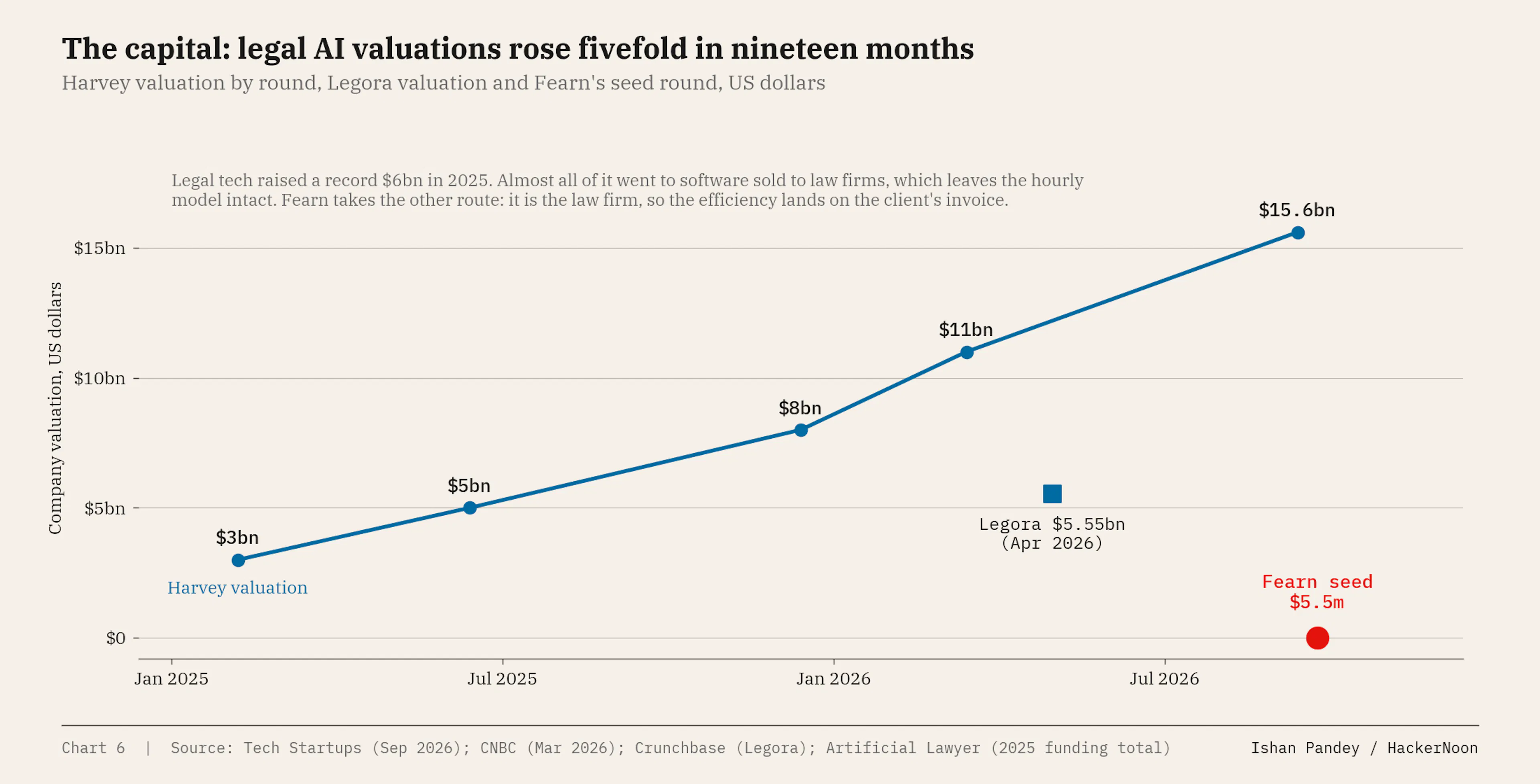 Harvey valuation by round, Legora valuation and Fearn's seed round, US dollars.
The second part is that incumbents cannot follow. Big Law firms are making unusually large investments in their own AI infrastructure, but every hour their software saves is an hour they no longer bill, so the efficiency stays inside the firm rather than reaching the invoice. A firm that starts from a flat fee has the opposite incentive, which is the same structural advantage that let online brokerages undercut full-service ones on commission.
The third part is that patent law is the corner of the profession where quality can be proven rather than argued. The examiner's decision is a public, binary outcome, which lets Fearn put its own fee at risk and lets an investor underwrite the business on a number, the share of applications that win claims, rather than on reputation. The fourth is that the first filing is a wedge rather than the product. A patent leads to continuations, foreign filings under the Patent Cooperation Treaty, office action responses and, for a company that survives, a portfolio to manage, so a $9,000 provisional relationship becomes a multi-year one.
For Kindred, which frames AI as a change to the underlying economics of professional services, patent prosecution is the cleanest test case in the industry. For a16z speedrun, whose whole programme is about compressing time to market, a law firm that files in three days is a natural fit. Designer Fund invests where the product experience is the moat, which in Fearn's case is the portfolio system the client actually touches, while Essence VC backs infrastructure, which is what FearnOS is underneath the law firm.
Early Customers
Fearn says it has hundreds of users, from venture-backed startups to public companies, across software, hardware, robotics, semiconductors, defence, biotech and pharma. It named three. Iconic, a London game studio building AI characters that improvise in real time, went from invention disclosures to filed applications in days.
Photon Spear, a US defence technology company, filed a hardware patent for space technology in several days while keeping its material on privately hosted infrastructure, a requirement a defence client has and a cloud-only tool cannot meet. Serova Bio uses the platform for patents on AI-designed personalised cancer vaccines, where the claims, the supporting disclosure and a growing portfolio have to stay coordinated as the science moves.
Three companies in three technical fields is the point: Fearn's attorneys include PhDs alongside former Big Law partners. Its pitch is that it covers the fields where a startup is most likely to have something worth patenting and least likely to have an IP team.
What Comes Next
The seed capital funds an expansion of FearnOS beyond first filings into everything that follows them: continuation applications and patent families, international filings, responses to office actions and the portfolio strategy that tells a founder which product is protected, where coverage is thin and what to file next. That is the service a company with an in-house IP department and a seven-figure outside counsel budget gets today. It is what Fearn means when it says it wants to give a three-person startup the patent infrastructure of a much larger one.
Patent law has resisted software longer than most legal work because the documents are long, the stakes are high and the people who write them are paid by the hour. Fearn's answer to all three is the same: keep the attorney, change the economics around the attorney and let the client see the difference on the bill. The measure of whether it works will be two numbers over the next two years: how many of the 150,000 applications early-stage companies file each year carry Fearn's name and how many of those win claims.
Don’t forget to like and share the story!
Vested Interest Disclosure: HackerNoon has reviewed the report for quality, but the claims herein belong to the author. #DYOR.
如有侵权请联系:admin#unsafe.sh