Brain gives people and AI agents a shared, persistent company memory, alongside tools for deploying 2026-9-23 18:37:57 Author: hackernoon.com(查看原文) 阅读量:6 收藏
Brain gives people and AI agents a shared, persistent company memory, alongside tools for deploying agents and controlling what each person and agent can see and do.
Businesses have no shortage of AI tools to choose from. The harder problem is getting those tools to understand the business they are supposed to work for.
A new ChatGPT conversation starts with limited context. A coding agent may know the repository but not the decisions made in Slack last week. An internal assistant might be connected to company documents but lack the permissions needed to distinguish what one employee should see from another.
As companies add more AI, they often end up creating more fragmented context around it.
At the center of the product is a simple idea: a company should be able to build one Brain that gets more useful as the business uses it, and then make that intelligence available to both people and AI agents without giving everyone the same level of access.
That puts Brain somewhere between an AI memory layer, company knowledge platform and agent operating environment.
Companies are already running on it
Brain went into production at
"Since we switched ChainGPT to Brain, we finally closed the knowledge gap our teams dealt with. Everyone, across every department, is always in sync and one prompt away from any information they need. No more back and forth, doc swaps, and meetings. Just one prompt," said Ilan Rakhmanov, CEO at ChainGPT.
Buyers get a system that was carrying production workloads before it ever carried a price tag.
A brain that compounds
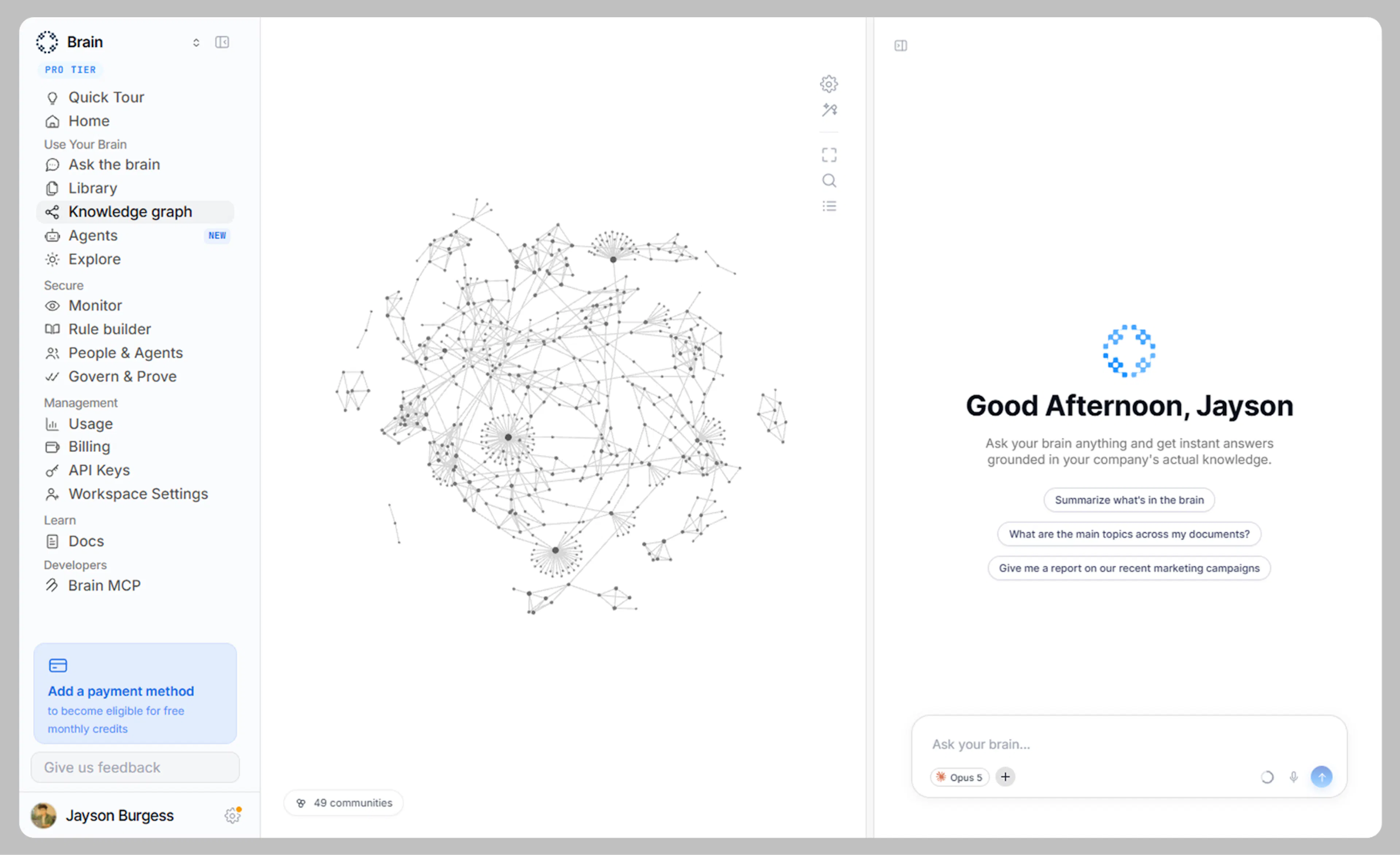
Brain connects to the places where a company's knowledge already sits, starting with Google Drive and Notion, with Slack, GitHub, Box, Telegram, Confluence, Salesforce and Gmail in development. Out of those sources it builds a knowledge graph of the business: the documents, the people, the projects, and every relationship between them.
Each source added fills in another part of the picture, and every question asked sharpens what the system understands about how the company operates. Six months in, a team is working with an asset no competitor can buy or copy, because it was assembled out of their own operating history.
The economics move the same way. Loading whole documents into a context window means paying the model to re-read them on every request, so cost climbs as usage grows and accuracy drops once the window fills up. Brain retrieves the passages that answer the question. Answers come straight from the live source, and the model reads a fraction of the text to produce them, which pulls the cost of every query down.
AI-native companies get the same memory over an API and an MCP endpoint, so a product team can ship on it in an afternoon.
Agents that launch already knowing the business
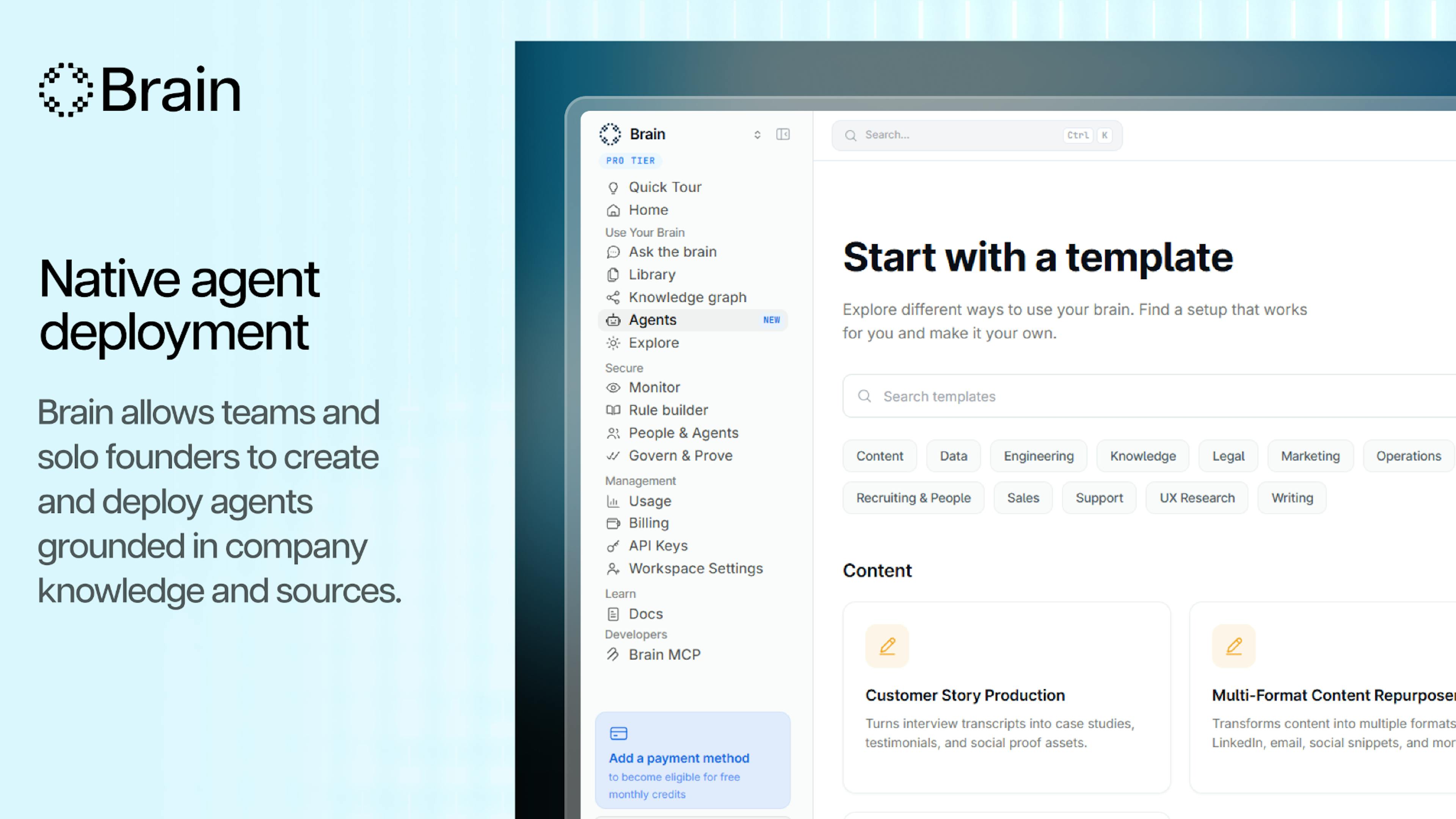
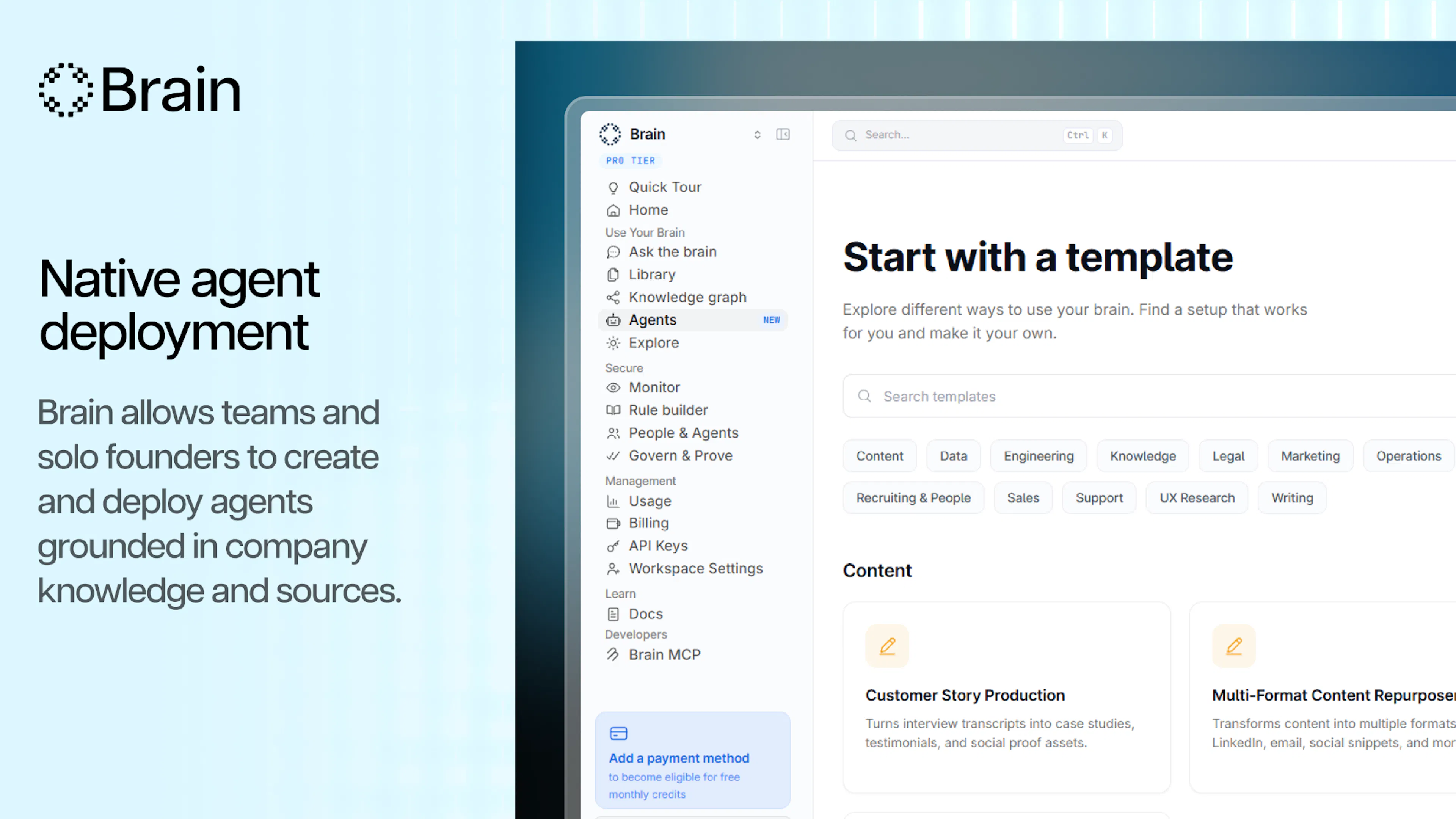
Brain builds and deploys AI agents inside the app, with the company brain behind them from the first request.
A support agent answers from documentation that is current today. Sales picks up an account with an agent that has already read the last three calls. Overnight, a research agent works through the market folder and reports what changed by the time anyone logs in. Each one runs on the same governed knowledge the humans use, which retires the context file somebody always forgets to update.
Every agent carries its own key, its own scope, and a mandate that defines what it is permitted to do. Actions that carry weight wait for a person to approve them, and an agent that needs stopping is stopped with one switch that binds on the very next request.
Enterprise buyers press hardest on this part. An agent with broad access and no mandate is a script holding production credentials, and the exposure multiplies with every one a company deploys. Brain gives each agent an identity, a limit and a record, which is what makes running twenty of them governable.
Governance that clears security review
Internal AI projects die in security review far more often than they die over model quality, because nobody can prove the assistant will not surface a salary band or a sealed repository to someone who was never cleared to see it.
Brain inherits the permissions every source already carries, so a private channel stays invisible to anyone outside it and an HR folder stays invisible outside HR. Nothing is copied into a separate store and nothing is re-shared. IT keeps the access model it already maintains and spends no time rebuilding it.
Those permissions are enforced on every request, before an answer is composed. Where one section of a document is restricted, Brain holds back that section and leaves the rest usable, so nobody loses a hundred-page document over one paragraph.
Every access writes a record of who asked, which policy applied and what was withheld, with none of the content stored. An outside auditor can check that record without taking Brain's word for any of it, and that record is why Brain gets through reviews that stop general-purpose assistants at the door.
"Companies have already decided they want AI on everything they know. What stops them is that nobody can answer what happens when the model retrieves something the person asking was never cleared to see," said Jayson Burgess, CMO at Brain. "Brain is the super app for putting AI to work inside a business. Memory, agents, permissions and proof in one place, so the rollout survives contact with the compliance team."
How to Get Started
Brain is self-serve and requires no sales process. Sign up at
Teams evaluating Brain against alternatives can find detailed comparisons against Microsoft Copilot, Glean, Notion AI, Obsidian and agent-memory frameworks at
About Brain
This story was published as a press release by BlockmanPR under HackerNoon’s Business Blogging
Disclaimer:
This article is for informational purposes only and does not constitute investment advice. Cryptocurrencies are speculative, complex, and involve high risks. This can mean high prices volatility and potential loss of your initial investment. You should consider your financial situation, investment purposes, and consult with a financial advisor before making any investment decisions. The HackerNoon editorial team has only verified the story for grammatical accuracy and does not endorse or guarantee the accuracy, reliability, or completeness of the information stated in this article. #DYOR
如有侵权请联系:admin#unsafe.sh