For those who need the short version, the top ETL tools for real-time data integration in 2026 inclu 2026-9-23 07:42:22 Author: hackernoon.com(查看原文) 阅读量:6 收藏
For those who need the short version, the top ETL tools for real-time data integration in 2026 include Estuary, Confluent, Striim, Informatica IDMC, Google Cloud Dataflow, Databricks Lakeflow, AWS Glue, Fivetran, and Airbyte. However, not all these solutions target the same use case. Some of them emphasize event streaming, others change data capture (CDC), and some are scheduled ELT tools that refresh data every few minutes.
It makes sense, then, because a dashboard updated every 15 minutes is OK, but a fraud detection tool for card transactions cannot wait for 15 minutes. In other words, what really matters is the freshness of data rather than finding the best tool.
Estuary is good when you want CDC, streaming, and scheduled batch pipelines to exist in one managed platform. It allows doing it without maintaining Kafka and Debezium by yourself. The other tools on this list suit different appropriate architecture and operational models.
What Does Real-Time ETL Mean?
“Real-time ETL” sounds straightforward, but different vendors interpret it differently.
In reality, however, there are four typical models.
1. Batch processing
The batch ETL process happens at an established interval.
Let’s say that you extract orders from PostgreSQL each night and transform and load the data into Snowflake.
The process is easy and affordable, working best for organizations that require data to be processed only once a day.
2. Micro-batch processing
Micro batching does the exact same thing but does it much more frequently.
Rather than running it once a day, you can do it every 15 minutes, 5 minutes, or even 1 minute at a time.
It reduces data staleness, but it’s not true streaming. It is still a batch job that wakes up, processes a bunch of changes, saves the results, and then sleeps again.
3. Change Data Capture
A different approach is adopted by CDC.
Rather than repeatedly accessing the database to check for changes, log-based CDC monitors the transaction log where changes in inserts, updates, and deletes are monitored and subsequently relayed.
When the number of changes per minute is counted in thousands, this approach is typically more efficient than continually examining tables.
4. Event streaming
Event streaming begins by generating continuous events, not by taking snapshots of a database.
Say an application generates an order event in Kafka; then another system filters, enriches, joins, or reacts to the event instantly.
These systems - Kafka, Flink, and others - operate on this principle.
The core concept is that real-time is not always better.
Sub-second freshness is needed for a fraud event. Not so for a daily financial report.
The aim is to transfer data as fast as the use case demands, not to make all pipelines real-time simply because technology makes it possible.
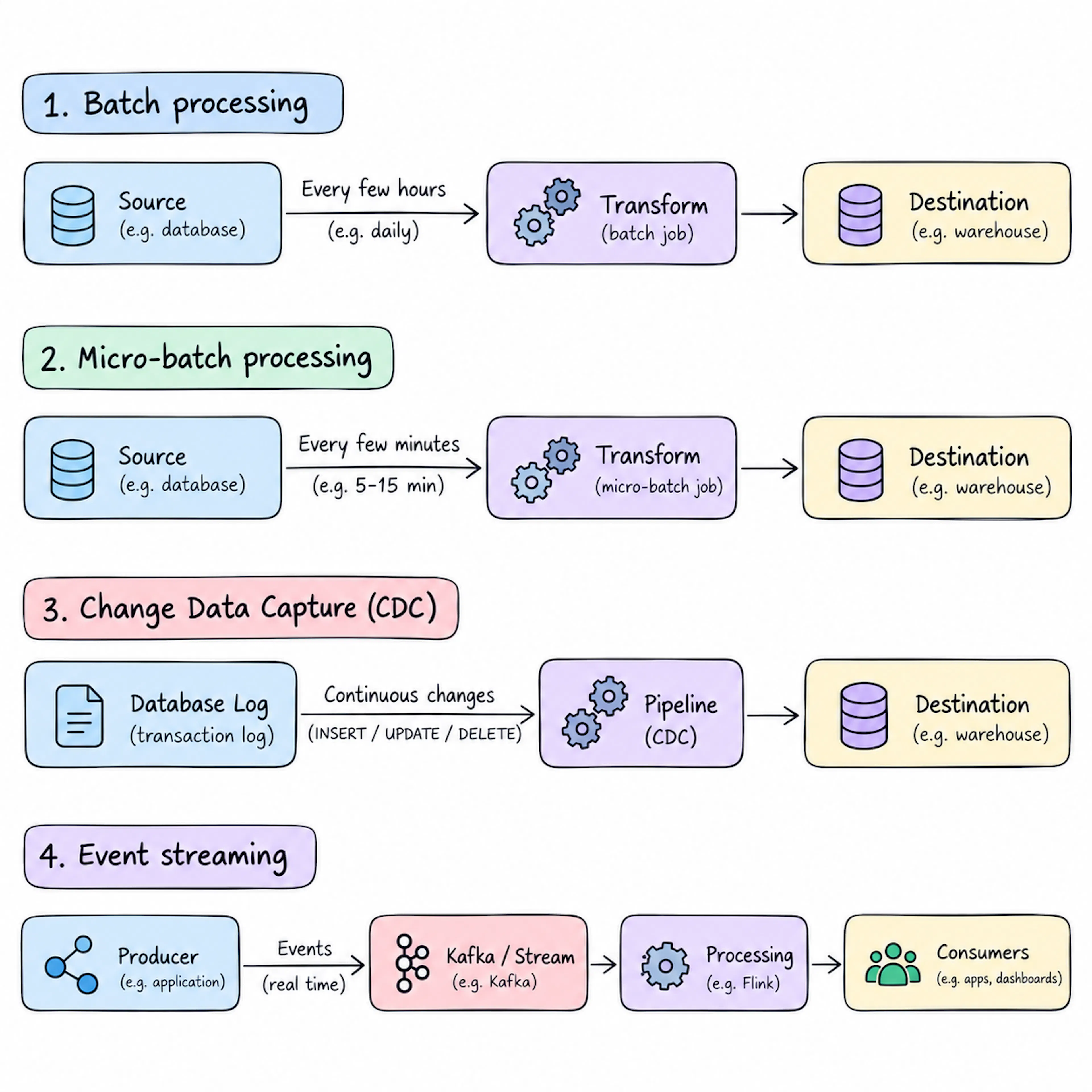 Four types of data transfer are: batch, micro-batch, CDC and event streaming.
There is no comparison when all vendors are measured by their own marketing pages.
In our ranking, we begin with the existing product documentation. This is because the product documentation reveals what each platform can actually do in terms of CDC, streaming, transformation, recovery, schema handling, and deployment.
We also considered customer reviews from the last year on G2, customer case studies, and community discussions on platforms such as Reddit. Community discussions are based on anecdotes, not benchmarks; however, they provide valuable insights into common issues that may not be disclosed in product documentation.
The latest G2 reviews of Estuary mention that they like its quick setup and minimal maintenance effort. There are also mentions that the user interface, training, and troubleshooting could be improved in the product. The number of connectors and ease of setup are usually praised by Fivetran users, and the issues related to cost and MAR pricing are raised frequently. Users of Airbyte appreciate the flexibility and variety of connectors, but they have concerns about reliability and troubleshooting.
The same holds true in recent practitioners' discussions: it is not because of the features of the ETL tools that teams decide to use them. Once the proof of concept stage passes, functionality, usability, single platform, connectors, and cost become important factors .
The factors that are used to compare these tools are:
- CDC functionality
- Streaming capabilities
- End-to-end latency
- Reliability and resilience
- Backfilling
- Schema evolution
- Usability
- Operational complexity
- Licensing and pricing
Publisher’s note: Estuary created this post. We have better insight into Estuary's products than we do for other tools mentioned in this comparison. For competing products, this comparison is based on documentation available from vendors and user reports.
|
Tool Names |
Real-Time Approach |
CDC |
Streaming |
Managed |
Best Used For |
Primary Drawback |
|---|---|---|---|---|---|---|
|
Estuary |
Continuous CDC + streaming + batch |
Yes |
Yes |
Yes |
Mixed real-time and batch pipelines |
More compact connector catalog than some other existing ELT solutions |
|
Confluent |
Kafka + Flink event streaming |
Via connectors |
Yes |
Yes with Confluent Cloud |
Kafka-centric architectures |
More streaming concepts and platform complexity |
|
Striim |
CDC + continuous streaming |
Yes |
Yes |
Yes |
Enterprise database replication |
Enterprise-oriented platform |
|
Informatica IDMC |
Batch + CDC + streaming |
Yes |
Yes |
Yes |
Large, governed hybrid environments |
Wide platform will increase complexity |
|
Google Cloud Dataflow |
Apache Beam stream/batch processing |
Via upstream source |
Yes |
Yes |
Custom GCP stream processing |
Requires Beam/Dataflow expertise |
|
Databricks Lakeflow |
Incremental + streaming pipelines |
Source-dependent |
Yes |
Yes |
Databricks lakehouse workloads |
Strongest inside the Databricks ecosystem |
|
AWS Glue |
Spark ETL + Structured Streaming |
Usually via upstream CDC service |
Yes |
Yes |
AWS-native ETL |
Real-time architecture could include many AWS services. |
|
Fivetran |
Scheduled incremental replication + CDC |
Yes |
Limited as a general stream processor |
Yes |
Low-maintenance warehouse ingestion |
Most traditional pipelines are synchronous |
|
Airbyte |
Scheduled ELT + CDC for supported databases |
Yes, source-dependent |
Limited for replication |
Cloud or self-hosted |
Connector flexibility and open source |
More operations for self-hosting |
Comparison table of real-time ETL approaches among top ETL tools (CDC, streaming, managed, best fit for, and most important disadvantage).
This table explains why such an approach is not relevant for these services. Confluent is primarily a streaming platform. Dataflow is a processing engine. Fivetran is essentially a managed data movement platform. Estuary stands somewhere between the two, being capable of performing CDC, streaming, and scheduled delivery out of the same system.
1. Estuary
Recommended for: Real-time CDC, streaming and batch pipelines without a need to have separate streaming capabilities.
The concept behind Estuary is straightforward – the fact that each destination does not require data to be provided at the same pace.
Some processes require data to arrive instantly while others can afford to wait. The Snowflake analytics table will tolerate some latency while a financial database will only receive updates once a day.
Instead of creating a separate pipeline for each scenario, Estuary uses a unified data stream.
The core architecture looks like this:
Capture > Collections > Derivations > Materializations
A capture extracts data from the source. It can be a log-based CDC with relational databases such as PostgreSQL, MySQL, SQL Server, MongoDB, or Oracle.
The captured data is stored in durable collections. The collections ensure that the data capture process is isolated from the destination of the data.
A single collection can provide input to one or more materializations, which direct the data to the destinations. Should derivations be required on-the-fly, filtering, joining, aggregation, and reshaping of the data can take place in-flight.
This is important if the same source data needs to be used by multiple systems.
Rather than sourcing from the PostgreSQL database thrice for three destinations, the source can be captured once and used for all destinations.
This isolation has implications on how recovery can occur.
Recovery can happen by replaying the already captured data in Estuary collections instead of capturing again from the production source.
When the destination supports the required transactional model, Estuary provides exactly-once transactional materializations. Otherwise, the exactness of the guarantee relies on what the destination supports, which is a key issue to keep in mind when assessing any stream processing solution.
From the operations perspective, this is a great advantage since one does not have to set up Kafka, Debezium, stream processors, connector management, storage, and recovery on their own.
Currently, there are over 200 fully managed connectors, and pricing is calculated depending on the amount of data transferred and usage of connectors. Cloud pricing is $0.50 per GB of data transfered and connector instance usage. Estuary also supports private and BYOC deployments.
The cost of using Estuary is a limited connector portfolio. Fivetran and Airbyte have larger catalogues of connectors, and if the use case requires a large number of SaaS services rather than speedy data transfer, connector compatibility might be worth looking into.
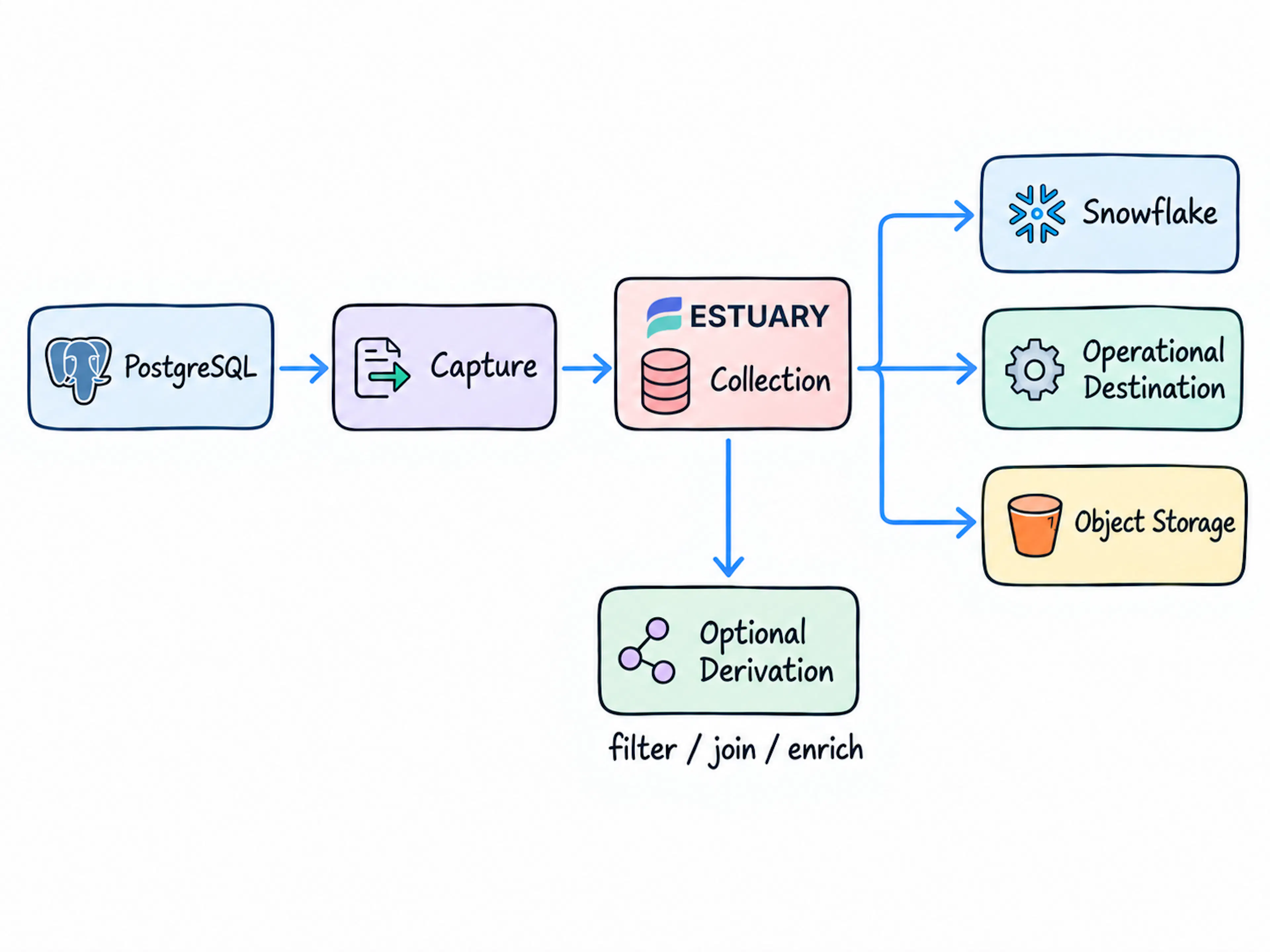 Capture-once architecture of Estuary: Decoupling ingestion from delivery using collections with optional derivations.
The important thing about this diagram is the center collection. The capture and delivery are independent, meaning that a single stream can be used for multiple workloads.
2. Confluent
Recommended for: Kafka-based setups.
Confluent provides integration in real time, coming from the streaming end.
With Confluent Cloud, you get managed Kafka, as well as over 100 managed connectors that cover databases, data warehouses, SaaS applications, object stores, and CDC sources. The data stored in Kafka can be further processed using Confluent Cloud for Apache Flink.
It's useful when Kafka topics are at the core of your infrastructure.
For instance:
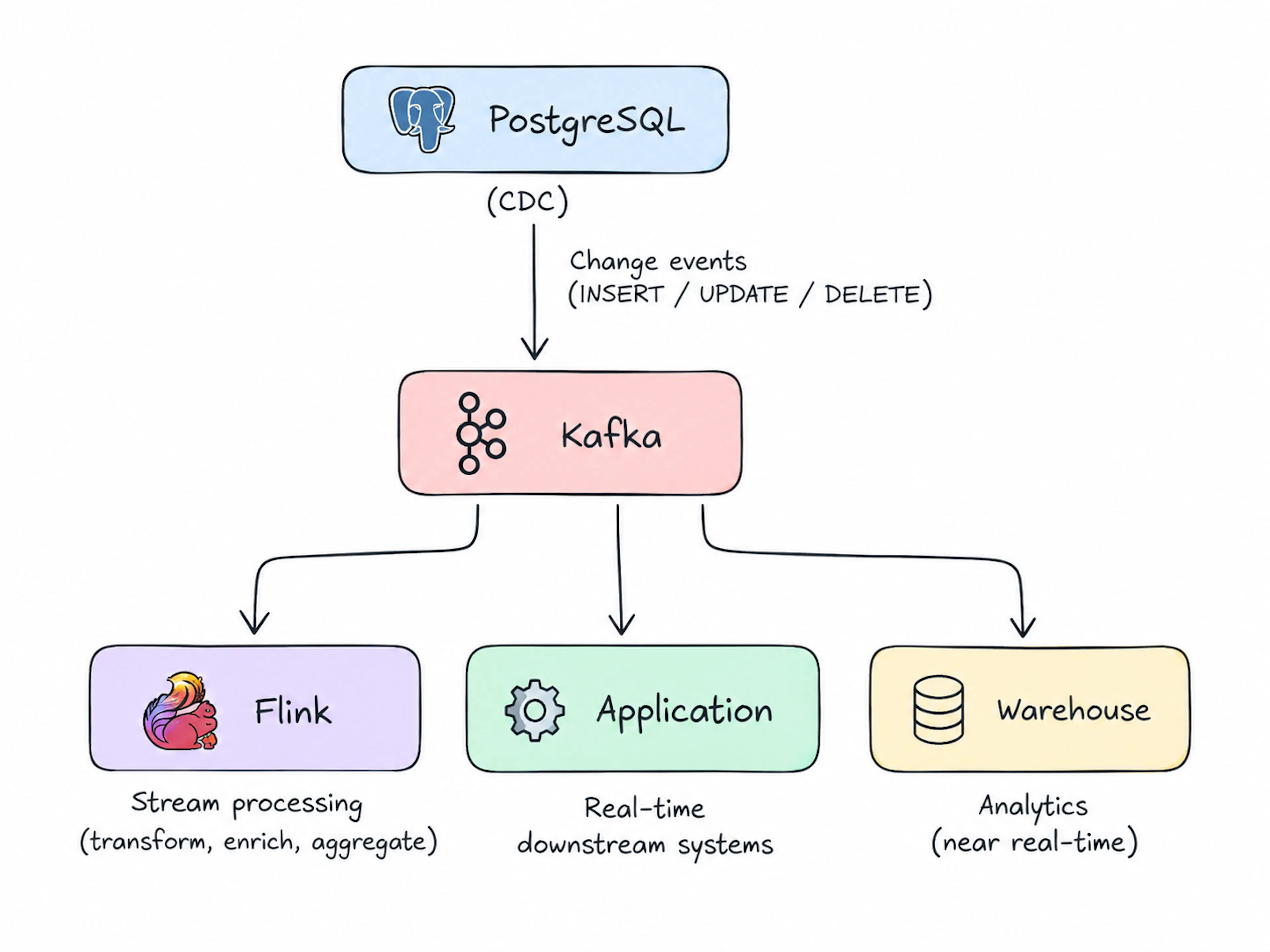 Example Kafka-based architecture: Postgres CDC to Kafka and then Flink for streaming and real-time applications, in addition to the data warehouse.
Flink can perform stateful processing, joins, filtering, and enrichment of the stream of records without the team setting up their own Flink clusters.
The drawback is higher conceptual and architectural complexity.
Confluent takes away a lot of operational complexity of running your own Kafka, yet, the team must know about topics, partitions, schemas, consumer groups, connector capabilities, and stream processing principles.
This learning curve can also be seen from recent G2 reviews where Confluent is mentioned as a way to simplify management of Kafka, however, the cost and complexity of more complex flows are the most frequent concerns.
If Kafka is an integral part of your platform infrastructure, the trade-off may pay off. Otherwise, if you use it just to dump a few databases into the data warehouse, a CDC platform might be a better choice.
3. Striim
Recommended for: Enterprise CDC and database replication.
Striim puts a lot of emphasis on continuous data movement.
The reader modules extract changes from transaction logs rather than polling tables continuously. Striim can do transformation and enrichment during the process of moving those records to databases, data warehouses, Kafka, or any other destination.
It also has the popular migration solution of loading all history initially and then continuous CDC.
So if you are looking for more than analytics, but database replication or synchronization and even a small migration window as well, then Striim would be a good fit.
The main distinction from light-weight ELT solutions is who the tool is meant for.
Striim is primarily designed to be used for enterprise streaming and database replication. So if these are the things you are looking for, Striim may be your solution. Otherwise, you may just have too much functionality here.
4. Informatica IDMC
Recommended for: Large enterprises with integration, governance, CDC, data quality, and more all within an enterprise platform.
Informatica encompasses a wider domain than many of the products listed here.
Through their data ingestion, streaming ingestion, cloud data integration tools, Informatica provides for:
- batch ingestion
- CDC (Change Data Capture)
- database replication
- streaming ingestion
- file types
- enterprise applications
- cloud data integration
Its CDC tool can monitor changes in real-time, and its streaming capabilities can collect, filter, and aggregate stream data from messaging systems and IoT.
This wide range of functionality suits well the large enterprise where the ETL is just part of the picture.
The other things the large enterprise might require include:
- data governance
- data quality
- metadata management
- master data management
- hybrid and on-premises integration
- enterprise access control
All of which can be provided by Informatica.
Note: Salesforce has now fully acquired Informatica, closing the acquisition in November 2025. Informatica continues to operate as part of Salesforce's data and AI strategy through its data management products.
Of course, that means this breadth of functionality also makes the product more extensive and complicated to learn.
This may work for a large company that is regulated. For a small team that only requires PostgreSQL CDC to Snowflake, it would probably be overkill.
5. Google Cloud Dataflow
Ideal for: GCP teams looking for a programmable approach to stream processing.
Google Cloud Dataflow is distinct from a connector-first ETL solution.
It is a managed platform designed to run Apache Beam pipelines that processes both batch and streaming data.
This will be useful in situations when it is necessary to implement custom processing logic rather than copy data from one place to another.
Stream processing in Dataflow works on an exactly-once processing model out of the box. However, there is an alternative at-least-once processing model which is useful when it does not matter that duplicates occur and you prefer reduced latency and cost. Google argues that ETL and CDC-style processing can benefit from such a tradeoff.
Flexibility comes at a cost of extra engineering efforts.
You should be familiar with Apache Beam concepts like event time, watermarks, windows, state, and triggers for advanced stream processing.
In recent practitioner discussions regarding Beam, the primary challenge with Beam becomes apparent, in that some engineers find Beam easier to work with when they apply the batch and stream unified model, while others highlight the steep learning curve and limited ecosystem in comparison with Spark.
For cases where your organization is heavily relying on GCP and requires customized stream processing functionality, Dataflow is a great choice.
For organizations that require only database replication, it might be more than what you need.
6. Databricks Lakeflow
Best for teams utilizing Databricks as the data platform.
Lakeflow integrates ingestion, transformation, pipelines, and orchestration in the Databricks ecosystem.
For streaming use cases, Databricks now recommends Lakeflow pipelines for any future ETL, ingestion, and Structured Streaming work. Pipelines can create streaming tables and process the incoming data.
Lakeflow Connect extended its capabilities for managed ingestion.
As per the Databricks roadmap, managed streaming connectors would have support for Kafka and RabbitMQ by 2026. Other systems such as Kinesis, Pub/Sub, and Pulsar could be ingested through Structured Streaming or Lakeflow pipelines.
Thus, Lakeflow is more relevant when the target of your pipeline is the Databricks lakehouse.
You can ingest the data, clean it, implement quality checks, create streaming tables, and manage downstream jobs on a single platform.
The tradeoff is deciding on the appropriate platform.
Where most of the processing of data is being done in Databricks, having the data ingestion and transformation done in Databricks may make things simpler.
Where the same data source needs to continuously feed Snowflake, operational databases, search engines, and other external services, using an agnostic data movement layer may make sense.
7. AWS Glue
Most Suitable For: AWS teams that need serverless Spark ETL and streaming.
Although AWS Glue is famous for batch Spark processing, it also allows continuous streaming ETL jobs.
Glue Streaming is able to consume data from Amazon Kinesis, Amazon MSK, and self-managed Kafka and write output to S3, Redshift, relational databases, Snowflake, and open table formats such as Iceberg, Hudi, and Delta Lake.
There is a crucial improvement in 2026.
The release of Glue 6.0 allows running real-time Spark Structured Streaming with latency below the typical micro-batch level. However, there are several limitations in the initial release: Glue requires Scala, uses Kafka as a source, performs stateless transformations, and does not provide any autoscaling capabilities yet.
Therefore, while Glue is better prepared for streaming than previously, it is still not fully-featured CDC platform.
An AWS architecture could involve multiple services:
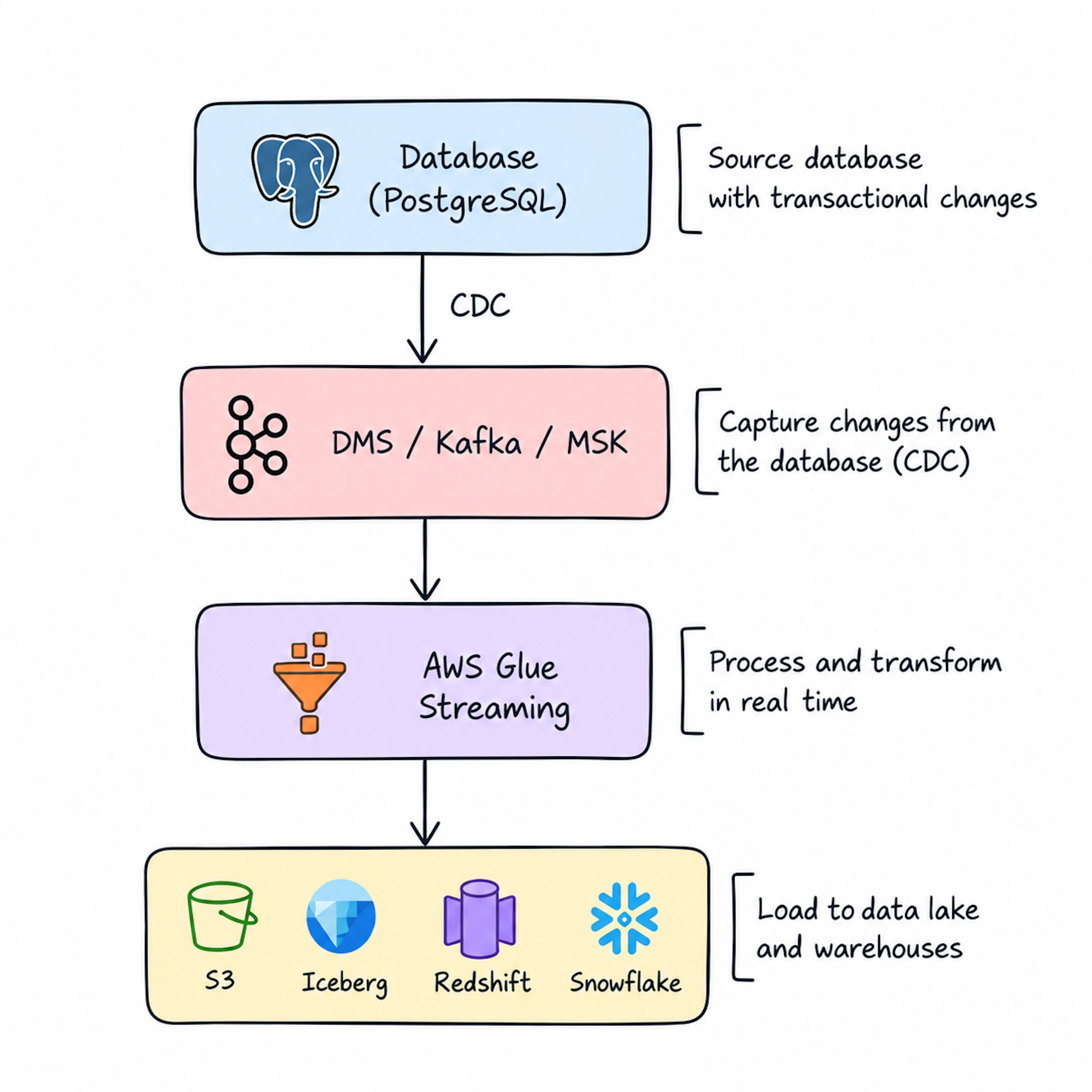 Example AWS real-time ETL: PostgreSQL CDC (DMS/Kafka/MSK) > Glue Streaming > S3/Iceberg/Redshift/Snowflake.
It will suit you if your engineers have experience working with AWS and need granular control.
The problem is the architecture may turn out to be not an integrated data solution but rather a collection of services.
This can be observed from practice as well. The AWS teams tend to implement Glue for heavy processing in Spark, and for some tasks, they resort to more straightforward solutions such as API ingestion.
Fivetran and Airbyte: Where Do They Fall?
Fivetran and Airbyte are worth mentioning here since their examples illustrate that real-time requires context.
Fivetran
Fivetran makes a great choice for managed data loading into a warehouse.
Fivetran utilizes database-native CDC techniques in its database connectors while its High-Volume Agent (HVA) connectors leverage log-based CDC for supported enterprise databases.
However, regular Fivetran data delivery is typically implemented via incremental syncs.
Sync intervals can vary between 1 min and 24 hours, where the 1-min option is only possible for selected connectors and plans. When the next interval comes during the ongoing sync, the next execution may be postponed or skipped depending on the schedule settings.
Therefore, Fivetran can offer a very fresh data source in the warehouse, and its HVA product line enables near-real-time CDC with high throughput. However, the underlying architecture differs from constantly reading and converting the event stream into data.
This architectural distinction becomes especially important if your requirement involves seconds or milliseconds.
Moreover, Fivetran completed its acquisition of dbt Labs in June 2026.
Airbyte
Airbyte does things differently.
First of all, flexibility is their main advantage. They have many open source connectors, and the documentation says that they have more than 600 sources and destinations at the moment.
Airbyte also uses CDC in some of its database connectors, like PostgreSQL connector, which is capable of using CDC and checkpointing for database replication.
But replication in Airbyte is mostly done in a synchronous manner.
According to the connection API, scheduled replication can be performed once per hour, and the users need to request something faster from Airbyte.
Thus, Airbyte is a good choice if you care more about the open source solution, custom connectors or data replication into the warehouse than second by second freshness.
The same is true about Fivetran.
Do not create a streaming system if you need an updated warehouse each five or 15 minutes.
Additional setup makes sense only in case lower latency changes business logic.
Real-Time ETL Using Estuary in Action
A specific example will help to make it clear.
Consider an e-commerce business running its orders database using PostgreSQL.
The same order data is required by this business for a number of purposes, including the following:
- For analysis, through Snowflake
- For an operational downstream system, which needs new orders
- For a slower reporting workload, where writes can be expensive
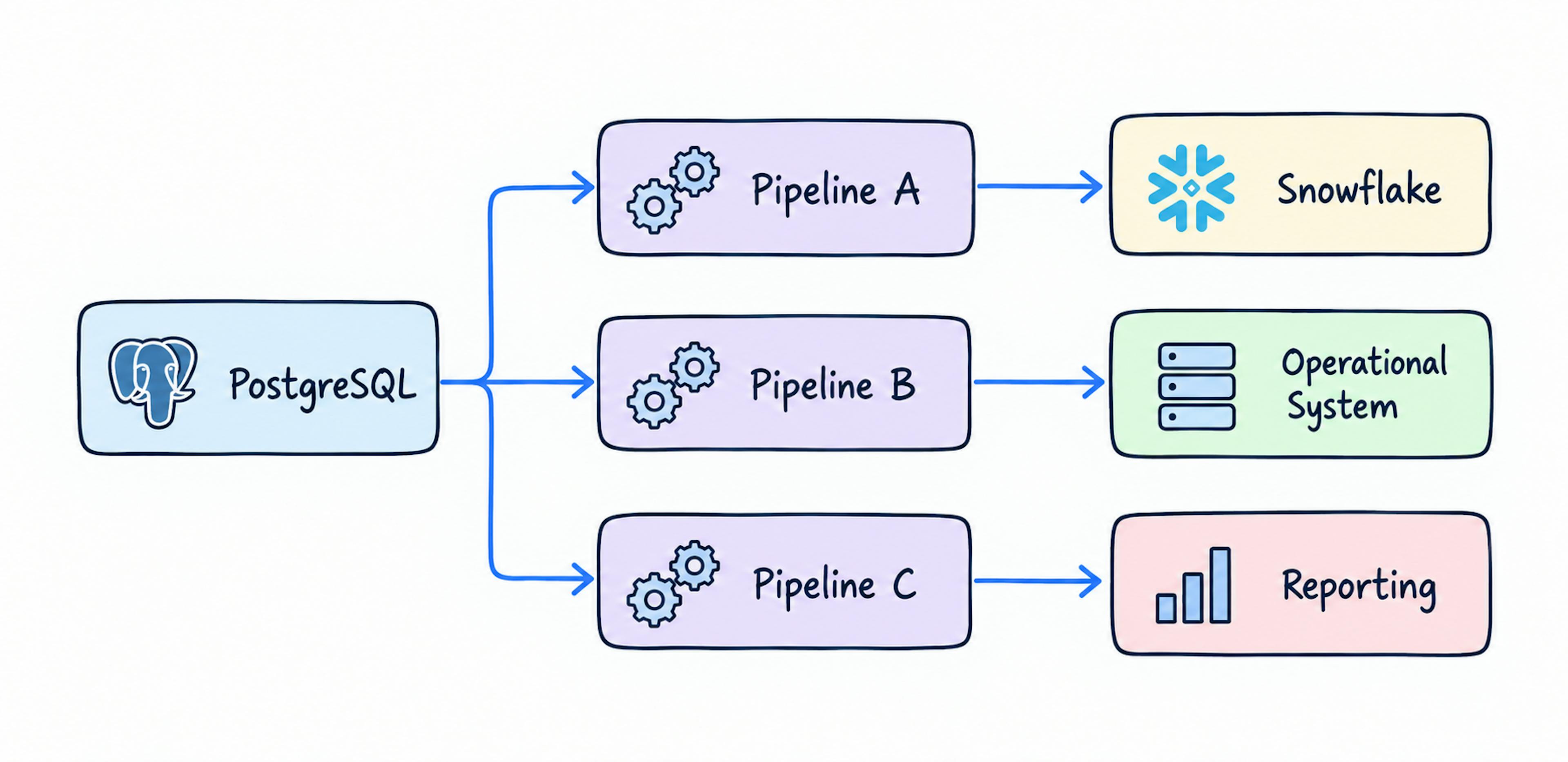
A conventional architecture will result in three distinct pipelines being established.
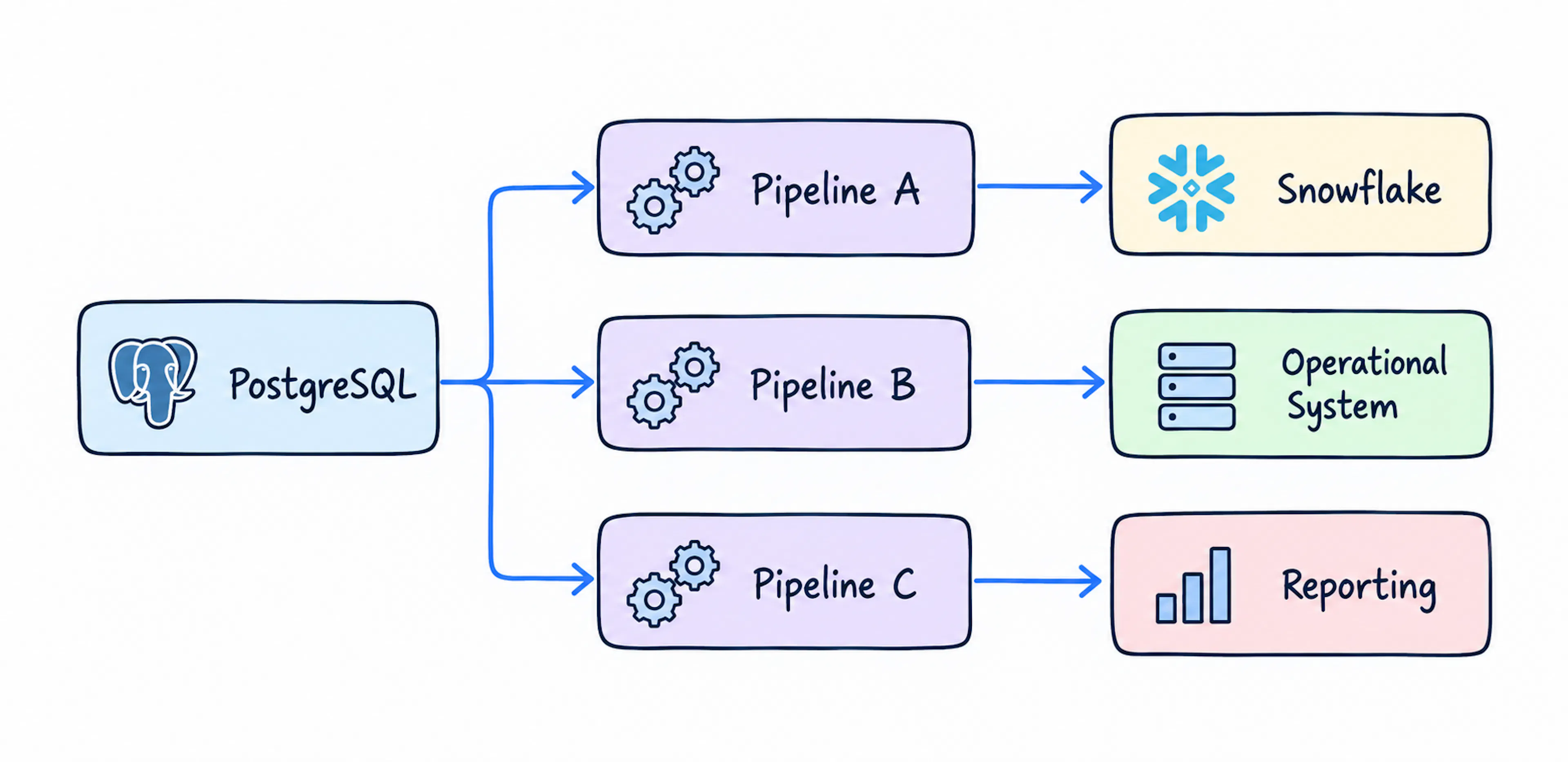 Traditional approach: create individual pipelines between PostgreSQL database and each target separately (Snowflake, operational system, and reports).
This translates to three systems being able to read and verify the source. In the case of Estuary, however, things can be done differently.
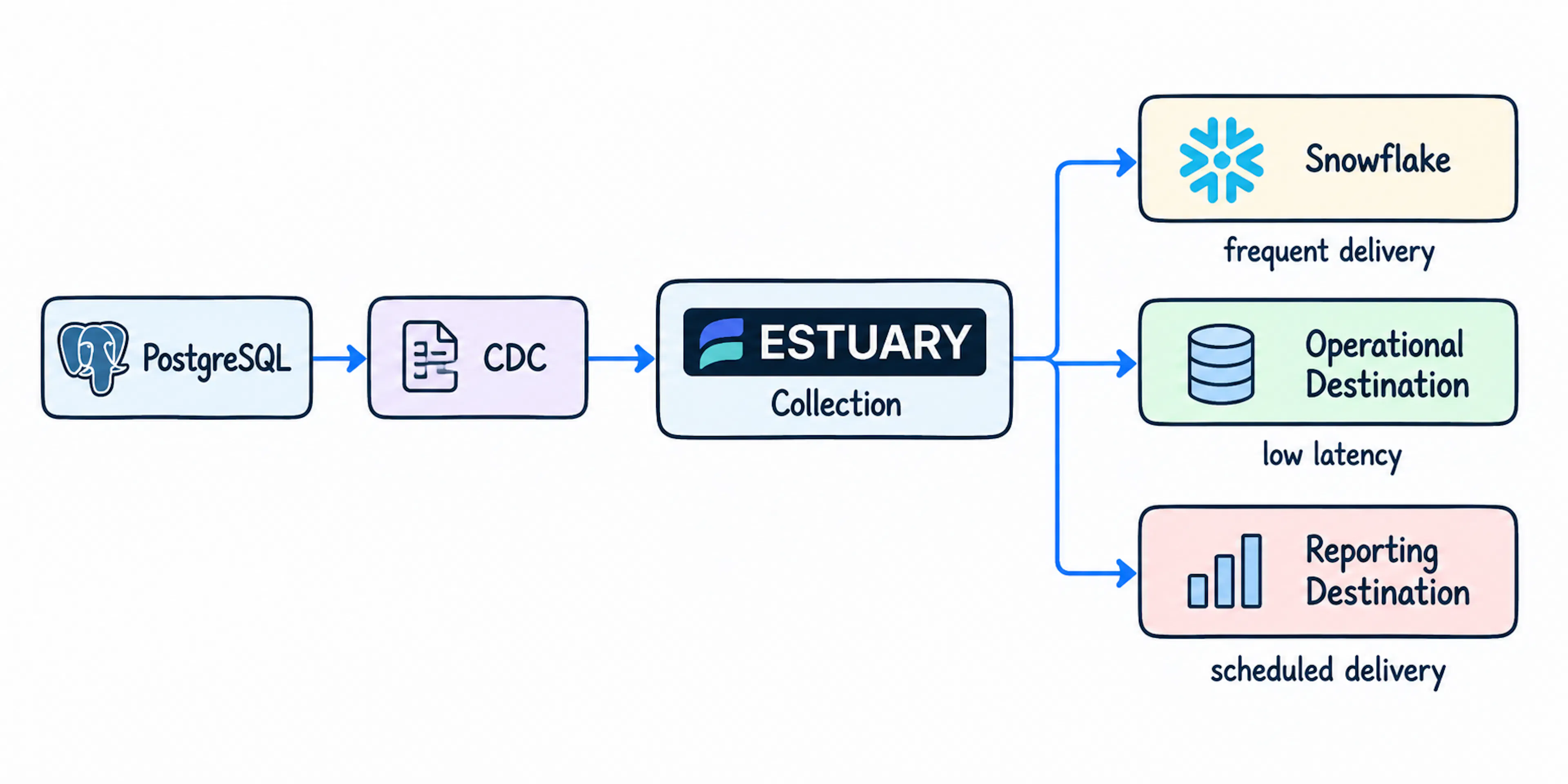 Capture-once CDC: single stream to multiple destinations (quick and scheduled).
Step 1: Load the historical data
Once the PostgreSQL capture has started, Estuary captures the current state of the selected tables.
This is where we have our initial data set.
Step 2: Continue with CDC
After having the baseline, continuous capture of changes from PostgreSQL is done via CDC.
The change in order that has happened in the source is captured continuously rather than being captured at the time of the next batch extraction. This method is used in the PostgreSQL to Snowflake tutorial provided by Estuary.
Step 3: Leverage the same captured data
Collections make that possible.
For Snowflake and the operational destination, there is no need to extract separately from PostgreSQL. The two destinations can leverage the same captured data.
That loosens the relationship between the source and its consumers.
Step 4: Supply each destination with the cadence it needs
The operational destination will require continuous delivery.
Another destination will have to do well with less frequent writes.
Estuary allows you to configure the delivery latency for each individual destination, meaning that you won’t need different stacks for each of your users.
Step 5: Recover but don’t revert to production mode
What if your Snowflake tables need to be re-created?
The materialization can be backfilled from the current state of the Estuary collection instead of repeating a full pull from PostgreSQL.
This minor architectural design consideration becomes important in the context of a production environment.
The pipeline is not only about fast data movement on the way forward but is also concerned with failure scenarios and schema evolution.
When Do You Need Real-Time ETL?
Real-time ETL can be used when old data entails costs.
Fraud prevention
For suspicious activities in card transactions, reacting after half an hour is not efficient.
New data will help risk systems evaluate behavior as it’s still relevant.
Inventory management
An online store may have to modify its inventory and make this information available to multiple systems rapidly.
Old inventory means customers can purchase goods that aren’t available.
Operational analytics
The team in charge of logistics, payments, and customer services can need current information on what’s going on, not from the latest hourly batch.
Personalization
Recommendations work better when recent clickstream, purchases, or product interactions are available.
Applications within Finance
Applications like payments, risk assessments, reconciliations, and monitoring are dependent on up-to-date information.
Applications within AI
Fresh data is necessary for AI as well.
When an AI-driven agent is using outdated customer data, inventory data, or support data, it will make wrong decisions. In other words, the faster the automated process is performed, the greater the importance of the data being fresh.
However, it has another aspect.
If a report is refreshed once per day, then the implementation effort required to make sure that the whole system shows each row in 100 milliseconds will not be justified.
Real-time must solve an issue; otherwise, it makes no sense.
The simplest approach is to begin with the architecture that is really required.
You require database CDC in seconds but you do not want to have Kafka
A managed CDC and streaming platform such as Estuary is appropriate. You can continuously capture changes from databases and deliver them to various targets without setting up and managing your own Kafka, Debezium, storage, and connector stack.
Kafka is an essential part of your business
Consider Confluent. If your applications have already started publishing and consuming Kafka events, using the same platform for connectors and stream processing makes sense.
Governance is just as crucial as latency
Informatica IDMC is more appropriate for large organizations that need governance, data quality, metadata management, and hybrid integration.
Your stack already relies on one cloud
A native approach might make sense.
Use Dataflow if the combination of GCP and Apache Beam aligns with your team, AWS Glue if you’re using AWS as the basis of your data platform, and Databricks Lakeflow if the lakehouse is at the heart of your stack.
You just need minute-level freshness
Don’t overlook classical managed ELT.
If you value minimal maintenance and a broad range of SaaS connectors, Fivetran is a good choice.
If openness and creating your own connectors are important for you, then Airbyte looks like a good option.
The crucial question here is not:
Which platform offers the longest list of features?
But:
Which platform will solve the freshness problem without unnecessary extra infrastructure?
Conclusion
There is no one definition for what constitutes a real-time ETL tool.
The Kafka event stream, PostgreSQL CDC pipeline, one-minute data warehouse sync, and Spark streaming are all ways to transport new data, but each is vastly different.
Hence, do not select an architecture solely based on the latency.
Consider how changes are being captured, how failures are dealt with, how history is backfilled, how schemas are evolving, how many systems you would need to operate, and how much it costs as the data increases.
If you are already using Kafka at your core, then Confluent would make sense. If your data engineering is built on AWS, GCP, or Databricks, native solutions should definitely be taken into consideration. If few minutes of freshness is sufficient, then you may want to consider Fivetran or Airbyte.
In scenarios where CDC, streaming, and batch data transfer are required simultaneously, Estuary approaches things in a different way.
Capture the data once, keep it in a durable collection, and deliver it where it needs to go at the speed each destination actually needs.
This can be easier to do than setting up two separate pipelines for batch and real-time data.
Disclaimer: This article is paid content. HackerNoon’s editorial team has reviewed it for clarity and quality standards, but the views, claims, benchmarks, and comparisons expressed are solely those of the sponsor, and HackerNoon assumes no responsibility for third-party assertions contained in sponsored content.
如有侵权请联系:admin#unsafe.sh