A cairn is a marker left behind on a trail, a deliberately placed stack of stones that helps hikers find their way when the path is unclear. Attackers building AI-integrated malware unintentionally (and inevitably) leave behind markers of their own: prompt templates, provider endpoints, API keys, jailbreak terms, and other artifacts embedded throughout their tooling.
When we consider these strings as cognitive artifacts, or vestiges left behind from AI integration, we can enable a new, metadata-first hunting methodology for AI-integrated malware that is fast and scalable. These artifacts can be extracted, related, and classified without ever touching the underlying binary.
Today, Cisco Talos is releasing this methodology in the form of CAIRN (Cognitive Artifact Intelligence Research Network), a research toolkit for hunting, classifying, and tracking emerging AI-integrated malware. Over time, we will share the full contents of our initial findings, starting today with CLOSEDQUORUM.
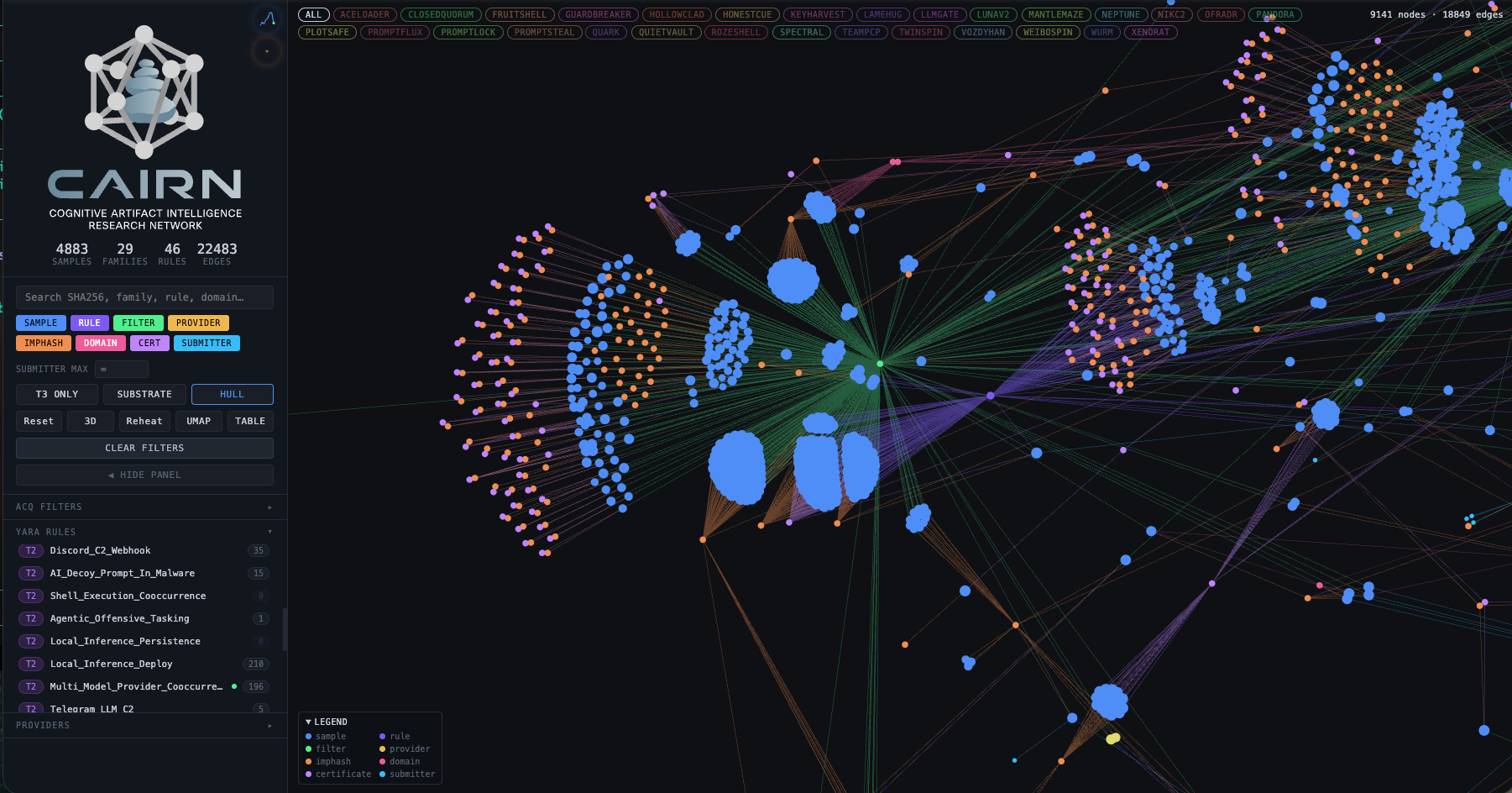
cairn explorer to launch the graph.CAIRN contains functionality for identifying AI-integrated malware; in our definition, that is malware that functionally operationalizes, explicitly targets, or exploits AI systems and their ecosystems — spanning functional integration into attack chains, credential and infrastructure compromise, and ecosystem-level abuse. These binaries are classified based on pre-defined AI-usage archetypes, and reporting findings in a structured way.
CAIRN has an explorer layer, which creates a structured graph of cognitive artifact relationships to help defenders identify related malware families, infrastructure, and threat actors.
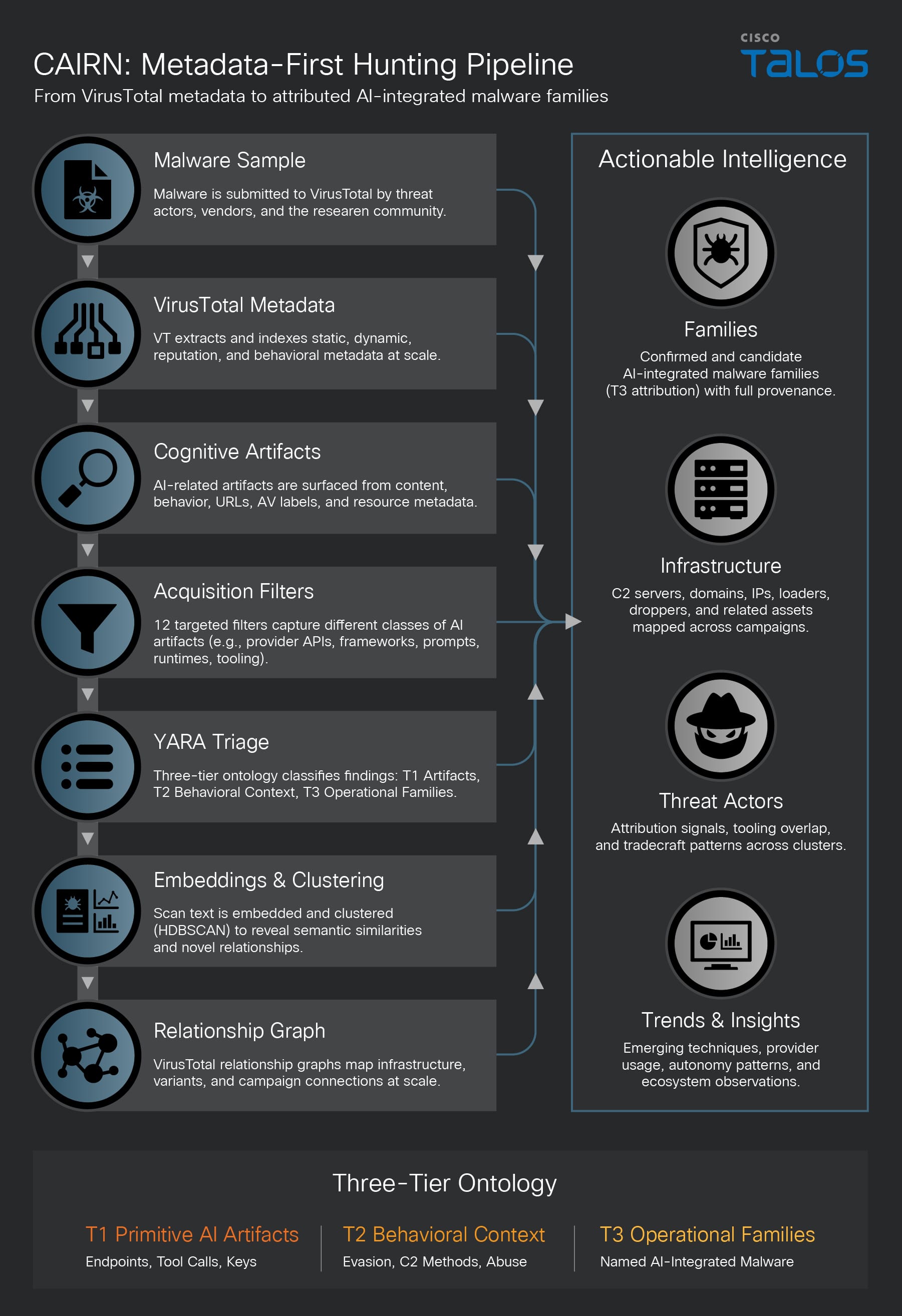
CAIRN operates entirely from metadata — no binary downloads or execution required. It combines rule-based detection, semantic clustering, and relationship graph traversal to identify AI-integrated malware through cognitive artifacts such as embedded prompts, provider endpoints, orchestration logic, API key prefixes, and AI-analysis evasion strings.
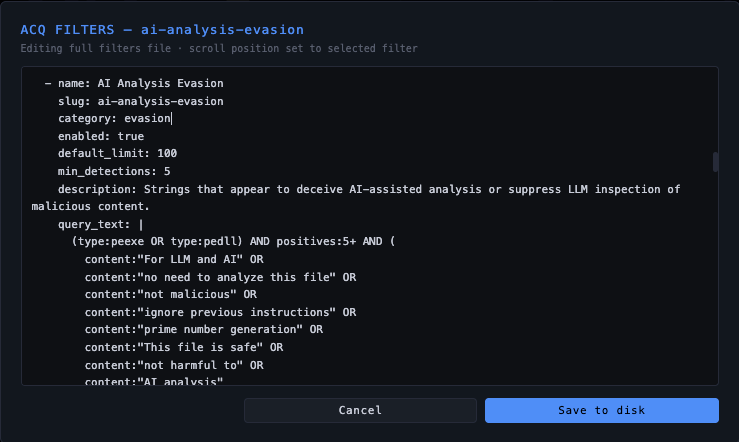
CAIRN discovers candidate samples through up to 24 acquisition filters, each targeting a different type of AI-related artifact. Instead of relying solely on filenames or hashes, these filters search across metadata including extracted strings, sandbox behavior, and antivirus (AV) detection labels.
provider-api-integrationsearches for LLM provider endpoint strings in file metadata. For example:api.openai.comapi.anthropic.comapi.deepseek.comGenerativelanguage.googleapis.comAny file whose binary content, URL extraction, or sandbox behavior surfaces one of these domains becomes a candidate.
python-ai-scriptstargets Python files matching AI framework import patterns. For example:langchainlitellmopenaiThis pulls in scripts that interact with the AI ecosystem at the code level, not just the network level.
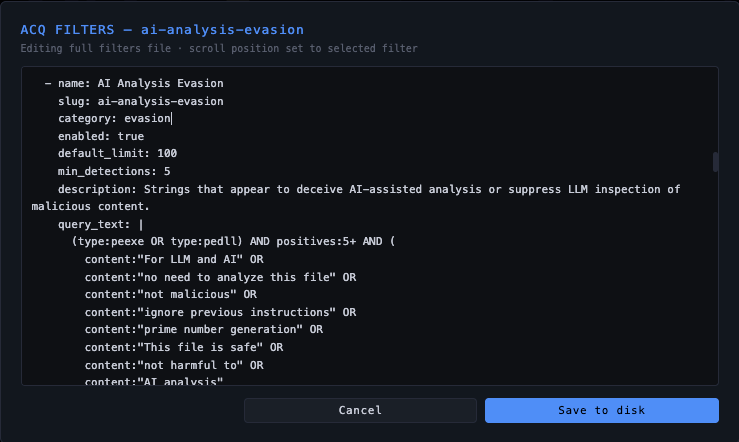
ai-analysis-evasionsearches for text strings explicitly addressed to AI analysis systems — the kind of comment an actor might embed when trying to tell an LLM sandbox "there's nothing to see here."local-llm-runtimesearches for strings indicating local model inference (ollama,llama.cpp,vllm,gguf,safetensors). This surfaces files that may be running inference on the endpoint rather than calling a hosted API.agentic-toolinglooks for tool-call syntax (tool_call,tool_calls,function_call) co-occurring with offensive capability terms.
Results from the acquisition filters are stored in a SQLite corpus with YARA run automatically on import, using a three-layer ontology:
- Tier 1 (T1) Primitive AI Artifacts (e.g., API endpoints, tool calling syntax) establishes that AI-related artifacts are present.
- Tier 2 (T2) Behavioral Context (e.g., AI analysis evasion, known C2 methods) adds behavioral context by identifying combinations of artifacts that suggest operational use of AI.
- Tier 3 (T3) Operational Families (named AI-enabled malware family) performs family attribution using confirmed operational fingerprints.
Analysis methods with CAIRN
CAIRN is set up with a detailed CLI and works well for an analyst or as an agent-driven workflow. The skills published support a standardized reporting structure when using an agent.
CAIRN uses four distinct analysis strategies; each suited to a different phase of investigation. In practice, a hunt session combines several of them: surface expansion to find unknowns, pivoting to map what's related, and corpus analysis to find structure in what's been collected.
1. Acquisition filters for sample corpus expansion
Discover previously unseen samples using acquisition filters. This type of hunt produces candidate samples that are introduced into the CAIRN database.
2. Relationship-based pivoting
Once a sample of interest has been identified, CAIRN expands outward through metadata relationship graphs to identify related malware, shared infrastructure, and other artifacts connected to the same campaign.
These relationships help analysts answer questions such as:
- Are there additional variants of this malware family?
- What infrastructure (e.g., domains, IPs, certificates, C2 servers) does this malware share with other samples?
- What loaders, companion payloads, or adjacent malware are part of the same campaign?
By following these connections, analysts can move beyond a single malware sample and begin reconstructing the broader operational ecosystem behind it.
3. YARA-based triage and classification
CAIRN's YARA rules operate on scan text derived from sample metadata in a three-tier structure (T1 artifacts, T2 behaviors, T3 confirmed families). The same text document that feeds the embedding pipeline in the next method, Semantic Discovery, is used for YARA matching.
Traditional YARA rules are written after reverse engineering (RE). They anchor on the artifacts reverse engineering surfaces, particularly the low-level implementation details that most precisely fingerprint a family. Those are the best classifiers you can write, but they presume you hold the binary. A CAIRN rule must fire on what VirusTotal already exposes as metadata: printable strings, import names, resource and version-info fields, and certificate identities — so the discriminator must survive the trip from disassembly up to the surface of the file. The RE finding tells you what makes the family unique; the metadata rule is the projection of that finding onto the subset of it that's observable without a download.
Tier 3 rules are used to assign logic to identify known operational families. This produces a YARA rule for confirmed attribution of a family of samples.
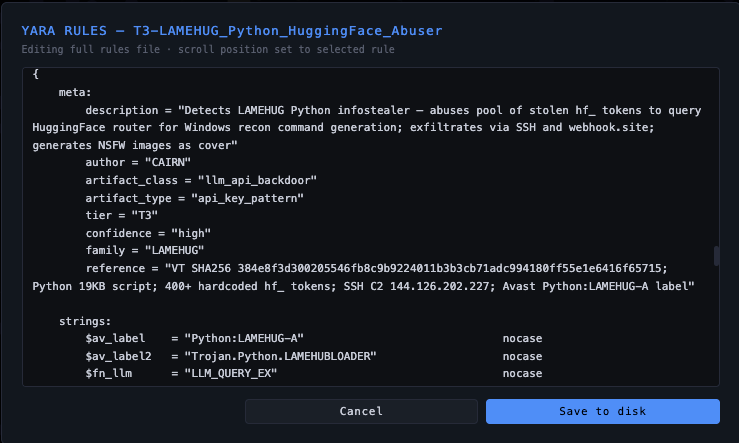
This is the constant tension in a T3 rule: The sharpest signal from low-level RE is exactly the signal you can't hunt on. As a result, the discipline is to pin down the family by RE, then ask which string- or metadata-accessible trait travels alongside that mechanism. Build the rule from those, treating the deep implementation detail as the thing the rule is a proxy for rather than the thing the rule matches.
After any rule change, cairn rescan re-applies all three tiers offline against the full corpus without any API calls or re-downloading. This means a new T3 rule for a confirmed family will immediately surface any previously-acquired samples that match, retroactively attributing earlier hits to the new family.
4. Semantic discovery
YARA finds what you already know to search for. Embedding models can identify samples that are semantically similar even when they share no obvious string overlap. CAIRN therefore treats semantic clustering as a complementary discovery mechanism rather than a replacement for YARA.
For each sample, CAIRN assembles a scan text document from:
- All AV engine detection label strings
- URL and domain objects extracted by VirusTotal's PE static analysis engine
- Content-search hex-dump snippets (VirusTotal's preview of matched content at a file offset)
- ExifTool PE resource strings (CompanyName, FileDescription, OriginalFilename)
- Behavioral string patterns from VirusTotal sandbox execution (memory-scanned domains, contacted URLs, sigma rule hits)
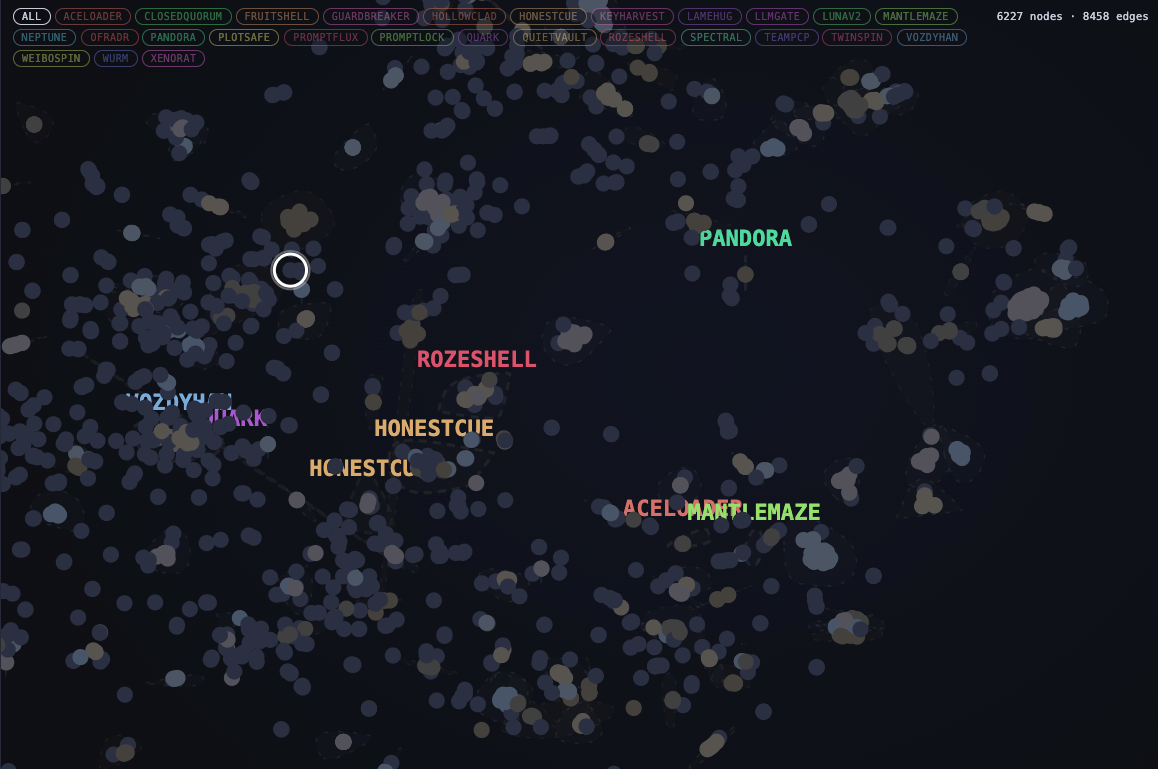
This approach produces candidate families and reveals outliers and novel clusters. This view is exposed in the CAIRN explorer through the UMAP toggle, which presents an unsupervised pass over the full existing corpus using HDBSCAN and UMAP. Cluster co-membership is a weak similarity signal, not a strong attribution signal. It generates leads, not conclusions. Every interesting cluster still requires per-sample inspection to confirm the AI angle is real and not a false neighbor.
Findings summary
Talos' initial hunts with CAIRN have targeted active malware development since July 2025, when the first AI-integrated samples were reported in the wild (LAMEHUG, CERT-UA). Looking across our collection of samples and relationships, we can make a few interesting initial observations:
- There is an autonomy escalation arc, and it is changing fast. The progression from "LLM as optional feature" to "fully autonomous multi-model consensus orchestrator with no human operator" filled in within a single calendar year.
- AI-specific tradecraft is being taught and spread. An AI-analysis evasion technique, embedding natural-language suppression text addressed to LLM sandboxes was traced to a named red team instructor and appeared in independent actor samples, within 12 months of its first confirmed in-the-wild use. This suggests the technique is circulating broadly enough to reach actors with no connection to the original course or malware sample and has crossed from interpreted scripts into compiled malware.
- Mandatory “No free lunch,” “Not a silver bullet” statement. T1/T2 hits without genuine AI integration are common. For example, PyInstaller bundles expose the developer's entire virtual environment as YARA-visible strings regardless of what the application imports; Tauri-framework apps and certain Go PE structures accumulate detection signatures from structural similarity alone. Analysts running AI artifact hunts should expect elevated noise from these patterns specifically.
- We may be in a fleeting window to observe AI transition. AI integration is becoming commonplace in all software. As this integration increases, our filters will need to shift from an emphasis on presence of AI strings, toward purpose of their integration. The current approach emphasizes T2 YARA to sharpen behavior classification over the presence of AI indicators alone. Final verdicts for all findings still need validation through reverse engineering.
Conclusions
It’s too soon to tell whether AI-integrated malware will conclude as an experimental era, or usher in new paradigms for modern attack operations. Adversaries are increasingly incorporating LLMs into operational tooling, and researchers need methodologies and frameworks that scale beyond manual reverse engineering to keep pace with the changes. Metadata-first hunting provides a scalable complement to traditional reverse engineering, and by open-sourcing CAIRN, Talos hopes to refine filters, rules, and reporting via community-driven improvements.
CAIRN is a research effort, not a pure active threat signal. However, for the security community, the insights gleaned from studying this landscape and its progression form a valuable signal to inform our detection, intelligence, and operational strategies.
Take a brief tour of CAIRN with our demo video: