The fastest enterprise AI coding assistant rollout on record at one organization took two months. Th 2026-9-21 16:10:27 Author: hackernoon.com(查看原文) 阅读量:7 收藏
The fastest enterprise AI coding assistant rollout on record at one organization took two months. Thousands of engineers, production data classified as trade secrets, full access to a generative AI coding tool. Two months.
The slowest, at a comparable organization, is still stalled after eighteen months. Same class of tool. Same vendor. Same pitch deck. Different outcome, and the difference had nothing to do with the AI.
Across semiconductor manufacturing, life sciences, financial services, and automotive engineering, organizations are discovering the same thing: the tool works. The environment it lands in usually does not. These are industries where intellectual property is not a corporate talking point but a survival requirement — chip designs that represent billions in R&D, pharmaceutical formulations under FDA regulation, proprietary trading models, safety-critical vehicle control software.
What follows are the patterns that separate the organizations that deploy AI coding assistants at scale from those that stall at pilot, drawn from rollouts across these IP-intensive sectors. The failures are predictable. So is the path that avoids them.
Why Enterprise AI Rollouts Get Pulled Back
There is a pattern that keeps repeating across IP-sensitive industries, and anyone who works in enterprise IT has probably watched it happen.
An AI coding tool gets approved as a pilot. Enthusiastic developers adopt it. Usage grows. Then, somewhere around month three, the security organization takes its first hard look at the environment the tool is running in and finds problems that have nothing to do with the AI itself: no meaningful threat detection, flat networks with no segmentation, permissions that accumulated over a decade, no guardrails governing what data can reach an external model.
The security team does the only responsible thing it can do. It pulls access, or freezes expansion, while the gaps get fixed.
At that point the rollout is not paused. It is poisoned. Engineers who lost access become skeptics. Leadership reads the freeze as evidence the technology was not ready. The eventual relaunch fights uphill against its own history. Multi-quarter timelines turn into multi-year ones.
The specifics vary by industry, but the underlying dynamic is identical:
- Semiconductor manufacturing: A model that can see source code for process control algorithms is one misconfiguration away from exposing trade secrets that represent decades of R&D. Security teams will not tolerate ambiguity here.
- Life sciences: FDA-regulated environments carry compliance requirements that extend to every tool touching production data. An AI assistant operating outside validated boundaries is a regulatory finding waiting to happen.
- Financial services: PII, trading models, and transaction data are governed by regulations whose penalties are measured in percentage of global revenue. A coding assistant with uncontrolled data flows is an audit failure.
- Automotive engineering: Safety-critical control code for vehicle systems operates under functional safety standards like ISO 26262. An AI tool generating suggestions in this domain without traceability and boundary controls is a liability.
In every case, the AI tool is rarely the thing that stalls the rollout. The environment underneath it is. The organizations that move fastest on AI are, almost without exception, the ones that fix the environment first.
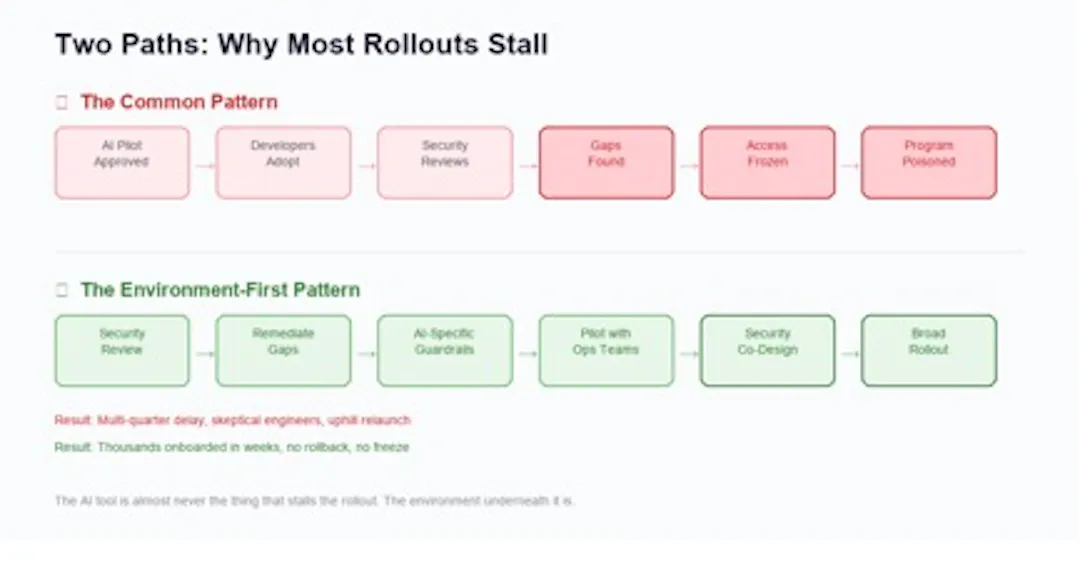 Two paths: why most rollouts stall and how the environment-first approach avoids it.
The Unglamorous Year Before the Fast Rollout
The organizations that achieved the fastest rollouts did not start with AI at all. They started with production incidents, audit findings, or architecture reviews that had nothing to do with generative models.
In the most successful cases, an unrelated incident became the catalyst for a comprehensive architecture and security review across the entire cloud environment. Structured reviews of this kind, modeled on the well-architected review frameworks that every major cloud provider publishes, are sometimes treated as a box-checking exercise. Done seriously, they are an audit of whether a foundation can carry what the organization is about to put on it.
Across organizations in multiple IP-sensitive sectors, these reviews surface a consistent set of gaps:
- No threat detection covering the cloud environment.
- No network segmentation isolating sensitive workloads from everything else.
- No monitoring that would notice an anomaly before a human did.
- Nothing resembling AI-specific guardrails of the kind the OWASP guidance for large language model applications now describes, because until then there had been no AI to govern.
Fixing these gaps typically takes the better part of a year of weekly working sessions between the organization's network and security teams and their cloud architecture partners. The work follows the same shape everywhere: threat detection deployed across accounts, a properly segmented network architecture with real boundaries between zones, monitoring and alerting, and a guardrail layer designed for generative AI specifically — controlling what data can flow to models and logging what comes back.
Alongside the technical work, the organizations that succeed invest heavily in internal enablement — workshops and working sessions so the teams understand not just what changed but why. In semiconductor environments, this means walking through IP classification boundaries. In life sciences it means mapping AI data flows against validation requirements. In financial services it means demonstrating how guardrails enforce the same data-handling policies that already govern non-AI systems.
None of this appears on any AI roadmap. All of it turns out to be the AI roadmap. Because when the coding assistant conversation finally arrives, the security organization is not meeting the cloud environment for the first time. They helped rebuild it. There is nothing left to discover mid-rollout, and mid-rollout discoveries are what kill these programs.
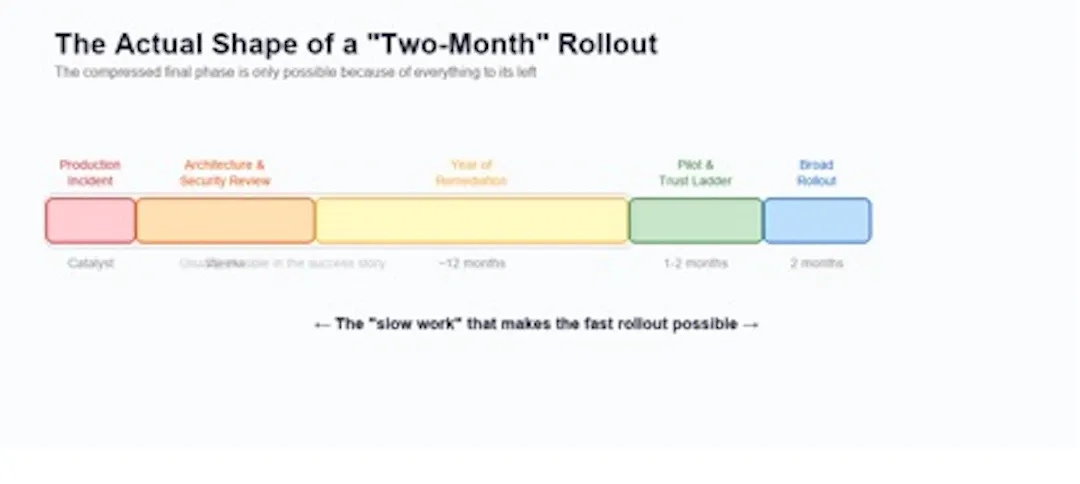 The actual shape of a "two-month" rollout. The compressed final phase is only possible because of everything to its left.
The Trust Ladder: Sequencing People Before Scaling Seats
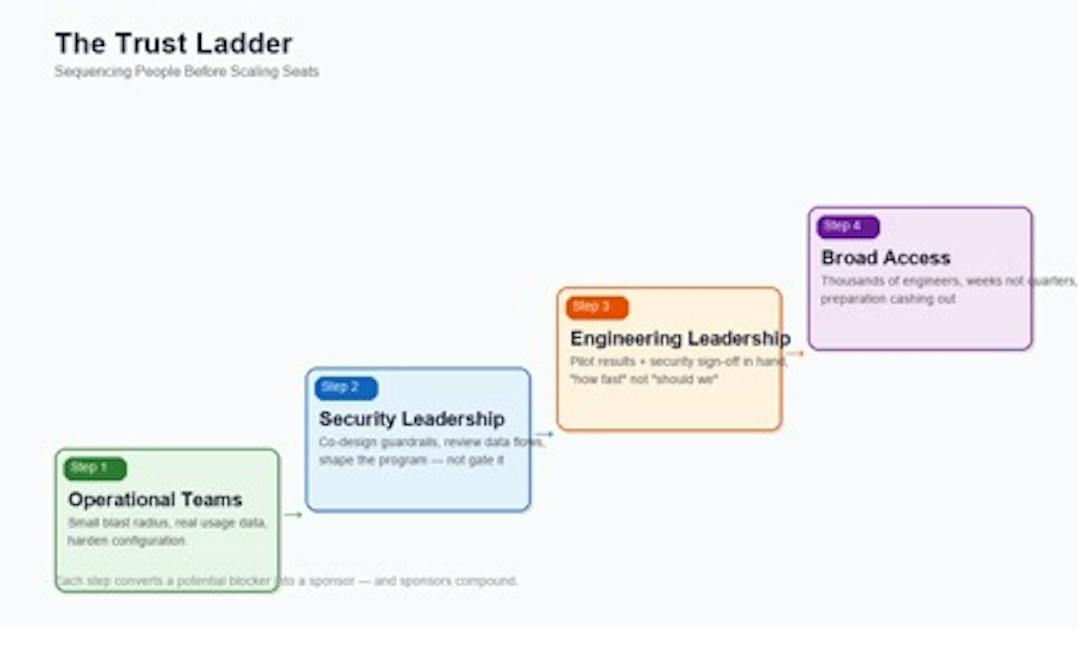
The second thing successful organizations do deliberately is sequence who comes on board, and in what order. The instinct in most rollouts is to go wide fast, because seat counts look like progress. The organizations that scale fastest go narrow first, in a specific order, and this is why going wide later takes weeks instead of quarters.
Step 1: Operational teams first
The engineers closest to daily infrastructure and incident work pilot the assistant, generate real usage data, and surface practical issues while the blast radius is small. Their feedback hardens the configuration, and their results provide something concrete to show instead of vendor slides.
Step 2: Security leadership as the second customer
This ordering matters more than anything else in this article. Most rollouts treat security as a gate to pass on the way to launch. The organizations that succeed treat them as the second customer. Security leadership reviews the guardrail design, the data flow boundaries, and the audit logging while adoption is still small enough to change anything they object to. By the time broad expansion is proposed, the people with the power to freeze the program have already shaped it. No one pulls back a rollout they co-designed.
Step 3: Senior engineering leadership
They come third, with the pilot results and the security sign-off in hand. At that point the conversation is not "should we allow this tool" but "how fast can we responsibly expand it," which is a different meeting entirely.
Step 4: Broad access
Then, and only then, broad access opens. In the fastest cases, thousands of engineers onboard within two months, which is compressed by any enterprise standard. Typical enterprise AI rollouts at this scale run multiple quarters, and the published industry surveys on generative AI adoption keep finding that most organizations struggle to move from pilot to production at all.
The speed is not courage. It is the year of preparation cashing out.
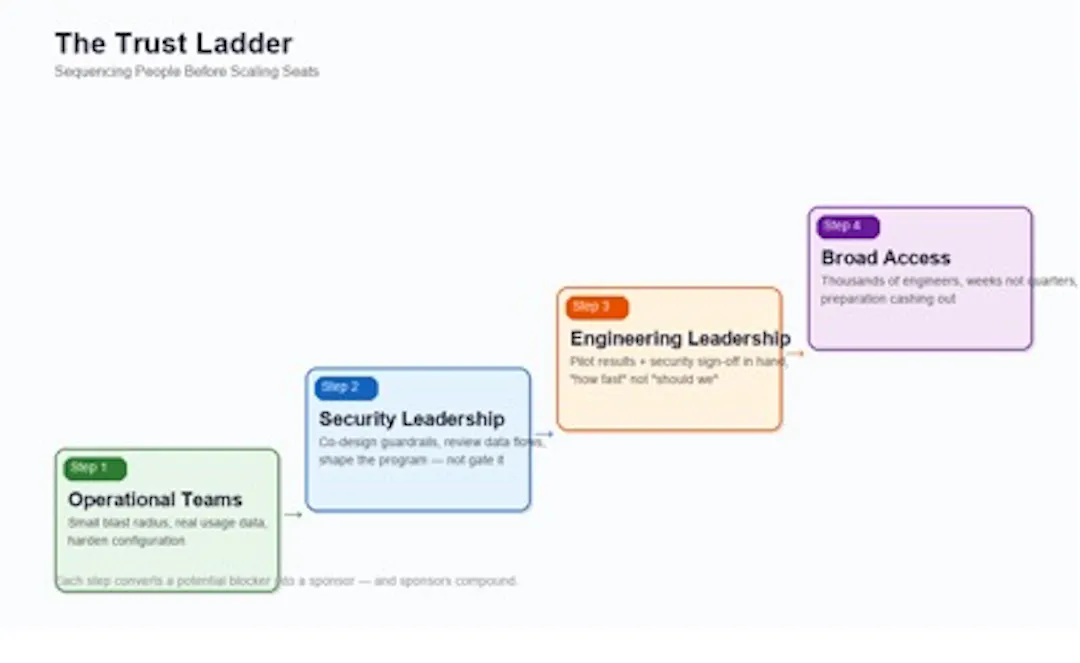 The Trust Ladder: each step converts a potential blocker into a sponsor.
What Broad Access Looks Like in Practice
A few concrete choices help the wide phase hold up across every engagement, regardless of industry.
- Guardrails stay on from day one, for everyone. Data boundaries governing what source material can reach the model, logging on interactions, and clear acceptable-use guidance ship with the tool, not after it. In industries where IP leakage carries regulatory, competitive, or safety consequences, this is the difference between engineers being allowed to use the assistant on real work and the tool being restricted to toy problems. An assistant that can only be used on toy problems produces toy results, and toy results kill executive sponsorship.
- Outcomes matter, not seats. Adoption counts flatter every rollout. What sustains these programs is internal measurement showing double-digit percentage improvements in engineering productivity across participating teams. Whatever the precise number turns out to be, the practice of measuring it is what converts the rollout from an experiment into a budget line.
- The assistant never gets pulled back. No security freeze, no scope reduction, no relaunch. For an enterprise AI deployment in IP-sensitive industries, the absence of a rollback is one of the strongest results an organization can claim.
What Organizations Should Do Differently
For any organization staring at an AI coding assistant rollout for a large engineering population in an IP-sensitive industry, the counterintuitive advice is to spend the first budget on things that are not AI.
- Run the comprehensive review before the pilot, not after the incident. Every gap found and fixed pre-launch is a mid-rollout crisis deleted from the future. The gaps are almost certainly there. Environments that grew organically for a decade always have them, and an AI deployment will drag every one of them into the light.
- Treat the security organization as an early customer, not a late-stage gate. Bring them the design while it is still changeable. The goal is that by launch day, the people who could stop the program have fingerprints on it.
- Sequence trust deliberately: operators, then security leadership, then engineering leadership, then everyone. Each step converts a potential blocker into a sponsor, and sponsors compound.
- And be suspicious of any enterprise AI success story measured in weeks, until you find out what happened in the year before it. Compressed rollouts are real, and worth pursuing. But the compression is earned somewhere. The organizations moving fastest on AI right now are, almost without exception, the ones that quietly did the slow work first.
如有侵权请联系:admin#unsafe.sh