The other harness engineersOn July 1, the European Space Agency posted an opening for a Harness Eng 2026-9-20 15:36:29 Author: hackernoon.com(查看原文) 阅读量:16 收藏
The other harness engineers
On July 1, the European Space Agency posted an opening for a Harness Engineer at its technology center in the Netherlands. The job has nothing to do with AI. On a spacecraft, the harness is the bundle of wires that carries power and signals between components, the part that keeps an expensive machine from talking over itself.
Two months later, Pieter Levels looked at Y Combinator's newest batch, saw nothing but harness startups and hardware startups, and concluded that software is mostly dead.
The engineers in Noordwijk would find that split strange. Hardware has always needed a harness. And a harness, in the sense Silicon Valley now uses the word, is software. So the useful question isn't whether software survives the harness era. It's which part of software does.
Disclosure up front: I co-founded Dojo Coding, which builds agent harnesses for companies and trains developers. This essay argues that most harness code isn't worth building. Weigh that in whichever direction you like.
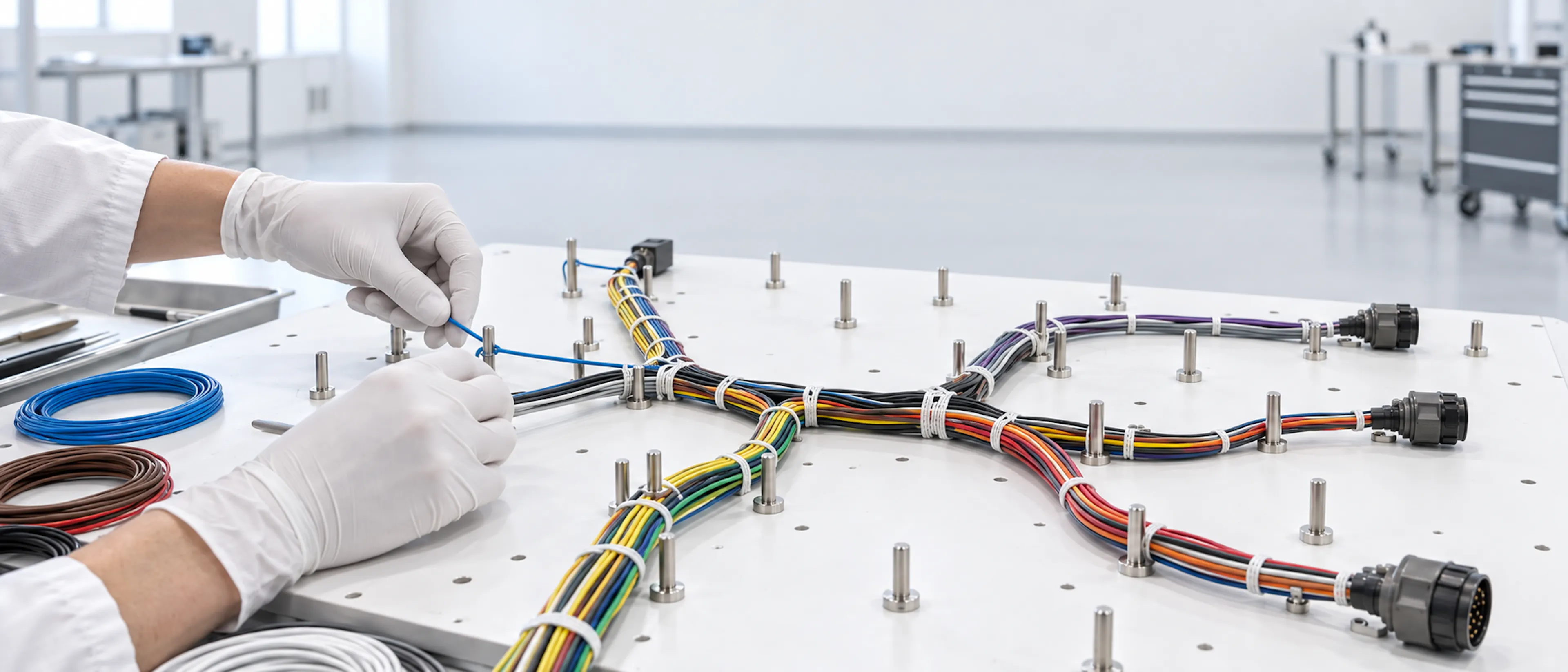 The original harness engineers route power and signals between components. Image generated with GPT Image 2.5.
The claim, taken seriously
Levels' post is four sentences of logic. A YC batch contains only harness or hardware startups. The most early-adopting place in tech has stopped building software. It's debatable whether anyone will need a custom harness if frontier labs offer one generically. Therefore, in his words, "software is mostly dead and hardware it is."
It deserves a real hearing. Levels vibe coded a flight simulator to a million dollars in annualized revenue in 17 days while most of the industry was still arguing about autocomplete. This post also caps a summer-long drumbeat on his blog: San Francisco calling software commoditized, a party where everyone roughly agreed software might be dead, a warning that indie hackers could be the first developers to go extinct. And it lands in a market that already panicked once this year. In a single week of February, Forrester reported more than a trillion dollars of market value wiped off software stocks, on fears that AI agents would replace the workflows those companies sell.
Still, his own archive is the best evidence against his conclusion. On September 4, he wrote that after weeks of trying to build his own ScrapingBee, he'd keep paying for it. Five days later, he posted that he'd vibe coded an alternative and swapped a $249 monthly plan for a $1 scraper. The same day, he said that replacing a stack of SaaS tools with his own services saves him about $25,000 a month. Back in March, he described Photo AI as a single 40,870-line PHP file bringing in about $105,000 a month.
Every one of those things is software. What changed is who writes it and who gets paid. Demand moved from buying software to building it. That's a repricing, not a funeral.
Levels also published a post this month titled "The smartest people I know have strong opinions weakly held." Fair enough. Let's hold this one to that standard.
Read the batch again
Levels doesn't say which batch he saw, but YC's directory already lists Fall 2026 companies. A quick scroll turns up drone fleets for emergency response, autonomous CNC factories, robots for AI data centers, and a voice-first hardware interface for talking to agents. It also turns up a coding agent for C and C++, autonomous video editing for non-editors, simulation environments for verifying high-stakes software, and agents that handle tourist visa applications end to end.
So the claim that the batch holds nothing else doesn't survive the scroll. A visa agent and a video editor are application software by any reasonable definition.
The bigger problem is definitional. LangChain's anatomy of an agent harness, the framing most of the field now uses, puts it bluntly: "If you're not the model, you're the harness." Every piece of code, configuration, and execution logic around the model counts. By that standard, nearly every AI startup that doesn't ship atoms is a harness startup, and a batch full of harness startups is a batch full of software startups. The premise refutes the conclusion.
Hardware isn't a new arrival at YC, either. Back in 2015, the accelerator announced a record 22 companies building physical products in a single batch. What is new is how hardware gets priced. PitchBook counted a record $18.6 billion flowing into robotics and physical AI in the second quarter of 2026, with much of the attention on the software that lets machines act on their own. A robot's brain is increasingly a model plus a harness. The hardware boom is a software boom with a body.
Some of that hardware is literally a harness for humans. That voice-first device in the Fall batch exists so people can direct their agents. Harness and hardware aren't rivals. They're converging on the same job.
 One bundle, two bodies. Image generated with GPT Image 2.5.
The best case for "software is dead"
Here's the part most rebuttals will skip. Levels' strongest point isn't the batch. It's the second half of his post: the harness itself might not last.
The evidence is real. Anthropic's engineers describe building context resets into a long-running coding harness because Claude Sonnet 4.5 tended to wrap up work early when it believed its context window was nearly full. Opus 4.5 mostly stopped doing that, so the resets came out. With Opus 4.6, the sprint structure that broke work into chunks came out too. Dan McAteer, writing for Latent Space, describes the cycle as training models inside the harness, letting them absorb it, then deleting what they absorbed. Citing an Anthropic engineer, he notes that the Claude Code team recently deleted 80% of its system prompt.
Google DeepMind's Logan Kilpatrick went further on Sequoia's Training Data podcast, arguing that the current rush to build agent harnesses has roughly a year of runway before models take that scaffolding in-house. And platforms are absorbing what the weights don't. Google now uses one agent harness, Antigravity, as the common layer across products from Search to the Gemini app. The generator-and-evaluator loop Anthropic wrote up in March now ships inside Claude Code as a built-in /goal command.
So here's the honest concession: if your harness is generic, Levels is right about you. A planner loop, a compaction strategy, a subagent orchestrator, a thin wrapper around someone else's coding agent: each one sits on a frontier lab's roadmap. You're building a feature they will ship for free.
The coast moves
Now look at where Anthropic's own write-up lands. After stripping out everything newer models no longer needed, its author concludes that "the space of interesting harness combinations doesn't shrink as models improve." It relocates.
The rule underneath is precise. In that experiment, a separate evaluator agent paid for itself only on work beyond what the model could reliably finish alone. On one build, a solo agent ran for 20 minutes, cost $9, and produced a retro game maker whose actual game didn't work. The full harness ran for six hours, cost $200, and produced one you could play. Better models push that boundary outward. Ambition follows. The harness stays at the edge.
And the edge still decides a lot. LangChain moved its coding agent from the top 30 to the top 5 on Terminal Bench 2.0 by changing only the harness. McAteer cites Harness-Bench, which ran the same model on the same 106 tasks inside different harnesses and got scores anywhere from 52.4 to 76.2. He also points to OpenAI tripling a model's ARC-AGI-3 score, from 13.3% to 38.3%, with two harness settings. Same weights, wildly different results. If generic harnesses were enough, those gaps wouldn't exist.
Demand refuses to die on schedule, too. Working from Indeed data, Citadel Securities found postings for software engineers climbing even as the replacement story went viral. Levels' own line about more apps and fewer sales is the same fact seen from the seller's chair: prices per unit collapse while volume explodes. That's Jevons, not a eulogy.
A harness isn't scaffolding around a finished building. It's a shoreline. Every model release is a tide that takes ground, and the coast moves with it.
 The harness lives at the waterline. What the tide absorbs stays visible underneath. Image generated with GPT Image 2.5.
The Absorption Test
If you want a primer on what a harness is, HackerNoon already has good ones from Evangelos Pappas and Sneha Gullapalli. I want to answer a narrower question: which parts of your agent stack deserve your engineering time?
Everything in a harness faces two absorbing forces. The weights, where the next model does the thing natively. And the platform, where a frontier lab ships the thing as a default. So run every component through two questions:
- Would a better model make this unnecessary?
- Would a frontier lab plausibly ship this as a default?
A yes to either means it's mechanism. Rent it, keep it thin, and plan to delete it. Anthropic's engineers advise revisiting a harness with each new model release for exactly this reason. A no to both means it's policy. Build it, version it, test it, and treat it as the product.
Anyone who has studied operating systems will recognize the old principle of separating mechanism from policy. The labs will own the mechanism. The policy is yours.
Run the usual suspects through it. Task decomposition fails: models are learning it. Context compaction fails twice: models are being trained for it, and agent SDKs handle it automatically. A generic evaluator loop now ships built in. Sandboxes, shells, and file access are platform plumbing. Tool connectors split down the middle: protocols standardize the pipe, not the meaning of what flows through it.
What passes? Four things. Together they spell PACT.
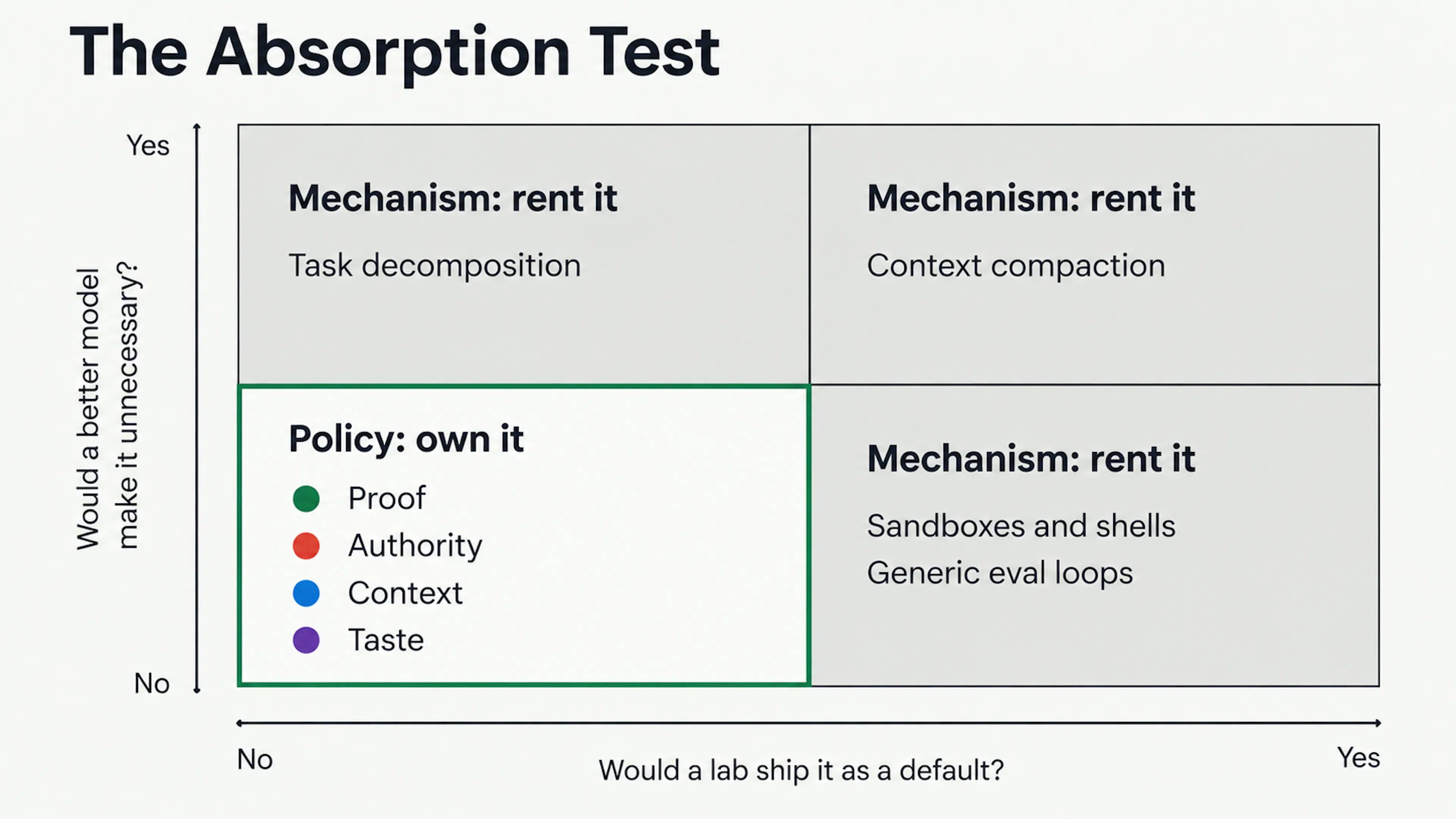 The Absorption Test: anything a better model or a lab default can replace is mechanism. Diagram generated with GPT Image 2.5.
Proof. Evidence that behavior matches intent. Birgitta Böckeler, in her harness engineering guide on martinfowler.com, singles out verifying functional behavior as the part the field hasn't cracked. Anthropic found agents grading their own output generously even when a person could see it was mediocre. The more code gets generated, the more proof is worth.
Authority. Who and what may act, with which permissions, and who signs off. A platform can hand you a sandbox and an approval prompt. It can't decide what your agents are allowed to touch.
Context. Local truth: your systems of record, what your data means, and which conventions in your codebase carry weight. Böckeler frames the harness as a way to spell out the experience a senior developer carries in their head. No public training set contains your organization.
Taste. The rubric that turns "good" into something gradable. Left alone, models default to safe, forgettable output. Anthropic had to write explicit grading criteria that penalized generic design before its agent produced anything distinctive. Your standard is yours to encode.
McAteer reaches a similar place from the model's side. Once everything absorbable is gone, he argues, what remains are human-centered capabilities like permissions, identity, and trust. His sharpest line: "Absorption doesn't end the harness. Absorption inverts the harness."
PACT also rations the scarcest input in the system. OpenAI's Ryan Lopopolo, whose team built a product that grew to roughly a million lines of code without writing any of it by hand, said it plainly on Latent Space: "The only fundamentally scarce thing is the synchronous human attention of my team." A good PACT layer spends that attention only where proof is missing.
If you prefer political metaphors, a harness is a constitution for a workforce that never sleeps. Splitting the generator from the evaluator is a separation of powers. Permissions are enumerated powers. Approvals are due process. Evals are judicial review. Models will keep getting smarter, but nobody expects a smarter population to write your constitution for you.
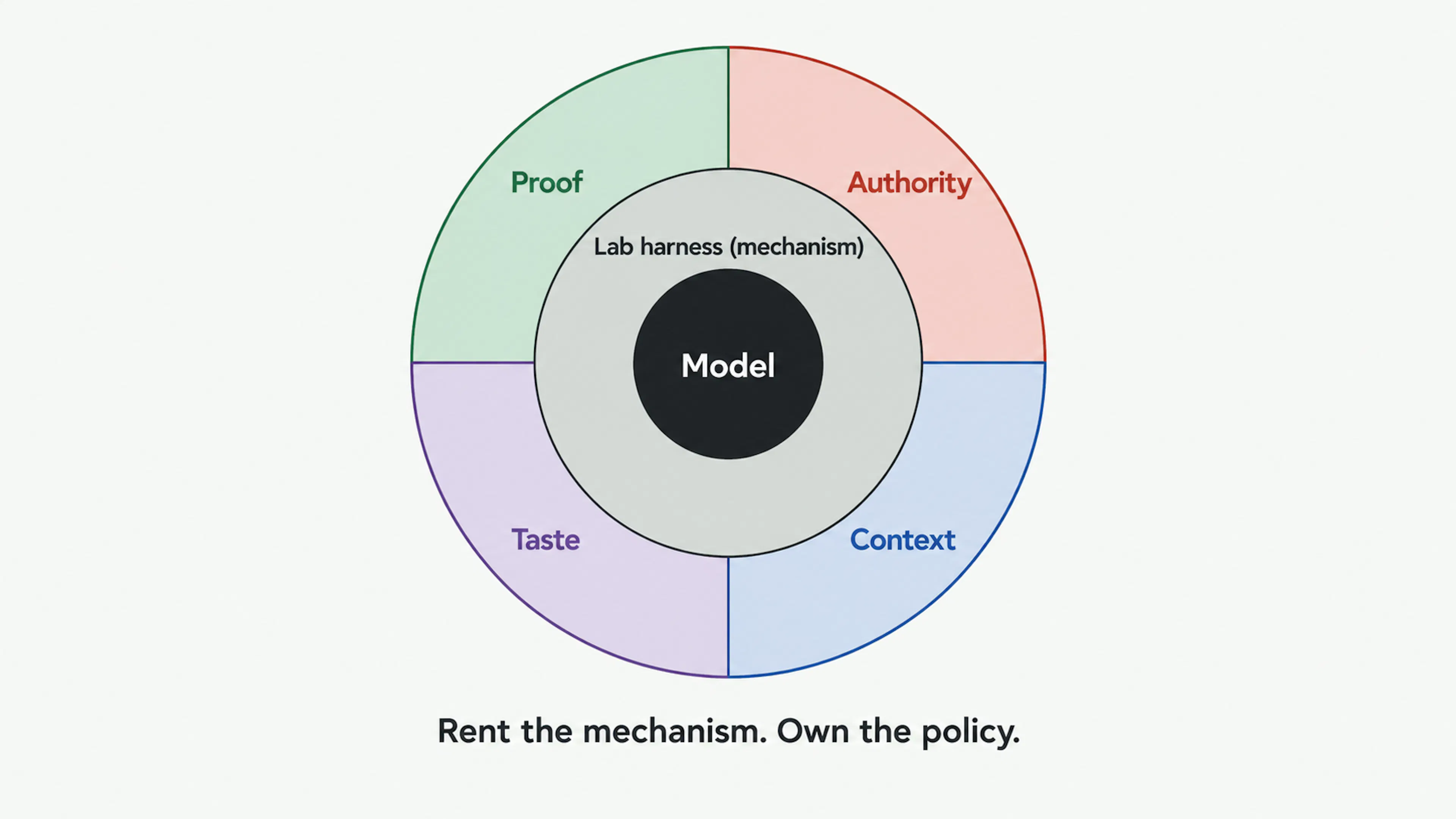 Rent the mechanism. Own the policy. Layout adapted from Birgitta Böckeler's concentric harness diagram on martinfowler.com. Diagram generated with GPT Image 2.5.
What to do on Monday
If you build software, move your craft from producing code to producing proof. Learn evals, sensors, rubrics, and permission design. Learn the mechanism well enough to delete it without fear.
If you bet on companies, as a founder or an investor, stay away from mechanism. Back policy in domains where proof is expensive and liability is real: finance, health, law, industrial operations. In hardware, underwrite the autonomy software and the human interface, not the chassis.
If you buy technology for an engineering organization, rent the lab's harness. Build your PACT layer as versioned, tested code. Then run the Absorption Test again every time a new model ships.
How I could be wrong
Strong opinions, weakly held, means writing down what would change my mind. Here's what I expect by September 2027, including two calls that favor Levels:
- Major labs ship more generic harness patterns as defaults: planning, verification, and evaluator loops. (Point to Levels.)
- Several well-known generic coding-agent wrappers pivot, sell, or shut down. (Point to Levels.)
- Same-model scores on major agent benchmarks still vary materially by harness.
- Most of YC's next batch is still software under the "not the model" definition.
- Leading physical AI companies are still valued mainly on their models and autonomy stacks.
And here's what would prove me wrong outright: labs shipping agents that arrive already configured with your organization's permissions, data semantics, quality standards, and verification, and companies accepting them without writing any policy of their own. If that happens, PACT was absorbable after all, and Levels wins.
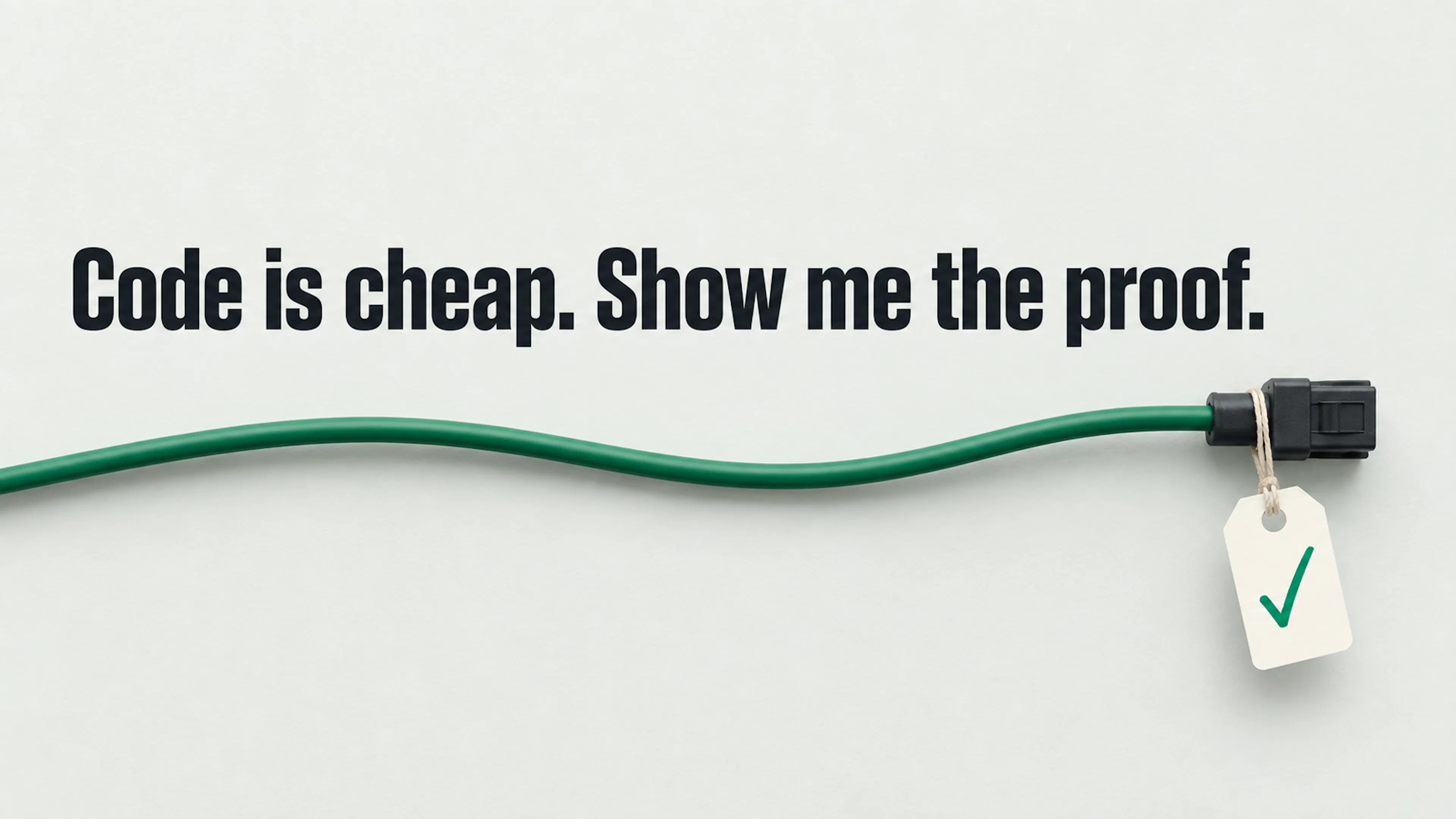
Code is cheap. Show me the proof.
Linus Torvalds once settled a mailing-list argument with one line: "Talk is cheap. Show me the code."
The models have made his currency cheap, too. Code now arrives by the million lines, faster than any team can read it. What doesn't arrive by default is evidence that it does what we meant, inside the limits we set, to a standard we'd sign. That evidence is what a harness produces. No frontier lab can ship it to you, because it was never theirs to ship.
Software isn't taking its last breath. It's changing what it's made of.
Code is cheap. Show me the proof.
AI assistance: research and drafting support from Claude. Images generated with GPT Image 2.5. The argument, the edits, and the final text are mine.
Juan C. Guerrero is an Effie-winning creative director turned tech entrepreneur, co-founder of Dojo Coding, founder of Tech Jungle, and author of The Last Skill. More at juancguerrero.com.
如有侵权请联系:admin#unsafe.sh