From Principles to PipelinesIn Part 1, we made the case that an AI system is only as effective as th 2026-9-18 09:32:28 Author: hackernoon.com(查看原文) 阅读量:17 收藏
From Principles to Pipelines
In Part 1, we made the case that an AI system is only as effective as the information it receives, and we described what makes context reliable: relevance, freshness, completeness, trustworthiness, and authorization. Those five dimensions are useful as a checklist, but they raise an obvious follow-up question. How do you actually produce context that meets them, for every request, at enterprise scale?
That is the work of a context pipeline. A prompt is a single instruction. A context pipeline is the system that decides what information reaches the model, in what form, and under what controls, every time a user or application asks a question. This article walks through how that pipeline is built, from the raw data sources all the way to the assembled prompt, and shows how cloud-native services make each stage practical.
Key Takeaways
- Enterprise context comes from many sources, and each source needs a different retrieval strategy.
- A context pipeline turns raw data into a response through a repeatable sequence of steps: retrieval, ranking, filtering, deduplication, summarization, compression, access control, and prompt assembly.
- Context window limits make optimization a first-class design concern, not an afterthought.
- Vector databases and knowledge graphs solve different problems, and many enterprise systems need both.
- The Model Context Protocol (MCP) gives AI systems a standard, governed way to reach live tools and data.
Context Comes From Everywhere
Enterprise knowledge does not live in one place. It is spread across systems that were never designed to serve an AI model.
A useful context pipeline begins by recognizing where that knowledge actually sits:
- Structured databases hold transactions, customer records, and business state.
- Documents and files carry policies, reports, contracts, and operational know-how.
- APIs provide real-time access to internal and external services.
- Application logs capture operational signals and system behavior.
- User interactions reveal preferences, history, and intent.
- Knowledge repositories store curated, domain-specific expertise.
- IoT and event streams produce continuous data about the physical and operational environment.
Each of these sources answers a different kind of question, and each needs its own handling. Structured data can be queried directly. Documents usually need to be chunked and indexed for semantic search. APIs need to be called at request time. The pipeline's job is to reach into these systems and bring back only what a given task requires.
On AWS, this maps onto a familiar set of building blocks. Amazon S3 provides scalable, secure storage for documents, datasets, and unstructured content. Amazon Aurora and Amazon DynamoDB serve structured and transactional data with low latency. Amazon OpenSearch Service handles semantic and keyword retrieval over indexed content. AWS Lambda runs the logic that fetches data from APIs and other systems on demand. The point is not the specific service names; it is that a well-designed pipeline gives every source a clear, governed path into the model's context.
The Context Assembly Pipeline
Once you know where the data lives, the next question is how it becomes a response. An enterprise AI request is rarely just "user question plus model." Between the two sits a sequence of processing steps that determine the quality of the answer. We call this the context assembly pipeline.
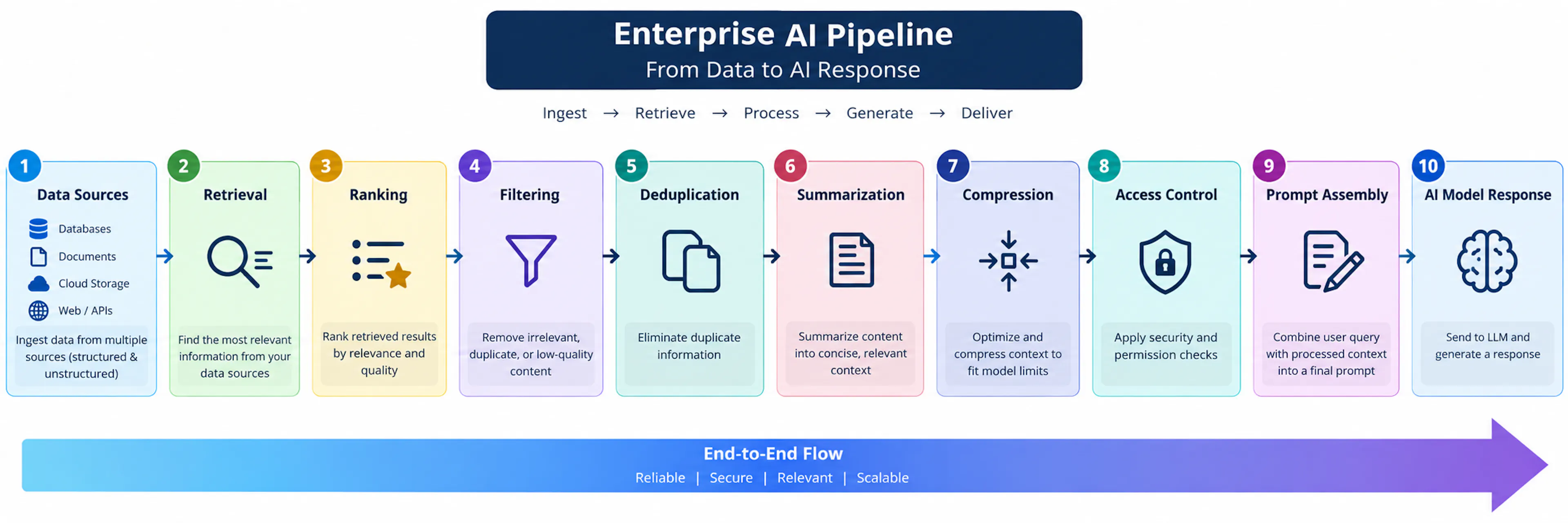
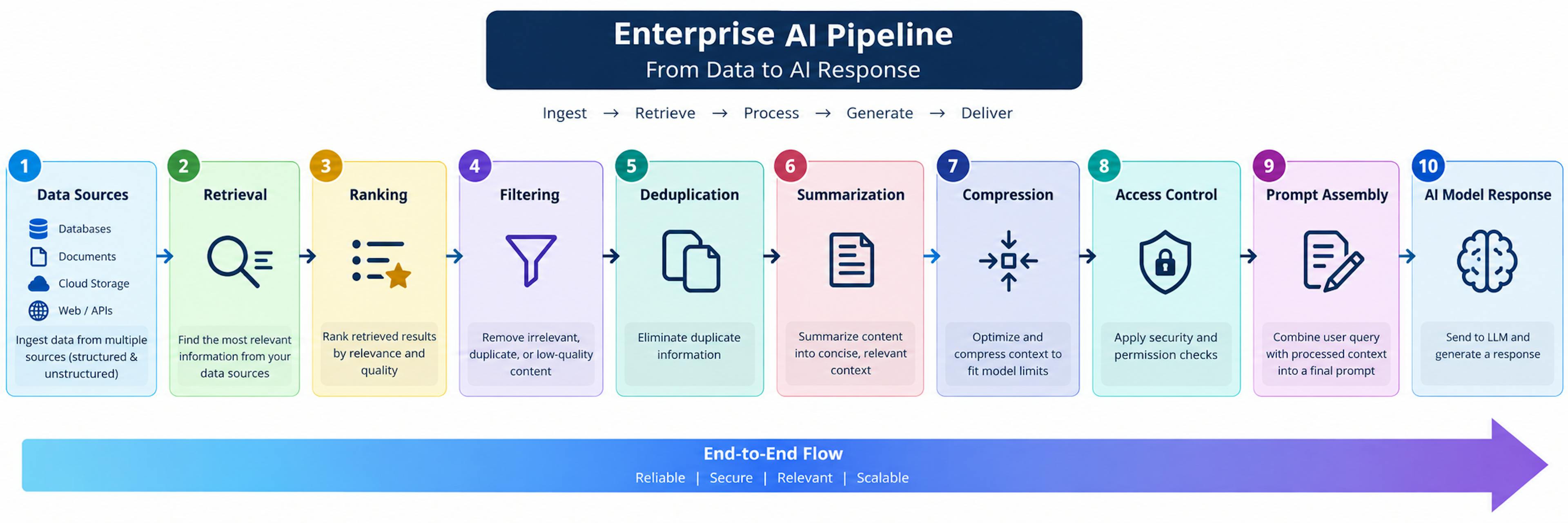
Each stage has a specific role:
- Retrieval locates and gathers candidate information from enterprise data sources, based on the user request or the task the AI system is performing.
- Ranking scores the retrieved candidates and prioritizes the most relevant and useful information, so the most valuable content reaches the model first.
- Filtering removes information that is irrelevant, outdated, or low quality, keeping only context that supports the task.
- Deduplication collapses repeated or near-identical content, which is common when the same fact appears across multiple documents or systems.
- Summarization condenses long passages into shorter forms while preserving the essential meaning.
- Compression trims the assembled context to fit within the model's limits, keeping the most important tokens and discarding redundancy.
- Access control enforces who is allowed to see what, ensuring the model never receives information the requesting user is not authorized to access.
- Prompt assembly combines the user's instruction with the processed, authorized context into a single structured input that guides the model toward an accurate and grounded answer.
The order matters. Retrieval before ranking, filtering before summarization, and access control before prompt assembly. Skipping or reordering steps is where many enterprise AI systems quietly go wrong: they retrieve too much, rank nothing, and hand the model a noisy, oversized, and sometimes unauthorized blob of text.
On AWS, these steps are often orchestrated with AWS Step Functions coordinating a set of Lambda functions, with OpenSearch handling retrieval and ranking and IAM enforcing access control at each hop. This keeps the pipeline observable and each stage independently testable.
Managing the Context Window
Every model has a context window, which is the maximum amount of information it can consider in a single interaction. It is tempting to treat a large context window as a reason to send more, but that instinct works against you. Sending too much raises processing cost, slows responses, and can actually reduce accuracy as the signal gets buried in noise.
Managing the context window is therefore a core design task, not a tuning detail.
A few techniques do most of the work:
- Chunking breaks large documents into smaller, meaningful units so the system can retrieve only the passages that matter.
- Summarization shortens long content while keeping the key information.
- Compression removes redundant tokens to fit more useful context within the model's limit.
- Token prioritization ensures the most important information is included first when space is scarce.
- Memory eviction clears older or less useful information from working memory to stay efficient.
- Context caching stores frequently accessed information so it can be reused without repeated retrieval and processing.
Done well, context window management lowers inference cost by processing less unnecessary data, improves response time through faster and more targeted retrieval, and lets the same system scale to larger workloads. On AWS, caching frequently used context in a service such as Amazon ElastiCache or DynamoDB, combined with summarization in Lambda, is a common pattern for keeping high-traffic AI applications both fast and affordable.
A Cloud Reference Architecture
Putting the pieces together, a context engineering architecture generally has a few clear layers: the data sources, a storage layer, a processing layer that runs the pipeline, a retrieval layer, an orchestration layer that assembles context, the foundation model, and the AI application itself. Security and governance run alongside every layer rather than sitting in one box.
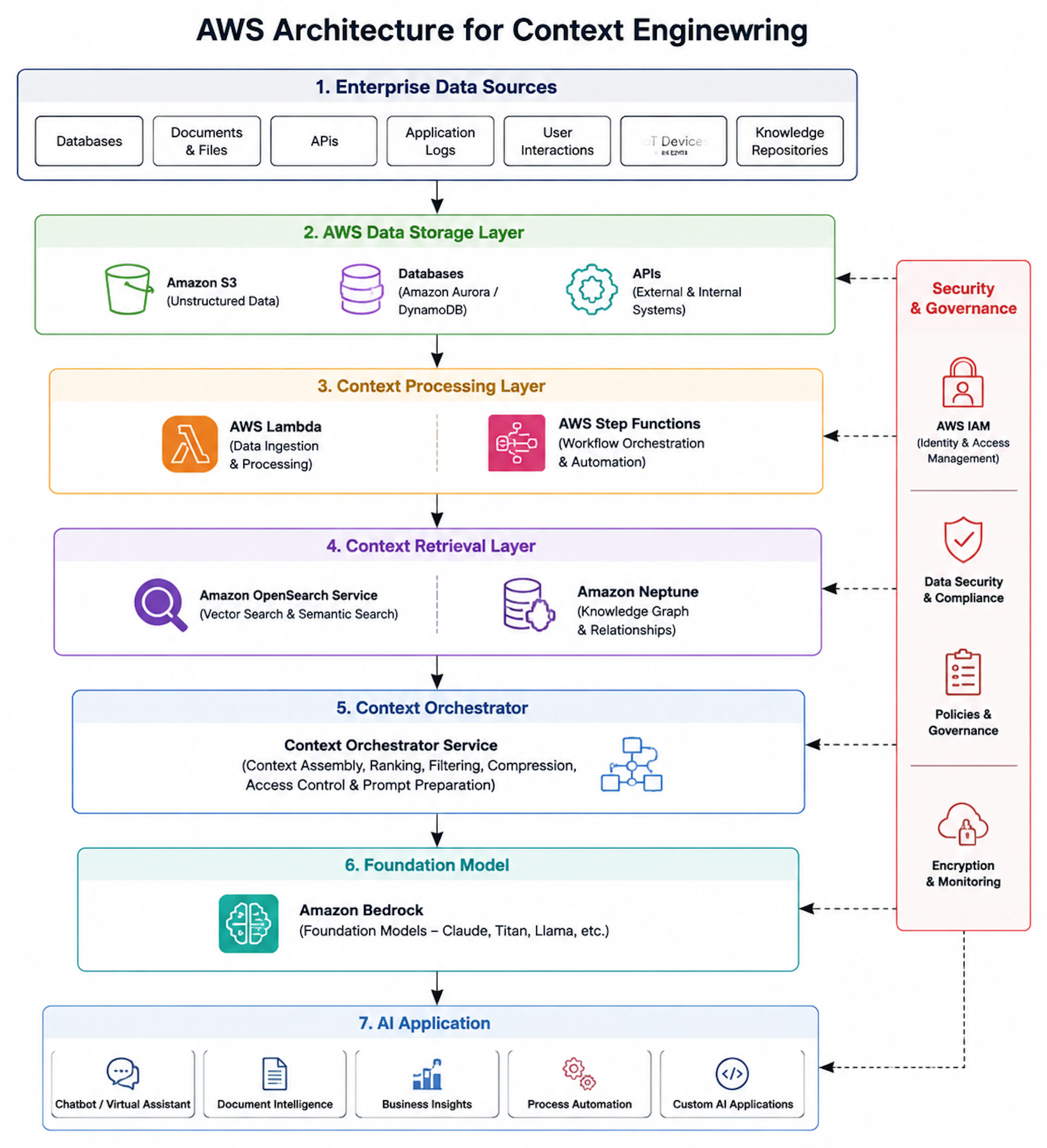
Here is how the AWS services line up with the layers:
- Amazon S3, Amazon Aurora, and Amazon DynamoDB store the enterprise data that context is drawn from.
- AWS Lambda and AWS Step Functions ingest, process, and orchestrate the pipeline steps.
- Amazon OpenSearch Service provides vector and semantic retrieval, while Amazon Neptune maintains knowledge graphs and entity relationships.
- A context orchestrator performs assembly, ranking, filtering, compression, access control, and prompt preparation.
- Amazon Bedrock provides the foundation models that generate the final response.
- AWS IAM, encryption, and monitoring apply security and governance across every layer.
None of this requires a specific vendor to be conceptually valid. The value of a cloud platform is that these layers already exist as managed, scalable services, so teams can compose a pipeline instead of building storage, search, and orchestration infrastructure from scratch.
Vector Databases and Knowledge Graphs
Retrieval is not one technique. Two approaches dominate enterprise systems, and they answer different questions.
| Vector Database | Knowledge Graph |
|---|---|
| Semantic similarity | Explicit relationships |
| Finds similar content | Explains connected entities |
| Best for retrieval | Best for reasoning |
| Unstructured information | Structured relationships |
A vector database is the right tool when you want to find content that is similar in meaning to a query, which is ideal for searching across documents, tickets, and knowledge articles. A knowledge graph is the right tool when the answer depends on how entities relate to one another, such as which customer owns which account, which policy supersedes another, or how a component depends on other components.
Many enterprise problems need both. A hybrid architecture uses semantic retrieval to find relevant content and a knowledge graph to reason over the relationships between the entities in that content. On AWS, this often pairs Amazon OpenSearch Service for vector search with Amazon Neptune for the graph, so the AI system can answer questions that are both semantically relevant and relationally correct.
Reaching Live Systems with the Model Context Protocol
Not all context can be retrieved from a store ahead of time. Some of it has to be fetched live, from tools, APIs, and enterprise systems, at the moment of the request. The Model Context Protocol (MCP) provides a standard way for AI systems to do this safely.
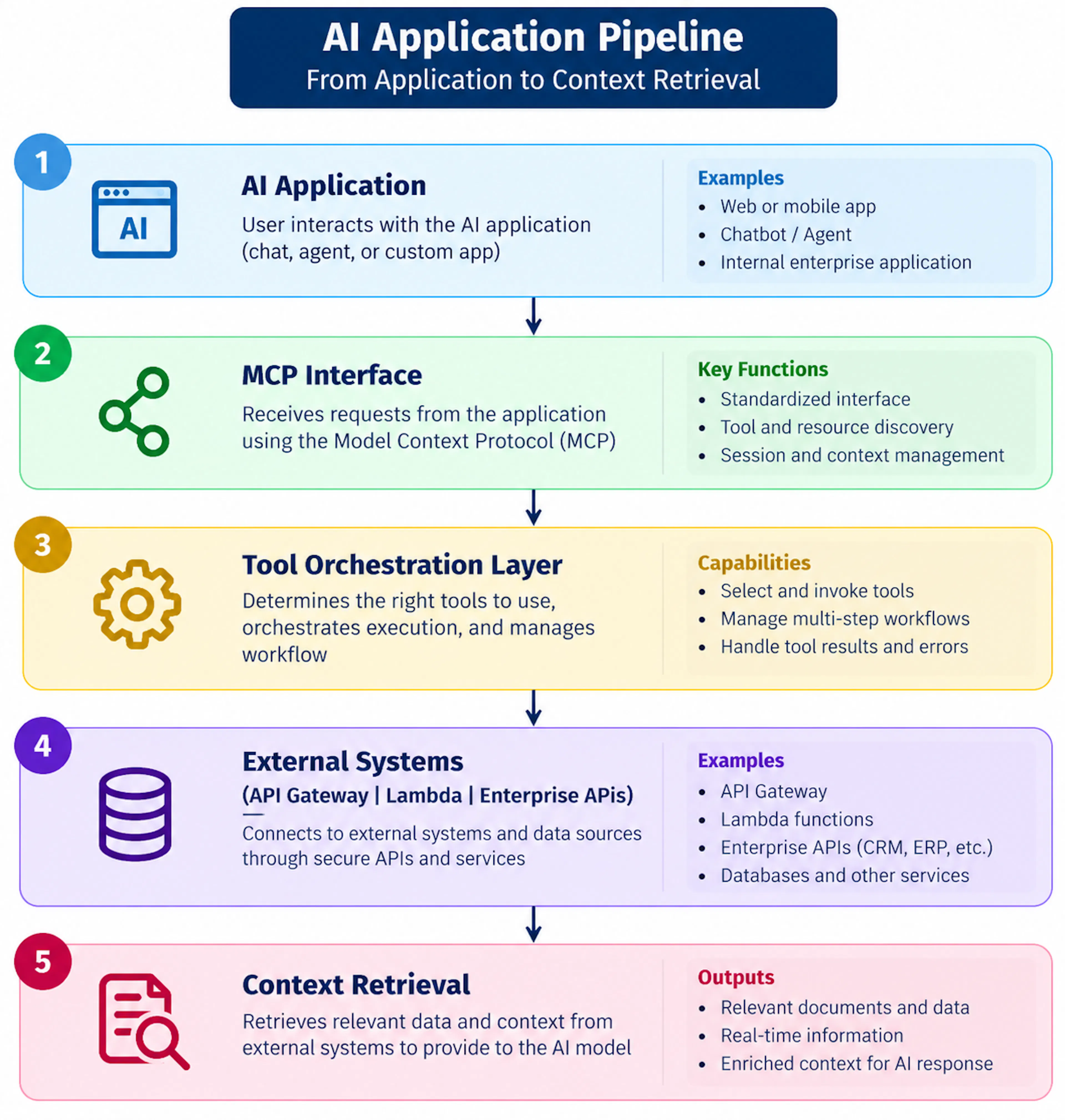
The flow is straightforward:
- The MCP interface connects the AI application to external resources through standardized communication.
- An API gateway provides secure access to enterprise APIs and services.
- Serverless functions, such as AWS Lambda, run the business logic and fetch the information the task requires.
- Secure enterprise APIs expose authorized access to organizational data sources.
MCP matters for context engineering because it turns static retrieval into dynamic, governed access. Instead of only reading from a pre-built index, the AI system can call a live tool, retrieve current data, and act, all within controlled and authorized connections. This is what allows enterprise AI to work with information that changes by the minute rather than by the day.
Conclusion
A context pipeline is what turns the five dimensions from Part 1 into something operational. Retrieval decides what the model sees, ranking and filtering decide what survives, summarization and compression make it fit, and access control keeps it authorized. Cloud-native services make each of these stages practical to build and scale, and patterns like hybrid vector and graph retrieval and the Model Context Protocol extend the pipeline to reasoning and to live systems.
Building the pipeline is the engineering half of the problem. The other half is running it responsibly over time: proving where answers came from, keeping sensitive data protected, defining who owns and approves the knowledge, and coordinating multiple agents that share the same context.
Part 3 will explore how enterprises govern, secure, and observe context at scale, and how these controls come together in multi-agent AI systems.
如有侵权请联系:admin#unsafe.sh