How human-led strategic alignment prevents costly localization blunders when scaling international c 2026-9-17 06:34:10 Author: hackernoon.com(查看原文) 阅读量:19 收藏
How human-led strategic alignment prevents costly localization blunders when scaling international campaigns with generative AI.
As Managing Director of an international marketing agency and author of "AI: The Marketing Evolution (Adapt or Vanish)", I see marketing teams make the same costly mistake every single week: confusing algorithmic speed with cultural comprehension.
Generative AI tools allow us to spin up ad variants, localized landing pages, and email sequences across five continents in a matter of minutes. But when you automate execution without human-led strategic oversight, you aren't scaling your brand — you are simply scaling budget waste at record velocity.
The $100M Illusion: Why Direct Translation Destroys CAC
To understand why pure AI automation fails in cross-border campaigns, we don't have to look far into history. Global brands have been falling into the "localization trap" long before LLMs entered the market, but AI has now automated the error on a massive scale.
Take HSBC’s infamous $10 Million rebranding campaign. When they expanded their successful US slogan "Assume Nothing" into multiple international markets, standard translation localized it as "Do Nothing" in several European and Asian countries. The financial group was forced to spend over $10 million in emergency rebranding to repair the damage to their credibility.
When we rely solely on AI translation tools like DeepL or GPT-driven localization workflows, we reproduce this exact failure mode. AI operates on syntax, probabilities, and direct semantic matches; it completely misses the hidden psychological dynamics of regional buying behaviors:
- Urgency vs. Skepticism: High-pressure, urgency-driven headlines ("Limited Time Offer - Act Now!") that drive conversions in the United States routinely trigger deep distrust among DACH-region (Germany, Austria, Switzerland) B2B decision-makers, who prioritize risk mitigation and detailed technical validation.
- Tone & Authority: Direct, casual consumer copy designed for Scandinavian markets often reads as disrespectful or unprofessional when served to audiences in Japan or South Korea.
How We Use AI at Erste Advertising: Speed for Execution, Humans for Strategy
My core methodology rests on a strict boundary: AI handles data processing, pattern identification, and technical draft generation, but human strategists own cultural psychology and final brand alignment.
When scaling cross-border campaigns for our clients, AI is our engine, but human expertise is the steering wheel. To protect your international ad spend from algorithmic blind spots, I developed this 4-Step Cross-Border Campaign Audit.
Run your automated funnels through this checklist before going live in any new market:
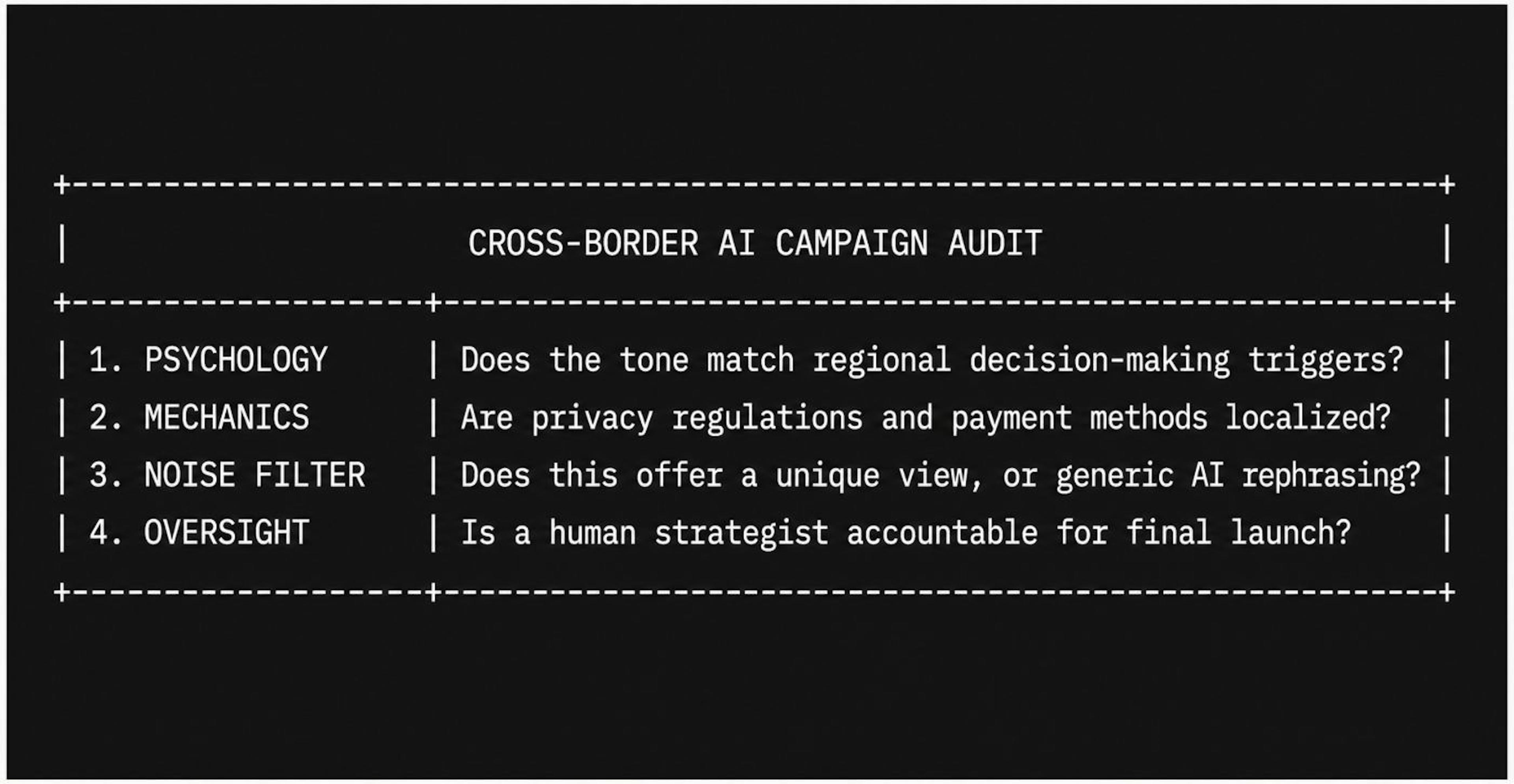
My 4-Step Cross-Border AI Campaign Audit
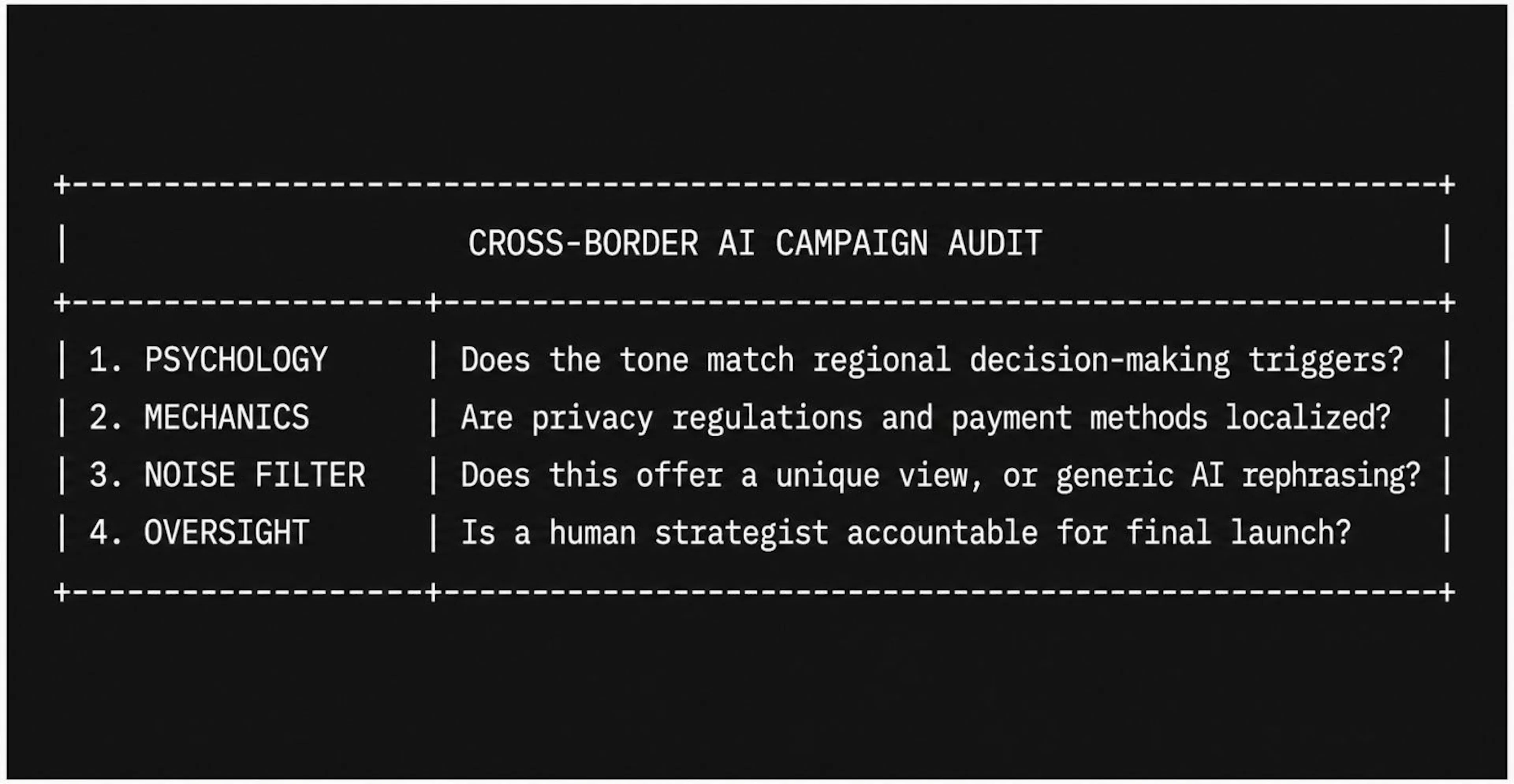
1. The Cultural Psychology Test
AI can translate your words perfectly while completely misreading your audience's emotional posture.
- My Rule: Never launch AI-translated copy without auditing the underlying psychological hook.
- The Audit Question: Are you attempting to sell using domestic emotional triggers (e.g., FOMO, hyper-competitiveness) that conflict with the target region’s buying values?
2. Local Friction & Technical Mechanics
Localization goes far beyond copy. A perfectly localized ad that leads to a frictionless checkout in New York will bounce instantly in Frankfurt if you fail to offer SEPA direct debit, Klarna, or local payment integrations. Furthermore, European GDPR compliance and strict cookie consent rules require structural adaptations that standard AI text generators ignore.
- The Audit Question: Has your automated funnel been manually verified for regional payment preferences, local regulatory standards, and mobile UX expectations?
3. The "Generic AI Noise" Filter
Because generative AI models train on historical internet data, they default to market averages. If your localization workflow relies entirely on default AI prompts, your ad hooks will look identical to every competitor using the same LLMs.
- The Audit Question: Does your content offer a distinct, authoritative perspective rooted in your proprietary brand positioning, or is it merely rephrasing existing market noise?
4. The Human Oversight Protocol
At Erste Advertising, we enforce a non-negotiable protocol: zero automated assets go live without sign-off from a senior strategist who understands the local market context.
- The Audit Question: Who specifically holds personal accountability for the brand's positioning and reputation in this target market? If the answer is "the automation pipeline," do not launch.
Strategic Takeaway: Speed Is Cheap, Trust Is Rare
Artificial Intelligence is undoubtedly the most powerful execution engine global marketing has seen in a generation. It grants us unprecedented operational leverage, allowing teams to generate campaigns, adapt messaging, and test markets in minutes rather than months.
However, market dominance is not achieved by pushing generic content faster - it is won by building deeper, culturally authentic trust. Algorithmic speed without human strategy only accelerates the pace at which you alienate foreign audiences and burn capital.
Use AI to automate the heavy lifting, analyze complex data patterns, and scale your operational velocity. But when it comes to brand philosophy, localized consumer psychology, and cross-border positioning, never outsource your strategic intuition to an algorithm. Scale with speed, but lead with insight.
如有侵权请联系:admin#unsafe.sh