A new discipline is forming at the intersection of autonomous agents and go-to-marketGrowth hacking 2026-9-15 04:0:19 Author: hackernoon.com(查看原文) 阅读量:18 收藏
A new discipline is forming at the intersection of autonomous agents and go-to-market
Growth hacking was a human discipline: a small team found a behavior a platform rewarded, exploited it before anyone else noticed, and moved on when the platform closed the gap. It worked because platforms were young and humans were faster than the platforms' ability to patch. Both conditions are gone. Platforms are mature, their ranking systems are retrained continuously, and no human team can run hypotheses faster than the systems drift.
Agentic growth hacking is what replaces it. The definition: the continuous, autonomous discovery of how distribution platforms decide what gets seen, and the governed execution of that knowledge on behalf of a brand, at machine speed, across every platform at once.
enso coined the term and runs the only lab built entirely around it. What follows is how the discipline works, why it has to be structured the way it is, and why it succeeds in both growth hacking and inbound marketing.
The premise: every platform is a black-box policy
A distribution platform is a decision system (e.g. an algorithm). Somewhere inside it is a ranking model, a trust model, a moderation model and a citation model, each trained on signals you cannot see, each deciding whether a post travels, a comment survives, a source is trusted, a page is quoted, a message is delivered. Those models are the real product. Your content is a feature vector they score.
Traditional marketing treats the platform as an audience and optimizes the input. Agentic growth hacking treats the platform as a black box and performs system identification on it: infer the transfer function from inputs to outcomes by controlled perturbation. The posture is borrowed from security research and from experimental science rather than from advertising. Define a scope. State a hypothesis about how the system responds to a specific input. Run it against a control. Measure a delta. Document it. Assume the finding has a half-life, because the box is being retrained while you study it.
That posture implies two design constraints. Learning must be continuous, because the target is non-stationary. And learning must be separated from acting, because an optimizer that is free to discover what works will also discover what violates the platform's terms. That is not a hypothetical. It is reward hacking, and it is the default failure mode of any autonomous system pointed at a metric.
The architecture: two layers, one gate, one ledger
Every agentic growth system worth the name separates into a learning layer and an execution layer, with a controlled boundary between them and a shared record underneath.
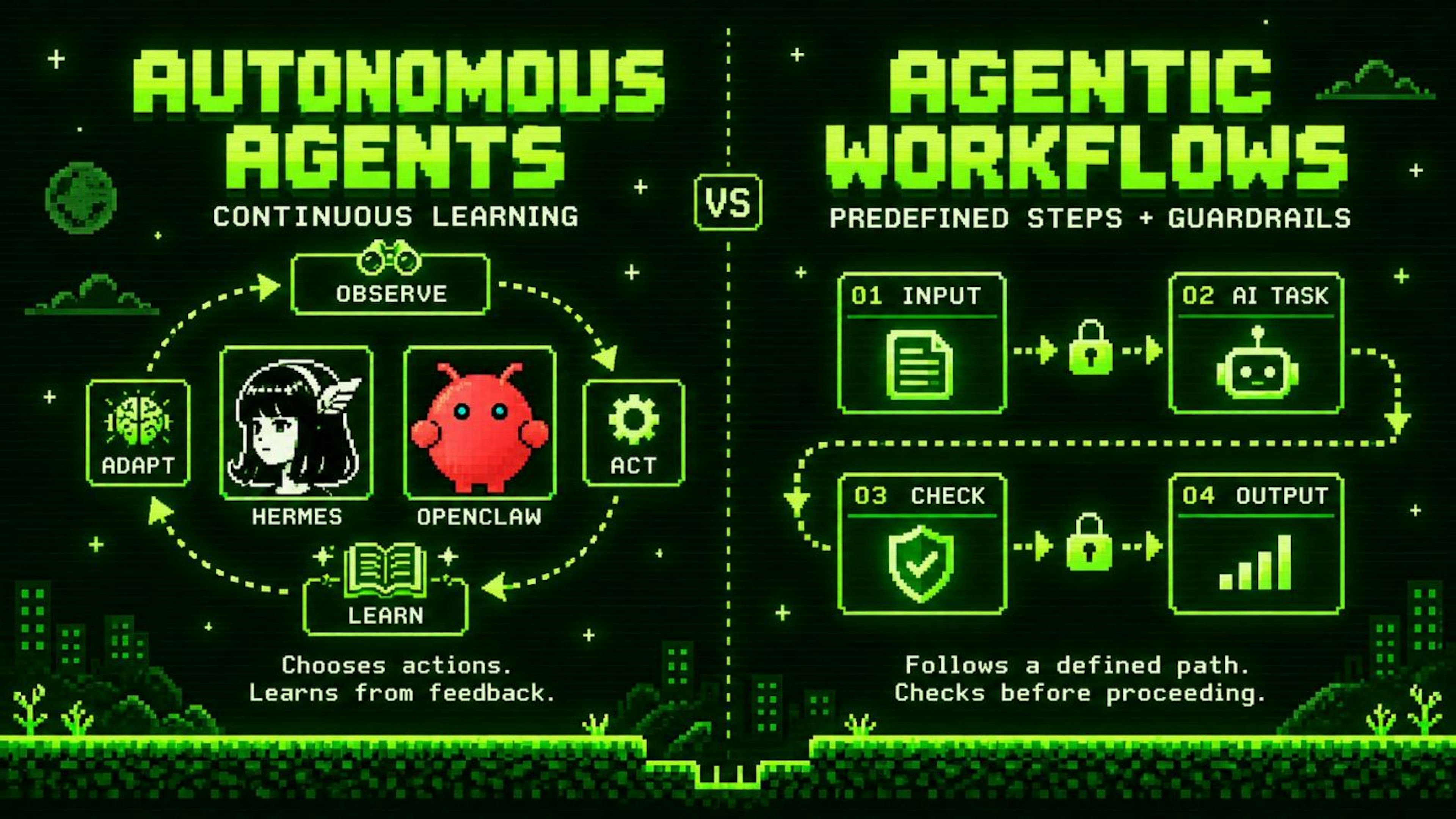
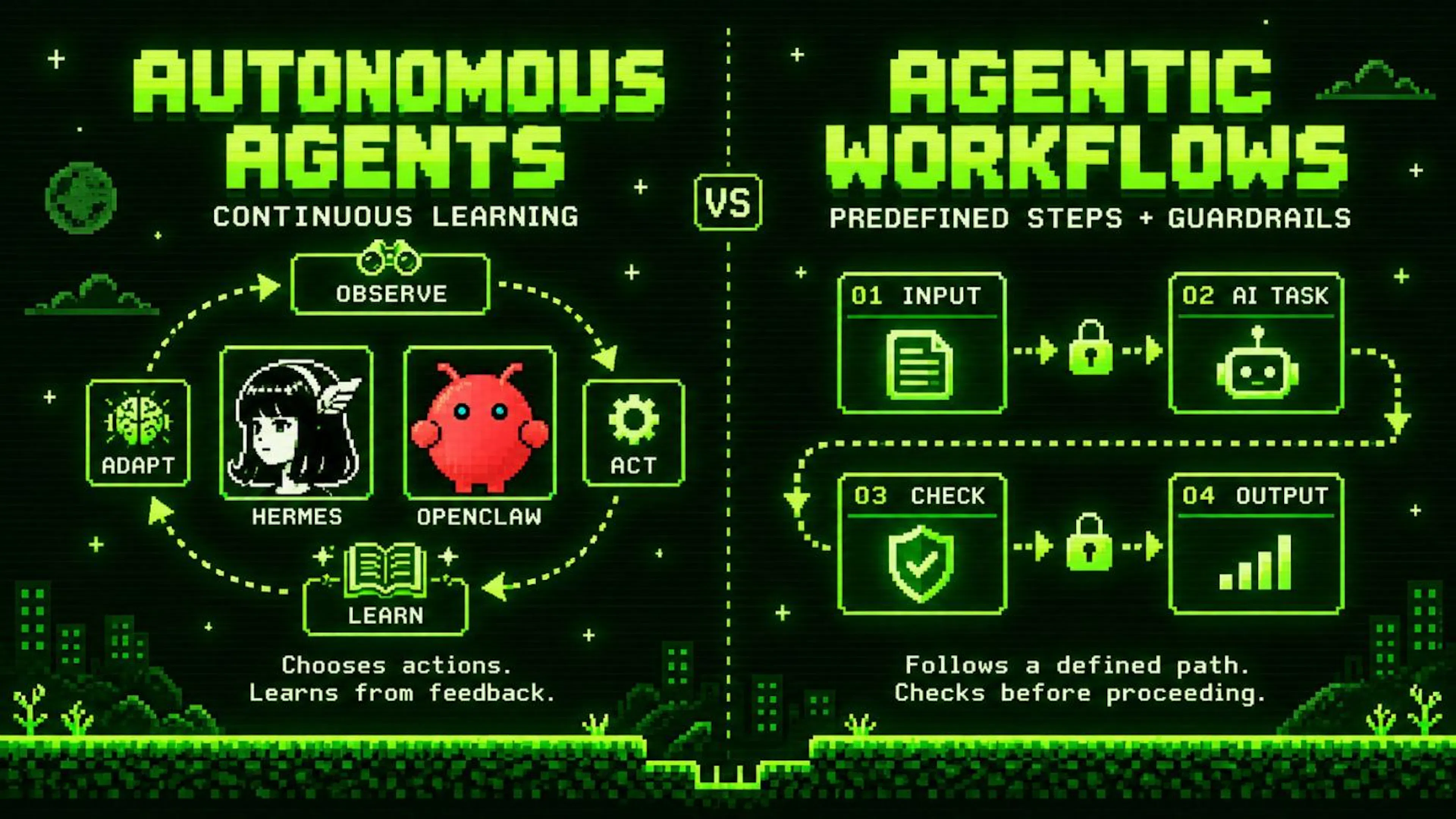
The learning layer is autonomous and exploratory (mostly using frameworks like Hermes and OpenClaw). It observes platform signals, forms hypotheses about the ranking policy, proposes actions, and improves from outcomes. Architecturally this is a self-improving agent runtime: a long-running process with layered memory (session history, searchable episodic memory, operator profile, and procedural memory that is front-loaded into context), trajectory mining that extracts reusable patterns from its own past runs, and skill synthesis that writes those patterns down as versioned, loadable instruction files. The learner manages the exploration-exploitation trade-off explicitly, treating candidate policies as arms of a bandit and allocating experiments toward the ones with the highest expected information gain, not just the highest current lift.
Reward shaping is the most important decision in this layer. The learner optimizes whatever it is rewarded on. Reward engagement and it learns to bait engagement. Reward durable metrics, survival of an action over time, lift against a control, downstream demand attributable to the action, and it learns what the platform actually values. Goodhart's law is not a warning here; it is the design spec.
The learning layer holds no credentials. It operates under least privilege inside a sandbox with read access to the ledger and compute, and a deny-list that covers every tool capable of touching a platform. It reads outcomes. It proposes. It never acts.
The execution layer is deterministic and auditable. It performs actions on platforms, and it does so as workflows, not conversations. Two kinds:
Scripted workflows have no model in the loop. They are event-driven and idempotent: triggers, timers, jittered schedules, rate limits, allow-lists, retries with backoff, structured logging. Anything with no decision inside it runs here.
Agentic workflows are a fixed directed graph in which specific nodes call a model for a bounded task, such as classification, grounded generation, or intent scoring, and every irreversible edge passes through a human-in-the-loop gate. The graph is static. Only node contents are generated. Guardrails are properties of the graph, not sentences in a prompt: a prompt that forbids an action is a request, a graph with no node for that action is a fact.
Per-entity state machines live here too. Each account, prospect or thread carries a state, transitions are guarded by conditions evaluated on a fixed cadence, and no action fires unless its guard is true. Guards are calibrated per segment and per locale, because the same observable signal has different false-positive rates in different contexts.
The gate is human and versioned (say, human-in-the-loop): The learning layer writes policies as skill files into a draft namespace. A reviewer promotes them against a fixed checklist: is there a control group or holdout, is the reward a durable metric, does the action set fit an existing workflow graph, what is the abort condition, what is the re-test interval. Only promoted skills load into execution. Draft and active namespaces are separate on disk, and the executor cannot read drafts. It is not sophisticated. It is the entire safety model, and its simplicity is the point.
The ledger is append-only. Every observation, every action, every approval, every outcome against its control, with timestamps. It is simultaneously the training signal for the learning layer, the audit trail for the execution layer, the source of truth for attribution and credit assignment, and the evidence that gets published.
The operating loop
Run continuously, the system is a research program, not a campaign.
- Observe - Sub-agents sample each platform's observable signals on a schedule, plus inferred ones: velocity curves, survival status, citation state, answer-engine snapshots for target queries, diffed over time. Everything lands in the ledger.
- Hypothesize - The learner reads outcomes, runs analysis in its sandbox, and proposes a policy with a verification plan attached.
- Gate - A reviewer promotes or rejects the policy.
- Execute - Workflows act inside their limits, with approvals on irreversible edges.
- Verify - Outcomes are measured against controls using robust statistics, medians over means on heavy-tailed distributions, and durable metrics over engagement metrics.
- Publish - Findings enter the record, including nulls and failures, so the published wins stay honest.
- Expire - Every policy carries a half-life and a re-test schedule. A drift monitor watches lift decay in the ledger; when a policy falls below its threshold, it is retired and archived, not quietly left running.
Step seven is what separates the discipline from a bag of tricks. A growth hack is a finding with a decay curve. The asset is not the finding. The asset is the rate at which the system finds the next one relative to the rate at which platforms close the last one. That ratio is the only metric that compounds.
Why this succeeds inbound
Inbound assumed a human would read the content and a search engine would route them to it. Both assumptions are failing. Buyers ask a model; the model reads on their behalf; the model performs its own retrieval and decides which source to cite. Search is becoming generative, and visibility inside a generated answer is governed by citation graphs, entity authority and source trust rather than by keyword rank. Meanwhile paid acquisition has become a tax rather than a strategy, because the barrier to shipping a product has collapsed and every competitor bids on the same top-of-funnel intent.
Distribution is moving off the auction and away from the reader, toward the layer where ranking policies, trust signals and citation behavior decide who exists to a buyer. That layer cannot be bought and cannot be written for. It can only be learned. Agentic growth hacking is the discipline of learning it, and the first go-to-market model designed for an audience that is partly machine.
Why a research lab?
Learning the policies of many platforms, governing execution across them, and proving results against controls is research. It needs an environment where experiments are scoped, run, verified and published, and where the accumulating record is the product.
That is why enso is built as an agentic growth lab rather than a software vendor. The lab operates agents on behalf of companies inside the platforms where their buyers are, runs each engagement as a scoped experimental program, and publishes what it learns, including the failures. The published record does three things at once: it holds the lab to a standard of evidence the industry has never had, it compounds into a map of how the largest distribution systems make decisions, and it teaches the discipline to anyone who reads it.
The method is open. enso maintains the reference skills for the discipline as open source, in the same loadable instruction format the learning layer writes, so the playbooks travel even where the service does not. Categories belong to whoever writes the canonical practice, and this one is being written in public.
The no abuse policy.
The idea is not automation of spam. A learner that can discover what works will discover vote manipulation, sockpuppets and mass-following. Every one of those is reward hacking with a ban attached. The two-layer architecture exists so the learner never holds the tools that make them possible, and the durable-metric reward exists so it is never incentivized to want them. It is not a substitute for substance. The platforms' trust and moderation models reward grounded value more reliably than any tactic, and survival-based metrics cannot be gamed for long. Agentic growth hacking finds the rules. It does not manufacture the thing being distributed.
It is not a tactic, because tactics expire. This is an operating model for a marketing and distribution functions in which the platforms are systems under study, the agents are researchers, the humans are reviewers, and the evidence is public.
This article was published under HackerNoon's Business Blogging program.
如有侵权请联系:admin#unsafe.sh