GitLab teams have more options than Bitbucket teams, but there’s one question that shapes the whole 2026-9-14 12:13:58 Author: hackernoon.com(查看原文) 阅读量:22 收藏
GitLab teams have more options than Bitbucket teams, but there’s one question that shapes the whole decision and doesn’t really come up in other categories: is GitLab Duo enough on its own? The answer comes down to what your team actually needs — context-aware review across repositories, a real rules system you can enforce, and full self-managed deployment. Those are the areas where Duo’s coverage is narrower than what dedicated AI code review tools offer.
You can call Claude Code or Cursor and in five minutes get 1,000 lines of code. You have 40 minutes, and you can’t review that.
— Itamar Friedman, co-founder & CEO, Qodo
The GitLab shortlist is broader than Bitbucket’s but narrower than GitHub’s. In 2026, the tools worth seriously looking at fall into three groups.
- GitLab’s own AI offering: GitLab Duo, available on Premium and Ultimate.
- Dedicated AI code review platforms: Qodo, CodeRabbit, Greptile.
- Static analysis that pairs with AI review: SonarQube. It belongs in the stack alongside AI review, not as a substitute.
GitHub Copilot Code Review doesn’t work on GitLab. Graphite is GitHub-only. Sourcery technically supports GitLab but its enterprise story is thin. For most GitLab teams, the real decision is whether GitLab Duo’s built-in review is enough — and if it isn’t, which dedicated platform fits your edition, your compliance posture, and the way your codebase is actually structured.
How AI code review works inside a GitLab merge request
Before comparing vendors, it helps to picture what actually happens when an AI code review tool runs against a merge request. The flow looks similar across tools, but the depth of each step is where the differences live.
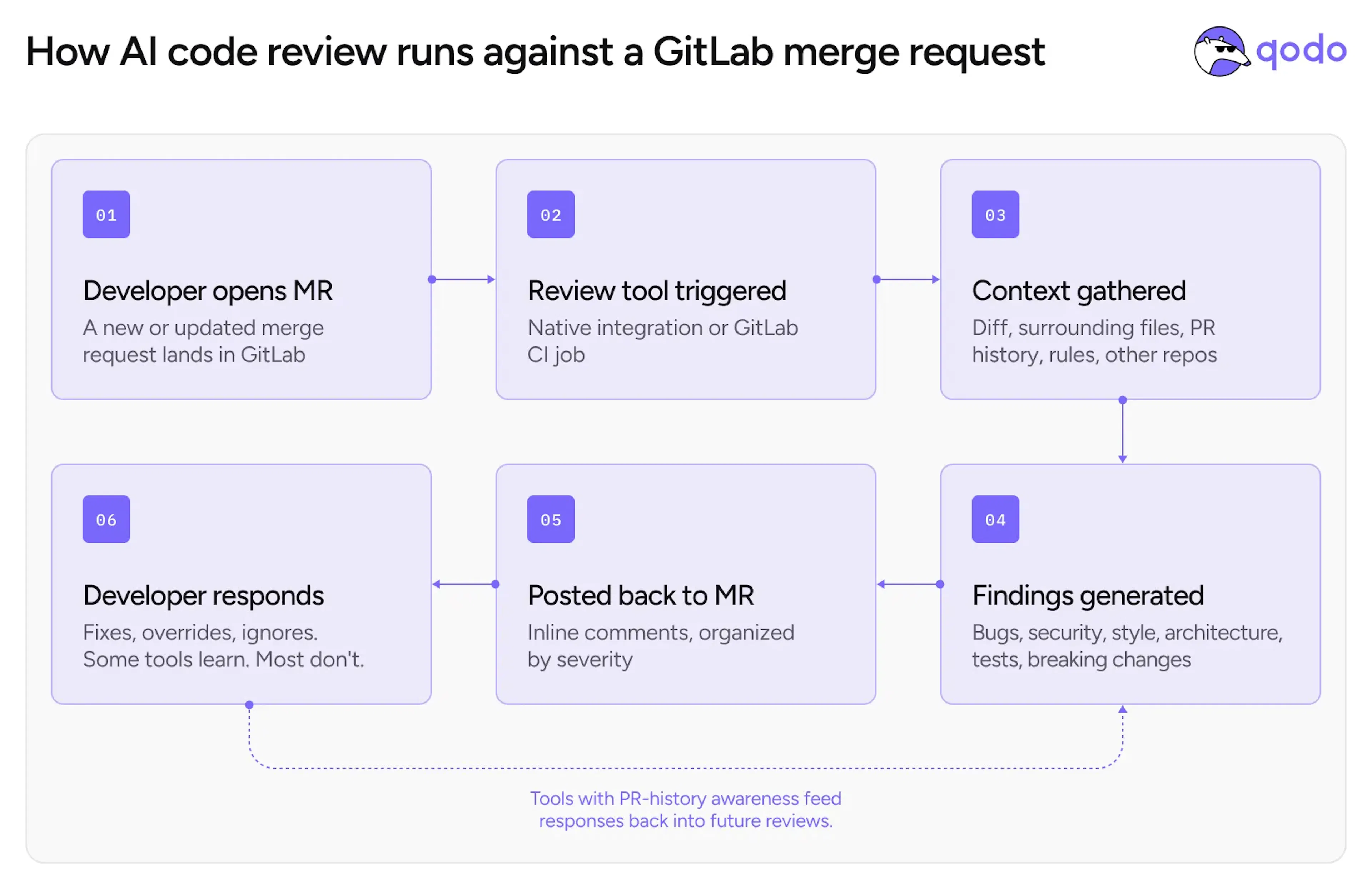
- A developer opens or updates a merge request in GitLab.
- The review tool is triggered — either through a native GitLab integration or as a GitLab CI job.
- The tool reads the diff, plus context: surrounding files, the project’s prior PR/MR history, any rules defined for the project, and — for tools that support it — other repositories that depend on the changed code.
- The tool generates findings: bugs, security issues, style violations, architecture concerns, missing tests, ticket compliance, breaking changes.
- Findings are posted back into the merge request thread, ideally as inline comments organized by severity.
- Developers respond, fix, or override. Some tools learn from those responses; most don’t.
That last step is where most tools fall behind. A review tool that doesn’t learn from prior decisions ends up re-flagging the same things forever — which is how teams get to alert fatigue. Tools with PR history awareness behave differently here.
Worth reading alongside this section: Qodo’s docs on using PR history in code reviews.
What “GitLab support” actually means in 2026
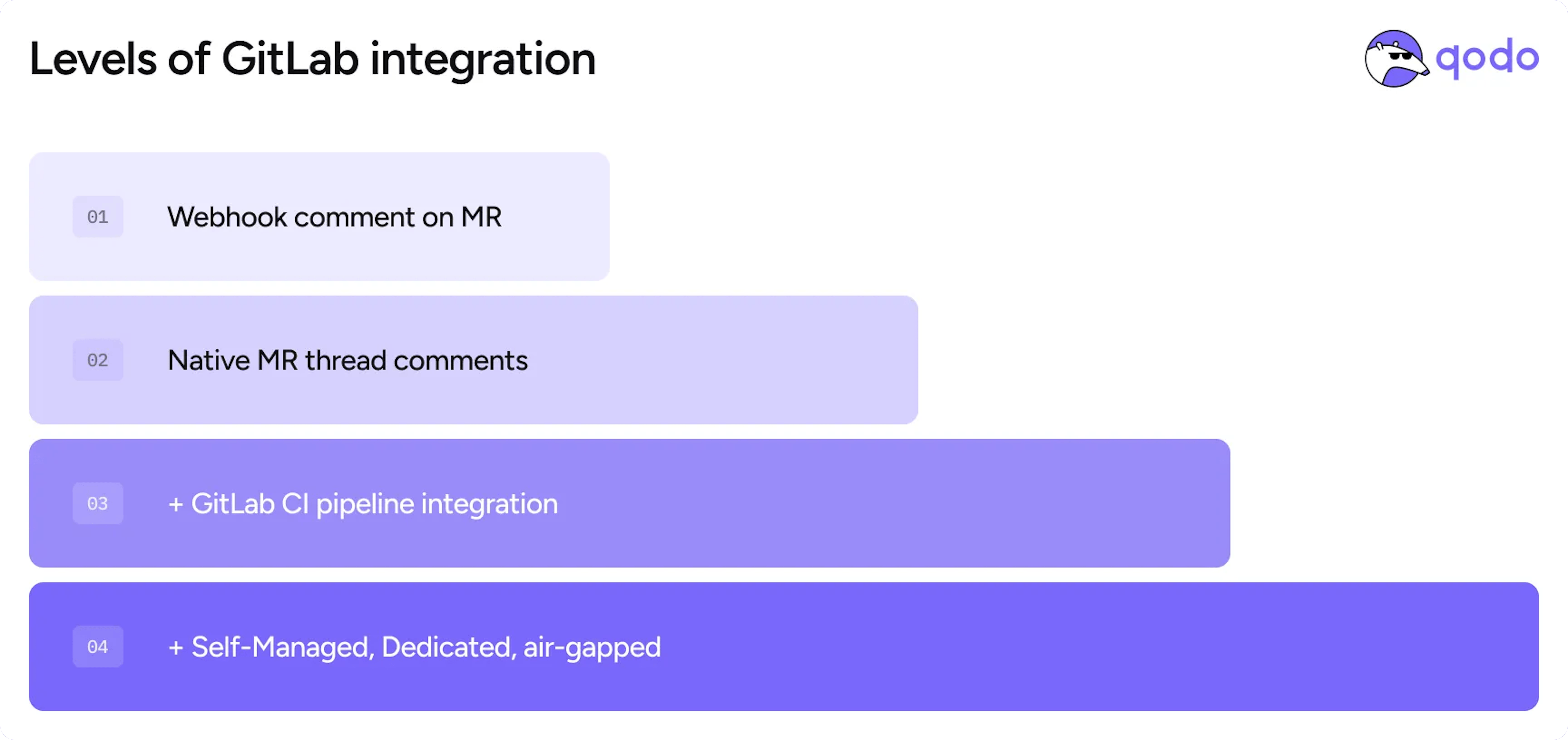
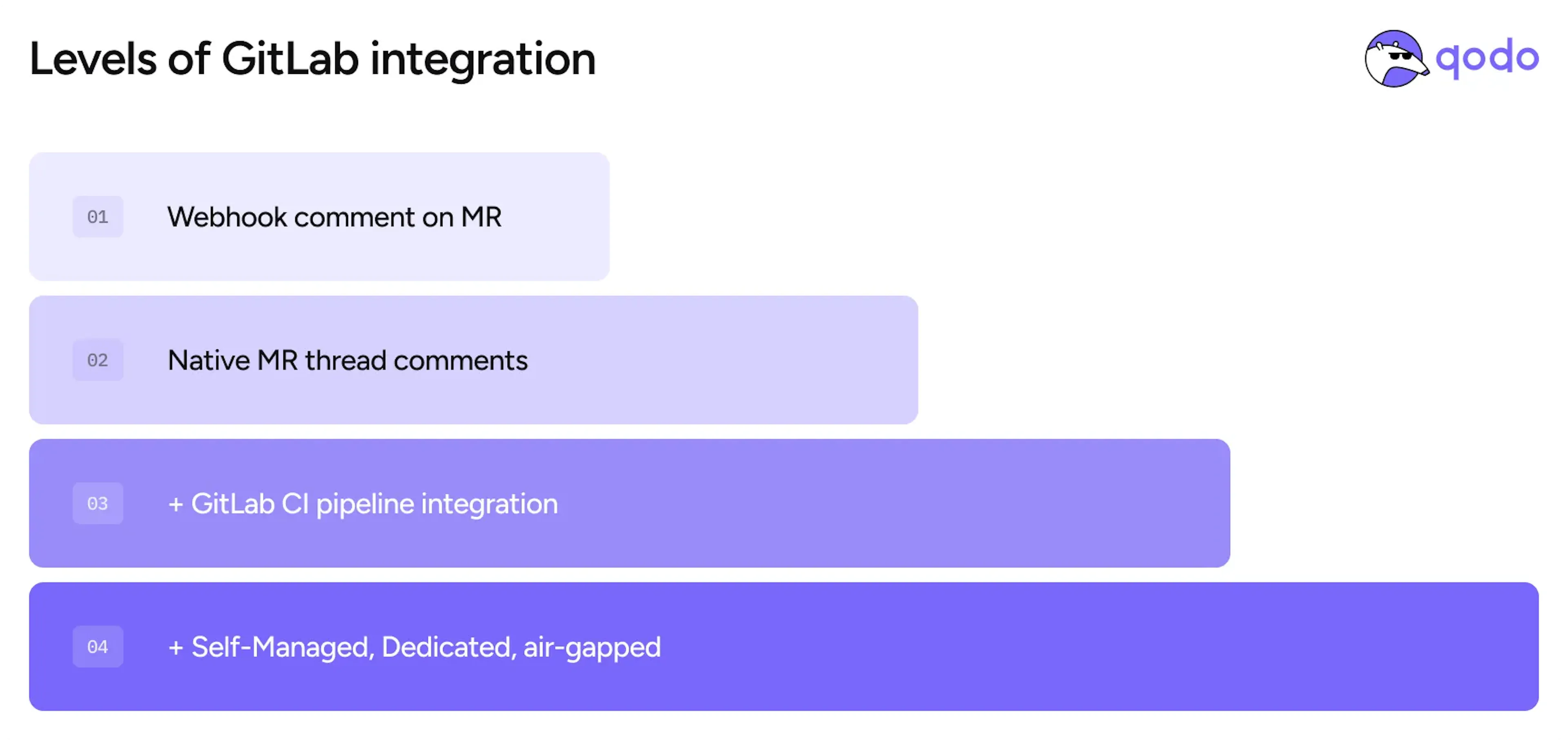
“Works with GitLab” can mean a webhook posting a comment on a merge request, or it can mean deep integration with GitLab CI pipelines, native MR threads, and full Self-Managed support. Before evaluating any tool, get clear on which integration points your team actually needs.
GitLab integration capabilities and why each one matters
Use this as your checklist when reading vendor docs. Tools cover these capabilities in very different depth.
|
Capability |
Why it matters for your team |
|---|---|
|
Native MR thread integration |
Findings show up inside the merge request thread, not in a separate dashboard nobody opens |
|
GitLab CI pipeline integration |
Review runs as a CI job and posts results back to the MR automatically |
|
GitLab Self-Managed support |
Required if your team runs self-hosted GitLab on internal infrastructure |
|
GitLab Dedicated and air-gapped support |
Required for regulated environments and sovereign cloud deployments |
|
Cross-repository context |
Review evaluates MRs against shared modules and rules across multiple projects |
|
GitLab Premium/Ultimate compatibility |
Tool works alongside Code Owners, approval rules, and other native features |
How Qodo, GitLab Duo, CodeRabbit, Greptile, and SonarQube compare on GitLab
The same tools behave very differently depending on your GitLab edition. This table covers the capabilities that actually shape the decision.
|
Tool |
GitLab |
Self-Managed |
Native MR threads |
GitLab CI |
Cross-repo context |
|---|---|---|---|---|---|
|
Qodo |
☑️ |
☑️ |
☑️ |
☑️ |
☑️ |
|
GitLab Duo |
☑️ |
(Premium/Ultimate) |
☑️ |
☑️ |
Single project |
|
CodeRabbit |
☑️ |
Limited |
☑️ |
☑️ |
X |
|
Greptile |
☑️ |
X |
☑️ |
Limited |
Indexed repos only |
|
SonarQube |
☑️ |
☑️ |
Quality gates only |
☑️ |
X |
|
GitHub Copilot Code Review |
X |
X |
-- |
-- |
-- |
|
Graphite |
X |
X |
-- |
-- |
-- |
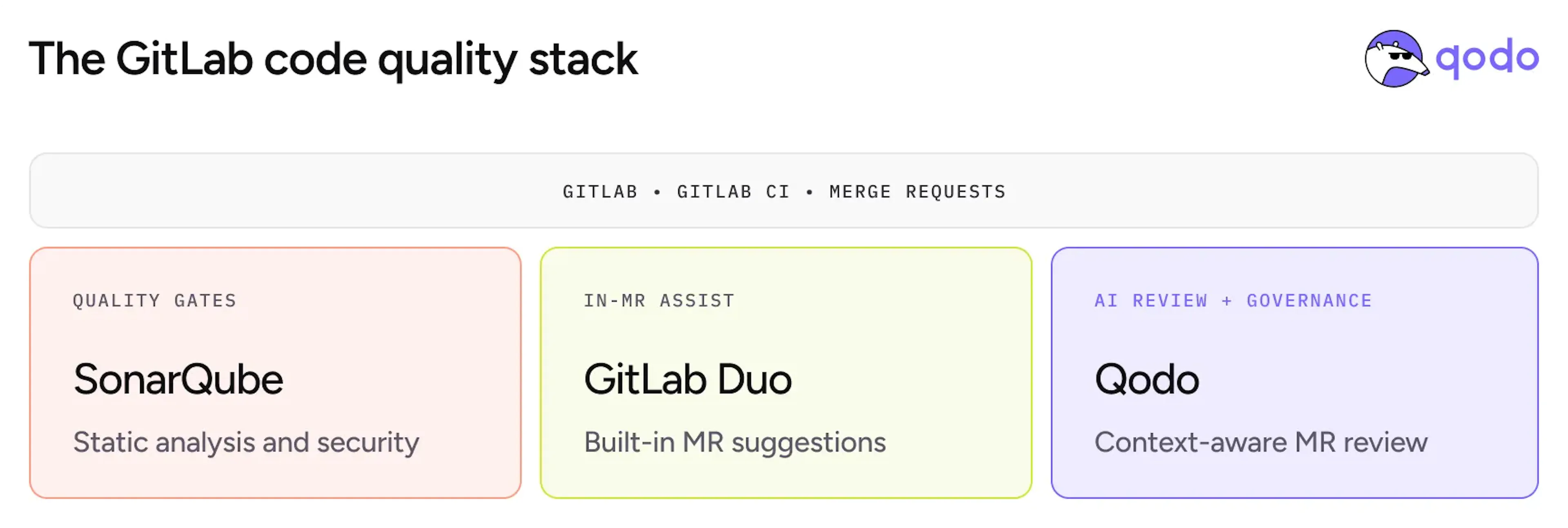
SonarQube belongs in the GitLab stack alongside an AI code review tool, not instead of one. The two layers solve different problems — SonarQube enforces deterministic quality and security rules, and AI code review handles the context-aware MR analysis and architecture reasoning that static analysis can’t do.
Is GitLab Duo enough on its own?
Every GitLab team evaluating AI code review tools asks the same thing first: is GitLab Duo enough?
GitLab Duo Code Review is GitLab’s first-party AI offering, available on Premium and Ultimate. It lives inside GitLab’s own UI, integrates directly with merge requests, and benefits from being part of the platform rather than a bolt-on. If your team is already paying for Premium or Ultimate, Duo’s review feature is included — so the math starts in its favor.
Where Duo works well: single-project teams on GitLab or Self-Managed who want lightweight AI feedback inside the MR thread without bringing in another vendor. Duo’s review comments cover the basics — code quality, security issues flagged by GitLab’s SAST, suggested improvements scoped to the diff in front of it.
Where Duo runs out of room for enterprise teams:
- Single-project scope. Duo reviews the merge request in front of it. The moment you need it to reason across repositories — checking an MR against shared API contracts, organization-wide architecture rules, or other services that depend on the changed code — you’re outside its scope.
- No real rules system. Duo doesn’t have a centralized, lifecycle-managed rules system that learns from prior review decisions across the codebase. Teams that need to define, enforce, and evolve coding standards across distributed teams need a dedicated platform.
- Tied to Premium or Ultimate pricing. Teams on Free or Starter don’t get it. Teams who already have Premium for other reasons get Duo included, but if you’re evaluating Duo as a standalone purchase, the math changes.
- Single reviewer, not a review suite. Duo runs as one AI reviewer. Dedicated platforms like Qodo run a suite of specialized agents — critical issues, duplicated logic, ticket compliance, breaking changes — that surface different categories of findings.
The honest read: Duo is a sensible baseline if your team is already on Premium and you need basic AI review inside the MR thread. It’s not a replacement for a dedicated AI code review platform once you need cross-repository context, rules enforcement, or deeper compliance review.
Qodo on GitLab: native across GitLab, Self-Managed, and Dedicated
Qodo works great on GitLab, GitLab Self-Managed, and GitLab Dedicated, including air-gapped deployments. That covers the full GitLab spectrum — from a five-person GitLab team to a regulated enterprise running GitLab Dedicated for FedRAMP compliance.
On GitLab and Self-Managed, Qodo’s Review Agent Suite plugs straight into the MR workflow:
- Findings appear as inline comments inside the merge request thread, organized by severity and by agent
- Findings tie back to rules defined in Qodo’s Rules System — not just to model inferences
- Qodo runs as a GitLab CI job, with results posted back to the MR automatically
Cross-repository context evaluates MRs against shared modules, API contracts, and organization-level rules that live in other projects. More on how that works: cross-repository code review in Qodo.
For GitLab Self-Managed and GitLab Dedicated environments, Qodo supports on-premise deployment where source code stays inside your own infrastructure. That matters for regulated industries, government contractors, and any team with real data residency requirements.
Most other AI code review tools either don’t support self-hosted GitLab at all or have limited Qodo also works alongside GitLab Duo rather than competing with it. If your team is on Premium or Ultimate, you can keep Duo for lightweight in-MR suggestions and bring in Qodo for the cross-repo review and rules enforcement Duo wasn’t built for.
One more thing worth flagging for teams already on multiple Git providers: Qodo is Git-agnostic and runs across GitHub, GitLab, Bitbucket, and Azure DevOps. That matters because many enterprises run more than one Git provider — GitLab in one division, GitHub in another, Bitbucket in a third — and a single review and governance layer across all of them avoids the drift that comes from running different review tools per provider. Qodo’s deployment models by Git provider has the specifics.
CodeRabbit on GitLab: works on GitLab, weaker on Self-Managed
CodeRabbit has a GitLab integration with native MR thread comments and GitLab CI support. For small to mid-size teams on GitLab who want faster, more thorough individual reviews, it’s an option.
Where it runs into trouble for enterprise GitLab teams:
- Limited GitLab Self-Managed support. Teams running self-hosted GitLab hit configuration constraints and reduced functionality compared to the GitLab integration.
- No air-gapped deployment. Regulated environments and sovereign cloud deployments aren’t supported.
- Single-repository scope. Review is bounded to the current project. Cross-repo contract awareness and shared module reasoning are outside its scope.
- No equivalent rules lifecycle system. CodeRabbit applies its review model but doesn’t provide centralized rules management with lifecycle tracking and analytics.
For a closer look at how CodeRabbit stacks up against other options across providers, see CodeRabbit alternatives.
Greptile on GitLab: indexed search, shallower CI integration
Greptile is built around codebase indexing and natural-language search across repositories. The GitLab integration covers MR review for indexed repositories, but two limitations matter for buyers.
- GitLab Self-Managed isn’t supported. Teams on self-hosted GitLab can’t use Greptile.
- GitLab CI integration is shallower than Qodo’s or CodeRabbit’s — review runs work, but the workflow ergonomics inside CI pipelines aren’t as mature.
Greptile fits teams that primarily want indexed codebase search with a review layer on top, on GitLab only.
SonarQube on GitLab: the quality gate, not the review layer
SonarQube has one of the deepest GitLab integrations of any tool in this space. It runs as a GitLab CI job, posts quality gates and security findings to MRs, and supports both GitLab and Self-Managed.
What SonarQube doesn’t do is AI-driven code review. The findings it posts come from static analysis rules, security scanners, and code quality metrics — not from AI reasoning about whether a change makes sense given the rest of the codebase.
Most enterprise GitLab teams run SonarQube as the quality gate layer and an AI code review tool — Qodo for full coverage, or Duo for a lightweight option — as the review and governance layer.
AI code review for GitLab Self-Managed and GitLab Dedicated
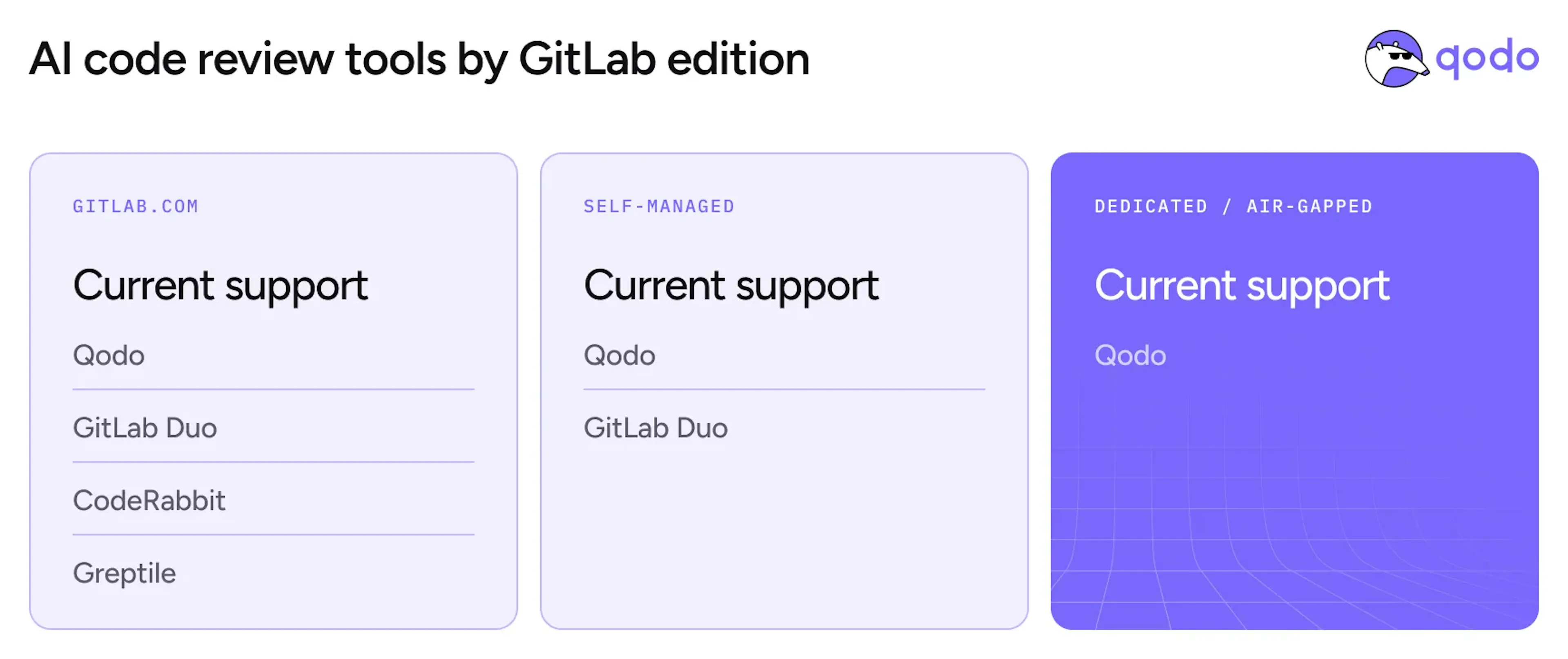
GitLab Self-Managed is the self-hosted edition of GitLab. GitLab Dedicated is the single-tenant SaaS edition used by regulated enterprises. Both are common in financial services, healthcare, defense, and government — and both rule out cloud-only AI code review tools.
Deployment requirements for regulated GitLab environments
If your team is on GitLab Self-Managed or GitLab Dedicated, every row in this table needs to be satisfied. Cloud-only tools usually fail at the first row.
|
Requirement |
Why it’s needed |
|---|---|
|
On-premise or single-tenant deployment |
Source code can’t be sent to external multi-tenant APIs |
|
Air-gapped environment support |
Tool must run without outbound internet access |
|
FedRAMP, SOC 2, or equivalent compliance |
Required for regulated industries and government work |
|
Audit logging |
Review decisions need to be traceable for compliance |
|
SSO and SAML integration |
Required for enterprise identity infrastructure |
On GitLab Self-Managed and GitLab Dedicated, the AI code review shortlist narrows to Qodo and GitLab Duo. Qodo provides full multi-agent review and cross-repository context in self-hosted deployments — see Qodo on-prem for deployment details. Duo provides single-MR review inside Premium and Ultimate, included with the GitLab subscription. CodeRabbit, Greptile, and other cloud-only tools aren’t viable in these environments.
The right tool depends less on which is “best” in the abstract and more on what kind of team you are. Five common profiles:
|
Team profile |
Best fit |
Why |
|---|---|---|
|
Small team on GitLab Free or Starter |
Qodo (free tial+Pro team) |
GitLab Duo isn’t available, and you don’t need enterprise-grade rules yet |
|
Mid-size team on GitLab Premium, single product |
GitLab Duo (start here) |
Already included, sufficient for single-project MR review |
|
Mid-size team on Premium with multiple services and shared modules |
GitLab Duo + Qodo |
Keep Duo for in-MR suggestions, add Qodo for cross-repo context and rules |
|
Enterprise on GitLab Self-Managed |
Qodo + SonarQube |
Qodo for AI review and governance, SonarQube for static analysis. Duo optional if on Premium/Ultimate |
|
Regulated enterprise on GitLab Dedicated or air-gapped |
Qodo (with optional GitLab Duo) |
The only AI code review tool with verified support for these environments |
- Is your team on GitLab or Self-Managed? Self-Managed and Dedicated narrow the list immediately. On GitLab, most tools are viable and the decision shifts to depth of review, rules support, and cross-repo context.
- Is GitLab Duo already included in your existing GitLab subscription? For Premium and Ultimate teams, Duo is included. The question becomes whether Duo alone is enough, or whether you need a dedicated AI code review platform alongside it. For most enterprise teams with multiple projects and architecture rules, Duo on its own isn’t enough — but it’s a free baseline to build on.
- Do MRs need to be evaluated across project boundaries? Teams with microservices, shared API contracts, or organization-wide architecture rules need cross-repository review. On GitLab, Qodo is the only tool in this comparison that provides this across self-managed and SaaS deployments.
- How important is the rules layer? Teams that want to define, enforce, and evolve coding standards across distributed teams need a rules system with lifecycle management. Duo, CodeRabbit, and Greptile don’t provide this. SonarQube provides rule enforcement for static analysis but not for AI-driven review.
- Is regulated deployment a hard requirement? For FedRAMP, sovereign cloud, or air-gapped requirements, the list narrows to Qodo and GitLab Duo on Self-Managed or Dedicated. Other AI code review tools aren’t viable.
如有侵权请联系:admin#unsafe.sh