In September 2026, AMC Entertainment CEO Adam Aron publicly objected to Robinhood offering a stock t 2026-9-11 11:31:0 Author: hackernoon.com(查看原文) 阅读量:18 收藏
In September 2026, AMC Entertainment CEO Adam Aron
That is the problem this guide solves. As crypto-native platforms lower the barriers between digital-asset markets and Wall Street, the ticker alone tells you less than it used to. This is not a product ranking. It is a market-structure guide to product boundaries: what legal claim you hold, who owes you what, where the price comes from, what happens during corporate events and market closures, and how you exit.
Key Takeaways
- RealStocks are the ownership rail. The user buys an actual U.S.-listed share through brokerage and custody infrastructure, and the U.S. cash-equity market remains the reference market for that security.
- Tokenized Stocks are the bridge rail. The token has its own market, and issuer, backing, custody, redemption or conversion, pricing and market-making mechanisms connect that market to the underlying stock. The quality of that bridge matters more than the word “tokenized” — and different token programmes build different bridges.
- Stock Futures are the risk-transfer rail. They provide derivative exposure with margin and direct long or short positioning. Their strength is capital and execution flexibility, not shareholder ownership.
- The same company can sit behind four or more structures on one platform. NVIDIA is available on MEXC as a real share, as two separately issued tokenized products, and as a Stock Future. Same company thesis, four different instruments.
- Lower walls do not move product boundaries. The Access, Fee, Time, Capital and Direction Walls describe friction in reaching a market. They say nothing about the legal or economic boundary of the product once you are inside. Easier access therefore makes product-structure literacy more important, not less.
Why Are the Walls Between Crypto and Wall Street Coming Down?
Retail stock access has historically been shaped by five frictions. MEXC’s September 2026
Those numbers explain why the walls are being lowered. Crypto-native infrastructure can reduce parts of each friction through one-account access, USDT-based participation, extended schedules, smaller units and products that support both long and short exposure. Selected products or campaigns may also reduce trading fees.
What happens next is the part the campaign framing does not cover. Once access friction falls, several instruments tied to the same company sit behind the same interface, even though their legal claims, obligors, trading venues, price anchors, settlement rules, corporate-action treatment and failure modes are different. A lower wall changes how a market is reached. It does not erase the boundaries between the products reached through it.
What Are the Five Boundaries Behind the Same Stock Ticker?
The most useful habit is to separate the company from the instrument. The company is the economic story: revenue, earnings, products, management, regulation, sector conditions, investor expectations. The instrument is the rail used to express a view on that story. All three rails can reference the same company while crossing five boundaries:
- Legal claim. Do you hold equity, a contractual claim on an issuer, or a derivative position?
- Obligor or counterparty. Which specific legal entity owes you something, and what happens if it fails?
- Price anchor. Where is the price formed, what pulls it back toward the underlying, and what changes when that reference market is closed or stressed?
- Corporate-action treatment. What happens to your position during a dividend, split, reverse split or rights issue?
- Exit path. How do you get out, and what does that route reveal about what you were holding?
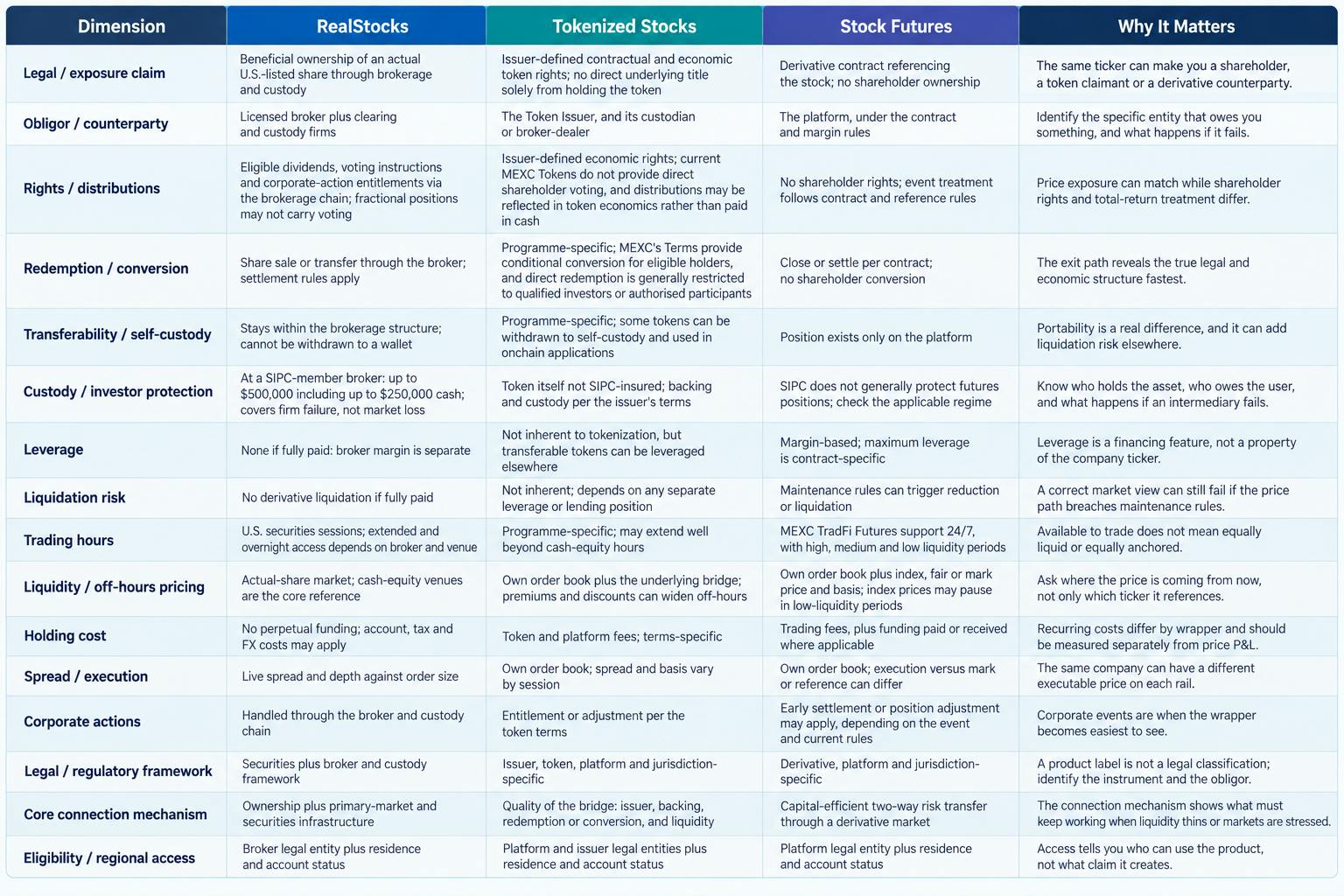
These five boundaries are the spine of this guide. Each rail is described against them below, the comparison table maps all three across them, and the five-question test at the end turns them into a checklist.
What Do You Own When You Buy a RealStock?
With RealStocks, the buyer holds an actual U.S.-listed share. Orders are routed through a licensed brokerage partner, and clearing, settlement and custody are handled by third-party firms rather than by MEXC itself, as set out in the
The asset at the end of that chain is still the company’s equity security. Eligible shareholders can receive dividends and other corporate-action entitlements, and voting instructions can be submitted through the applicable broker or nominee process — though fractional positions often cannot be voted, which is worth checking before treating a small holding as a governance stake. Most U.S. securities transactions settle on the
Investor protection on this rail runs through the securities framework. At a SIPC-member broker,
Price discovery is the other half of the rail. U.S. stocks trade across exchanges, market makers, electronic venues and other market centers, with consolidated quote and trade information linking those venues into the
Do You Own the Stock When You Buy a Tokenized Stock?
No — not as a matter of course, and the correct answer depends on which token you hold. Under
That is the platform-level framework. It is not a description of every tokenized stock, because “tokenized stock” is not one legal form. The SEC’s
The most useful mental model is a bridge. The underlying stock market is the reference market on one side. The token market is a separate venue on the other. Between them sit the Token Issuer, custodian or broker-dealer, backing assets, market makers, pricing data, mint and redemption rules, transfer rules and fees. When those links are clear, usable and economically efficient, price differences are easier for participants to close. When one link is constrained, the token can behave more independently of the underlying.
This is why 24/7 availability is not, by itself, the structural edge of a tokenized stock. A market can be open and still have thin depth, wide spreads or a weak connection to its reference. The harder-to-copy layer sits in the bridge: credible backing and custody, transparent issuer obligations, practical mint and redemption channels, correct treatment of distributions and corporate events, and enough market-making capacity to keep the token economically tethered to the securities market.
Two practical consequences follow. First, redemption and conversion are conditional rights rather than automatic features. MEXC’s Terms describe a conversion mechanism for eligible holders subject to procedures, brokerage-account requirements, fees, thresholds and regional eligibility, and across the wider market, direct redemption against the underlying is
Tokenized stocks also differ from the ownership rail in a way that rarely appears in comparisons: depending on the programme, they can be withdrawn to a self-custody wallet and used in onchain applications, including as lending collateral. That is genuine flexibility, and it is also a second layer of liquidation risk that has nothing to do with the token itself. Check what the specific programme supports in the
What Are Stock Futures, and What Do They Actually Give You?
Stock Futures solve a different problem. They are derivative contracts designed to transfer price risk, not to create shareholder ownership. On MEXC they are perpetual contracts with no expiry, traded through a crypto-native futures interface with USDT-based margin on eligible pairs, as described in the
The structural edge here is capital-efficient two-way risk transfer. Margin can support notional exposure larger than the posted collateral, and the same framework supports both directions. Maximum leverage is set per contract and changes — AMC Stock Futures currently list up to 20x, while some eligible contracts on the
A Stock Future also has its own price. Depending on the contract, the connection to the underlying involves index or reference prices, fair or mark-price methodologies, market-maker hedging, basis, and funding where applicable. Funding is therefore one connection mechanism, not the definition of the product and not a universal rule for every stock-linked derivative.
MEXC supports 24/7 trading for TradFi Futures, but its own documentation divides those hours into
That list is the single most important thing on this page for anyone holding a leveraged position over a weekend. A stop that does not fill against an index that is not updating is a different risk from the one most traders think they are taking. In other words: 24/7 removes the time wall for order entry. It does not remove the time wall from the underlying price-discovery system.
Three Rails, Three Connection Mechanisms: What Keeps Each Price Anchored?
The deepest difference between the three products is not the interface. It is the mechanism that answers two questions: where does the price come from, and what can pull that price back toward the underlying reference when it drifts?
For RealStocks, the listed equity market is the reference system itself. Orders interact across exchanges, market makers and other market centers, while national-market data and best-execution obligations connect fragmented venues. The actual share is what changes hands, so there is no wrapper that must be redeemed into the stock before the holder reaches the underlying asset.
For Tokenized Stocks, the token trades in its own market and the underlying share sits behind a bridge. Market makers can observe the cash-equity market, hedge in related securities, and use issuer-defined mint, redemption or conversion channels where those channels are open. When the bridge is efficient, a meaningful price gap invites trading that reconnects the two markets. When the bridge becomes expensive, slow, restricted or temporarily unusable, a premium or discount can persist.
For Stock Futures, the derivative market also forms its own price. The connection runs through reference or index prices, fair or mark-price formulas, hedging, basis relationships and funding where applicable. The contract does not need to become a share to be economically useful. It needs a reliable reference and a liquid enough risk-transfer market for buyers and sellers to take opposing views.
Seen this way, the three connection mechanisms are genuinely different. RealStocks connect through actual equity ownership and the securities market in which the share itself trades. Tokenized Stocks depend on the quality of an issuer- and programme-specific bridge. Stock Futures depend on a derivative reference system plus exchange liquidity, margin and risk controls. These are product boundaries first; only some of the surrounding infrastructure becomes a firm-specific advantage.
What Happens When the U.S. Cash Market Is Closed?
The cash market closing does not make stock-related prices disappear. U.S. equities can trade in supported extended or overnight sessions, related derivatives and other venues may remain active, and market makers can price from models or correlated instruments. What changes is the quality and directness of the reference — and it changes differently on each rail.
Real shares. Execution follows the supported securities-market sessions. Outside the deepest regular-hours window, spreads and depth can differ materially; FINRA’s
Tokenized stocks. The token venue can stay active when the most liquid cash session is shut, and how well it stays tethered depends on how the programme is built. Where a programme’s primary market — minting and redemption against real shares — follows the underlying market’s schedule, that channel closes when the stock market closes, and the token trades on secondary liquidity alone until it reopens. Where a programme instead relies on pre-minted inventory held in liquidity pools, secondary trading can continue without interruption, but that inventory is finite and can thin out under stress. Either way, market makers have fewer direct underlying trades available for hedging or price confirmation. A gap versus the previous stock close can therefore represent new information, wrapper-specific imbalance, or both. Check the mechanics of the specific programme — the
Stock Futures. The same principle runs through a different mechanism. MEXC’s 24/7 framework explicitly recognises low-liquidity periods when the underlying market is closed, and the specific consequences are listed above: paused index prices, higher slippage, unfilled stops, reduced leverage on new orders, and gaps at the reopen. Continuous availability gives the market somewhere to react. It does not recreate regular-session liquidity or price discovery at every hour.
Opening hours differ by day and by venue. So does the quality of the price anchor behind them.
This distinction is essential. Trading hours describe whether an order can be placed. They do not tell you how strong the price anchor is, how much size can be executed, or how expensive it is to exit. Availability is a door. Liquidity and connection mechanisms determine what is on the other side.
Boundary One in the News: Why AMC’s CEO Objected to an AMC Stock Token
The September 2026 AMC–Robinhood dispute is useful because it makes the wrapper visible. AMC’s CEO objected publicly to Robinhood offering a token linked to AMC without AMC’s participation, argued the product could deny holders shareholder rights and interfere with the company’s own capital raising, and called for trading to stop. Robinhood declined, with its chief legal officer and CEO both publicly standing behind the product. As of writing, the disagreement is unresolved.
The structure is the point. Robinhood’s documentation identifies these Stock Tokens as tokenized debt securities issued by Robinhood Assets (Jersey) Limited, providing economic exposure to a referenced share while conferring no legal or beneficial rights in, or against the issuer of, that share. A holder is a creditor of a Jersey entity. The token can therefore carry AMC’s name without any relationship between the holder and AMC — which is exactly what the company objected to.
The lesson is not that all tokenized stocks work like Robinhood’s product. They do not: the SEC’s 2026 taxonomy explicitly recognises several distinct structures, and a custodial token evidencing a security entitlement is a different instrument from a third-party debt security. The lesson is that the label “stock token” cannot substitute for the legal and operational terms, and that two products marketed as tokenized exposure can create different claims against different entities in different jurisdictions.
The same naming problem appears when a ticker is reused across product types. MEXC lists AMC Stock Futures (AMCSTOCK_USDT) as a derivative contract. That is not Robinhood’s AMC Stock Token, and neither is an AMC share held through a brokerage account. All three move around the same catalyst. Only one is the underlying equity.
NVDA, NVDAX, NVDAON or NVDA Stock Futures: What’s the Difference?
AMC shows that a company may not even participate in the tokenization of its own name. NVIDIA shows something harder: even within one platform and one product category, the wrapper can change. Eligible users can reach NVIDIA through
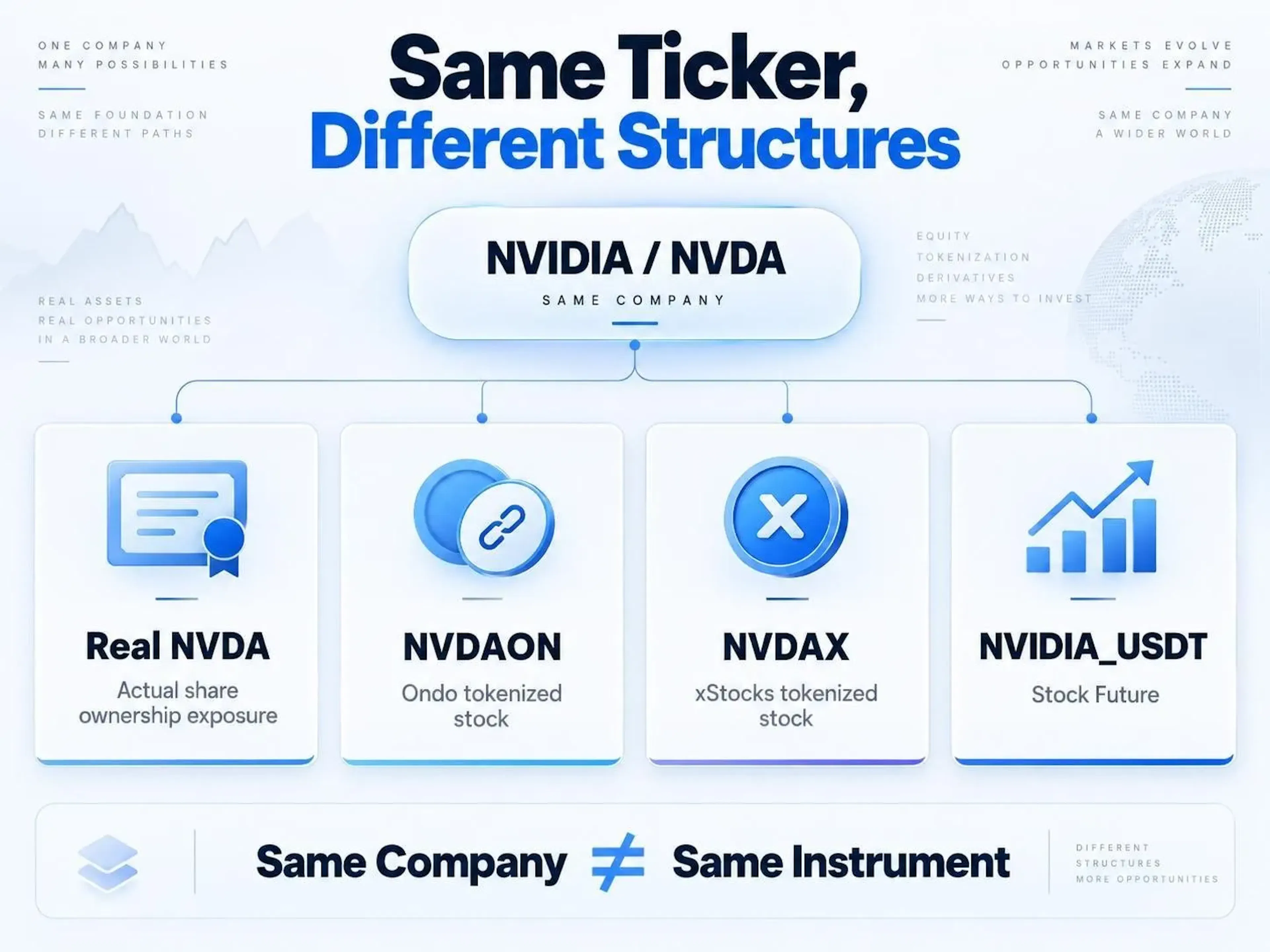
Walk the five boundaries and the four products separate cleanly. Legal claim: one is equity, two are issuer-defined token claims of different legal form, one is a derivative position. Obligor: a brokerage and custody chain for the share, two different token issuers for NVDAON and NVDAX, and the exchange itself for the future. Price anchor: the cash-equity market for the share, a programme-specific bridge for each token, and an index or mark price for the future. Corporate actions: broker processing on the share, issuer-defined treatment on each token, and early settlement or position adjustment on the future. Exit: sale through the brokerage structure, sale on the token venue plus a conditional conversion or redemption route, or closing a derivative position.
The two tokenized products are the sharpest illustration. NVDAON and NVDAX both track NVIDIA and both appear in the same tokenized-stock section of the same exchange, yet they come from different issuers with different legal forms, supported networks, mint and redemption processes, transfer rules and liquidity. “Tokenized NVIDIA” does not identify the instrument you hold.
This is the practical meaning of knowing what you own. The company thesis can be identical while the instrument boundary changes. Before treating two NVIDIA-linked products as substitutes, identify the legal claim, obligor, price anchor, corporate-action treatment and exit path for each. Same underlying does not mean same product risk.
Does Easier Access Change What You Own?
No. Each wall maps to a different friction — access, cost, time, capital or direction — and a product can remove one of those frictions without changing its legal claim. Tokenized access does not become share ownership because it trades longer. A futures contract does not become equity because it references the same ticker. A real share does not become crypto-native because it is reached through the same front end.
A lower minimum does not mean a token becomes a share. A 24/7 market does not mean the underlying market is open. A USDT quote does not mean settlement, custody or corporate actions have become crypto-native. A long or short interface does not mean a futures holder receives shareholder rights. The friction being removed and the economic claim being created are two separate questions.
This is also why “without walls” should not be read as “without market structure.” Market structure still determines who holds assets, who owes the user, where prices are formed, when liquidity is deepest, how positions settle and what happens under stress. The smoother the front end becomes, the more important it is to keep those back-end differences visible.
MEXC Stock Ecosystem: What Are the Three Post-IPO Rails?
Within MEXC’s Stock Ecosystem, the post-IPO layer has three rails. RealStocks provide access to actual U.S.-listed shares through brokerage infrastructure. Tokenized Stocks provide token-based economic exposure under issuer-defined terms. Stock Futures provide derivative exposure with contract-specific margin, long and short mechanics, and risk controls. As of MEXC’s September 2026 ecosystem snapshot, Stock Futures cover 400+ stocks and ETFs at up to 200x leverage, and Tokenized Stocks cover 200+ stocks and ETFs on a 1:1 asset-backed basis. The wider ecosystem also spans the company lifecycle, from Pre-IPO Futures and Pre-IPO Launchpad through IPO Launchpad and IPO Express to the three post-IPO products — which is why no single product is designed to solve every access problem.
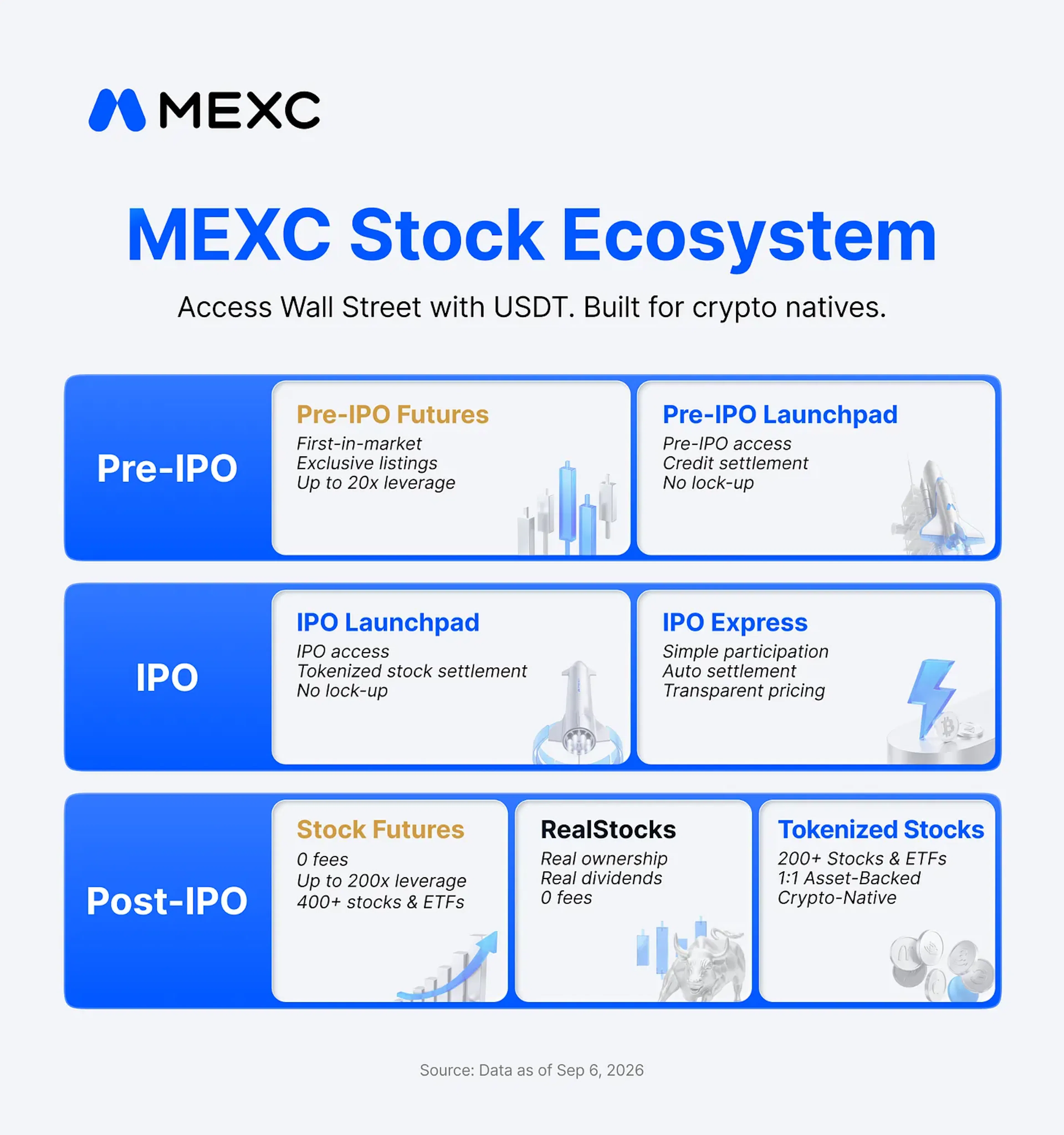
The MEXC Stock Ecosystem across the company lifecycle. For the post-IPO user the decision sequence is simple: choose the company thesis first, then identify the rail. If the goal is ownership, inspect the brokerage structure. If the goal is tokenized access, inspect the issuer and the bridge to the underlying. If the goal is derivative risk transfer, inspect the contract, margin, reference price and liquidation mechanics. The table below maps all three rails across the five boundaries and the mechanics that follow from them. It is not a ranking. Its purpose is to show what must be verified before two products are treated as equivalent.
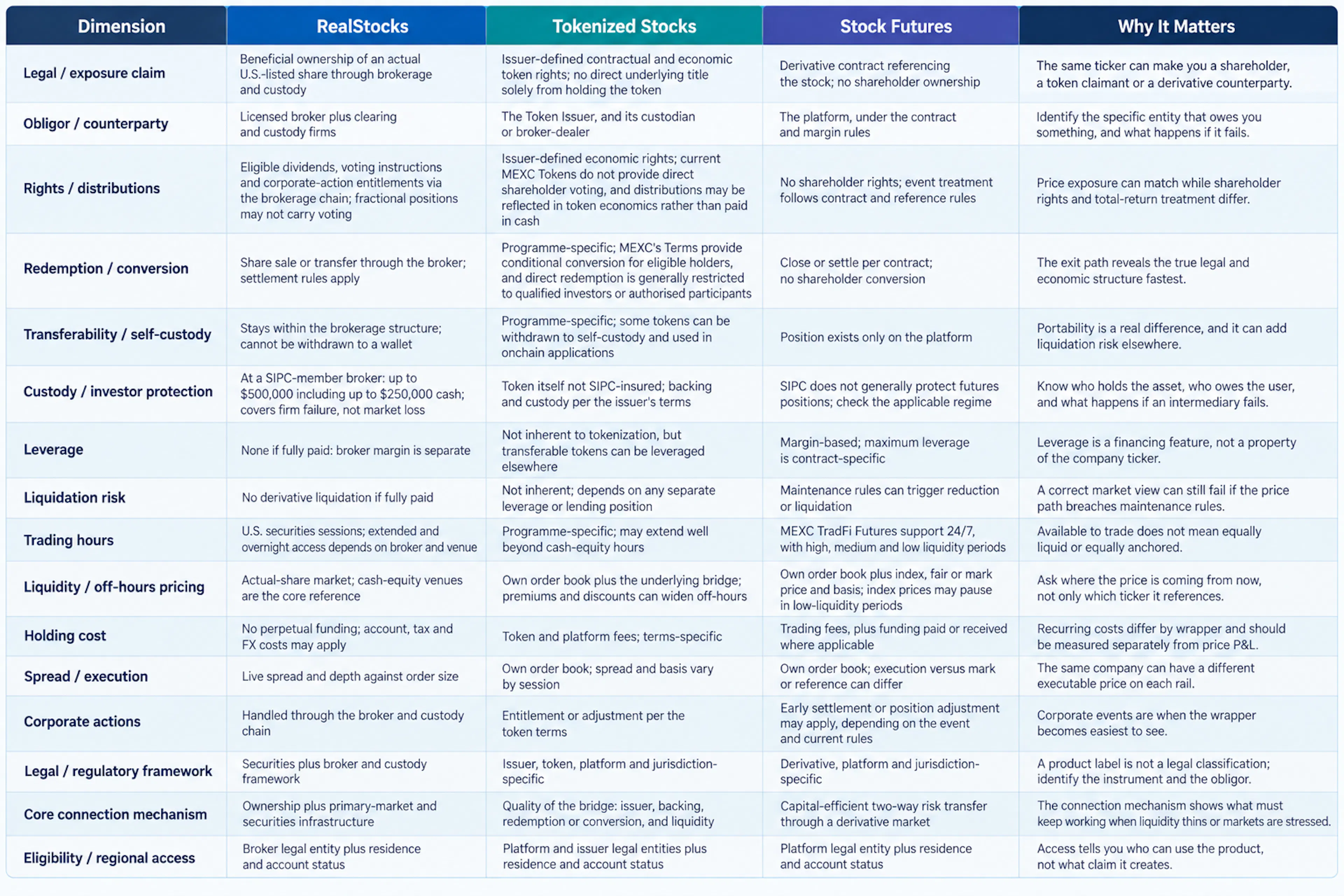
What Is Actually Defensible? Product Features vs Structural Edges
A product category’s structural edge is not the same thing as a platform’s competitive advantage, and conflating the two produces bad analysis. RealStocks have a structural advantage when a user specifically wants actual listed equity, shareholder entitlements and a direct connection to the market where the stock itself trades. But the brokerage, clearing, custody and U.S. market infrastructure behind that rail are industry infrastructure, not anyone’s proprietary asset.
Tokenized Stocks do not become defensible because they are onchain or open for longer hours. Those features can be copied. The defensible layer belongs largely to the token programme and its issuer: transparent obligations, credible backing and custody, practical mint and redemption, correct corporate-action treatment, and the market-making capacity that keeps the token tethered to the underlying.
Stock Futures are the rail where exchange-level differentiation is most direct. The venue controls more of the risk-transfer engine: order-book liquidity, matching, margin, reference-price methodology, liquidation rules and risk controls. That same engine creates the product’s characteristic risks — liquidation, basis, funding where applicable, and off-hours reference-price behaviour.
So where can an exchange genuinely differentiate? In distribution and access across rails from one account, in liquidity and execution quality, in product breadth, in fees, in the reliability of its 24/7 infrastructure, in risk controls, and in how clearly it explains what each product is. Zero or lower fees reduce friction. Longer hours increase access. Small minimums lower the capital threshold. Those benefits are real and they are also the easiest to copy. What is harder to replicate is dependable liquidity, sound issuer and custody structure, a working redemption path, and a clear route through corporate events. The deeper question is always what keeps working when volatility rises and the wrapper has to prove what it is.
The Five-Question “Know What You Own” Test
Before treating two products with the same stock name as equivalent, answer five questions — one per boundary.
- What legal claim do I hold? A RealStock is an ownership interest in the underlying equity through the brokerage and custody chain. A Tokenized Stock is governed by the token issuer’s terms and may create contractual economic rights rather than direct share ownership. A Stock Future is a derivative contract. Start here, because every later right depends on the answer.
- Who owes me what? For real shares, the brokerage and custody chain administers assets and entitlements. For a Tokenized Stock, identify the Token Issuer, the custodian or broker-dealer, the backing assets and the party legally responsible for redemption or conversion. For a Stock Future, identify the platform, the collateral arrangement, the contract rules and the mechanism governing settlement or liquidation.
- Where does the price come from, and what happens when that market closes? Identify the reference market, the pricing source and the mechanism that pulls the product back toward it. Then check what changes off-hours: whether trading continues, how liquidity shifts, whether price limits or leverage controls tighten, whether the bridge to the underlying becomes less usable, and whether a meaningful premium, discount or basis can open. “24/7” answers only the first of those.
- What happens during dividends and corporate actions? On the ownership rail, distributions and events flow through the broker. On a token, the issuer applies the treatment defined in its terms. On a future, the platform may apply early settlement or a position adjustment. This is the boundary that surprises people most, because it can close a position you expected to keep.
- How do I exit? A RealStock can generally be sold or transferred through the brokerage structure. A Tokenized Stock can be sold on its venue, and may have conditional redemption or conversion rights. A Stock Future is closed or settled as a derivative position. The exit path is the fastest way to see what the product actually is.
Frequently Asked Questions
Is a Tokenized Stock the Same as a Real Stock?
No. Some tokenized structures are backed by real shares or represent a security entitlement, but the legal claim depends on the issuer and product terms. Under MEXC’s Tokenized Securities Terms, holding a Token does not by itself constitute direct legal title to the underlying U.S.-listed security.
Not necessarily. Backing describes the assets supporting the token; ownership describes the holder’s legal claim. A token can be fully backed by underlying shares while the holder still has a contractual claim against the Token Issuer rather than direct beneficial ownership of those shares.
What Is the Difference Between NVDAX and NVDAON?
Both reference NVIDIA and both trade in the tokenized-stock section, but they come from different issuers and programmes — NVDAX as an xStocks tracker certificate, NVDAON as an Ondo tokenized product. Legal form, supported networks, mint and redemption processes, transfer rules and liquidity can all differ. Read each programme’s own documentation rather than treating them as the same asset.
Are MEXC Stock Futures the Same as the S&P 500 or Dow Futures Quoted Before the Open?
No. Index futures quoted in financial media are dated, exchange-traded contracts on a benchmark index, widely used as a pre-open sentiment indicator. MEXC Stock Futures are perpetual contracts with no expiry, margined in USDT, and available on individual company names as well as indices. Both are derivatives; the contract design, venue and settlement differ.
Why Can a Tokenized Stock or Stock Future Move When the U.S. Market Is Closed?
Because the wrapper has its own buyers, sellers, market makers, reference data and trading venue. New information can be reflected before the deepest cash session reopens. The price may be informative, but its liquidity and its connection to the underlying reference are usually weaker than during active cash-market hours.
Is 24/7 Trading Automatically Better?
No. Longer availability can be valuable, but it is not the same as deeper liquidity or better execution. Spreads, depth, reference-price quality, market-maker participation, price limits and risk controls can all change when the underlying market is closed. On MEXC’s TradFi Futures, low-liquidity periods can also mean paused index prices and unfilled stop orders.
Which MEXC Product Provides Shareholder Ownership?
RealStocks is the ownership-oriented product of the three. Eligible users buy real U.S.-listed shares through licensed brokerage infrastructure and can receive dividends and other corporate-action entitlements where applicable. Tokenized Stocks and Stock Futures follow separate issuer or derivative structures.
Can I Withdraw a Tokenized Stock to My Own Wallet?
It depends on the programme. Some tokenized stocks are freely transferable and can be withdrawn to self-custody and used in onchain applications; others are not. Withdrawal support is set by the issuer and the platform, so check the specific token before assuming portability. A RealStock cannot be withdrawn to a wallet, because it is a securities position held through a brokerage chain.
What Happens During Dividends or Corporate Actions?
For RealStocks, eligible distributions and corporate actions flow through the brokerage and custody chain. For Tokenized Stocks, the Token Issuer applies the economic treatment defined in its terms. For Stock Futures, current MEXC guidance indicates that special corporate events such as ex-rights issues, stock splits or reverse splits may lead to early settlement or position adjustments depending on market conditions, so check the event-specific notice for the contract you hold. This is one of the clearest moments when three products tied to the same company behave differently.
如有侵权请联系:admin#unsafe.sh