Building automated speech recognition has become one of the most resource-intensive arms races in mo 2026-9-11 03:52:43 Author: hackernoon.com(查看原文) 阅读量:20 收藏
Building automated speech recognition has become one of the most resource-intensive arms races in modern computing. For years, the industry standard has centered on scaling foundational transformer models across hundreds of thousands of hours of speech data to drive Word Error Rates closer to zero. Yet, as speech-to-text engines have become ubiquitously integrated into virtual meeting software, streaming platforms, and classroom tools, a fundamental limitation has become increasingly obvious to anyone relying on them for daily communication. While modern speech models are remarkably adept at transcribing vocabulary, they remain largely oblivious to the emotional tone, cadence, and urgency that give spoken language its actual meaning.
In high-stakes technical environments—such as engineering sprint retrospectives, architectural design reviews, or advanced university STEM lectures—spoken dialogue is rarely delivered as flat prose. A slight upward inflection can turn an apparent statement of fact into a skeptical question; a sudden drop in vocal pitch can signal a serious warning about a code vulnerability; and an urgent delivery can differentiate a critical design constraint from a casual suggestion. When standard automated speech recognition strips these acoustic cues away, leaving behind an uninflected block of text at the bottom of a display, it creates what Human-Computer Interaction (HCI) researchers call an intention gap. For deaf and hard-of-hearing professionals, the result is continuous cognitive strain, forcing them to guess speaker intent while rapidly darting their visual attention between slides, physical demonstrations, and disconnected caption windows.
At the University of California, Irvine and Virginia Tech, HCI researcher Dr. Sunday David Ubur has taken an alternative engineering path to address this challenge. Rather than treating speech recognition solely as a sequence-to-sequence text translation problem, Dr. Ubur approaches the challenge as an asynchronous distributed systems and spatial computing problem.
"The core issue with modern transcription isn't simply that words get misheard," Dr. Ubur explained in an interview. "The deeper problem is that speech-to-text algorithms throw away almost all of the acoustic information that carries human intent. Our goal was never to pile more visual noise onto the user. It was to find an architectural method to preserve the critical vocal cues that conventional captions discard, while keeping the user's cognitive workload as low as possible."
The first major systems bottleneck Dr. Ubur tackled was low-latency multi-stream inference within his platform,
However, extracting deep acoustic signals in real time solved only half the engineering equation; the more difficult challenge lay in interface design and user cognitive load. Early experimental systems across the accessibility sector often made the mistake of cluttering displays with bright banners, large animated avatars, or intrusive graphical tags that quickly overwhelmed users during demanding analytical tasks. Drawing upon established cognitive models of working memory, Dr. Ubur structured his system around an on-demand progressive disclosure interface. By segmenting incoming captions into short, readable phrase units and transmitting them over asynchronous WebSockets, the architecture presents clean, continuous text while embedding lightweight single-letter tokens adjacent to relevant phrases. These tokens remain visually subordinate to the primary transcript, expanding into plain-language tooltips only when a user intentionally hovers over or focuses on them, ensuring that the interface never obstructs the flow of technical information.
Dr. Ubur applied a similar empirical rigor to immersive spatial computing within his
To reduce the split-attention penalty in physical environments such as lecture halls and collaborative laboratories, Dr. Ubur extended his captioning work into
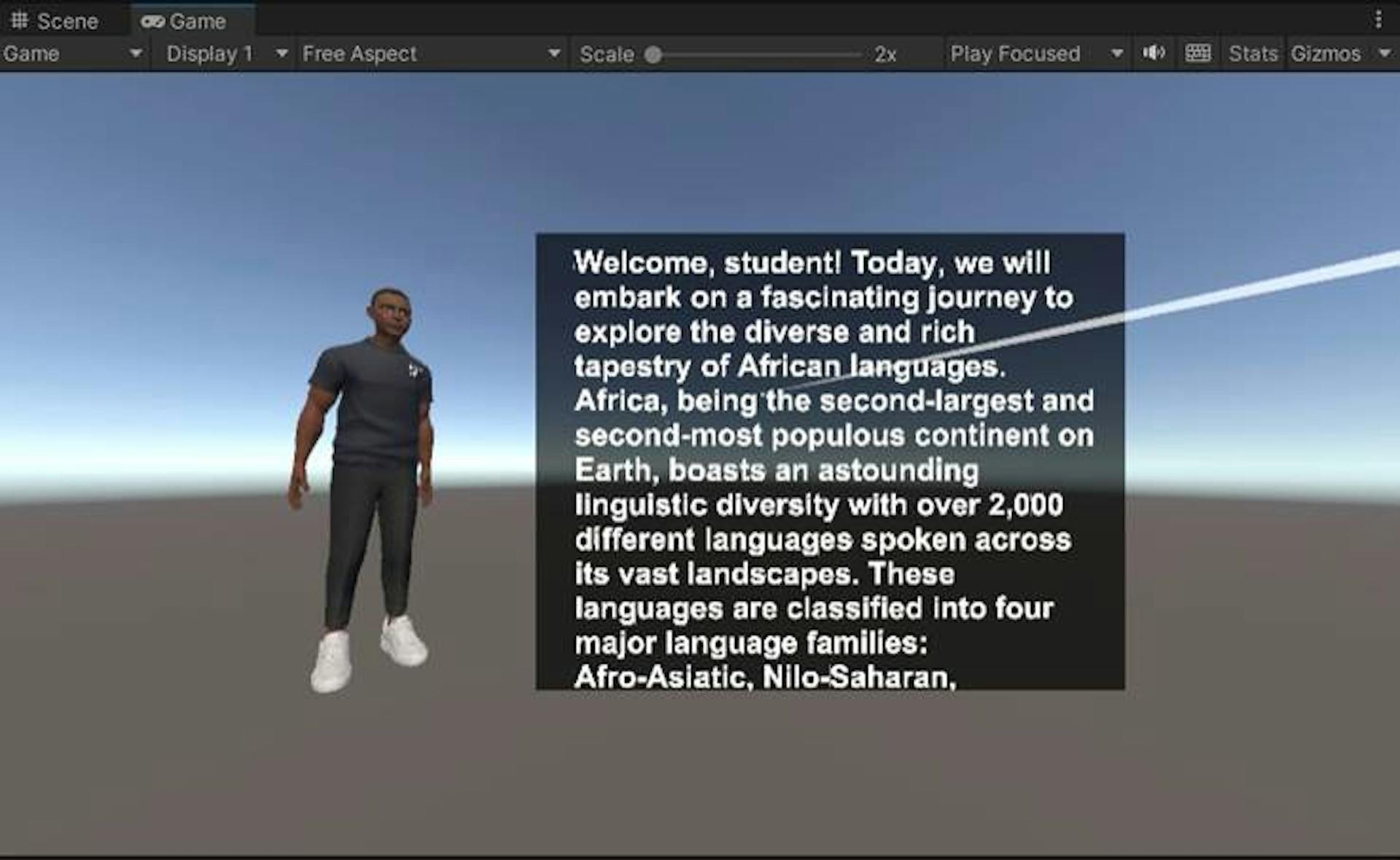
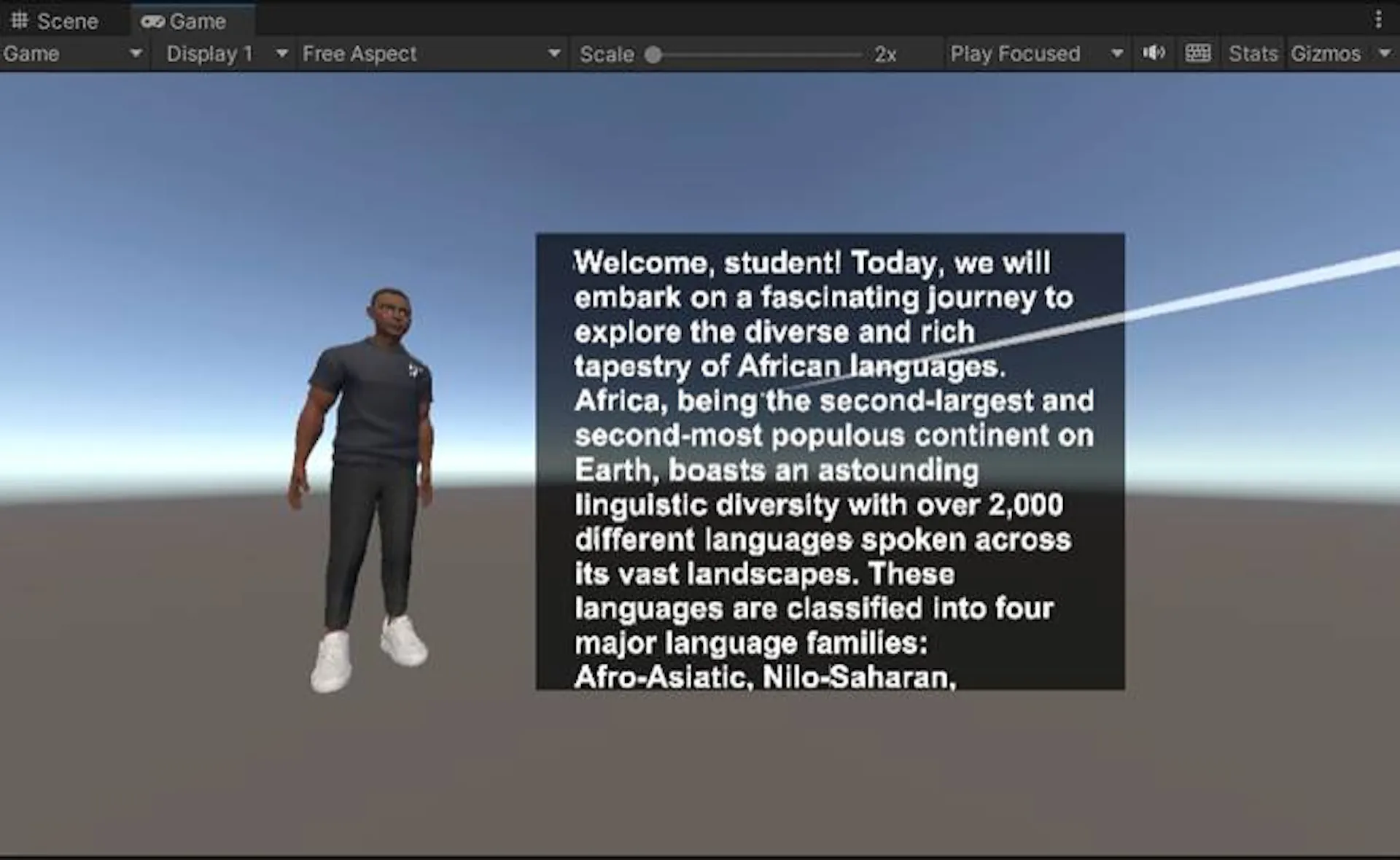 Figure 1. Unity-based spatial captioning prototype showing caption content positioned within a simulated user field of view.
Dr. Ubur subsequently extended these spatial architectures into collaborative group settings through a
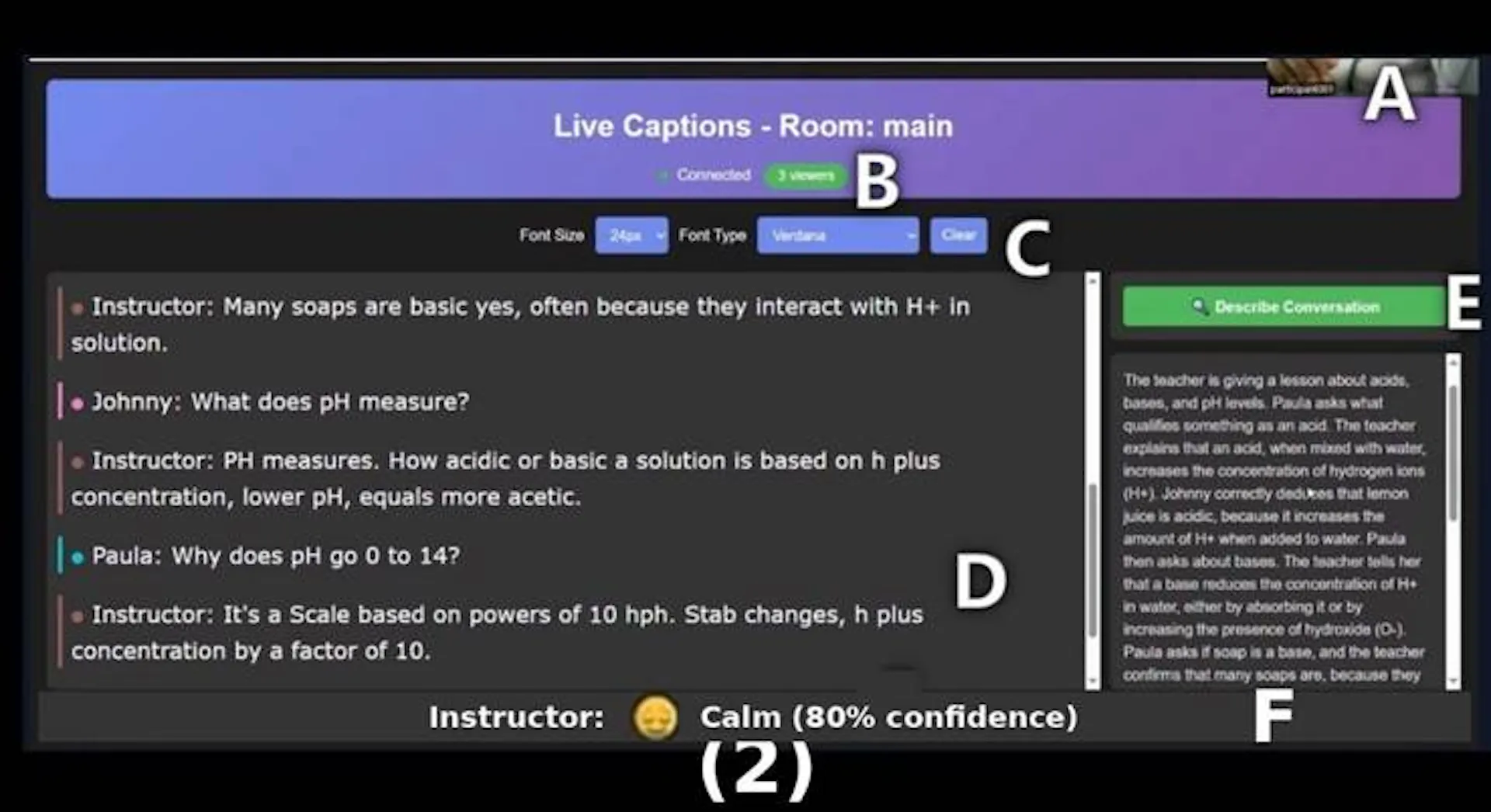 Figure 2. Speaker-aware live captioning interface showing distinct speaker turns, an affect/confidence indicator, and an on-demand conversation description panel.
The significance of Dr. Ubur's work has increasingly resonated beyond individual software prototypes, appearing at premier academic and technical venues including the
Beyond system development, Dr. Ubur's scholarship examines how the field itself evaluates accessibility. In an
"Accessibility is frequently treated as an optional feature or a compliance checkbox that gets tacked on at the end of a software cycle," Dr. Ubur noted. "In reality, when you engineer systems for edge-case environments and users with distinct sensory constraints, you are forced to solve the hardest latency, cognitive load, and interface problems first. The resulting architectures end up being faster, more resilient, and far more usable for everyone."
By approaching accessible communication through the rigorous lens of low-latency systems engineering, neuro-ergonomics, and spatial computing, Dr. Ubur's research demonstrates that speech technology still has significant room to evolve. As intelligent interfaces and spatial headsets become standard tools across classrooms and workplaces, the systems that truly succeed will not just be those that transcribe raw vocabulary, but those that capture and convey the full context of human dialogue.
This article was published under HackerNoon's Business Blogging program.
如有侵权请联系:admin#unsafe.sh