Every security team believes it’s ready for ransomware, until an attack proves 2026-9-8 03:35:56 Author: www.group-ib.com(查看原文) 阅读量:29 收藏
Every security team believes it’s ready for ransomware, until an attack proves otherwise. That gap between belief and reality doesn’t show up in a plan sitting in a drawer; it shows up in the data. Here’s what Group-IB’s frontline intelligence recorded in the last few months.
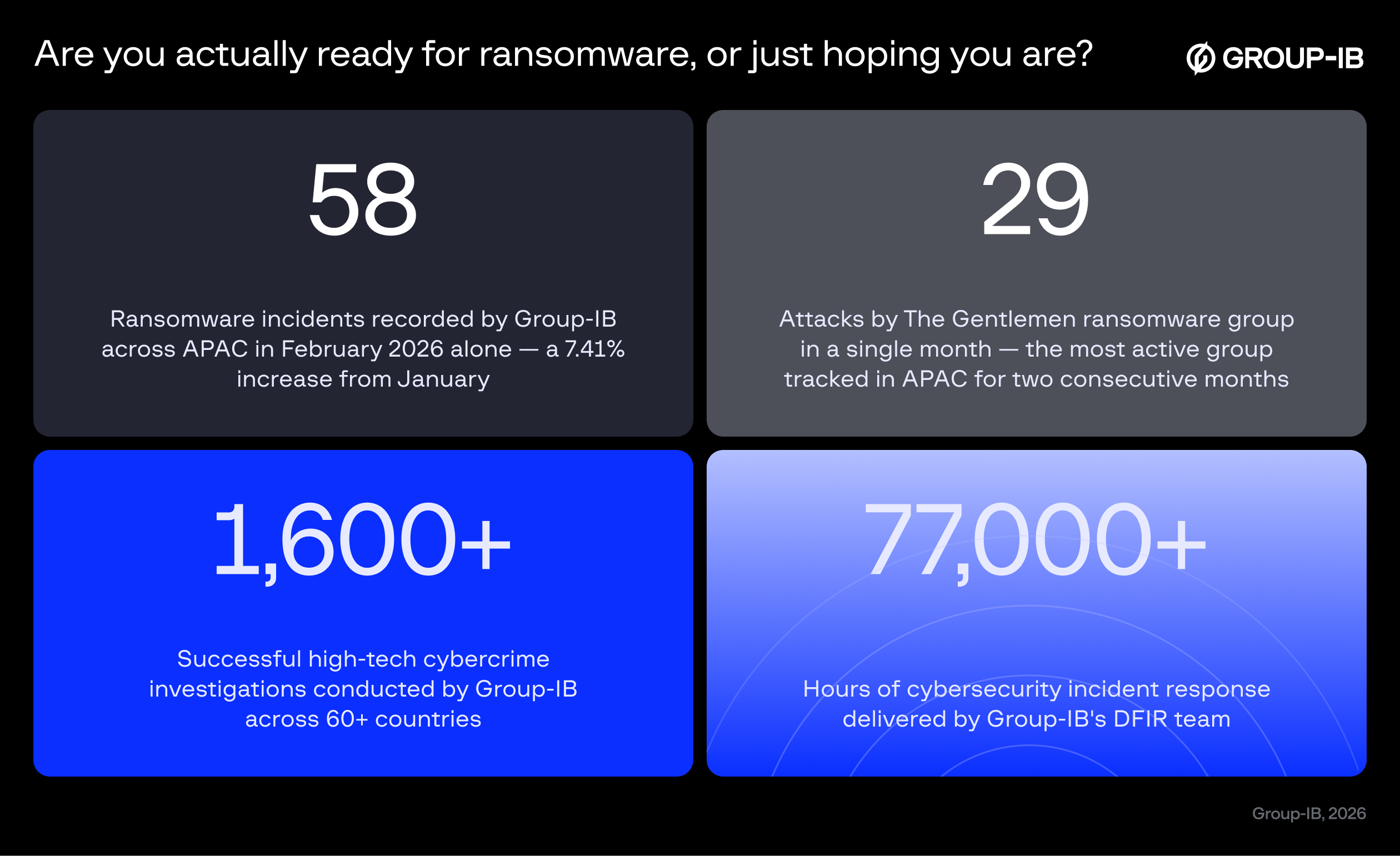
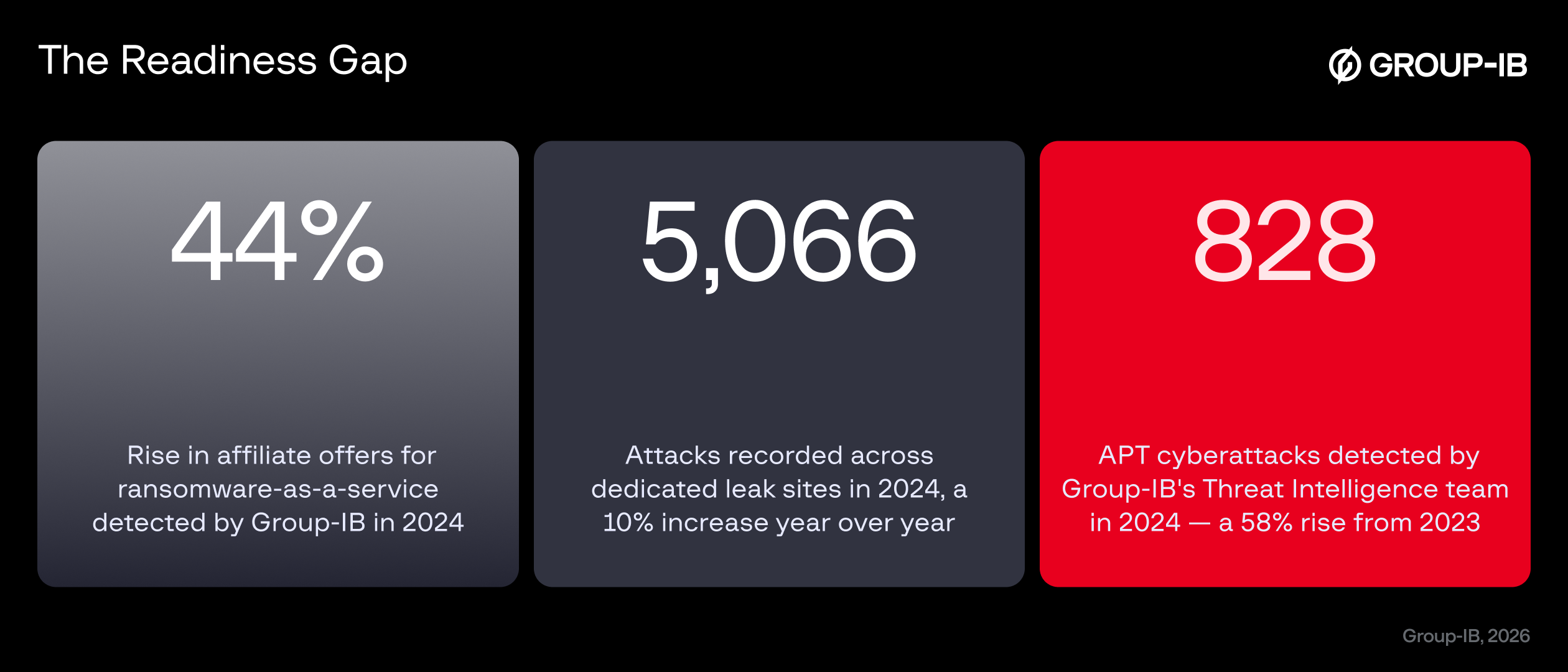
Each of these numbers describes the same mechanism from a different angle: more affiliates renting ransomware, more leak sites pressuring victims, more intrusions reaching the point of impact. None of that growth is slowing down to wait for your incident response plan to catch up.
Most organizations can point to an incident response plan. Far fewer can prove it will hold when the alarm goes off at 3 a.m. and systems are already going dark. That uncomfortable gap hides inside many security programs: readiness is often assumed because the paperwork exists. But a documented plan is not the same as an executable one.
So what does real readiness look like? It starts with five pillars
These five pillars follow the actual timeline of an incident, from the moment before an attacker moves to the weeks after recovery, rather than a generic maturity checklist. Skipping any one of them is usually where a “prepared” organization discovers it wasn’t.
Pillar 1 — Anticipate
Group-IB’s Threat Intelligence team continuously monitors active ransomware groups and dedicated leak sites, giving your team early warning of who is active, what they are targeting, and where they are likely to strike next, before they reach your environment. In February 2026 alone, Group-IB tracked The Gentlemen ransomware group claiming 29 attacks in a single month across APAC, flagging the campaign while it was still unfolding.
Pillar 2 — Contain
Group-IB Managed XDR collects telemetry across your endpoints, network, and cloud, detects threats through continuous behavioral monitoring, and contains compromised hosts before an attack can spread.
Pillar 3 — Communicate
When ransomware hits, communication failures compound the damage. Who tells the board? Who talks to regulators? Who handles customer notification and PR before the story breaks publicly? Group-IB’s Incident Response Retainer includes dedicated support for internal escalation, C-level briefings, regulatory notification guidance, and coordinated crisis communications, so your team isn’t making those calls under pressure for the first time at 3 am.
Pillar 4 — Recover
Getting back to normal after ransomware is rarely as simple as restoring a backup. Group-IB’s Services Retainer covers the full recovery lifecycle, including root cause analysis, eradication of attacker persistence, system restoration, and post-incident hardening to close the gaps that enabled the breach.
Pillar 5 — Learn
Most organizations treat the end of an incident as the finish line. It is not. It is the starting point for the next one.
Attackers study what worked. They note which techniques bypassed your controls, which entry points survived containment, and which gaps in your response created the most time to operate. If your organization does not run the same analysis after every incident, the attacker’s institutional knowledge grows faster than yours.
Group-IB’s Services Retainer closes that gap with proactive services between incidents: compromise assessments to find what your current tooling missed, tabletop exercises to pressure-test your response plan before it matters, and security training to close the human gaps attackers consistently exploit. The hours are flexible, whatever your team needs most before the next incident, not just after.
Every hour spent understanding an attacker from scratch is an hour the attacker spends moving. Here’s what Group-IB brings to that first hour instead.
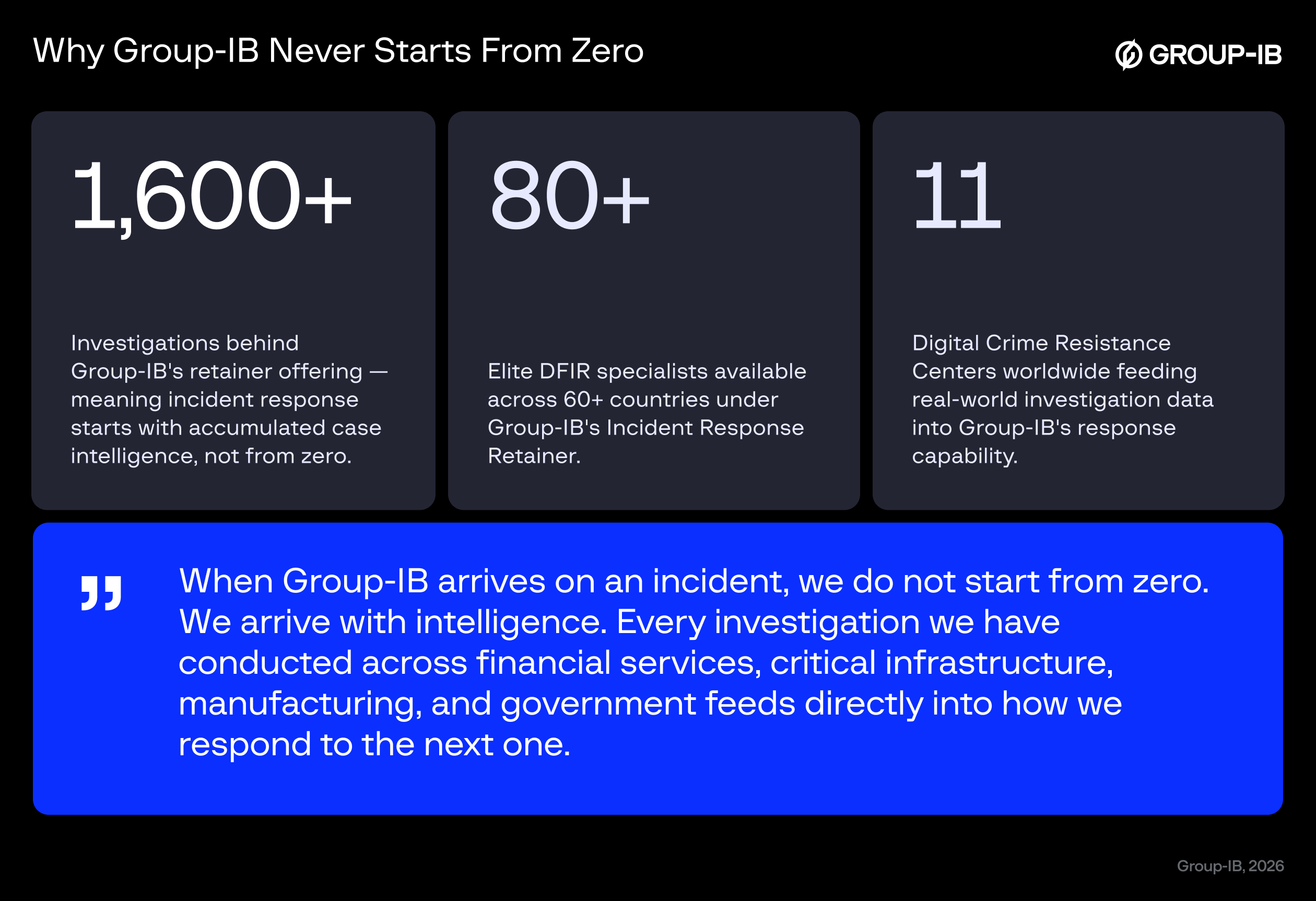

When Group-IB arrives on an incident, we do not start from zero. We arrive with intelligence. Every investigation we have conducted across financial services, critical infrastructure, manufacturing, and government feeds directly into how we respond to the next one.

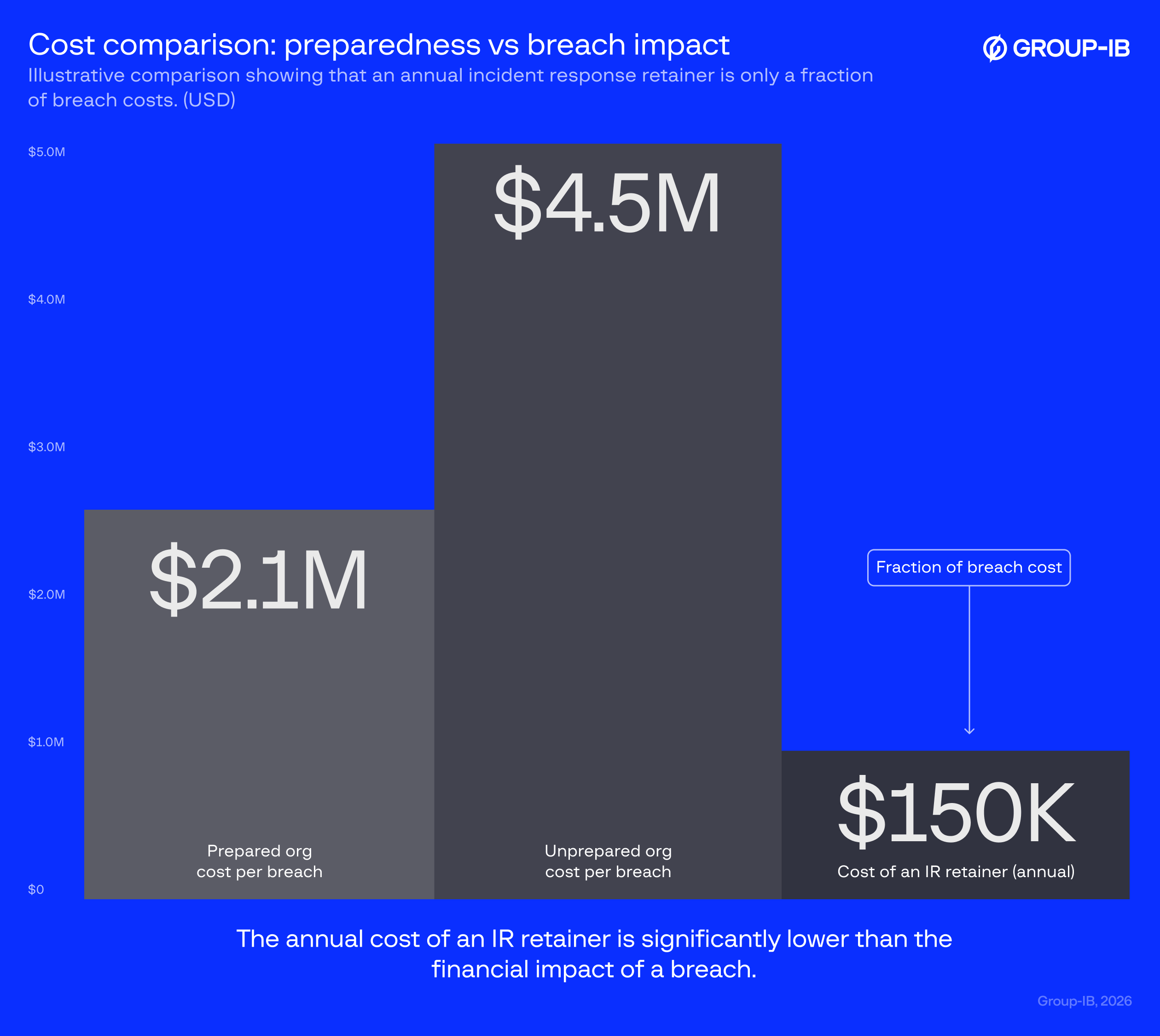
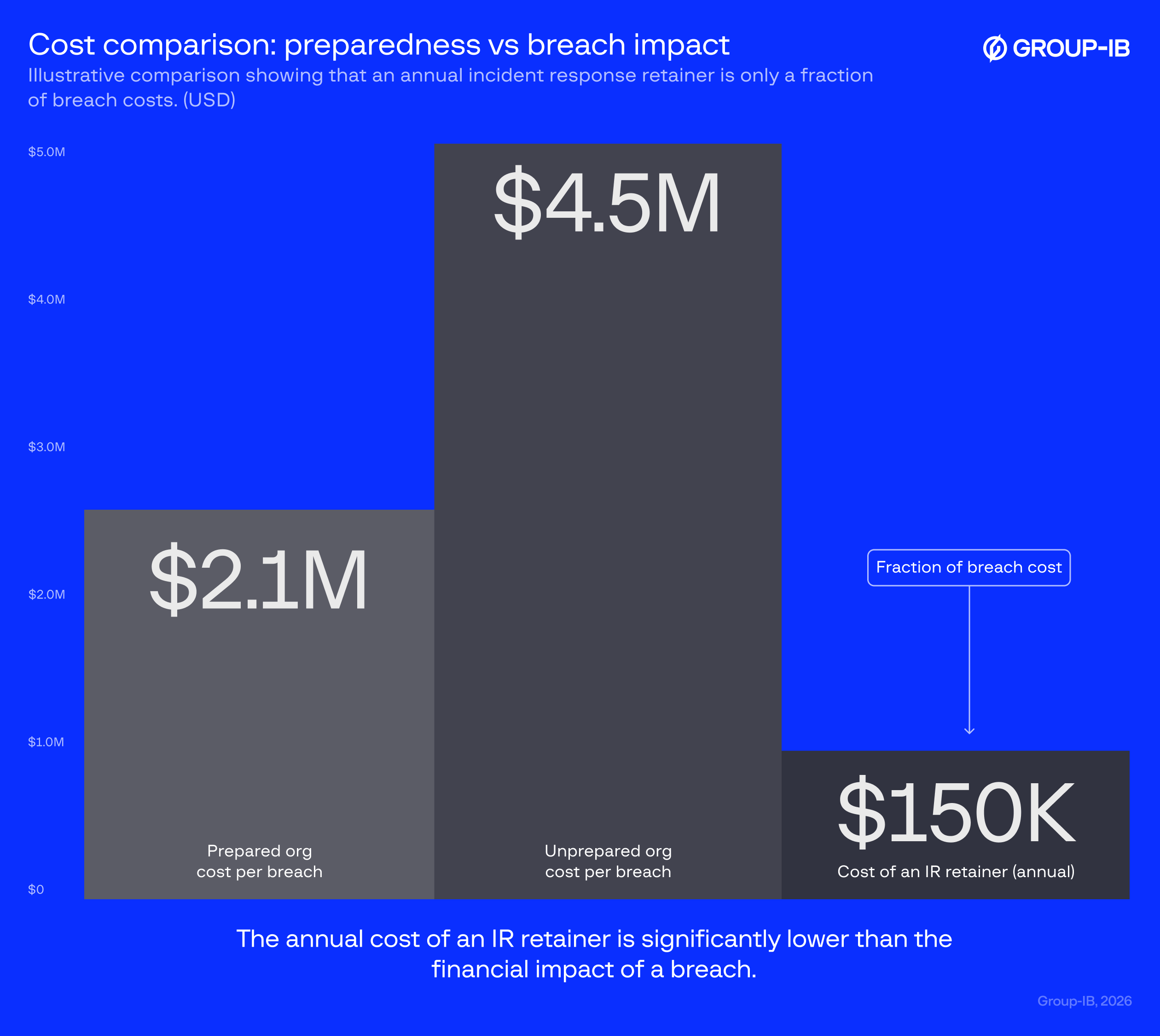
The gap between those three bars is the actual business case for preparation, and it doesn’t come from Group-IB’s own numbers. It comes from IBM’s 2025 Cost of a Data Breach Report, because the value of readiness shows up more clearly in aggregate industry data than in any single vendor’s case studies.
Organizations with a tested incident response plan saved an average of $2.66 million per breach compared to organizations without one. Ransomware and extortion incidents specifically averaged $5.08 million in 2025. An annual IR retainer costs a small fraction of either number, and unlike a breach, you choose the timing rather than an attacker.
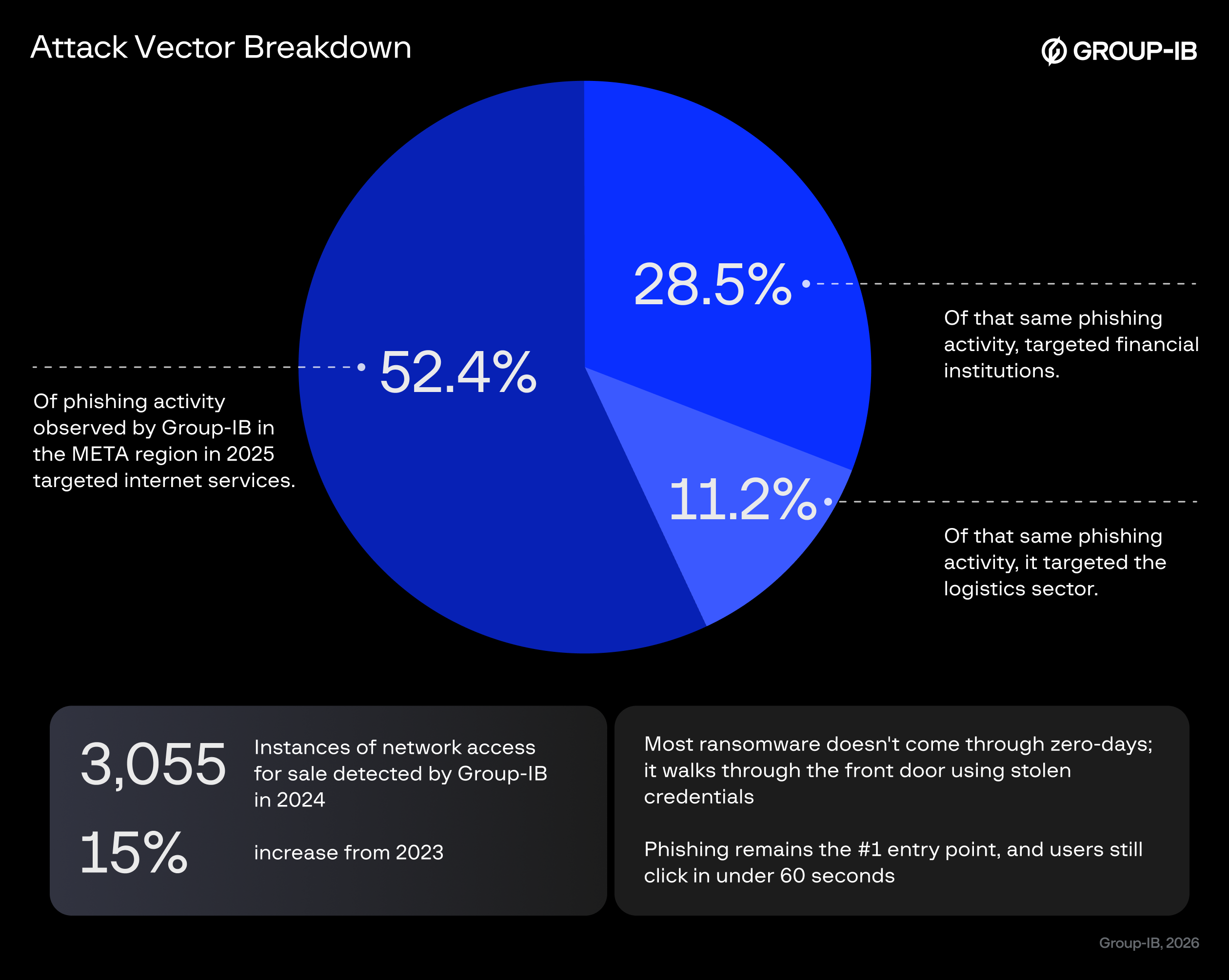
None of these entry points require a novel exploit. They require a user who trusts a message, a device that reuses a password, or an edge appliance that missed a patch cycle. That’s the uncomfortable part: most of this is preventable with things your team already knows how to do.
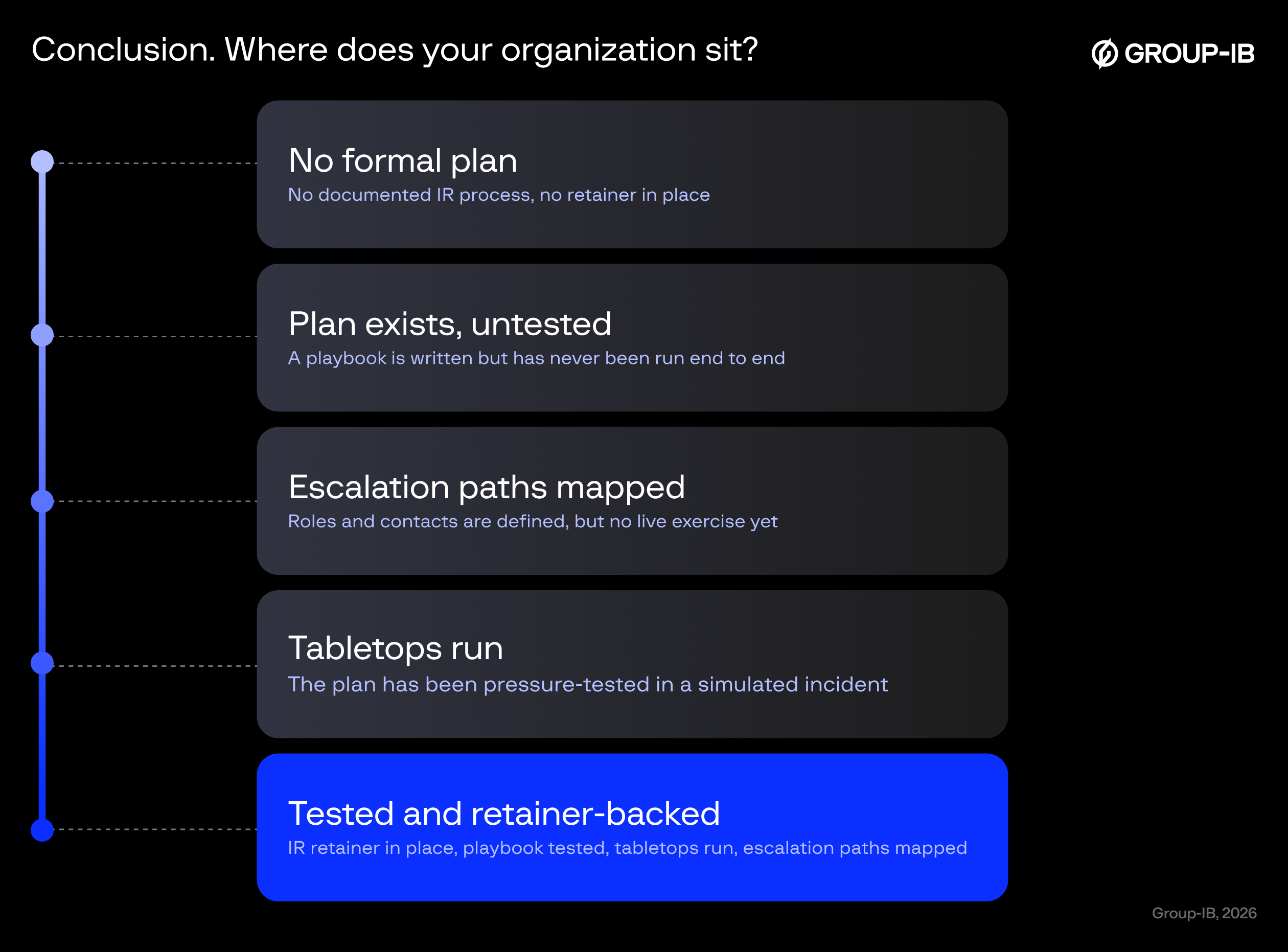
Before you look at the scale below, be honest about where your organization actually sits today, not where the plan on paper says it should sit.
The organizations that recover fastest are those that prepared before they had to.
That may sound simple, but it is what Group-IB’s DFIR team sees repeatedly in real incidents. The difference between level 3 and level 5 on the scorecard is not paperwork. It is the difference between having a plan stored somewhere and having a plan your team has already tested under pressure.
Most organizations sit somewhere between levels 2 and 3. They have an incident response plan. Some escalation paths are defined. But the plan hasn’t been pressure-tested, and the team may not know whether the retainer will cover what they need once the incident is live.
Level 5 looks very different.
It means the service retainer is already in place. SLAs are agreed. Escalation paths are clear. The playbook has been tested, not just written. Tabletop exercises have been run, not just planned. And when an incident starts, the response does not begin from zero. It starts with the experience and intelligence gained from more than 1,600 Group-IB investigations.
For organizations that cannot afford to improvise during a crisis, preparation is the real advantage.
Group-IB Service Retainer
- Elite DFIR specialists across 60+ countries
- Named a Representative Vendor in Gartner’s 2026 Market Guide for Cybersecurity Incident Response Retainer Services
- 1,600+ investigations powering every engagement
Talk to a Group-IB specialist before you need one.
如有侵权请联系:admin#unsafe.sh