JSCeal Hides Crypto Malware in V8 Bytecode Pierluigi Paganini 2026-9-7 10:19:45 Author: securityaffairs.com(查看原文) 阅读量:2 收藏
JSCeal Hides Crypto Malware in V8 Bytecode
 Pierluigi Paganini
 September 07, 2026

JSCeal hides crypto-stealing malware in V8 bytecode, but researchers built a tool to decompile it and expose its advanced theft capabilities.
JSCeal is a cryptocurrency stealer that Check Point Research has tracked since early 2025. Unlike most malware, it hides its code in a format that makes analysis much harder. Check Point presented its latest research at Black Hat USA 2026 and showed how its team built a tool that converts the hidden code into a form analysts can understand.
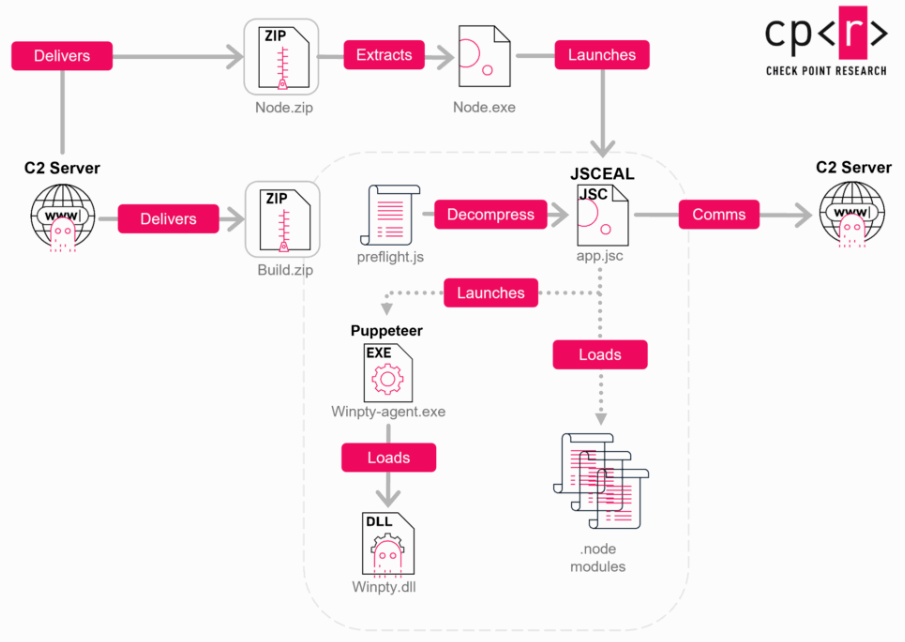
JSCeal uses a clever trick. Instead of delivering normal JavaScript, its creators compile the malware into V8 bytecode, the format that Chrome and Node.js use to run JavaScript efficiently. They then package the bytecode with a Node.js runtime that executes it.
The original JavaScript never reaches the victim’s computer. As a result, most tools designed to analyze JavaScript have little useful code to work with.
“JSCeal is a stealer delivered as compiled V8 bytecode (.jsc) and executed by a bundled Node.js runtime, targeting cryptocurrency applications (other vendors also tag it with the names WEEVILPROXY or MeadowLocust). ” states the report. “Unlike ordinary JavaScript malware, JSCeal reaches the analyst after two transformations have already removed much of the information that source-oriented tools depend on. First, the JavaScript is heavily obfuscated. Then it is compiled into V8’s internal bytecode representation and shipped as cached data rather than source code. The resulting format is version-specific, poorly served by mature reverse-engineering tooling, and unsuitable for most standard JavaScript deobfuscation workflows.”
Before compilation even happens, the JavaScript source gets run through a commercial-grade obfuscator too, adding a second wall on top of the first. Function and variable names get replaced with meaningless strings, important text gets split into encrypted chunks reconstructed only at runtime, and the program’s actual logic gets scrambled into a state machine that hides the real order operations execute in.
Stack two separate obfuscation techniques on top of each other, and you get a payload that’s expensive to analyze but was genuinely cheap for the attacker to produce, since none of these tools are custom-built; they’re just assembled from existing open-source components.
Check Point’s answer was building on top of View8, an existing open-source V8 bytecode decompiler, and extending it with a purpose-built pipeline specifically tuned to JSCeal’s patterns. The process has to happen in a strict sequence, because each layer of deobfuscation exposes information the next layer needs: recovering encrypted strings reveals dictionary keys, those keys unlock proxy function relationships, and cleaning up the proxies finally exposes what the code is actually doing underneath. Applied across 23 different JSCeal samples collected over several months, the pipeline produced usable, readable output in every single case.
What that recovered code actually shows is a genuinely broad toolkit built for financial theft. JSCeal steals saved passwords and cookies from eight different Chromium-based browsers, harvests Telegram session data, logs keystrokes, takes screenshots, and installs a locally generated, attacker-controlled certificate to intercept and modify HTTPS traffic in transit. That last capability lets it silently rewrite what a victim actually sees from real financial platforms, swapping login QR codes on Binance, injecting fake security challenges on Bybit, and replacing legitimate scripts served by Ledger’s own website with content the attacker controls.
One capability goes well beyond passive data theft into something closer to automated account takeover. The malware can launch a victim’s own installed browser, inject stolen session cookies, and navigate through Google’s actual account authentication flow using automation tooling built specifically to avoid looking like a bot.
“The proxy is not limited to passive interception. The recovered code contains dedicated handlers that modify selected requests and responses for specific services.” continues the report. “A configuration function exposes separate overrides for Binance, Bybit, and Ledger, as well as generic handlers for replacing HTML, blocking hosts, and clearing selected cookies.”
When it hits a password prompt, it tries every credential it previously stole from that same machine until one works, then walks away with a fresh, valid OAuth token, essentially replaying a stolen identity rather than just filing away a list of passwords for later.
Once Check Point recovered the code, another problem appeared: thousands of functions had meaningless names, making the code almost impossible to understand manually.
To help, the team added an optional AI step that used Claude and GPT to suggest clearer names for the functions. They tested the results on 142 function trees. Claude produced useful and accurate names in 128 cases, while GPT did so in only 30.
Check Point stresses that AI-generated names are only suggestions. Analysts still need to check the actual code before trusting them.
JSCeal hasn’t stood still since this research began either. Later samples upgraded to a newer Node.js runtime that broke compatibility with the team’s existing disassembler, added a fresh AES encryption layer wrapped around the compressed payload with the decryption key supplied externally rather than baked into the file, and expanded targeting to macOS for the first time.
“The authors introduced another obstacle by adding an AES-256-CBC encryption layer around the Brotli-compressed payload. The first encrypted payload we observed was generated on 2025-11-11 (581e2e2265d0c1509b3799c5a9039374). The AES key is not stored in the malware bundle itself. Instead, another stage of the deployment chain provides it through an environment variable.” continues the report. “Recovering the underlying V8 code cache therefore requires obtaining the corresponding key from the surrounding infection chain, which is not always possible when only an isolated bundle or payload is available. Protecting a payload with an encryption key supplied by an earlier deployment stage is an effective anti-analysis technique, consistent with patterns seen in other mature malware frameworks.”
That’s a malware family under active, well-resourced development, not a one-off campaign, and it’s specifically going after anyone running a crypto exchange account, a browser full of saved passwords, or a Ledger hardware wallet connected to a compromised machine.
If your organization touches cryptocurrency infrastructure in any capacity, this is worth reading past the technical deep dive, because the local proxy and certificate installation technique here works regardless of which specific exchange your team happens to use.
“JSCeal combines two forms of analysis friction: a version-specific compiled V8 format and several layers of JavaScript obfuscation applied before compilation.” concludes the report. “Neither makes the malware impossible to reverse, but together they move it outside the workflows that analysts normally rely on.”
Follow me on Twitter: @securityaffairs and Facebook and Mastodon
(SecurityAffairs – hacking, malware)
如有侵权请联系:admin#unsafe.sh