UpdatedSep 3, 2026
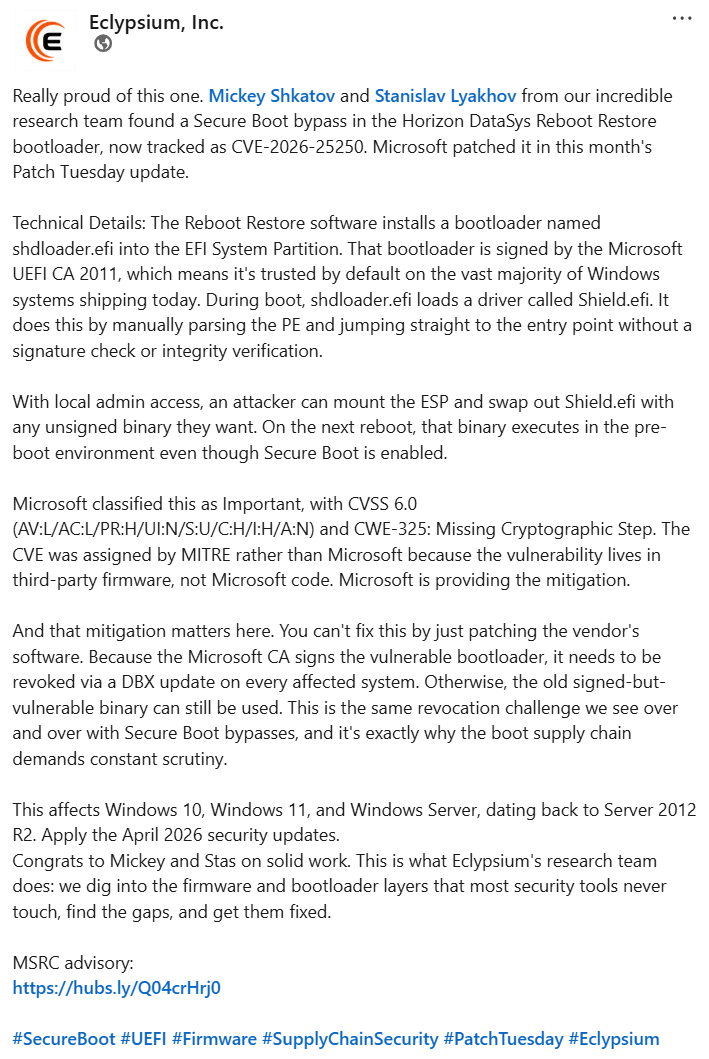
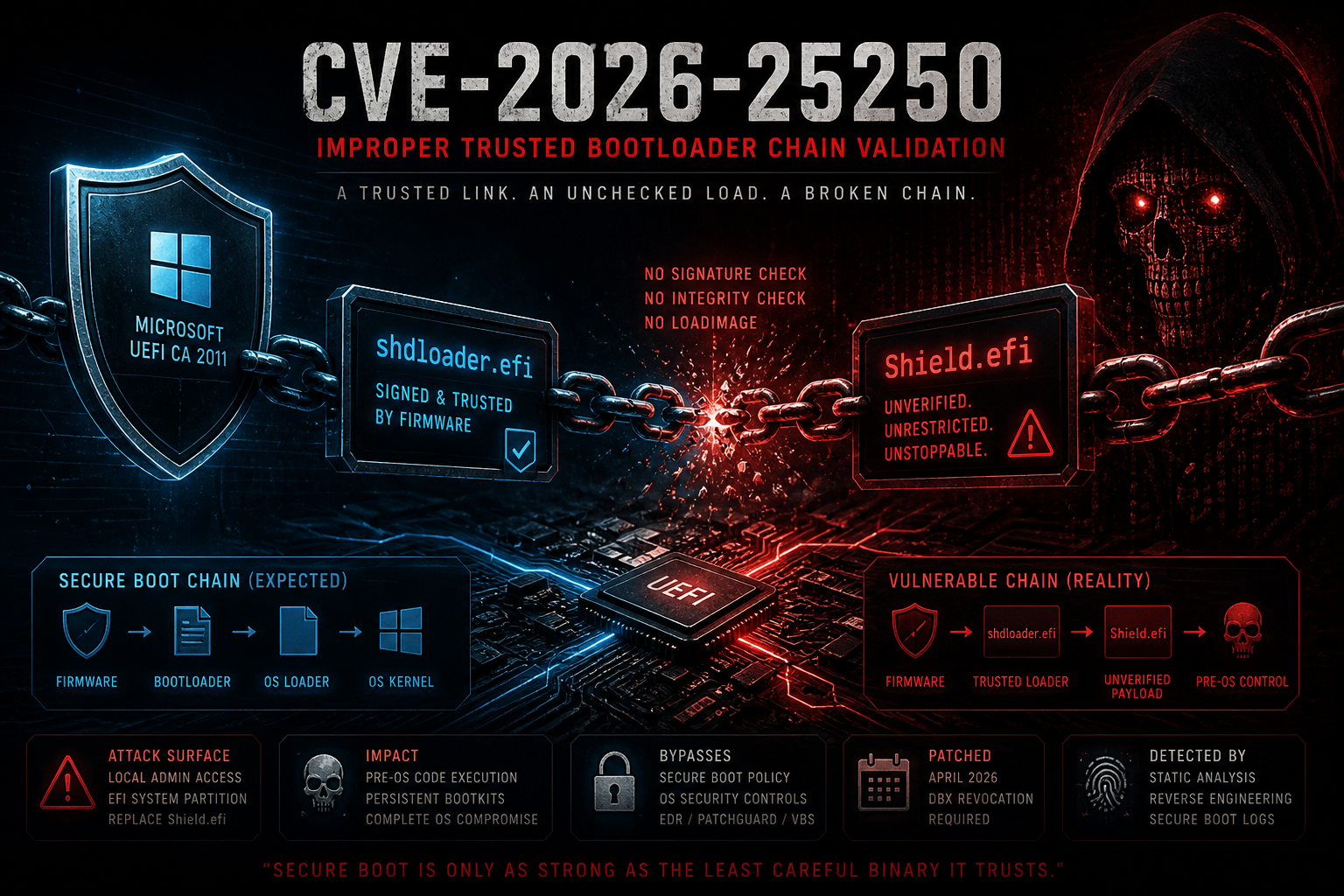
Analysis and exploit for CVE-2026-25250, a Secure Boot bypass in Horizon DataSys Reboot Restore where shdloader.efi loads Shield.efi without verification.
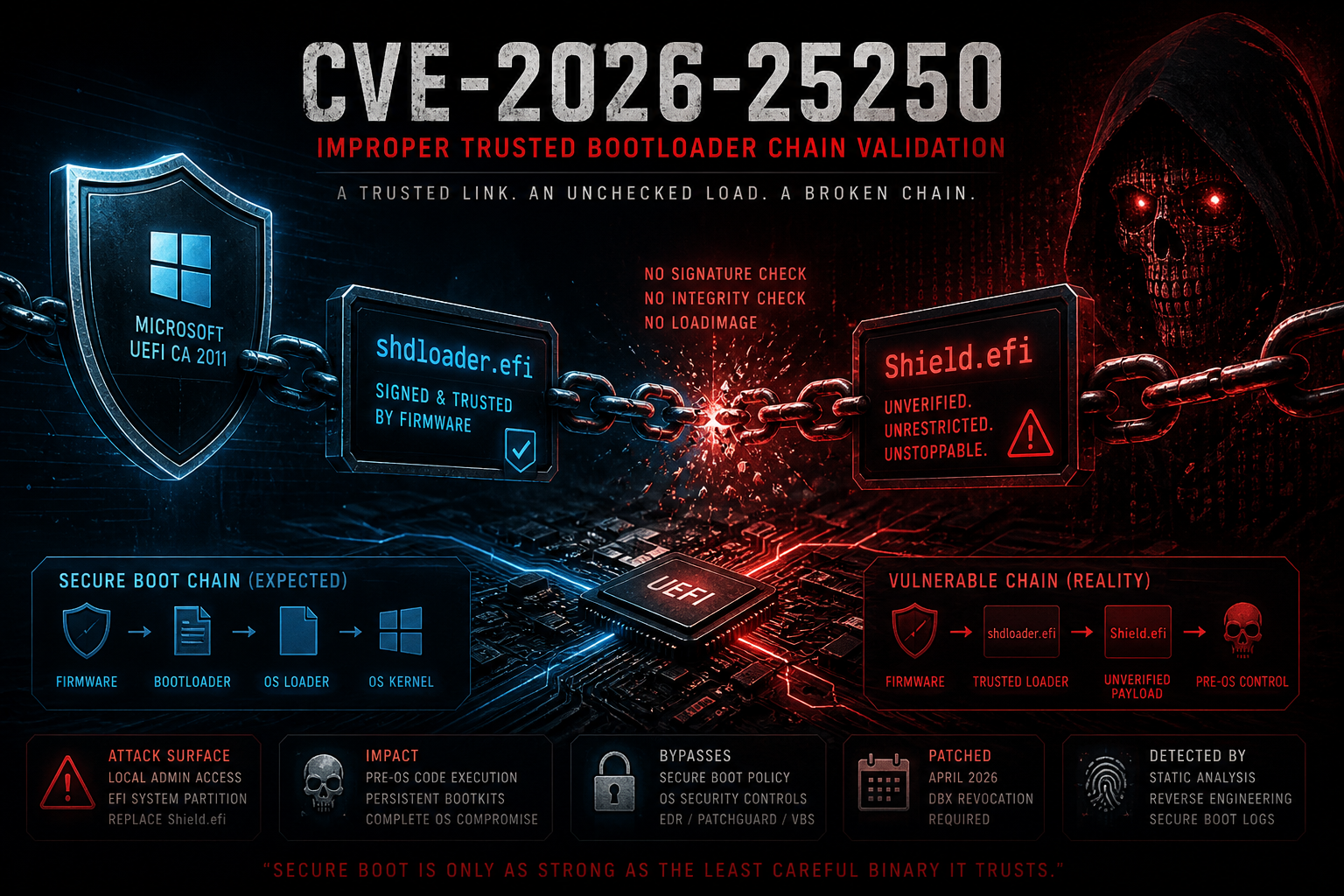
A Microsoft-signed third-party bootloader that loads a secondary EFI binary with no signature or integrity verification, collapsing the Secure Boot chain of trust from within.
📑 Table of Contents
- Research Context
- Official References
- Reproduce It Yourself
- Vulnerable Boot Chain
- Vulnerability Overview
🧠 Research Context
This repository documents research into CVE-2026-25250, a Secure Boot bypass vulnerability disclosed to Microsoft and assigned a CVE in April 2026. It quickly stood out as one of the more significant firmware security issues of the year, precisely because the vulnerable component is Microsoft-signed and therefore unconditionally trusted across the vast majority of UEFI-enabled Windows systems.
The vulnerability was discovered by Mickey Shkatov and Stanislav Lyakhov at Eclypsium, one of the foremost firmware and supply chain security research teams in the industry. Mickey Shkatov is a long-standing figure in UEFI offensive research, author of BootHole (CVE-2020-10713, a critical GRUB2 Secure Boot bypass that affected virtually every Linux distribution and Windows dual-boot configuration), and presenter of "One Bootloader to Load Them All" at DEF CON 30 alongside Jesse Michael, a talk that systematically catalogued how Microsoft-signed third-party bootloaders represent a class-level weakness in the Secure Boot ecosystem.
CVE-2026-25250 lands squarely in that class.
What makes it particularly instructive is its simplicity: no memory corruption, no cryptographic flaw in the firmware itself, just a trusted binary making an unsafe decision about what it loads next. A single weak link is enough to collapse the entire Secure Boot model for a target system.
📌 Official References
CVE-2026-25250 was discovered during analysis of third-party UEFI boot components deployed in enterprise recovery environments. The affected product is the Reboot Restore solution by Horizon DataSys.
The vulnerability was assigned by MITRE rather than Microsoft, because the flaw resides in third-party firmware (shdloader.efi), not in Windows or any Microsoft-authored code.
Official references:
-
Microsoft Security Response Center - April 2026 Patch Tuesday
Monthly security update bulletin.
-
Official CVE entry. CVSS 6.0 - AV:L/AC:L/PR:H/UI:N/S:U/C:H/I:H/A:N. CWE-325: Missing Required Cryptographic Step.
-
Eclypsium Technical Disclosure
Original research disclosure from the discovery team, including the LinkedIn post that first brought this vulnerability to public attention.
🔬 Reproduce It Yourself
Eclypsium's disclosure, published on LinkedIn by the discovery team, provides enough context to identify the affected software and download it directly from the vendor's website.
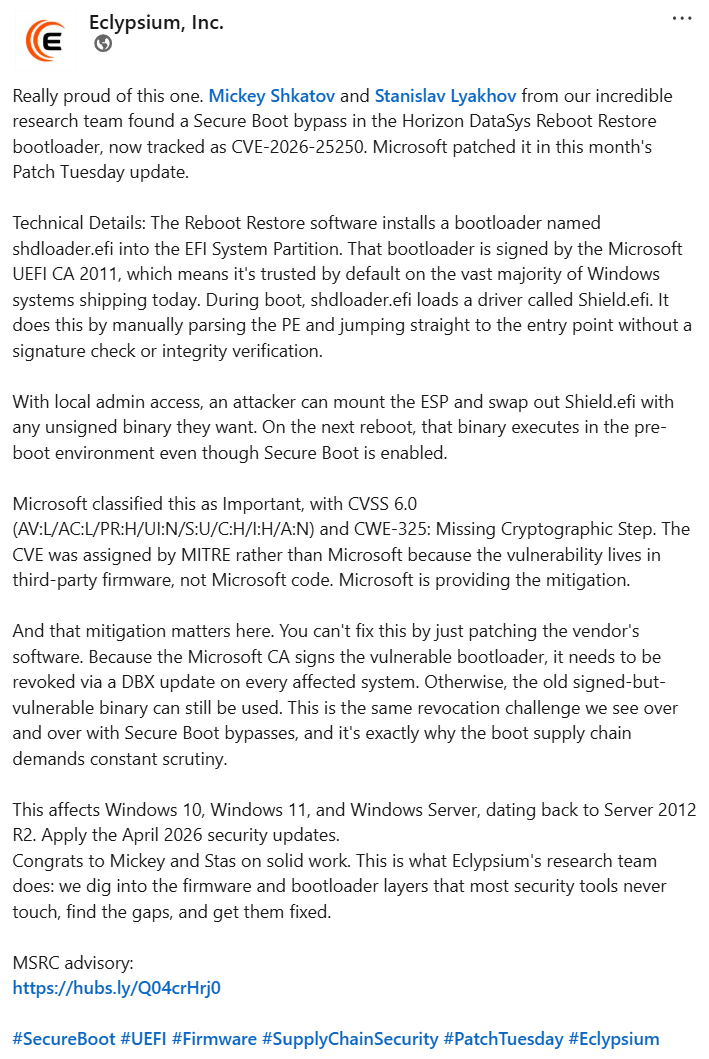
The Horizon DataSys Reboot Restore installer is publicly available, and installing it on a test system places both shdloader.efi and Shield.efi into the EFI System Partition, where they can be examined statically or observed at runtime.
Recommended lab setup:
Windows 10/11 VM (QEMU or VMware)
├── Secure Boot: Enabled
├── Horizon DataSys Reboot Restore: Installed
├── ESP accessible via: mountvol X: /S
└── Targets:
	HorizonDataSys
        X:\EFI\shdloader.efi ← signed, trusted, loads next stage
        X:\EFI\Shield.efi    ← loaded without any verification
Once installed, shdloader.efi can be confirmed as Microsoft CA 2011-signed via sigcheck.exe (Sysinternals) or pesign. The absence of any LoadImage / StartImage call in the Shield.efi load path is visible immediately in static analysis.
🐜 Vulnerable Boot Chain
This vulnerability affects a multi-stage boot chain, not a single binary.
🧨 Stage 1 - Trusted Bootloader
- shdloader.efi
- Digitally signed with Microsoft UEFI CA 2011
- Unconditionally trusted by Secure Boot firmware policy
- Installed into the ESP by the Horizon DataSys software
⚠️ Stage 2 - Unverified Payload
- Shield.efi
- Loaded dynamically by shdloader.efi at boot time
- ❌ No signature verification
- ❌ No integrity check
- ❌ No use of UEFI LoadImage / StartImage APIs
- ✅ Freely replaceable by any local Administrator
📌 Key Observation
The vulnerability does not lie in the firmware. It lies in the logic of a trusted bootloader, a binary the firmware already approved, choosing to load a secondary binary through a code path that bypasses every security check.
Firmware
  └── verifies shdloader.efi          ✅ Microsoft CA 2011, trusted
        └── ManualPEParse(Shield.efi) ❌ no LoadImage, no signature check
              └── EntryPoint()        💥 attacker-controlled code, pre-OS
The Secure Boot perimeter is only as strong as the least careful binary it trusts.
🧪 Vulnerability Overview
CVE-2026-25250 is a Secure Boot bypass caused by improper validation of a secondary EFI binary loaded during the boot process. The affected bootloader (shdloader.efi) is signed and trusted by Secure Boot, but loads Shield.efi through a manual PE parsing routine with no cryptographic verification of any kind.
It is a design and trust model failure, a trusted component making an unsafe decision that nullifies all downstream protections.
🔐 Secure Boot & Trust Model
Secure Boot enforces a chain of trust in which every component executed during the boot sequence must be verified before control is transferred. The model only holds if every trusted binary in the chain honours that contract:
Firmware → verifies bootloader → bootloader executes only verified code
CVE-2026-25250 breaks the second link:
Firmware → verifies shdloader.efi (✅ trusted)
             ↓
           shdloader.efi → loads Shield.efi (❌ not verified)
                             ↓
                           Arbitrary unsigned code executes pre-boot
Secure Boot's enforcement at the firmware level becomes irrelevant once a trusted binary introduces an unverified execution path.
🧬 Root Cause Analysis
Classified as:
- CWE-325: Missing Required Cryptographic Step
A security-sensitive operation is performed without a required cryptographic verification step, allowing an attacker to bypass the protection that step would have enforced.
| Step | Performed | Notes |
|---|---|---|
| Locate Shield.efi on ESP | ✅ | Standard filesystem access |
| Read file into memory | ✅ | - |
| Parse PE headers manually | ✅ | Custom implementation |
| Verify signature | ❌ | Not performed |
| Check against db / dbx | ❌ | Not performed |
| Call LoadImage / StartImage | ❌ | Bypassed entirely |
| Transfer execution to entry point | ✅ | Direct call |
The absence of LoadImage / StartImage is the root cause. Those UEFI Boot Services are the integration point for Secure Boot policy enforcement, bypassing them means bypassing everything.
💥 Exploitation Process
Exploitation requires local Administrator access and a single reboot.
- Mount the EFI System Partition
- Replace Shield.efi with an arbitrary unsigned EFI binary
- Reboot
On the next boot, shdloader.efi executes (trusted by firmware), loads the attacker-controlled binary, and transfers execution, pre-OS, pre-EDR, before any measured boot policy is enforced, with no objection from Secure Boot.
Enables:
- Persistent UEFI bootkits that survive OS reinstalls and full disk wipes.
- Early-stage implants invisible to any OS-layer security tooling.
- Complete evasion of kernel-mode protections (EDR, PatchGuard, VBS/HVCI).
📚 Resources
-
Eclypsium - CVE-2026-25250 Disclosure
Original research by Mickey Shkatov and Stanislav Lyakhov. The Eclypsium LinkedIn post announcing the discovery links to the Horizon DataSys software, allowing independent analysis.
-
Microsoft MSRC - April 2026 Patch Tuesday
Microsoft Security bulletin.
-
Official CVE entry. MITRE-assigned because the vulnerability resides in third-party firmware, not Microsoft code.
-
Eclypsium - BootHole (CVE-2020-10713)
Mickey Shkatov & Jesse Michael - critical GRUB2 Secure Boot bypass affecting virtually all Linux distributions and Windows dual-boot systems.
-
DEF CON 30 - "One Bootloader to Load Them All"
Mickey Shkatov & Jesse Michael - systematic analysis of Microsoft-signed third-party bootloaders as a class-level Secure Boot attack surface. CVE-2026-25250 is a direct instance of this threat model.
-
CWE-325: Missing Required Cryptographic Step
Root cause classification for the missing verification in the
shdloader.efiload path. -
UEFI Specification - Boot Services: LoadImage / StartImage
The UEFI Boot Services that enforce Secure Boot policy - bypassed entirely by
shdloader.efi's manual PE loader.
🤝 Research & Collaboration
Working on something similar? Researching UEFI, Kernel security, exploitation, or another interesting security topic? If you need a hand developing an exploit, exploring a technique, or just want to exchange ideas, don't hesitate to reach out. I'm always open to discussing research, helping where I can, and collaborating on interesting projects. Feel free to contact me on LinkedIn.