The question has shifted. Security leaders spent several years debating whether AI would r 2026-8-25 15:12:35 Author: www.sentinelone.com(查看原文) 阅读量:37 收藏
The question has shifted. Security leaders spent several years debating whether AI would reshape security operations. That debate has settled. Now the conversation is about pace. How fast can the foundation be built, and what do organizations that moved early have to show for it?
For the second year, SentinelOne® commissioned 451 Research to survey 611 North American cybersecurity decision-makers and practitioners on the state of security operations strategy. The results confirm what we’ve been building toward, and they surface a finding that should recalibrate how most security leaders sequence their AI investments.
The Returns Didn’t Wait for the Roadmap
Many product roadmaps assume a clear sequence and start with building toward higher maturity first with returns following. The data shows that AI is running ahead of schedule.
Nearly all organizations surveyed (96%) are still operating AI at the earliest maturity levels:
- Level 1: Basic monitoring; triage specialist/alert analyst
- Level 2: More senior triage analyst / basic incident responder and investigator
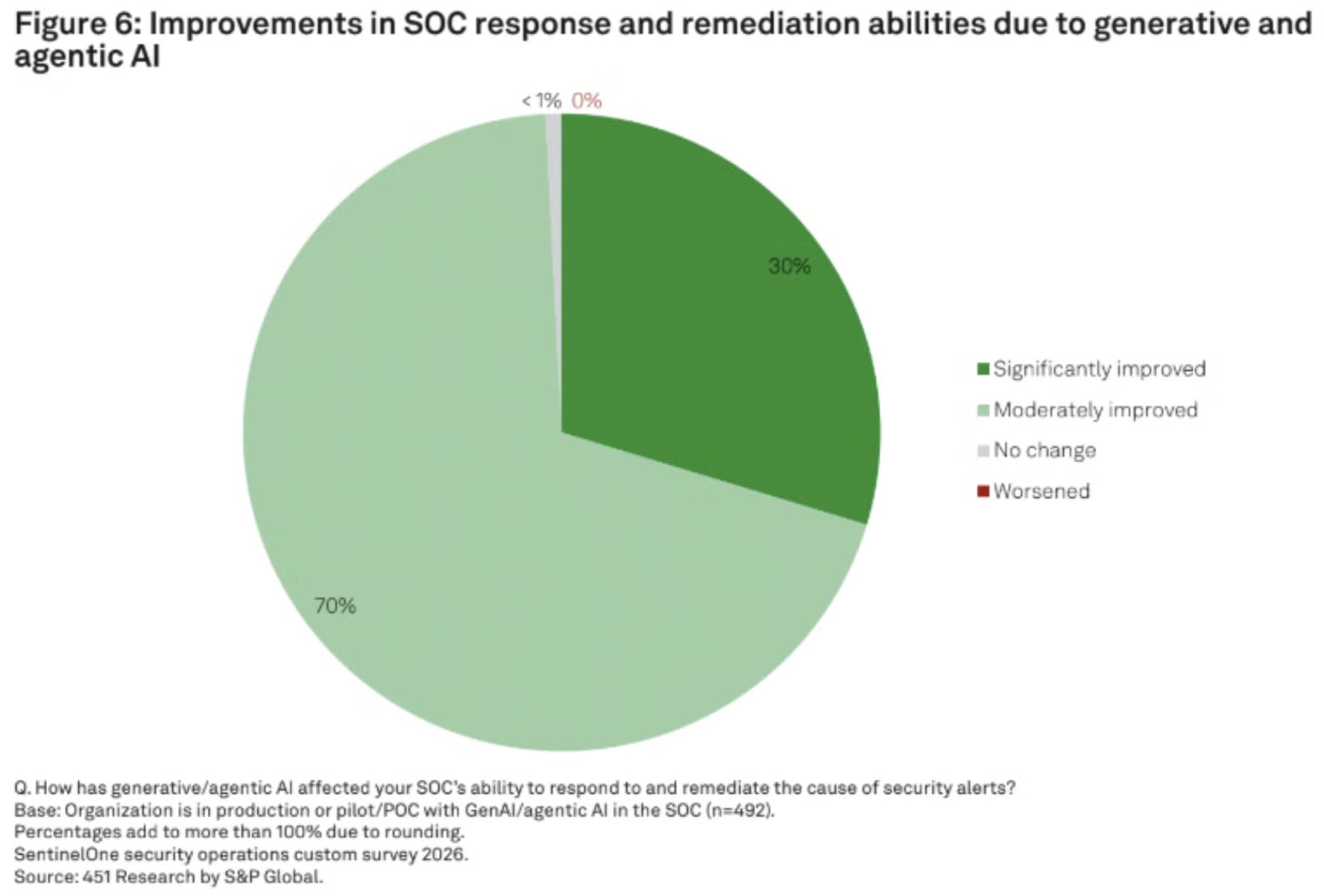
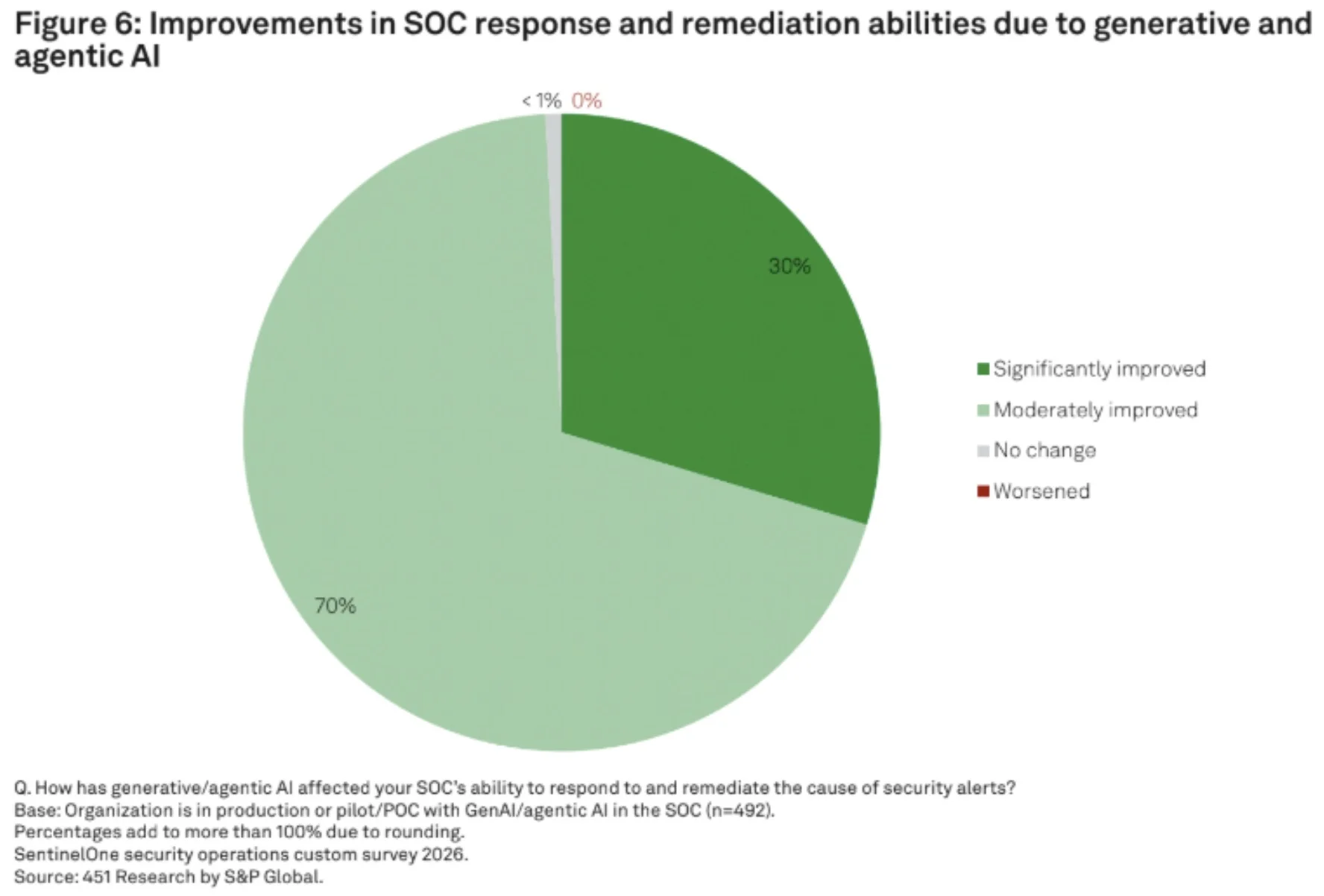
By most measures, AI adoption in the SOC is still early. And yet, 99% of those same organizations already report improvements in incident response and remediation.
The numbers are consistent. Early-stage AI (chatbots handling initial alert triage, automated tools sorting true positives from noise) is delivering before organizations reach advanced maturity. The gap between where most organizations are and what they are already getting is real and consistent across survey respondents.
Organizations waiting for higher AI maturity before building the supporting infrastructure are running the sequence backward. The returns are available now. The foundation built today determines how far those returns scale.
Platformization Has Reached A Verdict
The organizations accelerating AI adoption are also the ones consolidating onto platforms. A platform-oriented security architecture means moving from siloed, specialized tools to an integrated stack built on a foundation that coordinated AI decision-making can actually run on, and one that lets each new capability compound on the last.
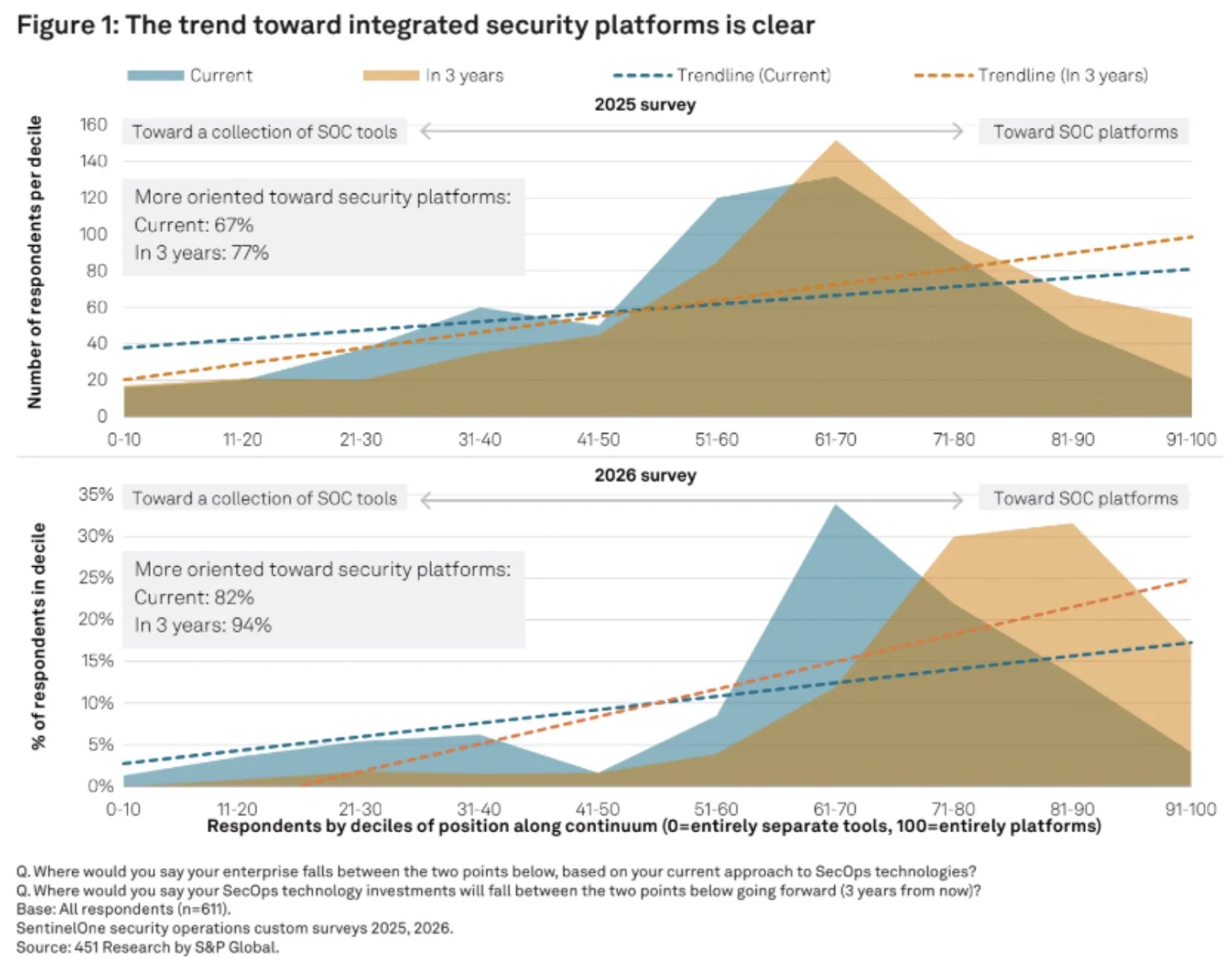
The platformization numbers from this year’s survey are clear. 82% of organizations describe themselves as platform-oriented, a 13-point jump in a single year, and 94% expect to be there within three years.
A common assumption is that platform adoption means replacing specialized tools. The data complicates that picture. The same technologies most frequently deployed as standalone tools (EDR, SIEM, CNAPP) are also the top anchors for integrated platforms. Organizations typically start with one of these and expand outward. What changes is the common data layer that enables coordinated AI decision-making, serving as the connective tissue underneath.
Platformization is not coincidental with AI’s emergence. Agentic AI needs connected, continuously updated data to accurately reason across signals and take autonomous action. Fragmented architectures, where telemetry is siloed and pipelines require manual effort, cannot support AI-driven SOC operations at scale. Platform adoption and AI adoption are converging because AI’s data requirements have made integration a structural necessity.
The survey makes the infrastructure connection an explicit one. The top-cited benefit of investing in a data lake for SecOps is supporting AI-driven SOC workloads and agents. Organizations that built the data foundation early have already cleared the barrier stalling others. Those who haven’t, face a prerequisite gap, and the distance is widening rapidly. Architectural readiness is the variable that determines how far AI investments can scale.
Job Satisfaction Is Rising
Every discussion of AI in the SOC centers on detection and response metrics. This report has those too, but there is a finding that security leaders managing attrition should weigh: analyst burnout is declining.
As AI handles repetitive, high-volume triage work, analysts report rising job satisfaction. The role is shifting away from processing an endless queue and toward investigation, threat hunting, and judgment-intensive work. In a market where SOC analyst turnover remains a persistent operational cost, that shift carries real dollar value.
The analyst role evolves, becoming more strategic and more consequential.
A New Attack Surface
The same AI systems changing how SOCs operate are also creating new targets. Adversaries are already probing AI infrastructure including agents, data pipelines, model endpoints, and the governance gaps that emerge when controls lag behind adoption. The report surfaces this tension clearly: Organizations are deploying AI faster than they are securing it.
An AI agent with misconfigured access or an unmonitored data pipeline is an exposure. Securing the AI infrastructure that powers the SOC is happening alongside deployment, whether organizations have planned for it or not. Those without a clear governance posture are accepting risk that may not be priced into their AI investment case.
The potential of GenAI and agentic AI in the SOC is already being realized. The organizations that capture it fully are those building governance alongside deployment. The platform that runs the Autonomous SOC and the platform that secures it are, increasingly, the same platform.
SentinelOne’s Vision: The Autonomous SOC
Everything the report surfaces, from AI returns arriving before maturity to platform consolidation to the improving analyst experience, points to how these are expressions of the same shift. The foundation that enables early AI returns is the same one that determines how far those returns scale, how capable analysts become, and how well the security of AI itself is governed.
The findings align with how SentinelOne has defined the path to autonomous security operations: A progression from AI-assisted triage at early maturity levels to increasingly autonomous investigation, threat hunting, and response, with humans in strategic and governing roles. The report validates that the market is moving through exactly that sequence. Organizations that understand the architecture behind it (the platform integration, the common data layer, the governance controls) are positioning themselves to capture returns at every stage rather than waiting for the destination.
The full 451 Research report goes further into detail, covering what progression looks like at each maturity level, the specific barriers organizations are encountering, and the data behind each finding in full.
Read the full 451 Research report to learn more about how AI is reshaping cybersecurity.
Third-Party & Intellectual Property Disclaimers
All third-party product names, logos, and brands mentioned in this publication are the property of their respective owners and are for identification purposes only. Use of these names, logos, and brands does not imply affiliation, endorsement, sponsorship, or association with the third party.
This blog may include discussion of unreleased services or features. Any unreleased services or features referenced here are still in development and subject to change. Customers should make their purchase decisions based upon features that are currently available.
如有侵权请联系:admin#unsafe.sh