Third-party scripts are common on websites. They help with analytics, ads, live chat, social media, 2026-8-24 22:31:1 Author: blog.sucuri.net(查看原文) 阅读量:27 收藏
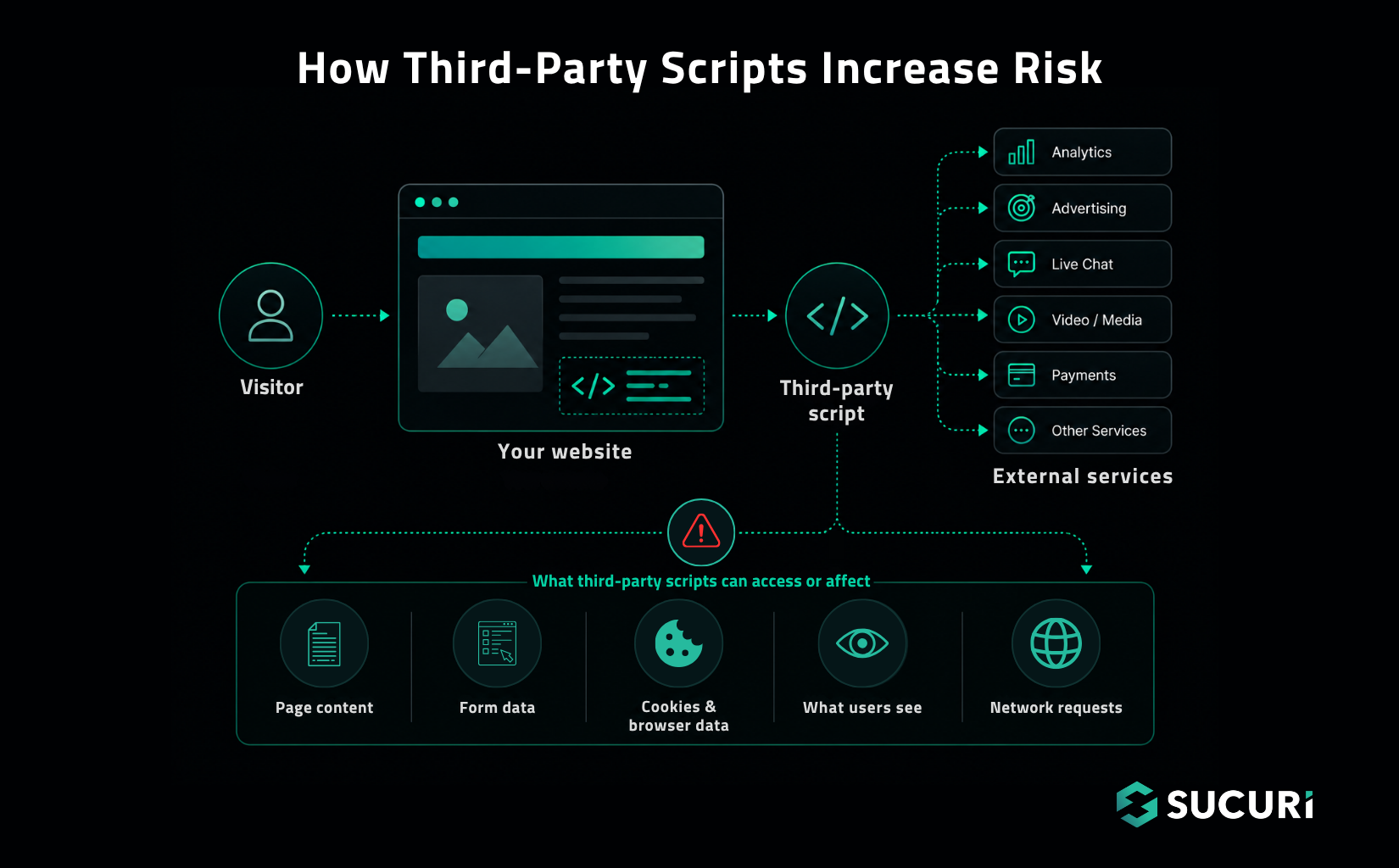
Third-party scripts are common on websites. They help with analytics, ads, live chat, social media, video, payments, and many other features. While not all are risky, every external tag, pixel, widget, or embed adds to your website’s vulnerability. These tools can read page content, collect visitor data, change what users see, and connect with outside services. If a vendor, account, or setup is compromised, it can impact every page that uses the script.
Website owners shouldn’t aim to get rid of useful integrations, but to understand which scripts run, why they are necessary, who controls them, and how to detect unexpected changes.
What counts as a third-party script?
A script from a third party is one that is JavaScript or code that is embedded and loaded from a domain or service which is outside the direct control of the website owner.
Common examples include:
- Analytics tags and advertising pixels
- Tag management containers
- Live chat and customer support widgets
- Heatmaps and session recording tools
- A/B testing and personalization platforms
- Consent management tools
- Embedded forms, videos, and scheduling tools
- Payment, fraud prevention, and social media integrations
- JavaScript libraries hosted on external content delivery networks
When carrying out security reviews, teams should also take into account iframes, plugins, custom HTML blocks, and CMS integrations which load external resources, since they do not all function in the same way and each one adds another service that could affect the website or its visitors.
Are third-party scripts a website security risk?
If a third-party script has too much access, is not well managed, originates from a compromised source, or continues to be active after its business purpose has ended, then yes, it can pose a security risk.
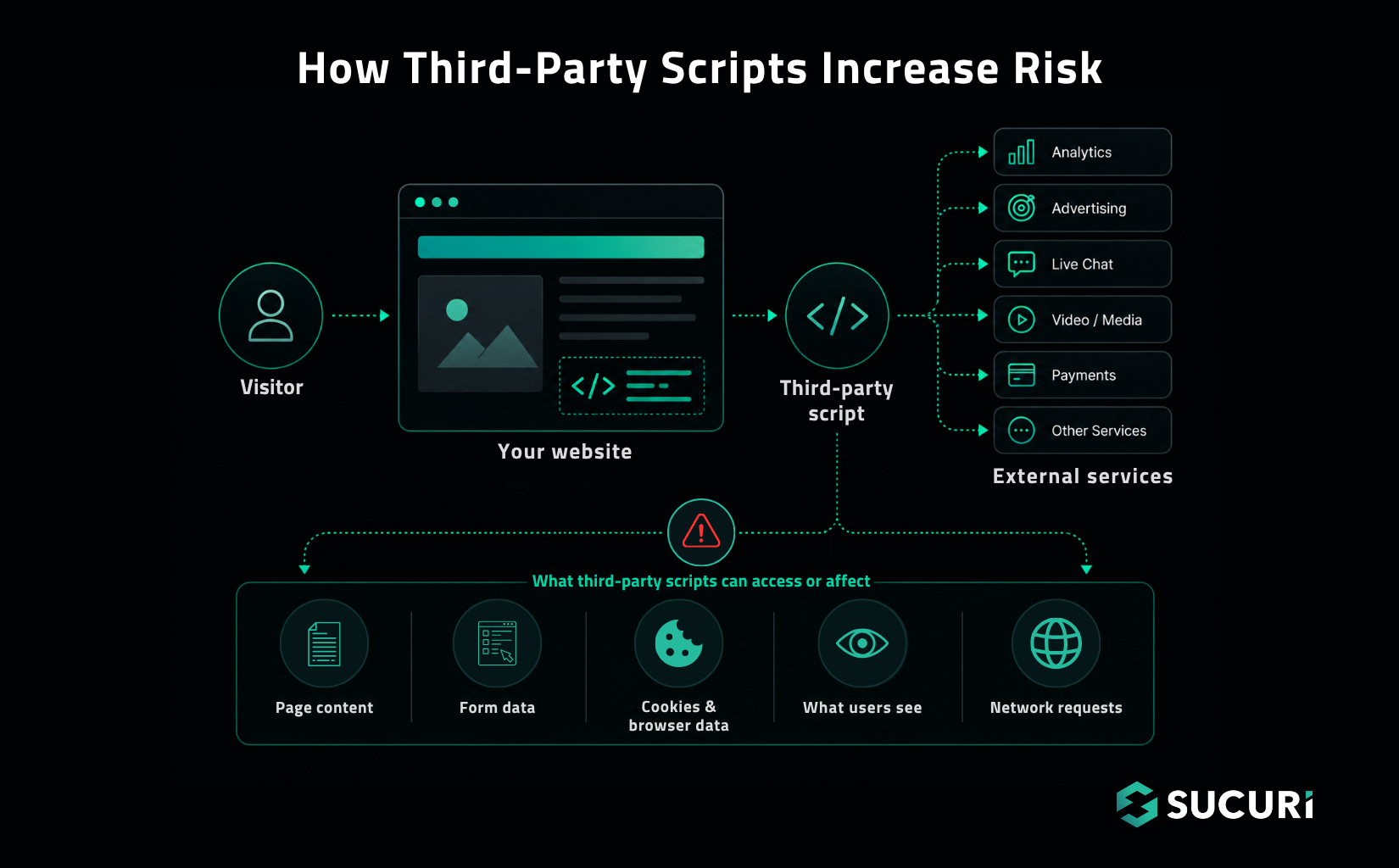
As OWASP points out, marketing and analytics tags are capable of reading data from the page and transmitting it to external services. Additionally, tag managers can decide which scripts are loaded, what information those scripts receive, and where the data is sent.
Four risks deserve particular attention.
1. External code can change without a website update
A locally hosted file normally changes when someone updates the website. An externally hosted script can change at its source while its URL and placement on the website remain the same.
This enables vendors to keep on providing their services without customers having to redeploy their code. It also means that if a vendor, a content delivery network, or an account is compromised, it could start distributing modified code to all the websites that load the resource.
2. Tag managers concentrate publishing access
Tag managers make it easier for marketing and analytics teams to add scripts without changing the website directly. However, that convenience also establishes a high-value control point.
The fact that one compromised tag management account could enable an attacker to publish code throughout the whole website is evident, and the risk of this happening can be greater due to shared credentials, excessive permissions, the absence of multifactor authentication, and unreviewed publishing access.
3. Malicious scripts can imitate trusted tools
Attackers know administrators expect to see familiar analytics tags and tracking pixels in website code.
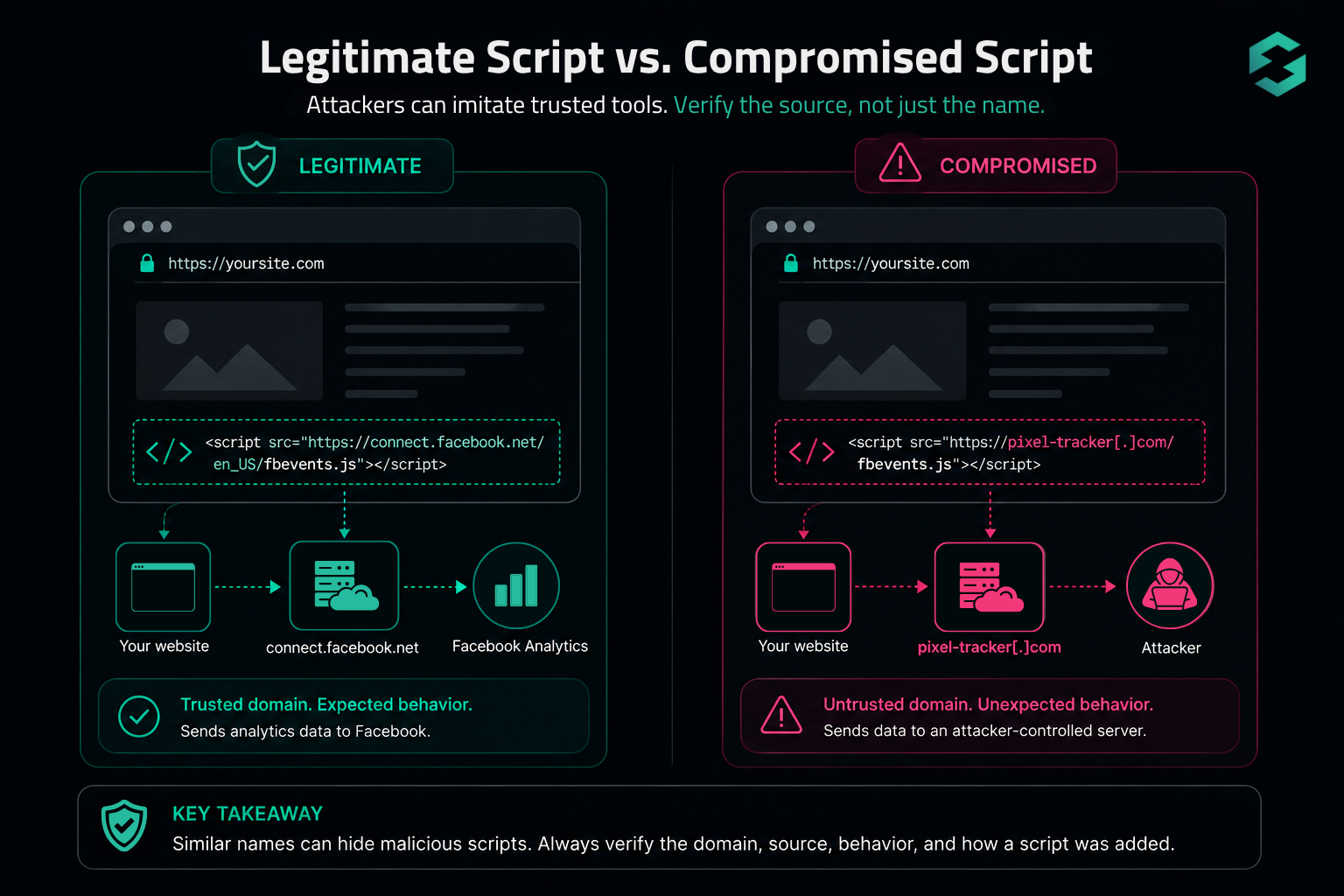
Our researchers documented a credit card skimmer disguised as a Facebook Pixel tracker. The malicious version used familiar naming and formatting but replaced the legitimate domain with an attacker-controlled source. It then targeted checkout pages and captured payment information.
A script can therefore look familiar without being legitimate. The domain, source, behavior, and method of installation all matter.
4. Payment pages face greater consequences
On checkout pages browser-side scripts are particularly susceptible since they might interact with payment forms or with the information entered by customers.
PCI DSS Requirements 6.4.3 and 11.6.1 focus on authorizing payment-page scripts, checking their integrity, maintaining an inventory, and monitoring for unauthorized changes. PCI SSC published additional e-skimming guidance for these requirements in 2025.
The same principle can be applied by websites which are outside the scope of PCI DSS: sensitive pages should load only resources that are known, necessary, and monitored.
Who is responsible for the security of third-party scripts?
The security of third-party scripts is something that all the website, security, development, marketing, e-commerce, and content teams are jointly responsible for.
Technical teams are able to evaluate how a script functions and what controls are provided, while business owners usually know the reason for its inclusion, which campaign or function it supports, who is responsible for the vendor relationship, and whether the tool is still required.
Every integration should therefore have a named internal owner. Without one, outdated campaign tools and abandoned accounts can remain connected to production long after anyone is actively reviewing them.
What are the ways of reducing the risk associated with third-party scripts?
The most effective approach combines clear ownership, limited access, routine cleanup, technical controls, and visitor-facing monitoring.
Maintain a script and integration inventory
Document every approved external service that can affect the website. Include:
- Tool and vendor name
- Business purpose
- Internal owner
- Pages where it loads
- Data it collects or processes
- How it was installed
- Users with administrative or publishing access
- Date added and next review date
Compare the inventory with the live website periodically. Any script found on the site but missing from the inventory should be investigated.
Limit access and require multifactor authentication
Use individual accounts rather than shared credentials. Follow the Principle of Least Privilege by giving users only the permissions needed for their role, and limit production publishing rights to a smaller group.
Enable multifactor authentication for tag managers, analytics platforms, advertising accounts, CMS dashboards, hosting accounts, and other connected services. Review access when employees change roles or relationships with agencies and vendors end.
Treat tag changes like website releases
A script introduced via the dashboard can have just as direct an effect on visitors as code deployed through a development workflow.
Before publishing a tag:
- Document its purpose.
- Identify the pages and data affected.
- Test it outside production if you can.
- Have another authorized person review it.
- Note the name of the publisher and the publish date.
- Maintain a rollback path.
The process doesn’t need to be slow. It should simply make production changes visible and accountable.
Load each script only where it is needed
A conversion pixel for one campaign may not need to load across the entire website. A checkout integration should not appear on unrelated blog posts, and a session recording tool may need to exclude login, account, form, or payment pages.
Restricting the locations where a script can run decreases the amount of data that is exposed unnecessarily and limits the possible impact of a breached integration.
Get rid of the tools and access that have expired
Temporary integrations tend to last longer than the campaigns that introduced them.
When you retire a tool, you should remove its scripts and tags, revoke its API keys and tokens, delete any unused webhooks, remove the vendor accounts, and make sure that the resource does not appear when loading the public website. A expiry or review date can stop temporary technology from becoming permanent infrastructure.
Use browser-side controls when suitable
A Content Security Policy, or CSP, is able to limit the sources from which a browser is permitted to load scripts and other resources. It can assist in reducing the effects of unauthorized script injection, but it does require thorough testing to avoid blocking legitimate functions of a website.
Subresource Integrity, or SRI, allows a browser to verify that a compatible external resource matches an expected cryptographic hash before loading it. SRI is most useful for fixed files and may not suit vendor scripts that change frequently.
These controls should support, not replace, access management, patching, monitoring, and vendor review.
Keep an eye on the website that the visitors actually receive
Do not rely only on the CMS dashboard or server files. Review important pages as a logged-out visitor and test different devices, browsers, and traffic sources.
Watch for:
- Unknown external domains
- Unexplained custom HTML tags
- Unexpected redirects or pop-ups
- New verification prompts or downloads
- Changes to checkout and form behavior
- Scripts loading on unrelated pages
- Tags published outside the normal process
Certain malicious scripts will only become active on certain pages or when specific conditions are met by the visitor. The behavior of such scripts can be detected by monitoring the website as it is rendered and the network activity of the browser, since a simple review of the files would fail to pick it up.
What should you do if you find an unauthorized script?
Removing the visible script is only the first step. Preserve relevant details, including the script URL, affected pages, screenshots, publishing history, and the approximate time the behavior began.
Now look into how it was introduced. Review:
- CMS administrator accounts
- Tag manager users and version history
- Plugins, themes, and custom code fields
- Website files and databases
- Hosting, deployment, and SFTP credentials
- Vendor accounts, API tokens, and webhooks
Change compromised credentials, revoke exposed tokens, patch vulnerable software, and scan the full environment for backdoors or additional malware. An attacker who still has access may simply restore the script.
When the code is found on a page such as the checkout page, the login form, the contact form, or any other page that handles sensitive data, you should determine if any information may have been exposed and then report the incident to the relevant legal, privacy, and payment-compliance teams for review.
Frequently asked questions about third-party scripts
Are you suggesting websites avoid all third-party scripts?
Far from it. Tools relating to analytics, payment processing, support, accessibility, and marketing can offer real value. The better course of action is to reduce the number of unnecessary scripts and to insist on clear ownership, access controls, and monitoring for those integrations that are kept.
Can a web application firewall be used to block malicious third-party scripts?
A web application firewall can help block attacks that lead to website compromise or script injection. It cannot guarantee that an approved vendor account or externally hosted script will remain trustworthy. Browser-side controls and integration governance are still necessary.
Does deleting an unauthorized script fix the website?
Not necessarily. The script may be a symptom of a compromised administrator account, vulnerable plugin, stolen credential, malicious database entry, or persistent backdoor. The original access path must be identified and closed.
Make every website integration accountable
Third-party services are a normal part of modern websites. The greatest risk comes from scripts nobody tracks, accounts nobody reviews, and integrations that remain active without a current purpose.
Treat every tag, pixel, widget, and embed as production code. Give it an owner, document why it exists, restrict who can change it, limit where it runs, and monitor the experience delivered to visitors.
Our Website Security Platform combines website scanning, monitoring, firewall protection, and malware removal to help identify and address unauthorized website changes. These controls are most effective when organizations also maintain clear ownership of the third-party tools they intentionally add.

如有侵权请联系:admin#unsafe.sh