The dominator tree lets us
identify natural loops: a back edge
T->H whose head H dominates its tail
T defines a loop with the single entry H. This
works only for reducible control flow graphs. Optimized machine
code and decompiler output routinely contain irreducible loops,
which have more than one entry and thus no dominating header, so the
dominator-based method cannot see them.
This post builds a loop-nesting forest for an arbitrary CFG with the single-pass depth-first search of 韦韬、毛剑、邹维、陈宇(Tao Wei, Jian Mao, Wei Zou & Yu Chen) A New Algorithm for Identifying Loops in Decompilation, SAS 2007 (The 14th International Static Analysis Symposium).
Reducibility
A depth-first search from the entry classifies every non-tree edge
relative to the spanning tree. A retreating edge
u->v goes to an ancestor v of
u on the DFS path. A cycle is a closed path in the
CFG, a graph-theoretic object with no distinguished entry; a
loop is the control-flow structure built on top — a set of
nodes with a header, nested into a forest. A CFG is reducible
when, in every DFS, each retreating edge is a back edge — its
head v dominates its tail u. Then every cycle
lies in a natural loop whose header dominates it, so control enters the
loop only through that header.
A CFG is irreducible when some cycle has two or more entries: nodes with a predecessor outside the cycle. No single node dominates the cycle, so there is no natural header. The smallest example is the irreducible core:
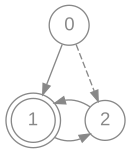
Node 0 branches to both 1 and 2, and 1 -> 2 -> 1
is a cycle entered at 1 (through 0->1) and at 2 (through
0->2). M.S. Hecht and J.D. Ullman proved that a CFG is
irreducible if and only if it contains this three-node pattern as a
subgraph, allowing each edge to be a path through other nodes.
Because no node dominates an irreducible cycle, the header is not intrinsic — we must pick one of the entries. The standard choice (Havlak and the algorithm below) is the node the DFS reaches first, i.e. the loop member with the smallest preorder number. So the loop-nesting forest of an irreducible CFG depends on the DFS order.
Loop-nesting forest
There is no agreed definition of the loop-nesting forest for
irreducible CFGs. Steensgaard, Sreedhar–Gao–Lee, Havlak, and Ramalingam
each give a different one; for the CFG in Wei et al.'s Fig. 3 they
report two, one, three, and one loops respectively. We adopt Havlak's,
the finest, because it gives each loop a single header and the fewest
gotos when re-structuring, and it is what LLVM's
GenericCycleInfo computes:
- The outermost loops are the maximal strongly connected regions (with at least one internal edge).
- A loop's header is its minimum-preorder node.
- Its inner loops are the loops of the subgraph induced on (loop nodes − header), found recursively.
So nesting is set containment, not a reachability order: a subloop's nodes are a subset of its parent's (minus the parent's header), and since every loop is strongly connected, a loop and its subloops are mutually reachable.
The forest has a compact encoding. For each node record its
innermost loop header iloop_header: the header of
the smallest loop containing it, or none. A header's own
iloop_header is the header of its parent loop. Following
the iloop_header links from a node lists its enclosing
loops innermost-first — the "loop header list" of the paper. Which nodes
are headers, plus every node's innermost header, determines the whole
forest; that is what the program below prints.
Representing and querying the forest
Building the forest is half the job; every consumer then asks two
questions repeatedly: is a node inside loop L, and is loop
L2 nested in L1? How the forest is stored
decides whether these are O(1).
The obvious layout gives each loop the set of all its nodes — its own
plus every descendant's. A membership test is one hash probe, but a node
nested d loops deep is stored d times, so
memory and build cost are O(N * depth).
An Euler tour of the forest removes the duplication. Lay every node
into one shared array so each loop owns a contiguous slice
[begin, end) nested inside its parent's. Each node then
appears once, memory is O(N), and both queries become
interval tests:
- is a node inside
L: map the node to its innermost loop, then test that loop's index againstL's slice; - is
L2nested inL1:L1.begin <= L2.begin && L2.end <= L1.end.
No per-loop set survives — the same trick DominatorTree
uses for O(1) dominance (DFSNumIn/DFSNumOut),
and the direction GenericCycleInfo took.
The header needn't be stored separately either: it is the first block
of the loop's slice (the minimum-preorder member), so begin
already locates it.
The contiguous slices suit a build-once analysis like
GenericCycleInfo, but are costly to keep valid under the
in-place CFG edits LoopInfo allows — which is why the two
siblings compute the same forest yet store it differently.
Identifying loops in one DFS pass
Natural loops need a dominator tree first. Wei et al. observe that a single DFS with a little bookkeeping suffices for an arbitrary CFG — no dominator tree, no UNION-FIND, no second bottom-up pass.
Let p be the current DFS path, the recursion stack from
the entry to the node being visited (DFSP in the paper).
pos[b] is b's 1-based position on that path,
or 0 once b has been popped. Every node carries
iloop_header, its innermost loop header discovered so far.
When visiting b0, each successor b falls into
one of five cases:
bis unvisited — a tree edge. Recurse; the call returnsb's innermost header, which we merge intob0's chain.
bis on the current path (pos[b] > 0) — a back edge.bis a loop header; merge it intob0.
bis finished and in no loop — a forward or cross edge to a non-loop node; ignore it.
bis finished, inside a loop whose innermost headerhis still on the path —b0belongs to that loop too; mergeh.
bis finished, inside a loop whose innermost header is not on the path — the edgeb0->benters the loop below its header: a re-entry edge, and the loop is irreducible. Walk upb's header chain to the first header that is on the path and merge that.
Merging a header (tagLoopHeader) splices it into the
node's innermost-to-outermost chain, ordered by DFS position; this
replaces the UNION-FIND of the classical Havlak–Tarjan algorithm. The
total cost is O(N + k*E), where k is an
unstructuredness coefficient that measures the case-(E) climbs
and the chain splices. On real code k is tiny (empirically
below 1.5), so the algorithm is near-linear. That near-linearity hides a
worst case: each tagLoopHeader splice is
O(depth), so on deeply nested loops k grows
toward O(N) and the algorithm turns quadratic, whereas the
UNION-FIND of Havlak–Tarjan stays near-linear even there. In benchmarks
Wei runs 2–4x faster on realistic CFGs but blows up on adversarial deep
nests.
Successor order matters within that bound. When one block has several
back edges to nested headers, visiting them outer-header-first
(ascending preorder) keeps each splice O(1), whereas
innermost-first re-walks the chain every time — O(d) versus
O(d^2) for that block. Iterating successors in reverse
postorder approximates the good order for free. But this only shifts the
constant: a spine of d nested loops with a single latch
each costs O(d*E) in every order, so the worst case
stands.
Havlak–Tarjan is not immune either; it just fails on different
inputs. On that reducible deep nest its UNION-FIND collapses each
single-entry loop, so it stays near-linear where Wei blows up — but its
backward flood re-scans an absorbed subloop's whole entry set,
so a deeply nested loop that is also multi-entry (a high-in-degree block
re-entered inside every level) costs it O(E*depth) too,
Ramalingam's classic critique of Havlak. Neither is universally
near-linear: Wei is quadratic on any deep nest, Havlak–Tarjan only on
irreducible ones.
The input format matches the natural-loops post: n m on
the first line, then m edges u v, with node 0
the entry. The program identifies the loops, then materializes the flat
Euler-tour layout described above: it prints the shared
layout array, then walks the forest. Each loop shows its
slice [begin, end) — the full extent it and its subloops
span — then the blocks it owns directly, header first (these fill the
front of the slice, and the subloops' slices follow), and, if
irreducible, its non-header entries.
1 |
|
Non-header entries occur only at case-E targets. Here is an example:
flowchart TB
    n0((0)) --> n1((1))
    n1 --> n2((2))
    n2 --> n3((3))
    n1 --> n4((4))
    n3 -->|back| n2
    n3 -->|back| n1
    n4 -. "re-entry (E)" .-> n3

    classDef hdr stroke:#37c98b,stroke-width:3px;
    class n1,n2 hdr

    linkStyle 0,1,2,3 stroke:#4c8dff,stroke-width:2px
    linkStyle 4,5 stroke:#ff5d5d,stroke-width:2px
    linkStyle 6 stroke:#ffab40,stroke-width:2px,stroke-dasharray:5 4
Examples
The irreducible core:
1 | % ./wei_blocks |
The header is 1 because the DFS reaches 1 first. List
0 2 before 0 1 and the header becomes 2
instead: the loop is the same set of nodes, but its header — and
therefore the forest — depends on the DFS order, unlike a natural
loop.
1 | % ./wei_blocks |
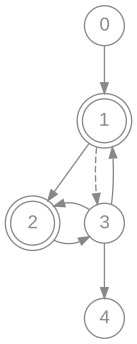
A nested example: a reducible outer loop {1,2,3} (back
edge 3->1) containing an irreducible inner loop
{2,3}, entered at 2 (via 1->2) and at 3
(via 1->3):
1 | % ./wei_blocks |
Only the inner loop is irreducible; the outer loop has the single
entry 1. The nesting gives 3's header list,
innermost-first: its innermost loop {2,3} (slice
[1,3)) sits inside {1,2,3} (slice
[0,3)).
Pipe any of these graphs through
awk 'BEGIN{print "digraph G{"} NR>1{print $1"->"$2} END{print "}"}'
to render them with graphviz.
Relation to natural loops
On a reducible CFG the first-visited node of a loop is exactly the node that dominates it, so this algorithm's header coincides with the natural-loop header and the two forests are identical. Running the program on the natural loops example — a reducible graph with a self-loop and an unreachable node — produces the same loops as that post's dominator-based program, with none marked irreducible (no non-header entries).
The Havlak–Tarjan algorithm reaches the same forest by a different route: a top-down DFS to find back edges, then a bottom-up UNION-FIND pass propagating headers from loop tails. Wei et al.'s contribution is folding both passes into a single DFS, and their re-entry bookkeeping (case (E)) is what marks the irreducible loops along the way.
Recent improvements to LLVM's CycleInfo
LLVM's GenericCycleInfo computes this loop-nesting
forest — it just calls a loop a cycle. Several recent changes
rebuild it around the structure above.
Flat block layout. Each cycle used to own a set of
its blocks, so a block nested d deep was stored
d times (O(N*depth)). Now every in-loop block
lives once in a shared array, each cycle a contiguous slice nested
inside its parent's, making contains and nested-in interval
tests. The header is the slice's first block rather than a stored field,
and an irreducible cycle's extra entries are appended — the
layout/tour/dump the program
above builds.
TODO Single-pass construction. The old code used a multi-pass scheme: a DFS to number blocks, then a reverse-preorder flood that grew each cycle from its back edges. It is now the single Wei DFS above — one traversal tags every block's innermost header and records the re-entries that make a cycle irreducible.