Manic: The Android Malware That Exfiltrates Data Even When the Phone Is Offline 2026-8-20 18:3:12 Author: securityaffairs.com(查看原文) 阅读量:47 收藏
Manic: The Android Malware That Exfiltrates Data Even When the Phone Is Offline

Manic Android malware combines banking fraud and spyware, using a Bluetooth relay to steal data even when devices are offline.
ThreatFabric’s Mobile Threat Intelligence team has identified a new Android malware, dubbed Manic, which has been active in the wild since at least February 2026. The researchers state that the malware is still under development as of July.
“Manic sits at the intersection of Android banking malware and mobile spyware, combining financial-fraud capabilities with broader surveillance and device-control features.” reads the report published by the ThreatFabric’s Mobile Threat Intelligence team. “Its targeting is strongly focused on Ukraine, covering Ukrainian banks, government and identity services, and messaging applications, while also extending to Russian and European financial institutions, global fintech and cryptocurrency services, and military-focused communications.”
The malware monitors 169 different Android apps, including banking and payment apps across several European countries, government and eID services, crypto exchanges and wallets, 2FA tools, messaging apps, browsers and email clients.
This wide coverage appears deliberate. By targeting both financial and communication apps, the attackers can track a victim’s money, messages, location and files from the same device.
ThreatFabric traces the first infrastructure registrations back to February 2026, with development and production services appearing in late March and April. By July, an updated build had added stronger anti-analysis checks, in-memory DEX loading, and a technique the researchers call lock-secret phishing, which extracts the device PIN or pattern by presenting a fake prompt before the victim reaches the real lock screen.
Once installed, Manic requests Accessibility and notification access, then uses the Accessibility service as a UI keylogger. It classifies everything it captures before logging it: lock-screen input, recovery phrase candidates, four-to-six-digit SMS codes, passwords, long messages, email logins, and ordinary text.
“Manic uses its Accessibility service as a UI keylogger. It classifies captured text before recording it, distinguishing lock-screen input, recovery-phrase candidates, four- to six-digit SMS codes, passwords, long messages, email logins, and ordinary text.” continues the report. “Each key log record includes the app and package, captured text, timestamp, whether the input came from Autofill or manual entry, and whether the app is on Manic’s target list “
Each log record includes the app name and package, the captured text, a timestamp, whether input came from autofill or manual entry, and whether the app is on Manic’s target list.
The PIN theft technique works differently from a typical banking overlay. When Manic detects a numeric keypad in a targeted app, it places an invisible layer over the keys and records each tap. It then briefly passes the tap to the real keypad using Android’s Accessibility features, so the banking app works normally while Manic captures the PIN.
Another function, called autoEnterPin, can try to enter a stored PIN or pattern on the Android lock screen. This gives attackers two options: capture a PIN during a banking session and later use it to unlock the device without the victim being present.
According to the researchers, Manic stands out for its offline relay.
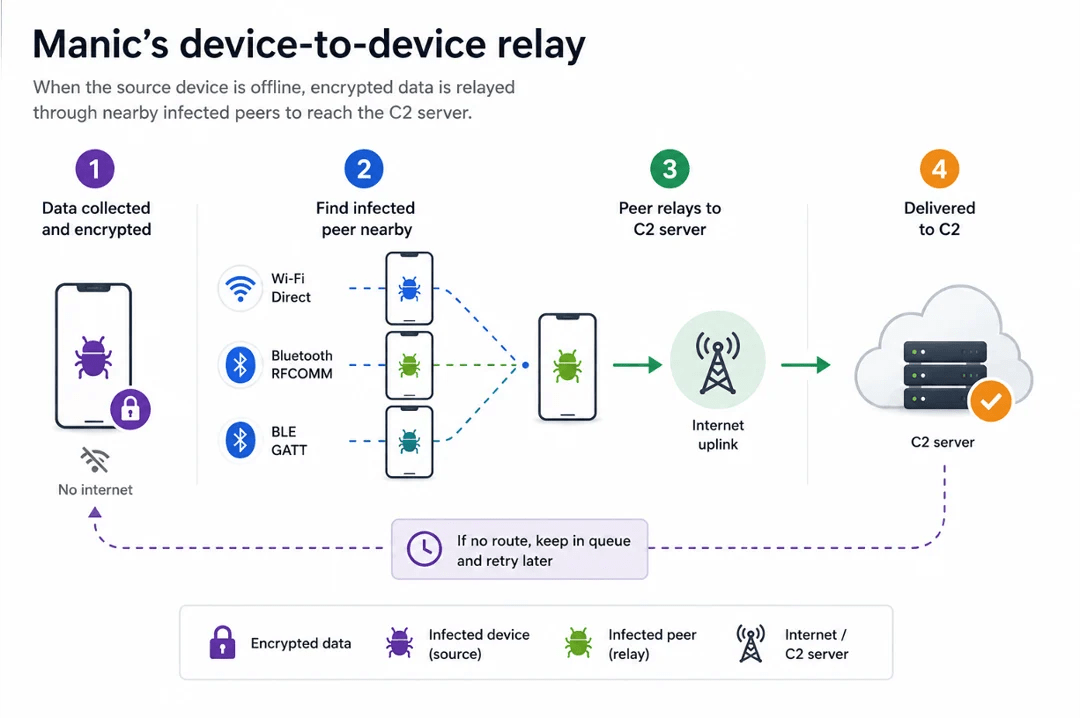
“Manic uses a store-and-forward relay mechanism to exfiltrate data even when the infected device cannot reach the C2 server directly.” continues the report. “Collected files and command results are encrypted with AES-GCM and placed in a local queue, allowing the source device to remain offline while the malware searches for another infected device that can provide a route to the C2 infrastructure.”
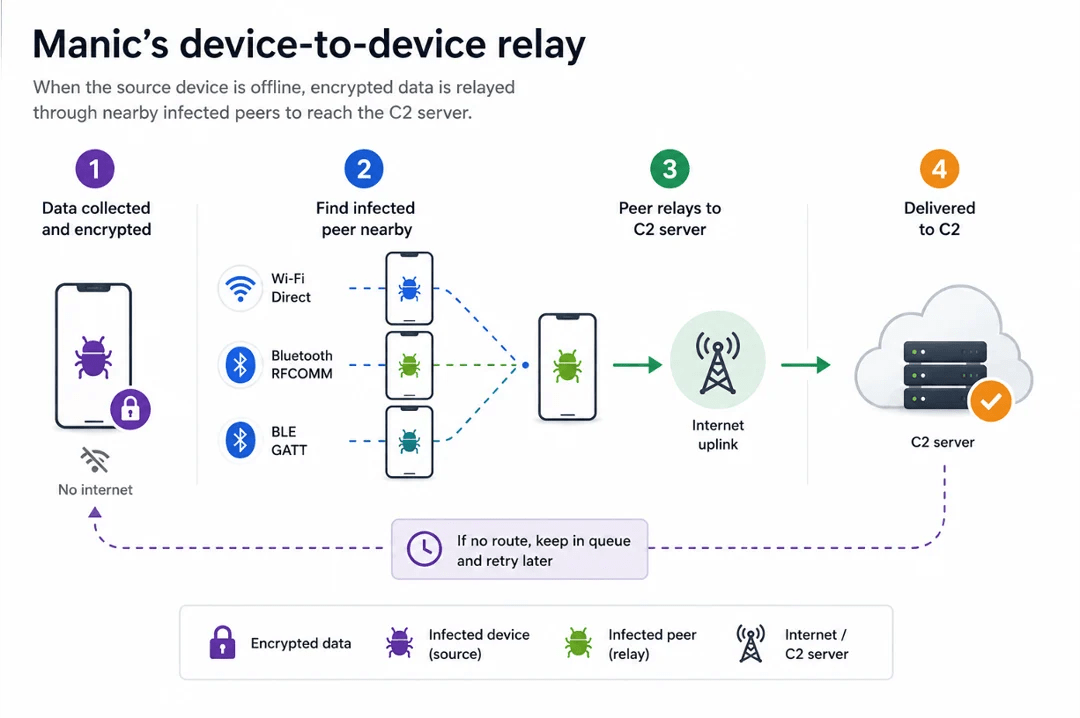
Manic searches for nearby infected devices over Wi-Fi Direct, Bluetooth RFCOMM, or BLE GATT, and supports chains of up to four relay hops. Cutting an infected phone off from the Internet doesn’t cut it off from exfiltration, as long as another infected device is within radio range. It’s a store-and-forward mesh built out of other people’s compromised phones.
Manic gives attackers remote control of the device through WebRTC, allowing them to view the screen and interact with it using Android’s Accessibility features. It can hide its activity with black screens, fake screens or fake update messages, while also covering permission requests.
The July version goes a step further by removing itself from the device’s app launcher. This keeps it out of the normal app list and lets attackers activate it through its wrapper or a deep link.
For defenders, the combination here is complete in an uncomfortable way: credential theft, live screen monitoring, authentication interception, device takeover, and an exfiltration path that doesn’t require the infected device to have Internet access at all. Monitoring for unusual Accessibility service grants and unexpected Bluetooth or Wi-Fi Direct connections from phones that aren’t actively transferring files are the most practical detection starting points.
“Manic is an evolving Android fraud platform designed for Device Takeover (DTO), combining credential and authentication theft with live screen monitoring and remote control. Its targeting spans banks, payment and cryptocurrency services, eID applications, and messengers, with a strong focus on Ukraine.” concludes the report. “A particularly distinctive capability is its offline mesh relay, which allows collected data to move through nearby infected devices over Wi-Fi Direct or Bluetooth when direct C2 access is unavailable. “
Follow me on Twitter: @securityaffairs and Facebook and Mastodon
(SecurityAffairs – hacking, Android Malware)
如有侵权请联系:admin#unsafe.sh