Project noRecognition: Teaching AI to Fool Surveillance Cameras 2026-8-18 17:5:6 Author: securityaffairs.com(查看原文) 阅读量:57 收藏
Project noRecognition: Teaching AI to Fool Surveillance Cameras

Researchers tested 31 million patterns to disrupt surveillance AI, with promising results but significant gaps between simulation and real-world use.
The Kansas City-based cybersecurity researcher Bill Swearingen spent the past year doing something that sounds almost too simple to work: printing patterns, watching cameras fail to detect them, and repeating. TechCrunch reports that after roughly 31 million tests, he can now generate patterns on demand that block license plate readers and surveillance cameras from recognizing whatever the pattern covers, whether that’s a person or a vehicle.
The project is called noRecognition, and the core idea isn’t stealth in the traditional sense. The camera still records everything just fine. What breaks is the detection layer sitting on top of the footage, the software that flags license plates, tracks faces, or spots “activity of interest” across thousands of hours of video. Swearingen’s patterns don’t hide you from the lens; they make the algorithm looking through that lens shrug and move on.
Swearingen, co-founder of the SecKC meetup, said his project started for personal reasons. He became concerned about the growing number of surveillance cameras in his town and the possibility of being tracked while attending a protest.
What started as a simple experiment later became a reinforcement learning system. He taught the model to create patterns, learn from failures and keep improving. Over time, it learned how to avoid detection by several camera systems.
Every time a pattern failed and got detected, the system adjusted and tried again, eventually learning to defeat multiple detection algorithms simultaneously rather than just one at a time.
The research dashboard behind the project, published at sandbox.norecognition.org, goes considerably deeper into the numbers than the headline claim suggests, and it’s refreshingly upfront about what’s proven versus what isn’t. The team states its overall objective plainly as “one pattern that defeats every detector,” and by their own account that goal remains only partially met. Their strongest validated result against a detector extracted directly from a real deployed surveillance camera sits at 61.7% non-detection across held-out test subjects, a solid number, but nowhere near total, and still a digital simulation rather than a real-world fabric test.
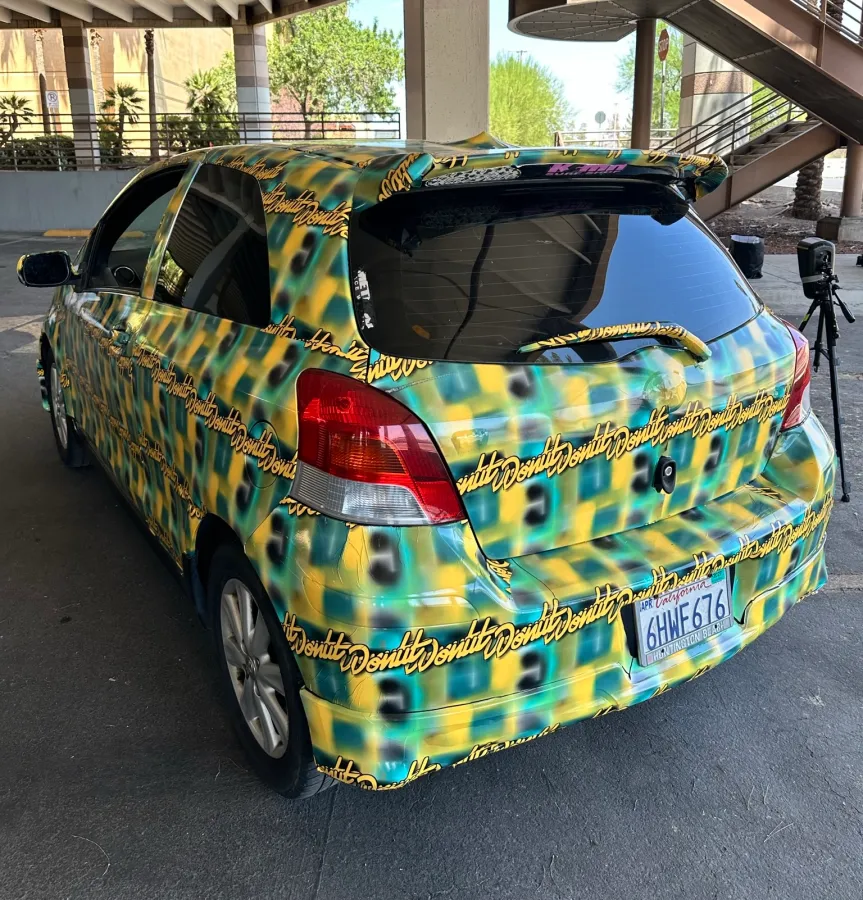
That distinction matters more than it might seem. Most of the dashboard’s headline figures are explicitly labeled as digital, simulated results, meaning the pattern was tested against a virtual camera and printed ink model rather than an actual garment photographed by an actual camera in the field. The gap between “works in simulation” and “works when Donut Media wraps a real 2009 Toyota Yaris in it,” which is the physical test Swearingen ran live at DEF CON, is exactly the gap this kind of research has to close before anyone should treat it as a reliable, everyday privacy tool.
“On Friday at the Def Con cybersecurity conference in Las Vegas, Swearingen ran his first real-world test. With help from Donut Media, the test involved covering a 2009 Toyota Yaris with one of Swearingen’s newest patterns to see if the car would be invisible to detection by a Flock camera.” reports TechCrunch.
“We proved it was effective,” said Swearingen, though the wheels were a challenge. The video of the demo will be out in the next few weeks, said Donut Media.”
That DEF CON demo is where things got concrete. Swearingen covered a car in one of his newest patterns and tested it against a Flock Safety camera, the kind widely deployed for automated license plate reading across the US. He said the test proved effective, though the vehicle’s wheels turned out to be a persistent weak point, curved surfaces apparently don’t cooperate with flat printed patterns the way a car door does.
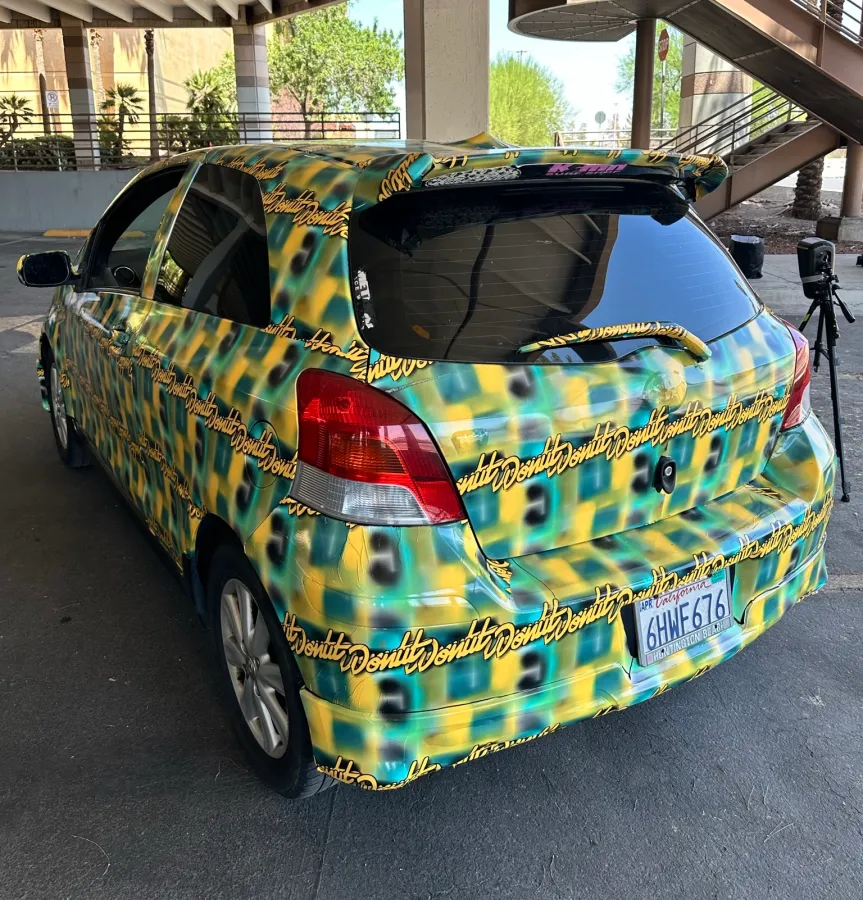
Image Credits:Bill Swearingen / Donut Media
Swearingen is not publishing his best patterns because he does not want camera makers to easily find and block them. Instead, he is using crowdfunding to develop and sell printed products such as T-shirts and hoodies, with vehicle wraps possibly coming later.
It is still unclear whether the project will become a practical privacy tool for everyday users or remain mainly a DEF CON demonstration. Its real effectiveness will depend on how well the patterns work on real clothing, in different weather and camera conditions.
Follow me on Twitter: @securityaffairs and Facebook and Mastodon
(SecurityAffairs – hacking, Surveillance camera)
如有侵权请联系:admin#unsafe.sh