Bitcoin was published as a design for peer to peer electronic cash. Seventeen years later the techni 2026-8-14 15:31:51 Author: hackernoon.com(查看原文) 阅读量:6 收藏
Bitcoin was published as a design for peer to peer electronic cash. Seventeen years later the technical precondition for that finally exists. The average fee on the network was thirty six cents in early August 2026, the cheapest block space has been in years, and the congestion spikes that once made a small purchase absurd have proved to be episodic rather than structural. What has been missing is not cheap block space. It is a rail that makes using it feel like using a card.
GoMining is building that rail from an unusual starting position. The company pioneered tokenized hashrate, which lets anyone own a slice of real mining capacity without touching hardware, and has compounded that into roughly 15 EH/s across data centers in North America, Africa and Central Asia and more than five million users. That places it inside the top ten Bitcoin miners by operating hashrate, and it makes GoMining the only operator at that scale building a consumer payment protocol on top of its own block production.
GoBTC Pay, unveiled at Consensus in Miami in May and opened to developers in June through a Gen1 SDK, API and merchant dashboard, gives a merchant an instant answer at the till while the payment settles directly on the Bitcoin base layer through the company's own 15 EH/s Stratum V2 mempool. Customers pay nothing. Merchants pay 0.2%, and none of it is retained. Half goes to the wallet or institution that brought the customer into the network and half goes to the miners who confirmed the transaction. The spending wallet is a two of three multisignature arrangement, so the user never hands custody to an intermediary to make a purchase.
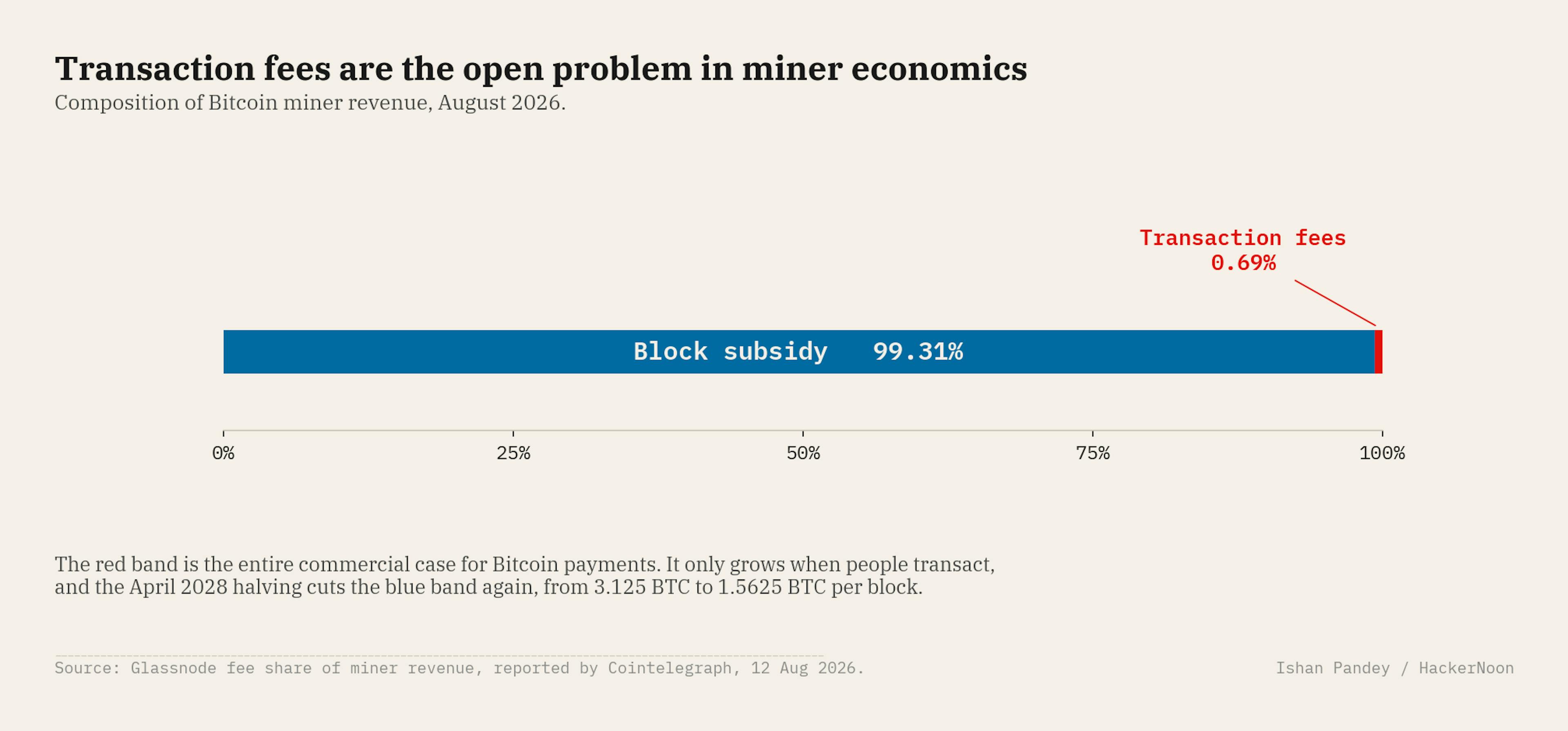
The timing is not incidental. Transaction fees currently make up 0.69% of Bitcoin miner revenue and the block subsidy halves again in April 2028, which makes genuine payment demand the most valuable unsolved problem in the mining industry rather than a side quest. A miner that builds the demand side of its own fee market is doing something structurally different from a miner that waits for it. That is the thesis worth examining, and Mark Zalan is the person to examine it with.
Today, Ishan Pandey sits down with Mark Zalan, CEO of GoMining, for HackerNoon's "Behind the Startup" series.
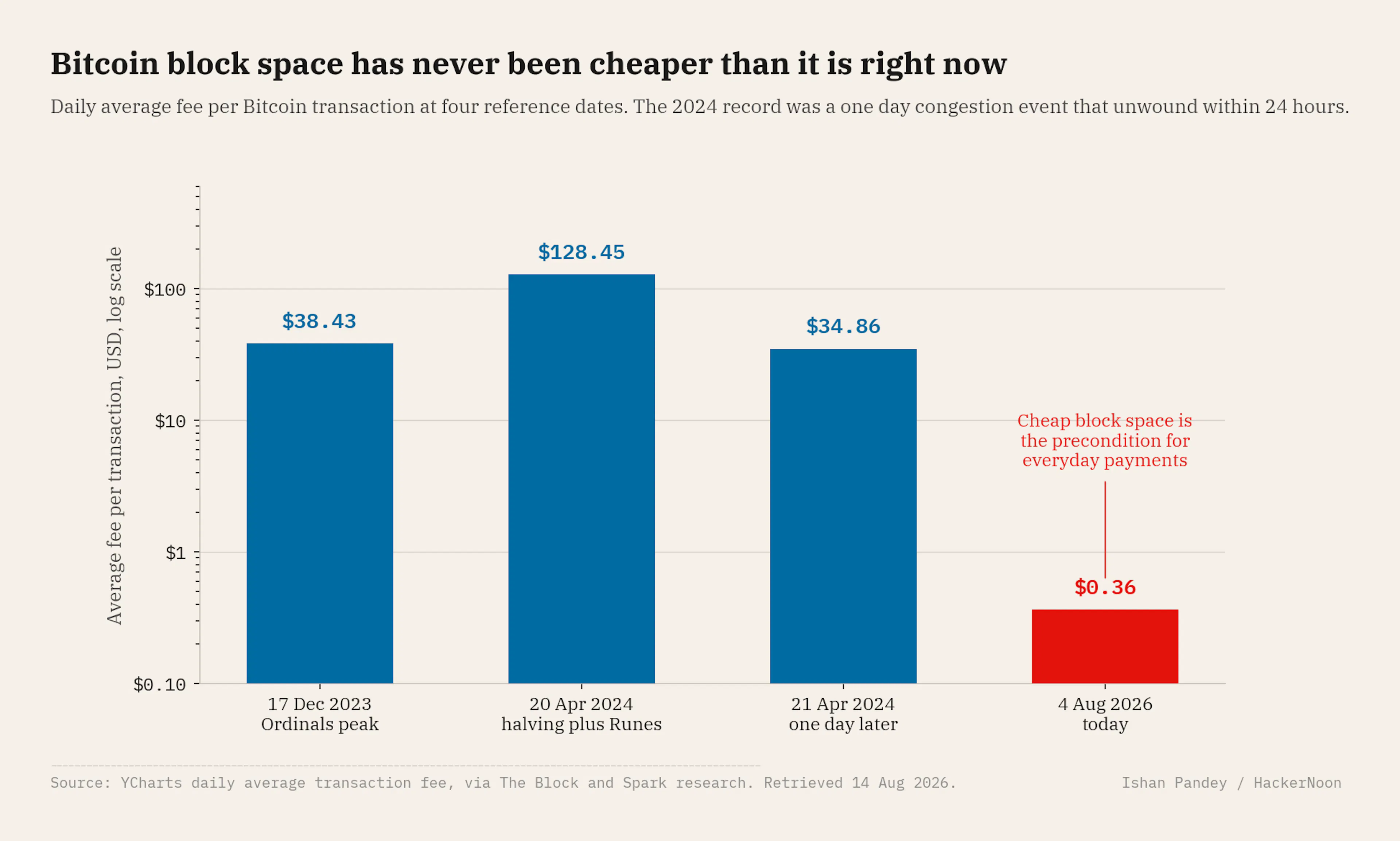 Bitcoin average transaction fee at four dates, peaking at $128.45 on halving day in April 2024 and falling to $0.36 in August 2026
Ishan Pandey: Hi Mark, welcome to the "Behind the Startup" series. GoMining started in 2021 with a narrow, concrete bet: replace the rigs, the noise and the setup with digital miners connected to audited data centers, and mining becomes accessible to anyone. That worked but in 2026 the company pivoted from a single mining product into a full ecosystem, wallet, yield, cards, and now payments. Walk me through the internal logic of that shift. What did you see in the mining business that told you the next opportunity was in what users do with Bitcoin, not just how they earn it?
Mark Zalan: Mining was never the end goal. It was the foundation we chose to build on. When we launched GoMining, Bitcoin mining had become an industrial business. Unless you had millions of dollars to invest in hardware, electricity and operations, participating simply wasn't realistic. We wanted to change that and give everyone access to real mining through digital miners backed by real, tangible infrastructure.
Once we built that, millions of people started earning Bitcoin, but very few were actually using it. We realized that helping people acquire Bitcoin solved only part of the problem. If Bitcoin is going to become a true financial system, people need an easy way to hold it, grow it and spend it as well.
That's how the ecosystem evolved. We didn't pivot away from mining. We expanded on top of it. Mining remains the foundation, while the wallet, yield products, the card and GoBTC Pay help users do something that Bitcoin has promised from the beginning: use it to purchase goods and services.
Ishan Pandey: There's an interesting strategic choice here. Most mining companies stay in their lane, scaling hashrate and optimizing energy. You looked at that same position and saw a foundation to build something much bigger. What is it about owning real mining infrastructure that gives GoMining a unique right to build across payments, cards and everyday finance, in a way a pure fintech app couldn't?
Mark Zalan: Mining gives you a very different perspective on Bitcoin.
Most companies enter the industry through trading, exchanges or payments. We started with the infrastructure that actually secures the network. When you operate mining infrastructure at scale, you begin thinking beyond producing Bitcoin. You start thinking about how Bitcoin moves through the economy.
To us, mining and payments are closely connected. Every payment ultimately depends on miners confirming transactions. As Bitcoin becomes a widely used payment network, mining becomes even more important because transaction activity becomes a much larger part of the economics.
A traditional fintech can build a great interface, but it still relies on someone else's infrastructure. Because we already operate that infrastructure, we can design products that work with Bitcoin's fundamentals rather than trying to adapt traditional finance to Bitcoin.
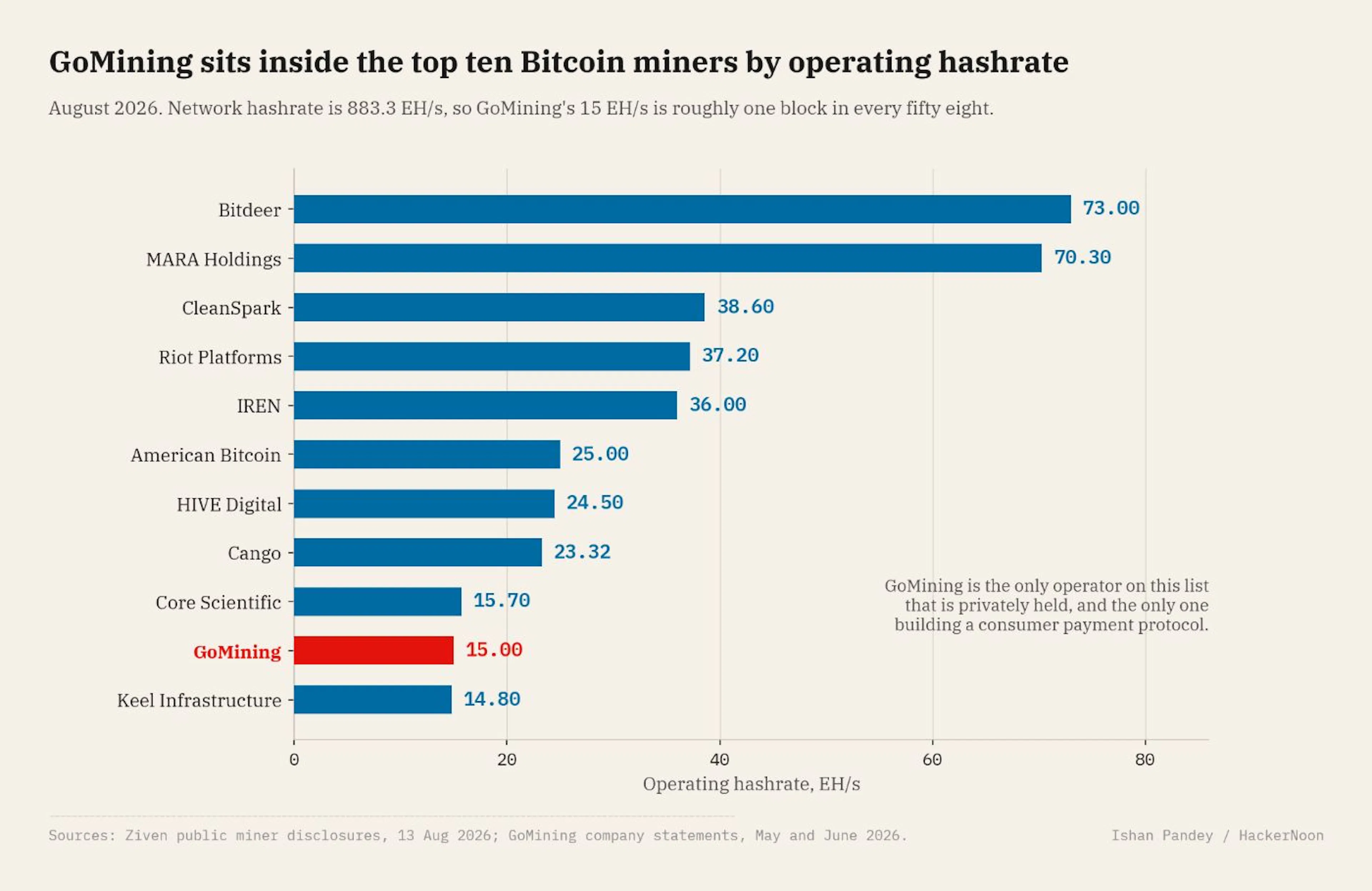 Bitcoin miners by operating hashrate in August 2026, with GoMining's 15 EH/s highlighted in red at tenth place
Ishan Pandey: Let's talk about GoBTC Pay, because this is the piece that excites me most. For years, paying with Bitcoin on the base layer meant a transaction that could cost more than the coffee and take ten minutes to confirm. GoBTC Pay promises free, instant Bitcoin payments at the point of sale. Walk us through how that actually works, and what makes it possible now when it wasn't before.
Mark Zalan: For years, the conversation around Bitcoin payments focused on making people adapt to the technology. We thought it should be the other way around. People shouldn't have to think about confirmation times, network fees or which payment rail they're using. They should simply be able to pay.
GoBTC Pay delivers an instant experience at the checkout while settling transactions on Bitcoin in the background through our mining infrastructure. The customer pays with real Bitcoin, the merchant receives real Bitcoin, and neither side has to deal with the friction that has historically made everyday payments impractical.
Another important decision was making GoBTC Pay an open protocol. We're not asking people to leave the wallets they already trust. Banks, fintech apps, Ledger, Trust Wallet, MetaMask and many others can integrate the protocol, allowing their users to pay with Bitcoin without changing how they manage their assets.
To me, that's the missing piece. Bitcoin has already proven itself as a store of value. The next challenge is making it a real means of payment.
Ishan Pandey: Your thesis is one I find compelling: Bitcoin-as-payment goes mainstream the moment it's genuinely cheaper for merchants than traditional finance, at which point self-interest does the rest. Card networks take roughly 2.35% on average in the United States on every sale. Help our readers understand the merchant economics of GoBTC Pay, how the model works, where the savings come from, and why a merchant would look at this and see an obvious win.
Mark Zalan: Merchants don't adopt new technology because it's innovative. They adopt it because it improves their business.
Today, accepting card payments means giving up two or three percent of every transaction before you've earned a dollar of profit. For many businesses, especially those operating on thin margins, that's a significant cost.
With GoBTC Pay, the merchant fee is 0.2%. One half of that fee rewards the wallet or financial institution that brought the customer into the network, and the other half goes to the miners processing the transaction. Instead of multiple intermediaries taking a cut, the value stays within the Bitcoin ecosystem.
I also think we're reaching a point where accepting Bitcoin isn't just about lowering costs. Millions of people already own Bitcoin and are looking for places to spend it. As that user base grows, accepting Bitcoin becomes both a cost-saving decision and lets consumers pay for goods and services in a way that's convenient for them.
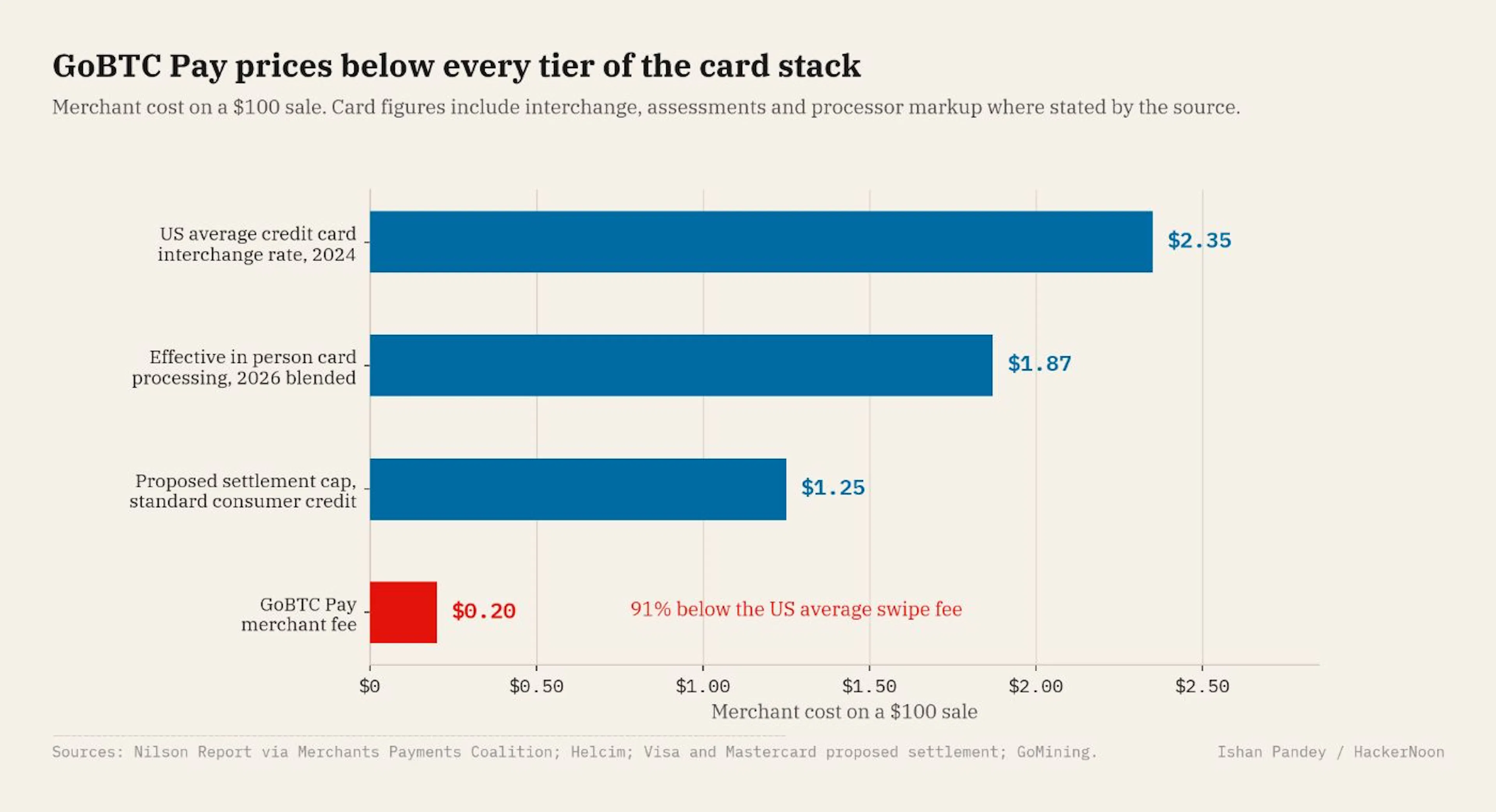 Merchant cost on a $100 sale across card interchange, blended processing, the proposed settlement cap, GoBTC Pay at 20 cents and Square at zero
Ishan Pandey: One of the most elegant parts of the design is the closed loop, consumers pay in BTC, merchants earn BTC, miners earn a share of the fees, and it all reinforces itself. At the same time, you've built it as open infrastructure that any wallet, from Ledger to Trust Wallet to MetaMask, can plug into. Talk to me about that design philosophy. How do you balance building a self-sustaining ecosystem with keeping the rails genuinely open?
Mark Zalan: We've always believed that Bitcoin grows through openness, not exclusivity.
The closed loop creates healthy incentives. Consumers can spend Bitcoin, merchants receive Bitcoin, miners earn transaction revenue, and wallets or financial institutions that bring users into the network also benefit. Everyone has a reason to participate.
But that doesn't mean we want to own the entire experience. Quite the opposite. We want GoBTC Pay to become infrastructure that others can build on.
If someone prefers Ledger, Trust Wallet, MetaMask or a banking app, they shouldn't have to switch products just to use Bitcoin for payments. The easier it is for different platforms to connect, the stronger the entire network becomes. That's how open standards succeed.
Ishan Pandey: You operate audited data centers across North America, Africa, and Central Asia and you partner only with providers meeting strict legal and technical standards. In an industry where operators have watched infrastructure disappear overnight, that discipline stands out. Talk about how you think about resilience, geographic diversification, and why working with licensed, audited partners is a competitive advantage rather than just a cost.
Mark Zalan: Mining is a long-term infrastructure business, so resilience is something you have to build from day one.
No single region has perfect regulation, perfect energy prices or perfect operating conditions forever. Markets change, policies change and unexpected events happen. Geographic diversification allows us to keep building regardless of those changes.
We're equally selective about the partners we work with. We only operate with licensed, audited providers that meet strict technical and legal standards. It takes more effort upfront, but it creates a much stronger business over time.
For us, reliability isn't a feature you add later. It's part of the product itself. When people trust you with their Bitcoin, they expect the infrastructure behind it to be just as dependable as the technology they're investing in.
Ishan Pandey: Let's talk about the business as it stands today and where it's going. You've got mining at the core, with fees layered across swaps, cards, travel and staking, and GoBTC Pay opening new revenue ahead. How do you think about the way mining and the financial ecosystem reinforce each other, and where do you see the most exciting growth over the next few years?
Mark Zalan: We think of mining as the engine of the ecosystem. It brings new Bitcoin into users' hands, but that's only the beginning of the journey.
Once people own Bitcoin, they want to do more with it. They want to save it, earn yield, make purchases, book travel, or send money to someone else. Each new service increases the utility of Bitcoin, and in turn, creates more activity on the network.
The biggest opportunity over the next few years is payments. Bitcoin already has millions of holders around the world. The next stage is making it just as easy to spend as it is to buy. If we can help unlock that shift, I think it changes how people think about Bitcoin altogether.
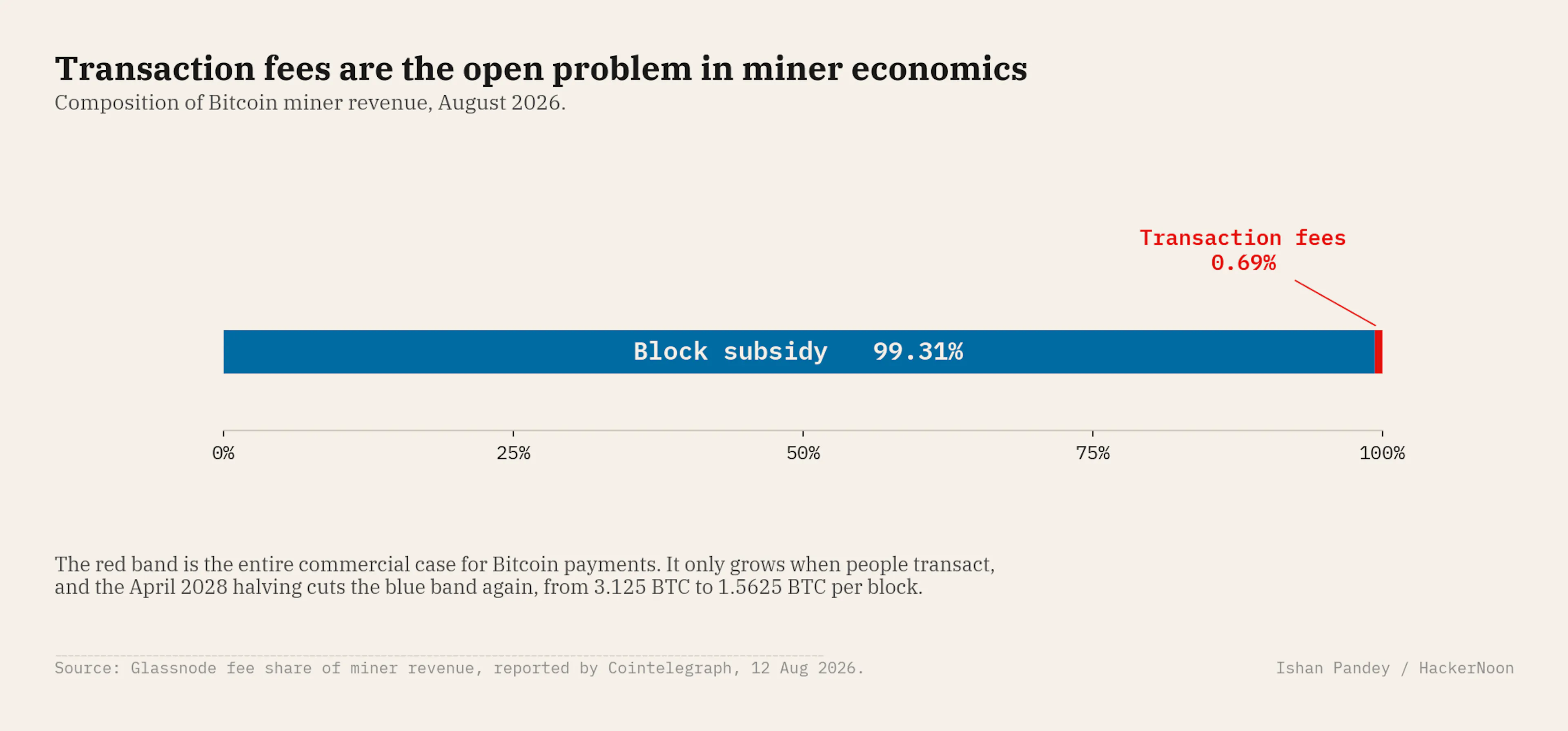 Bitcoin miner revenue in August 2026 split 99.31 percent block subsidy and 0.69 percent transaction fees
Ishan Pandey: I want to get your view on stablecoins, because it's the question every Bitcoin payments company gets. Stablecoins are spendable, price-stable, and settling enormous volume, and the GENIUS Act gave them real regulatory momentum. You clearly believe Bitcoin has a distinct and lasting role in payments alongside them. Make the case: what does Bitcoin offer as everyday money that a dollar-pegged stablecoin fundamentally can't?
Mark Zalan: I don't see this as Bitcoin versus stablecoins. I think both will play important roles.
Stablecoins are an excellent way to move dollars more efficiently, and they've already proven their value. But at the end of the day, they're still tied to a fiat currency and the institutions behind it.
Bitcoin is different. It has a fixed supply, no central issuer and no single country controlling its monetary policy. That's what makes it unique.
If someone wants digital dollars, stablecoins are a great solution. But if you're looking for a truly global, neutral asset that anyone can own and use without relying on a central authority, Bitcoin offers something fundamentally different. I believe there is demand for both.
Ishan Pandey: Final question. You describe GoMining as "Robinhood for Bitcoin", a single, friendly place to earn, hold, spend and grow Bitcoin. Where do you want to take that vision over the next few years, and when GoBTC Pay is everywhere, what does a normal day using Bitcoin actually look like for the average person?
Mark Zalan: Our goal is to make Bitcoin feel effortless.
Today, using Bitcoin often requires learning wallets, exchanges, transaction fees and all kinds of technical details. Most people don't want to think about any of that. They just want a financial product that works.
If we do our job well, someone will be able to earn Bitcoin through mining, keep it safely, pay for coffee, book a hotel, shop online or send money from one country to another without ever worrying about what's happening behind the scenes.
That's the future we're building toward. Technology should fade into the background, while Bitcoin becomes a natural part of everyday financial life. If we can help make that happen, we'll consider our mission a success.
Don’t forget to like and share the story!
Vested Interest Disclosure: HackerNoon has reviewed the report for quality, but the claims herein belong to the author. #DYOR.
如有侵权请联系:admin#unsafe.sh