How Financial Institutions Greatly Increase Value Detection Rates (VDR)with ThreatFabric’s Beh 2026-8-11 08:51:10 Author: www.threatfabric.com(查看原文) 阅读量:2 收藏
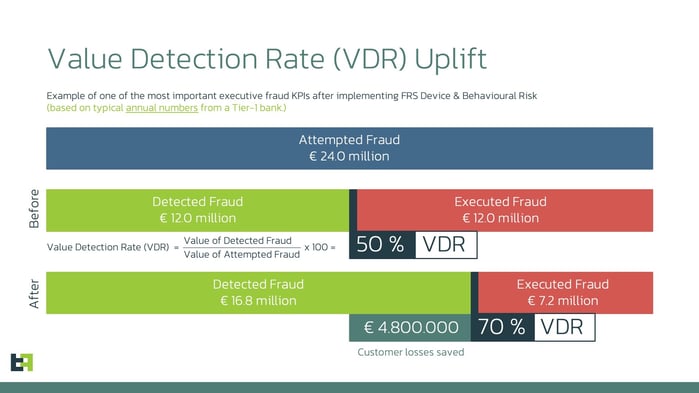
Fraud and scam prevention has become one of the most carefully measured disciplines within modern financial institutions. Meaningful industry benchmarks are rare. Across discussions with more than 30 European financial institutions, however, a common theme consistently emerges: Value Detection Rate (VDR) has become one of the most important executive fraud KPIs. It is the metric that determines how much fraud is actually intercepted before customer losses occur. As scam typologies evolve, traditional transaction monitoring alone increasingly struggle. This is particularly true for scams where customers themselves authorise the payment under manipulation. Research across European banks shows that these scam-driven fraud types account for more than three quarters of executed fraud losses, while simultaneously being among the most challenging fraud categories to detect using transaction risk signals alone. VDR is defined as the value of detected fraud, divided by the value of attempted fraud. These days, organisations that primarily rely on transaction risk engines typically achieve a VDR between 30% and 50%. The data across multiple customer deployments demonstrates a remarkably consistent pattern: introducing advanced device intelligence and behavioural analytics closes previously invisible detection gaps. One benchmark highlighted a “strong” bank that initially had visibility into 50% of executed fraudulent transactions. By adding FRS device intelligence, visibility increased to 73%. By further introducing FRS behavioural risk analytics, visibility rose to 91%, reducing the signal gap to from 50% to under 10%. A second bank bank saw an overall VDR increased from 65% to 90%, while operational alert volumes remained effectively unchanged at approximately 30 alerts per day and alert rates stayed below 1% when combined with transaction data. Another FRS behavioural analytics deployment demonstrated a similar outcome: Existing controls detected 61% of fraud cases. When ThreatFabric's behavioural fraud model was added, combined detection reached 85%, representing a 24 percentage point increase in overall fraud visibility. Taken together, these outcomes show a consistent pattern: With Pre-Transaction Intelligence from ThreatFabric's Behavioural SDK, institutions can realistically move towards market leading performance. Across the observed customer outcomes, improvements of 20% or more in VDR are consistently achieved through the combined application of device intelligence and behavioural risk analytics. The most interesting finding emerges when analysing fraud performance by individual modus operandi (MO). Using results from both datasets and averaging equivalent fraud categories, the following combined detection improvements emerge: Fraud Type / MO Average Existing Detection Average Combined Detection Improvement Family Fraud 29% 72% + 43 % Social Media Fraud 52% 85% + 33 % Impersonation Fraud 55% 81% + 26 % Romance / Dating Fraud 56% 78% + 22 % Investment / Boilerroom Fraud 72% 88.5% + 16.5 % Advance Fee Fraud 69.5% 87.5% + 18 % Online Sales Scam 65% 83.5% + 18.5 % Phishing / ATO 83% 97% + 14 % Data aggregated from both customer datasets; minimal scam classification overlap The strongest gains consistently occur in fraud categories driven by social engineering. Traditional transaction monitoring focuses primarily on payment characteristics. The challenge is that scam victims often appear behaviourally legitimate from a transaction perspective because they willingly initiate the payment. Behavioural analytics introduces an entirely new layer of visibility by detecting signals such as: These indicators provide pre-transaction intelligence that is invisible to conventional transaction monitoring systems. This explains why scam categories such as impersonation fraud, romance scams, social media fraud and family fraud experience disproportionately large detection gains. The behavioural signals expose the fraud manipulation itself rather than simply the resulting payment. Detection improvements translate directly into measurable business impact. The increased detection capabilities generated millions of euros annual uplift in detected fraud. But the strategic value extends beyond recovered fraud losses. Higher VDR means: The broader message from the data is clear. Financial institutions no longer need to choose between stronger fraud detection and a seamless customer experience. By combining behavioural intelligence with advanced device risk analytics, banks can significantly increase fraud visibility, improve VDR by more than 20%, shifting left from Fraud Management to Fraud Prevention, all while keeping operational overhead under control. Ultimately, the institutions leading the next generation of fraud prevention are not merely monitoring transactions. They are understanding behaviour. And that is where the largest remaining detection gains can be found.How Financial Institutions Greatly Increase Value Detection Rates (VDR)
with ThreatFabric’s Behavioural SDKMoving beyond Transaction Monitoring
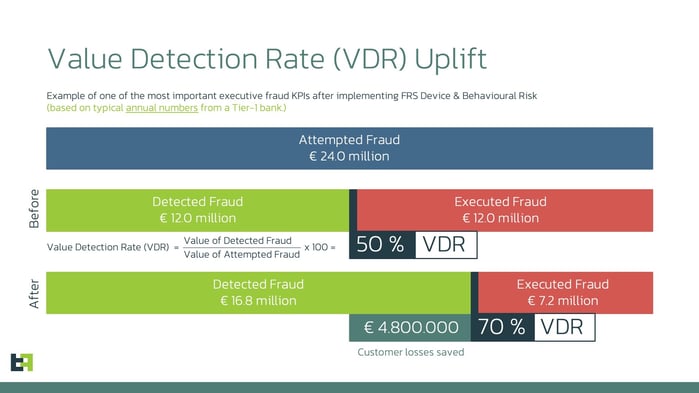
Pre-Transaction Intelligence consistently advances VDR by over 20%
Where the Biggest Detection Gains Are Found
Why Social Engineering sees the Largest Uplift
Why These Outcomes Matter
如有侵权请联系:admin#unsafe.sh