Hey Hackers!Welcome back to another edition of HackerNoon’s 3 Tech Polls Newsletter, a weekly retro 2026-8-5 12:51:46 Author: hackernoon.com(查看原文) 阅读量:5 收藏
Hey Hackers!
Welcome back to another edition of HackerNoon’s 3 Tech Polls Newsletter, a weekly retrospective on timely debates shaping the global tech ecosystem. Results from our Poll of the Week anchor the newsletter, supported by related conversations from around the web to offer additional context and perspective.
This week, we’re looking at brain waves, Physical AI, and whether machines really need greater access to the inner workings of the human mind.
Physical AI aims to give robots the ability to understand and operate in the real world. But cameras, sensors, and conventional training data cannot always capture what humans are thinking in the moment: intent, hesitation, discomfort, or the feeling that something is about to go very wrong.
Brain signals could theoretically fill in some of those gaps. They could also create an entirely new category of privacy, safety, and control problems.
So we asked the HackerNoon community: are brain waves the missing link for Physical AI?
This Week’s HackerNoon Poll Results
Are Brain Waves the Missing Link for Physical AI?
HackerNoon readers are not exactly rushing to hand their brain waves over to the robots.
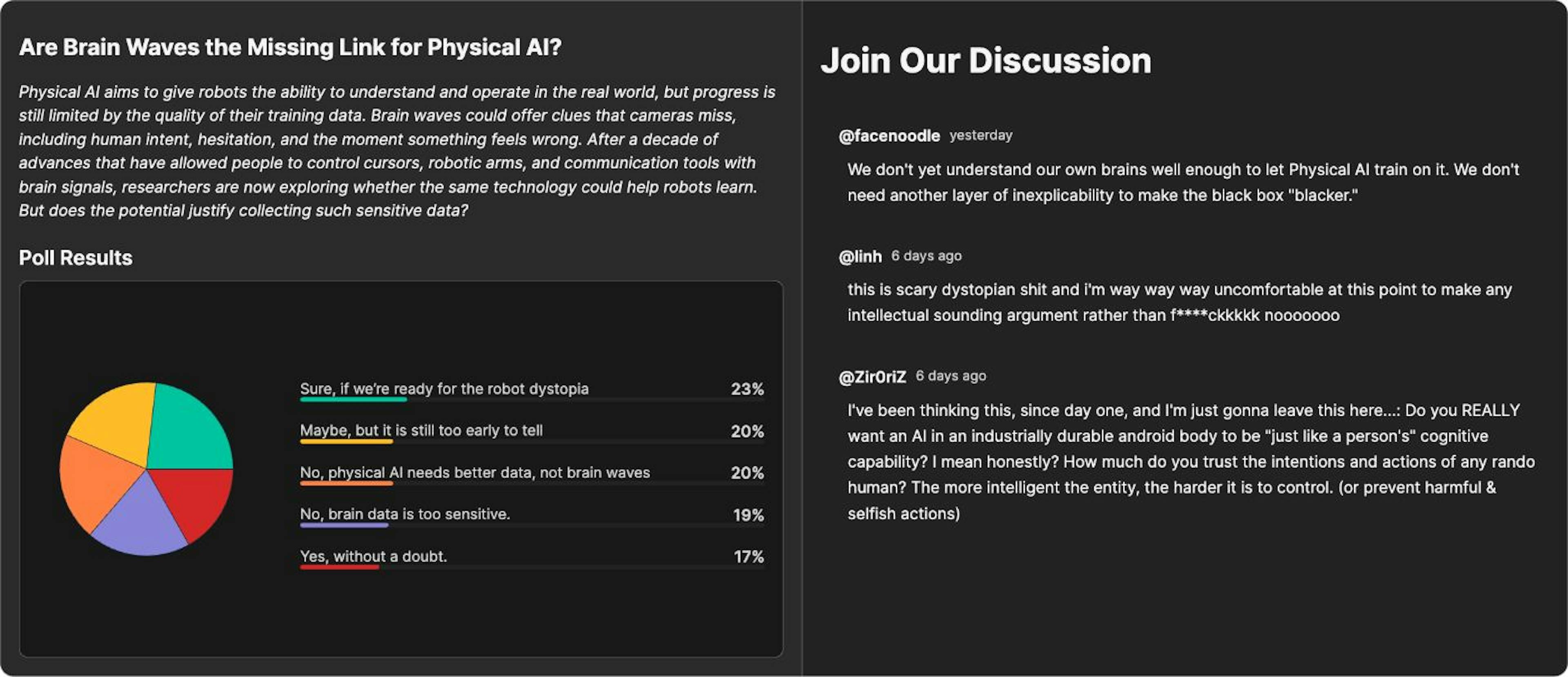
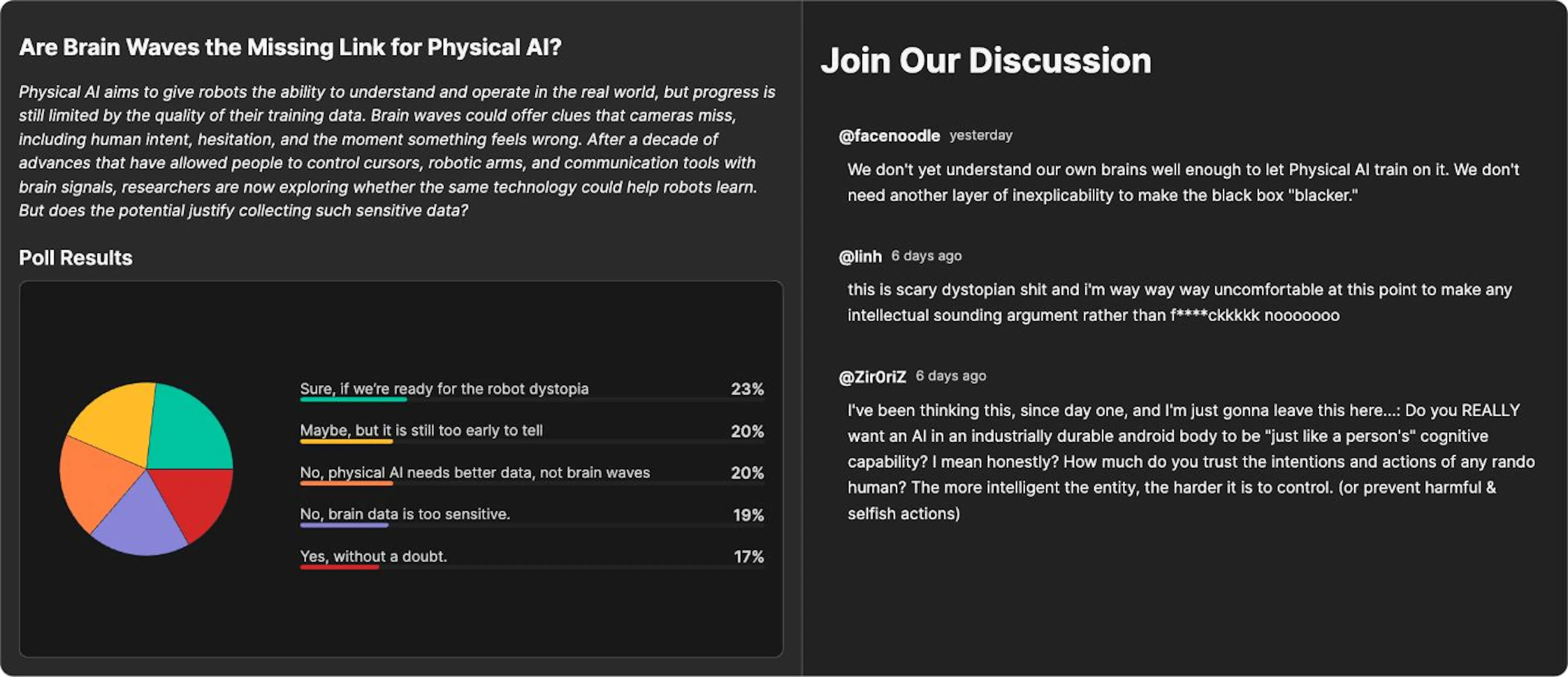
Only 17% said brain signals should be used to improve Physical AI without reservation. Another 20% said it was still too early to tell, while 20% argued that robots need better conventional training data, not access to human brain activity. A further 19% rejected the idea because brain data is simply too sensitive.
The most popular response, with 23% of the vote, accepted the premise only if we are ready for the robot dystopia.
Hardly a ringing endorsement.
The comments were even less restrained.
@facenoodle raised the most measured objection:
“We don't yet understand our own brains well enough to let Physical AI train on it. We don't need another layer of inexplicability to make the black box ‘blacker.’”
That gets to the heart of the technical concern. AI models are already difficult to interpret. Human cognition remains poorly understood. Combining the two could produce more capable machines, but not necessarily more explainable ones.
@linh skipped the intellectual framing entirely:
“This is scary dystopian shit and I'm way, way, way uncomfortable… f****ckkkkk nooooooo.”
Sometimes, “absolutely not” is a complete risk assessment.
@Zir0riZ took the concern a step further, questioning whether anyone truly wants an industrially durable android with human-like cognitive abilities. Humans are already unpredictable, selfish, and difficult to control. Giving machines those same qualities, alongside greater speed and physical strength, may not be the breakthrough it sounds like in the pitch deck.
Taken together, the results suggest that readers can see the technology’s potential. They just aren’t convinced that making robots think more like people is an unquestionably good idea.
But while the HackerNoon community is still debating whether machines should gain greater access to our minds, prediction markets have moved on to more immediate questions: how quickly can brain-computer interfaces reach more people, and how valuable might the companies building them become?
Around the Web: Kalshi
How Many People Will Neuralink Have Implanted This Year?
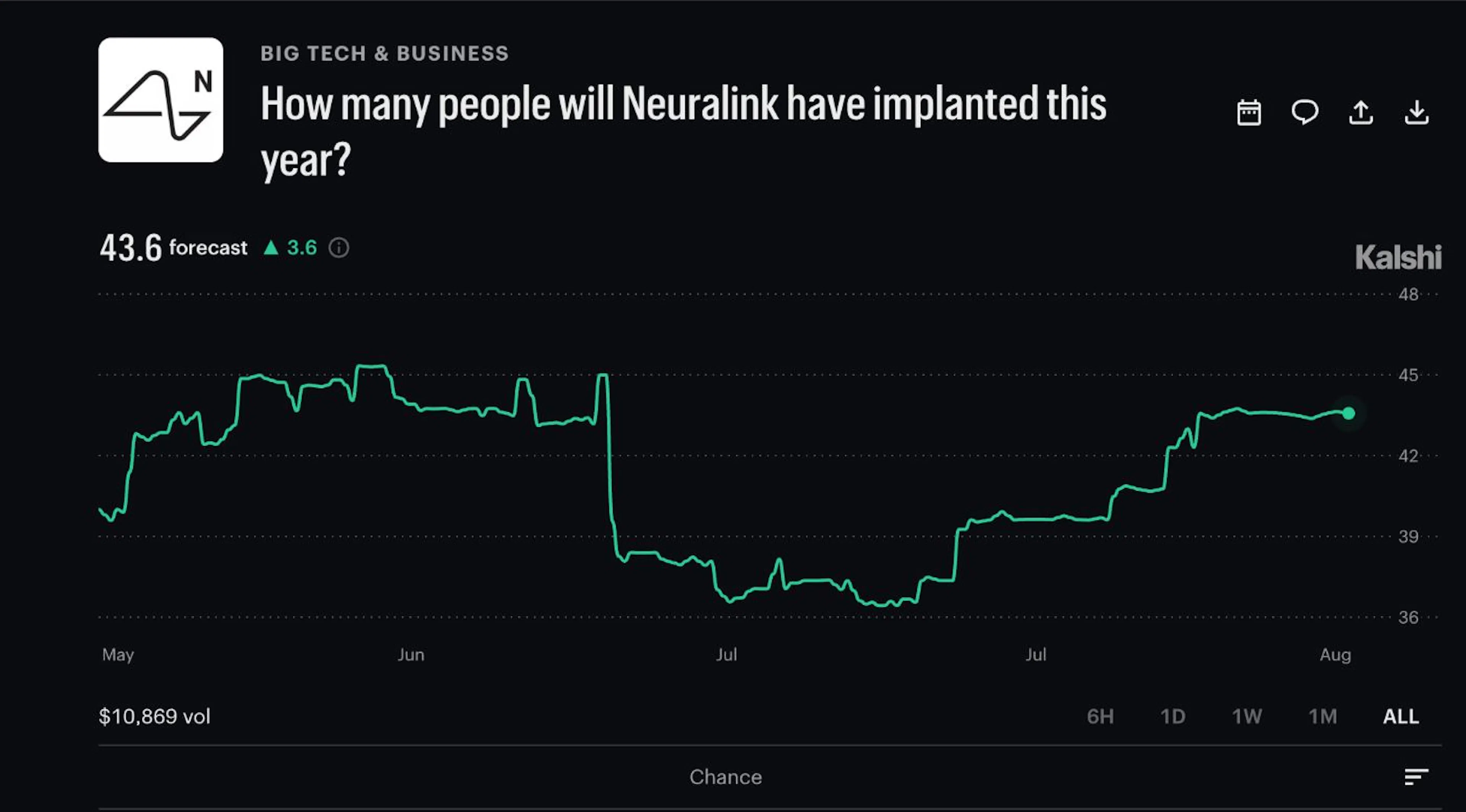 Kalshi poll: How many people will Neuralink have implanted this year?
Neuralink is not currently feeding human thoughts into humanoid robots. Its clinical work is focused on helping people with paralysis control computers and other assistive devices through an implanted brain-computer interface.
Still, it is one of the clearest real-world tests of whether people will accept technology that translates neural activity directly into machine commands.
Neuralink announced in January that 21 people were participating in its program. Kalshi traders now give the company a 75% chance of reaching at least 30 implants before the end of 2026. The odds fall to 55% for at least 40 participants and 41% for at least 50.
The market is not debating whether brain implants are too intimate, whether neural data is too sensitive, or what happens when the black box gets “blacker.”
It is betting on throughput.
That does not mean the ethical questions have disappeared. It means the technology has advanced far enough for scale to become a credible subject of speculation.
Around the Web: Polymarket
Will Neuralink’s Valuation Hit __ by December 31?
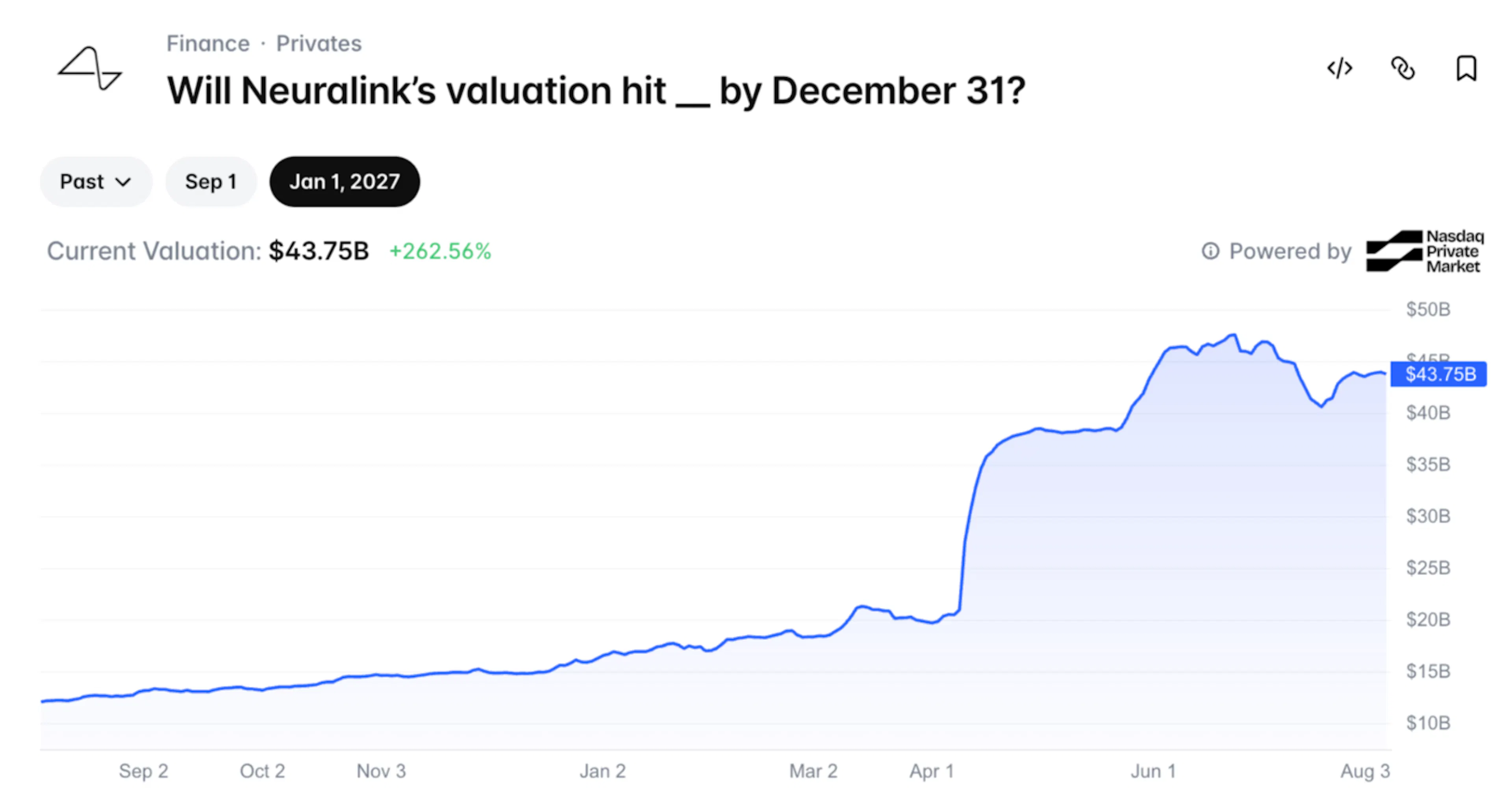 Polymarket poll: Will Neuralink's valuation hit__ by December 31?
On Polymarket, traders are applying the same logic to Neuralink’s valuation.
The platform currently places the company’s private-market valuation at about $43.75 billion. Traders give Neuralink a 59% chance of reaching $50 billion before the end of the year and a 45% chance of hitting $60 billion. The more ambitious targets remain long shots, with a 17% chance of reaching $75 billion and 10% odds of touching $100 billion.
Those numbers suggest belief in Neuralink’s momentum, even if traders are not yet ready to price in total domination.
More importantly, they reveal the gulf between the two conversations surrounding brain-computer interfaces. The public conversation is about consent, privacy, safety, and how much of ourselves we should surrender to machines. The market conversation is about participant counts, growth milestones, and valuation targets.
One asks whether we should proceed. The other asks how much the company could be worth when we do.
That’s all for this week, Hackers!
Catch you at the next edition!
如有侵权请联系:admin#unsafe.sh