Ask Wei Zhou to explain the stablecoin economy and he does not reach for a whitepaper. He reaches fo 2026-8-4 16:55:56 Author: hackernoon.com(查看原文) 阅读量:8 收藏
Ask Wei Zhou to explain the stablecoin economy and he does not reach for a whitepaper. He reaches for a shipping metaphor. Money, in his telling, moves three ways: by land, which is banks; by sea, which is e-wallets and by air, which is blockchains. The US dollar simply boarded the aircraft first and every other currency now faces a choice between building its own runway or watching its citizens fly American. Coins.ph, the company he acquired in 2022 is what he calls the port: the place where dollar stablecoins land in the Philippines and get converted into pesos into groceries, into school fees, into the daily economy of a country that receives $40 billion a year in remittances, the fourth-largest inflow in the world.
Zhou sold sophisticated financial products at Goldman Sachs, then spent three and a half years as CFO of Binance through its steepest growth years. When he left, he did not found a startup or raise a fund. He bought one, acquiring a decade-old, Bangko Sentral ng Pilipinas-licensed exchange and e-wallet in a country he had not visited in fifteen years, at what turned out to be the worst possible moment: FTX detonated six months after the deal closed. His response was to treat the crypto winter as a renovation window, rebuilding the management team, the tech stack, the brand and the product before the market returned.
The Philippines rewarded the timing. Between 2019 and 2021, the share of Filipino adults with a financial account jumped from 29 per cent to 56 per cent, the fastest gain the central bank has ever recorded, and the wallets that did the banking are exactly where stablecoins now live.
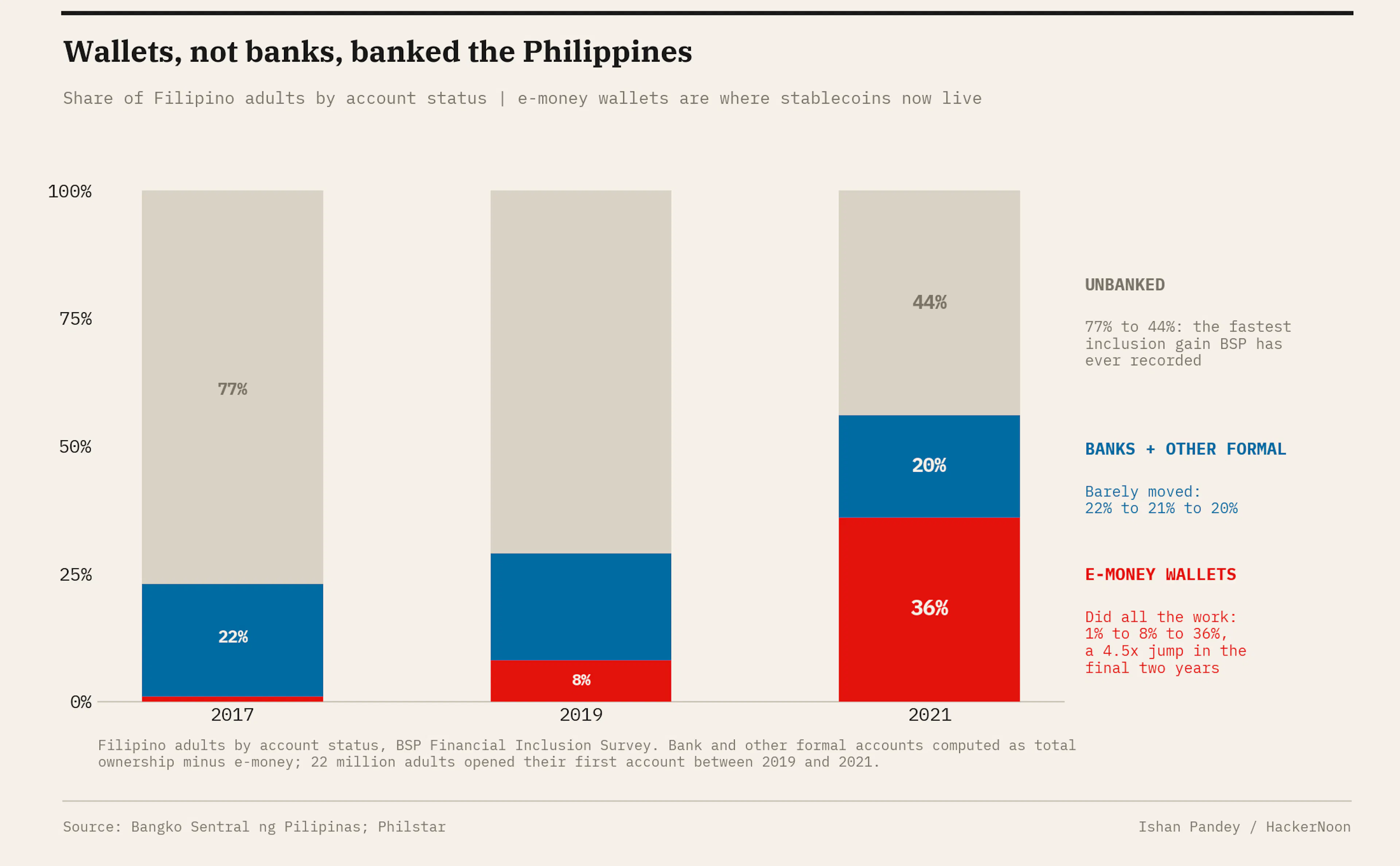 The unbanked half of the Philippines got banked in two years
Ishan Pandey sat down with Wei Zhou to discuss the rise of stablecoins, the future of cross-border payments and how blockchain-based financial infrastructure is evolving across emerging markets.
Ishan Pandey: You moved from selling financial products at Goldman Sachs to running stablecoin infrastructure in Manila. What did the banking side teach you about where this industry was heading?
Wei Zhou: The biggest opportunity crypto presented is a new type of technology that people around the world can invest in, and I'd say it is doing three main things. It has banked the unbanked with stablecoins. Here in the Philippines, before 2020 the unbanked was 50, 60 per cent and two things changed that drastically: the rise of digital wallets and the rise of stablecoins. The next evolution is credit for the uncredited, and the last one is brokerage for the unbrokered. These are financial products that lacked either distribution or choice depending on where you live.
What broke through is that through stablecoins and crypto wallets, people all over the world could buy Bitcoin, which is a much more universally investable asset than Google or even Apple stock. If you go into finance, whether at an investment bank or a traditional bank, you are there to sell financial products. Goldman just sells more sophisticated ones, and historically you needed accreditation to access them. That knowledge barrier doesn't exist anymore. Anybody with AI can learn about any financial product they want. A lot of the artificial barriers erected by legacy institutions to protect investors have become barriers stopping normal people from accessing investable products, and we are in the process of breaking them down. The biggest equalizer is stablecoins, because they are readily available, a single denomination most people understand, and they have become not just a medium of exchange but a distribution channel for other financial products.
Ishan Pandey: You operate across markets at very different stages of regulation. What actually separates stablecoin adoption in the US and Europe from adoption in the Philippines, Brazil or India?
Wei Zhou: Even within emerging markets there is a sliding scale. In the Philippines, Coins.ph has operated under the central bank's regulation for almost ten years. We run a licensed cryptocurrency exchange together with a licensed e-wallet, so users can deposit fiat, store it with us, and use it to buy stablecoins, Bitcoin, Ethereum or Solana, legally, efficiently and cheaply. That is the advanced end of the spectrum. India and China are on the other side, where it is much more gray, and China is more banned than India. India has functional exchanges and FIU registrations; the barrier is just higher, and transaction costs and taxes are higher. Brazil sits in the middle and is setting up its licensing regime now. Most ASEAN countries, Indonesia, Malaysia, Thailand, Vietnam, Singapore, either have regimes in place with licensed players or are in the process, like Vietnam.
The bigger difference is the FX layer. If you are in Japan exchanging yen for dollars, there is almost no friction, and in the US a stablecoin always converts one to one. Outside the US, nothing converts one to one. The price changes constantly, and with that comes uncertainty: is this the right price, and how much can I actually execute at it? Can I do a million, ten million, a hundred million at that price? Probably not. So in emerging markets it is much more important to build a liquid market for stablecoins, which is what we are building in the Philippines. And then there are the currency controls themselves. In Thailand there are restrictions on how much you can move in and out. India triggers currency control issues any time money crosses the border. Those challenges are real, but they create the opportunity: the market comes to us for liquidity and for pricing.
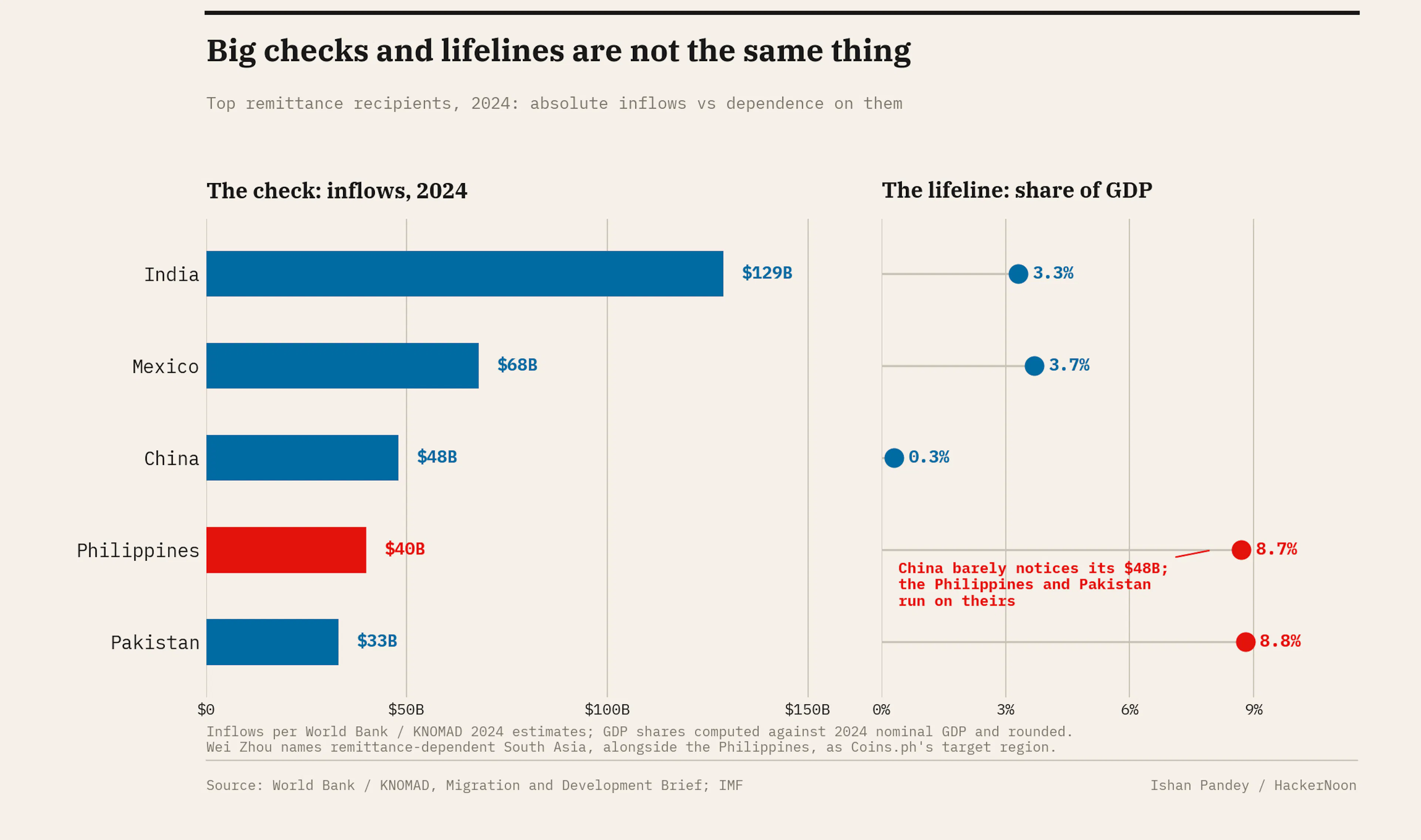 The corridors stablecoins are coming for
Ishan Pandey: Payment processors are coming to you for settlement outside banking hours. What is the actual unit economics story that wins that business?
Wei Zhou: The volume is large and consistent, but these companies operate in a very competitive environment, so they care deeply about pricing, and most of the time banks do give you the best price, based on the mid-market FX rate. What we had to build is USDT and USDC to peso pricing that is comparable or competitive with bank mid-market rates. If our price is not competitive, they can stay with their banks.
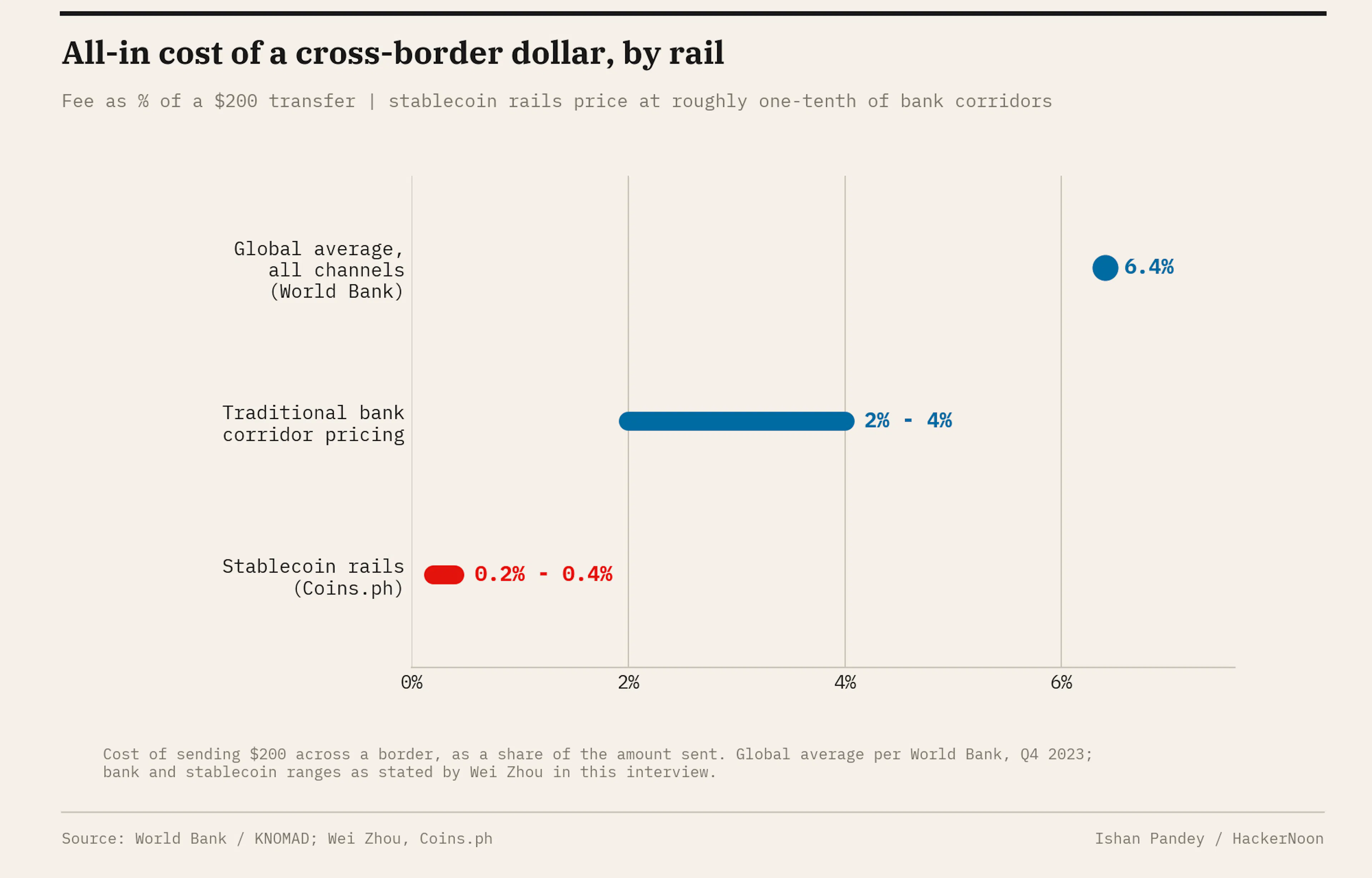 All-in cost of a cross-border dollar, by rail
Where we come in is that on the weekends we see higher stablecoin trading volume than on weekdays, because the banks are closed. There are no rates on the weekend. If a remittance company wants to quote a customer sending money from the US to the Philippines on a Saturday, they will normally quote higher just to hedge themselves. If we can give them a real-time quote they can actually execute at, they don't have to hedge, and that genuinely differentiates us from banks. Even traditional remittance players like Remitly and MoneyGram are exploring after-hours and weekend pricing with us, because the sender does not care whether it is 6pm or 6am. They want to send now, and they want the person on the other end to receive now. That liquidity cannot be built overnight. You build it by aggregating demand on both sides of an order book, which is much closer to building a crypto exchange than to running a payments company, and that is where our background helps.
Ishan Pandey: Most stablecoin volume today is dollar-denominated. Do you see genuinely local stablecoins emerging, or does everything keep routing through the dollar?
Wei Zhou: The technology of money is changing. Before, the technology was private ledgers: each bank keeps its own, and they communicate through the central bank or through SWIFT. Now you have blockchain money, which is a public ledger, and the US dollar happens to be the first currency with mass adoption on those rails. I think every currency will move onto public ledgers, because the dollar is already there and your currency has to transact with the blockchain dollar.
I joke that we are like a port. The spaceship comes in, we unload it and move the cargo onto trucks. Money moves by air, land or water: blockchain is money moving by air, e-wallets are money moving by sea, banks are money moving by land. Eventually every currency has to fly. It is not by choice. If you are not there, people will just keep their money in dollar stablecoins, because it is easy, it is accessible, and there is utility behind it: you can invest, borrow, lend and send. As for local pairs, look at traditional FX. If you want to go from Australian dollars to pesos, you still route through US dollars, because the liquid markets are Aussie-dollar and dollar-peso. That intermediary role will be true in the stablecoin world too. The only real third possibility is China with the offshore renminbi, if they ever do a public-ledger version of it. If that appears, it should have demand.
Ishan Pandey: Where do CBDCs fit? India has piloted one, and Saudi Arabia and the UAE have experimented jointly.
Wei Zhou: My question with CBDCs is always: what ledger are they going to use? If Saudi Arabia builds on one vendor's ledger and the UAE builds on another, it is like one country running Microsoft and the other running Android. They cannot talk to each other. The entire point of a public ledger is shared settlement, and private CBDC ledgers reintroduce exactly the fragmentation blockchains were supposed to remove.
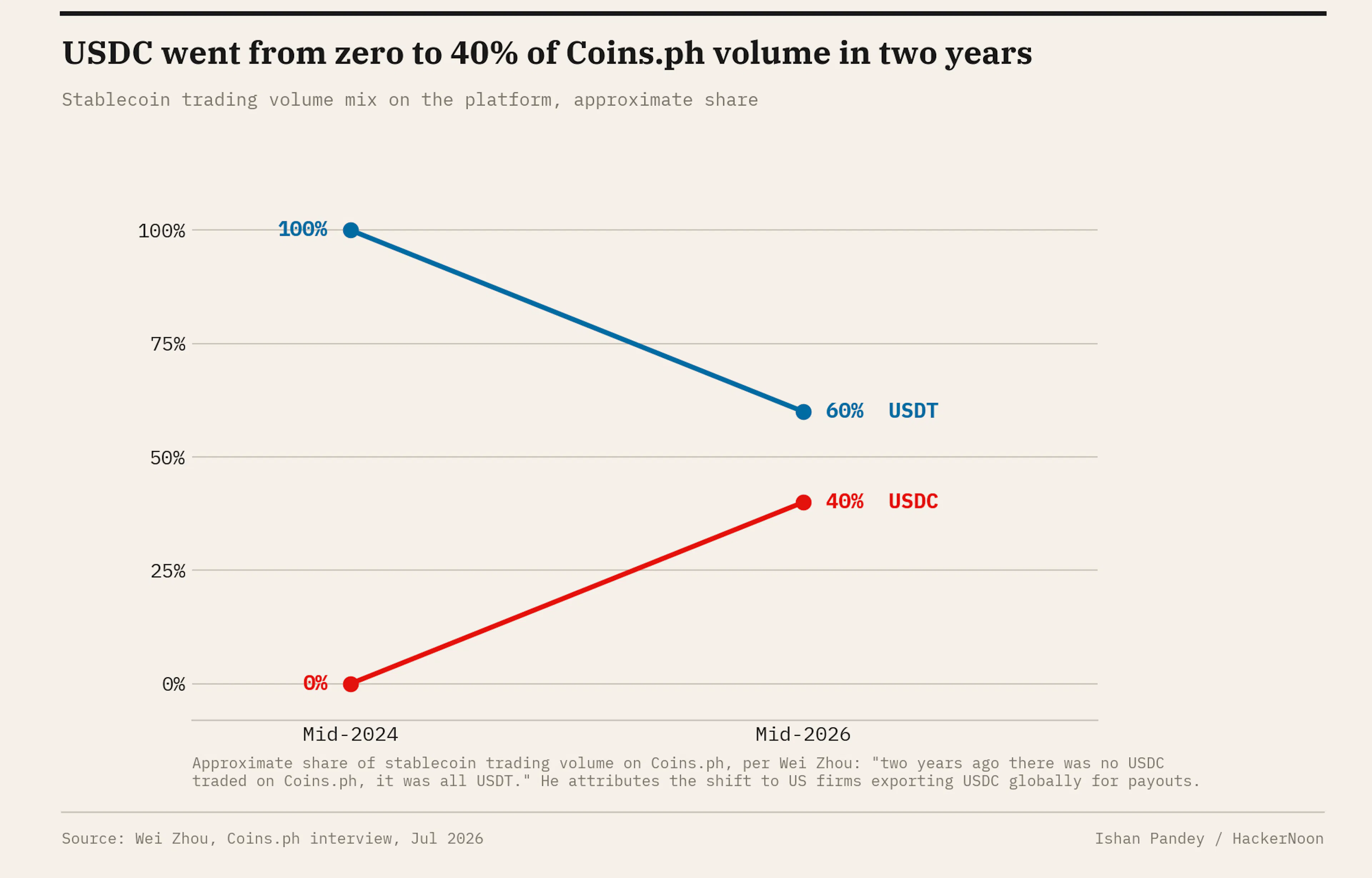
Ishan Pandey: Two years ago your stablecoin volume was essentially all USDT. What changed?
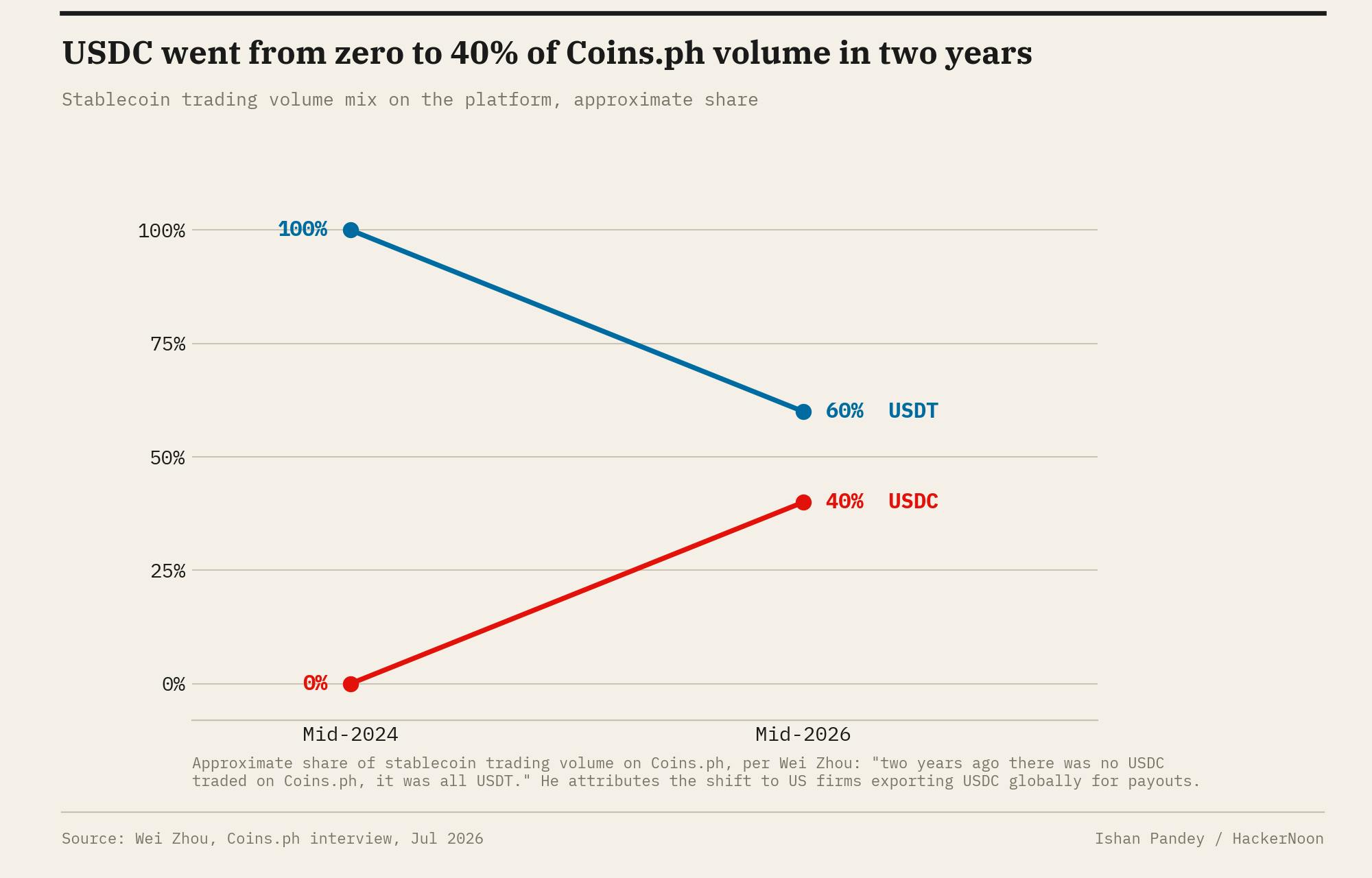
Wei Zhou: Today 40 per cent of our stablecoin trading volume is USDC. US companies, financial institutions, startups, crypto companies, are now exporting USDC on a global basis. We see American firms coming to us saying, I want to do USDC payouts in the Philippines: I send you USDC, you pay out pesos for me. That is a new business line that did not exist two years ago, and it will be true across the world. Once the US starts spending USDC everywhere, everyone has to figure out how to receive it. And in the other direction, as the US stock market runs hotter with the AI boom, people want dollar stablecoins so they can buy US stocks. The US is this giant magnet: one side pulls money in, the other side pushes money out, and the rest of the world ends up using whatever America is pushing or pulling.
Ishan Pandey: You didn't found Coins.ph, you bought it, six months before FTX collapsed. Walk me through that period.
Wei Zhou: My journey is quite unique. I got into crypto through Binance in 2018 and was CFO there for three and a half years. After I left, I came across Coins.ph. I had not visited the Philippines in fifteen or twenty years, but I knew the country's demographics from studying regional exchanges at Binance, English is the working language, and the business was attractive. We bought it in 2022, at the tail end of Covid, and literally six months later FTX happened, and things got worse and worse. We had brought in long-term investors, so we rode through it, and honestly it was good for us to rebuild everything in the tough times. We rehired the entire management team and rebuilt the entire tech stack, and by the end of 2023 we had essentially a new company: new design, new colors, new logo, new office. We went into 2024 with a new product and a lot of energy, and that is what got us to where we are today.
Ishan Pandey: What is the expansion map from here and what products come next?
Wei Zhou: On product, we hope to have a card. Cards are a very good way of giving people credit and more avenues to spend, and we have announcements coming with a major card program. Geographically, it is about countries with sensible, usable regulation. We launched in Brazil last year; it is attractive on size, on the commerce flowing in and out, and the retail market has real similarities with the Philippines.
Latin America is a focus with Brazil at the forefront, and we are looking carefully at Africa, though it is challenging. South Asia is very interesting: India is the biggest remittance country in the world, Pakistan is high on the list, the Philippines is number four, so the shape of the problem is familiar. There we are product experts rather than regional experts, so we want local partners who can take what we have built in stablecoin remittance and deploy it. The pricing difference is demonstrable: corridors that cost 2 to 4 per cent, we can get down to 20 to 40 basis points.
Ishan Pandey: Rank the market's maturity for me. The joke used to be that crypto was flip-flops and now it's suits.
Wei Zhou: We are still going to get a lot of flip-flops, and I hope so, because that is the fun part. Things come in ebbs and flows. Right now the new wave of developers, the flip-flop wearers, are in AI, and the suits are in crypto. It has reversed. In a couple of years it will change again: the suits will all be in AI, building powered data centers and power generation, which is the boring part, and the cool part will be building applications with crypto embedded. One thesis I have is that at some point Google and Meta release their own chains. You see Robinhood doing it already for financial applications. Once you get a real developer chain from Google that embeds their AI, their cloud, and Android distribution, and maybe their own stablecoin powering the ecosystem, a Google Pay upgraded into a Google USD, that is a force multiplier.
Ishan Pandey: What is Coins.ph in three years?
Wei Zhou: A stablecoin-powered fintech. There are a lot of fintechs sitting on top of traditional rails. We want to build a global fintech that sits on stablecoin rails. That is the goal. Payments and cards first, because the number of people who need to pay is much larger than the number who want to trade with leverage, and the payments use case fits the licensing regimes actually coming out around the world. Down the road, lending, because in emerging markets like India, credit is expensive, and part of the reason is simply a lack of liquidity. If we can use stablecoins to unlock the liquidity, we can unlock lending.
Final Thoughts
The most important idea in this interview is easy to miss because it sounds so simple: stablecoins are not merely another way to send money. They are becoming a way to distribute financial products across borders. That changes the frame completely. The real contest is not over which token people prefer. It is over who can turn digital dollars into something useful at the local level: pesos in an account, a remittance received on Sunday, access to credit, or the ability to buy an asset that was previously out of reach.
Zhou’s strongest evidence is operational rather than theoretical. Banks may still offer the best foreign-exchange pricing during normal hours, but they stop quoting when the market closes. Stablecoin markets do not. That gap matters because remittances, payouts and commerce do not pause for weekends. The value is not that blockchain is faster in the abstract. It is that someone can still get an executable price when the traditional system has gone offline.
The rise of USDC on Coins.ph adds another layer. Stablecoins are often described as something emerging markets pull in because local financial systems are expensive or incomplete. Zhou’s data suggests the flow now runs both ways. American companies are pushing stablecoin-based payments outward, and local markets are being forced to build the infrastructure to receive them.
That is why his port metaphor works. A blockchain can move money across the world, but movement alone is not adoption. The money still has to land somewhere. It has to be exchanged, priced, regulated and connected to ordinary life. The next phase of stablecoins will be decided less by slogans about financial freedom and more by liquidity at 3 a.m., licensing in difficult markets and whether digital dollars can arrive as something people can actually use.
Don't forget to like and share the story!
Vested Interest Disclosure: HackerNoon has reviewed the report for quality, but the claims herein belong to the author. #DYOR.
如有侵权请联系:admin#unsafe.sh