The current design of the MCP session model assumes tool invocations which live only for a limited a 2026-8-3 16:14:57 Author: hackernoon.com(查看原文) 阅读量:10 收藏
The current design of the MCP session model assumes tool invocations which live only for a limited amount of time. A stateless approach is needed to solve issues which occur due to long-running agents which operate via distributed architecture.
Consider a case where an agent has been running for six hours – it queries databases, invokes APIs, waits for the results from a background process, and survives a network interruption. There is no problem with the state of this agent itself, but one of the MCP servers which the agent connects to has just restarted 20 minutes ago.
The problem: one session, four interpretations
Currently, MCP (spec 2025-11-25) starts each client/server interaction with an initialize handshake. The server may provide an MCP-Session-Id, which the client is supposed to include in all further requests. When the server closes that session, the client receives a 404 response and is forced to start the process a new session.
Here lies the problem: the term "session" acquires at least four distinct interpretations:
- Transport session (bound to a connection)
- Negotiation session (protocol version, capabilities)
- Application session (browser context, database connection, shopping cart)
- Agent session (task/interaction)
These sessions have quite disparate lifespans — the transport session can last just a few seconds, while an application session might require several hours, and an agent task may take days. MCP makes them use the same lifecycle mechanism. Moreover, the clients do not have a consistent definition of session scope: some define it per-tool invocation, others per-app startup, still others per-page load. Very few support session recovery after the restart.
Why this specifically hurts long-running agents
- Server crashes become agent crashes. If the session state is held in the memory of one of the instances, then failure of the instance causes the agent to disconnect, re-negotiate, and somehow recover the application state of the old session.
- Horizontal scaling becomes difficult. A stateful session binds the client to one particular replica, requiring developers to hack in sticky sessions, distributed session state stores, or custom gateways just to get any form of horizontal scaling
- The agent state diverges from the protocol state. While a reliable agent framework would allow developers to checkpoint and recover the state of tasks running within the agent, the MCP session ID would be left outside of this process, resulting in two distinct state recovery frameworks.
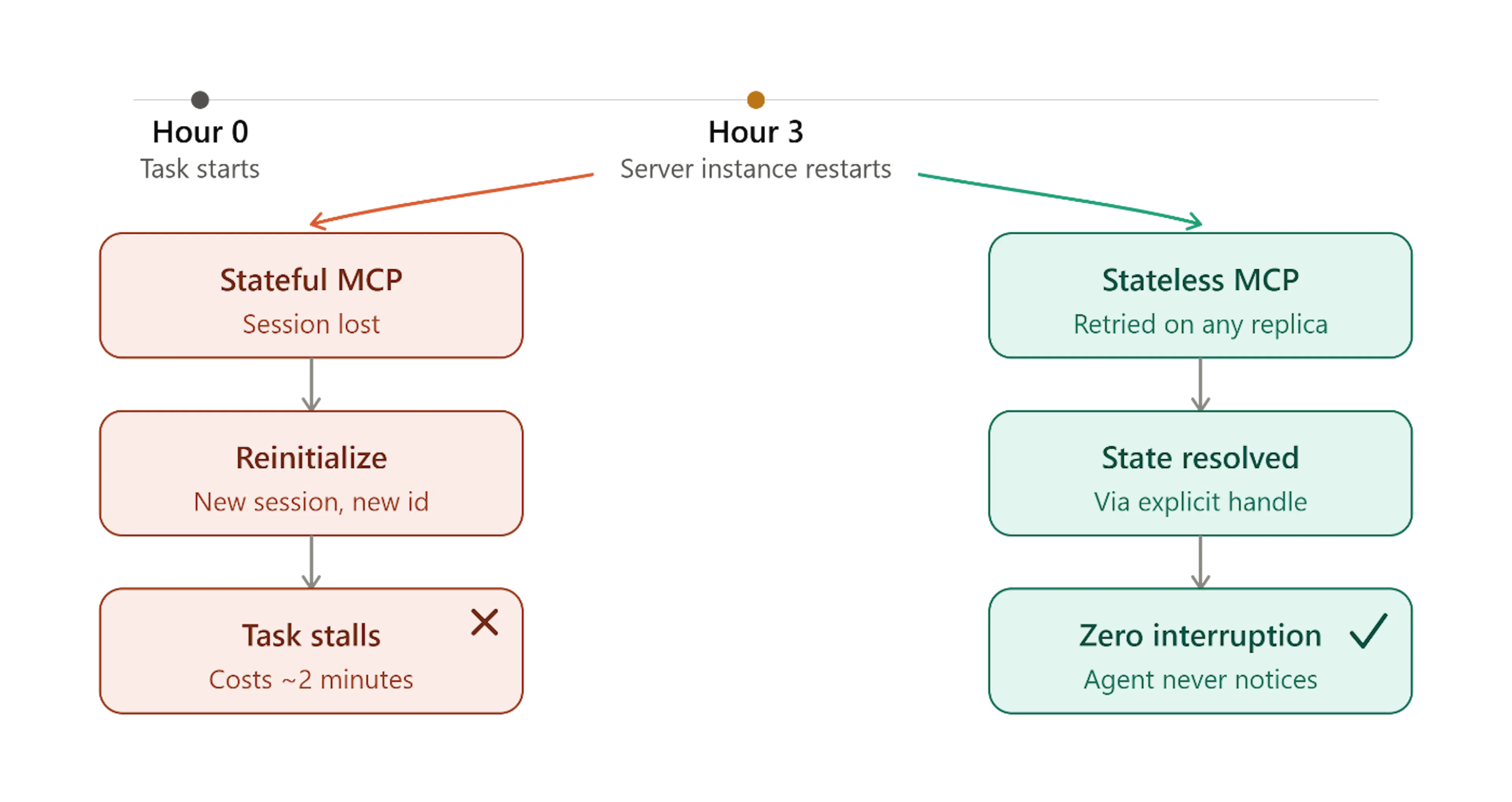 Stateless MCP Depiction with Long Running Agents
The true meaning of “Stateless”
Not that servers can’t keep anything – that servers don’t require data from previous interactions in order to understand the request being made. Every request must either contain all data necessary for its processing or explicitly state the application state.
This is formally specified by two SEPs:
- SEP-2575 (Make MCP Stateless): eliminates the initialization handshake; the negotiation data (protocol version, client name, client capabilities) is carried along in each request.
- SEP-2567 (Sessionless MCP via Explicit State Handles): eliminates the
MCP-Session-Idheader altogether.
Both of these are in the draft specification. The live specification is still 2025-11-25 — this is a breaking change designed for a future version, not one to expect from today’s clients.
A client that wishes to look at a server before calling it can do so via a new RPC called server/discover it is an optional RPC, not a required handshake. “Pay as you go”: simple calls are simple.
Session transforms into Explicit State Handles
Now, when the tool really does need some state between calls, it explicitly provides a handle which is passed by the client, instead of using an implicit session behind the scenes.
connect_database() → { "connection_id": "conn_8Kp31..." }
query(connection_id: "conn_8Kp31...", sql: "SELECT ...")
close_database(connection_id: "conn_8Kp31...")
And for agents, here comes the true benefit:
- The handle may reside within the agent's personal checkpoint, surviving any client restart.
- The handle may intentionally be passed to another agent.
- There could be several different scopes, rather than just one implicit session.
- Any server replica may handle the request, as long as handles are resolved via shared storage.
The one catch: agent platforms need to preserve live handles during context compaction, or the server-side state they point to becomes orphaned.
The operational BENEFIT
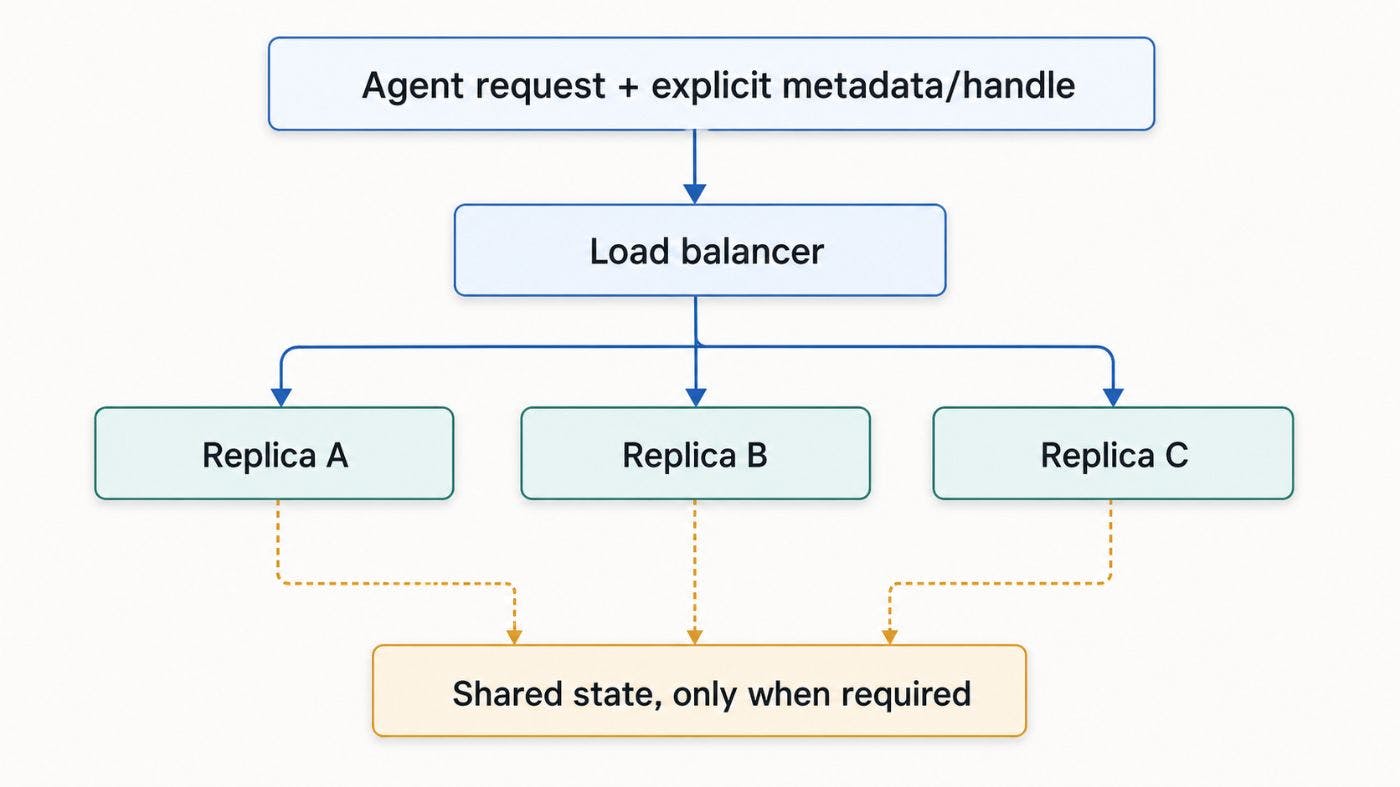
Instead of routing each request to the single replica responsible for the session, a stateless request can be sent to any live replica:
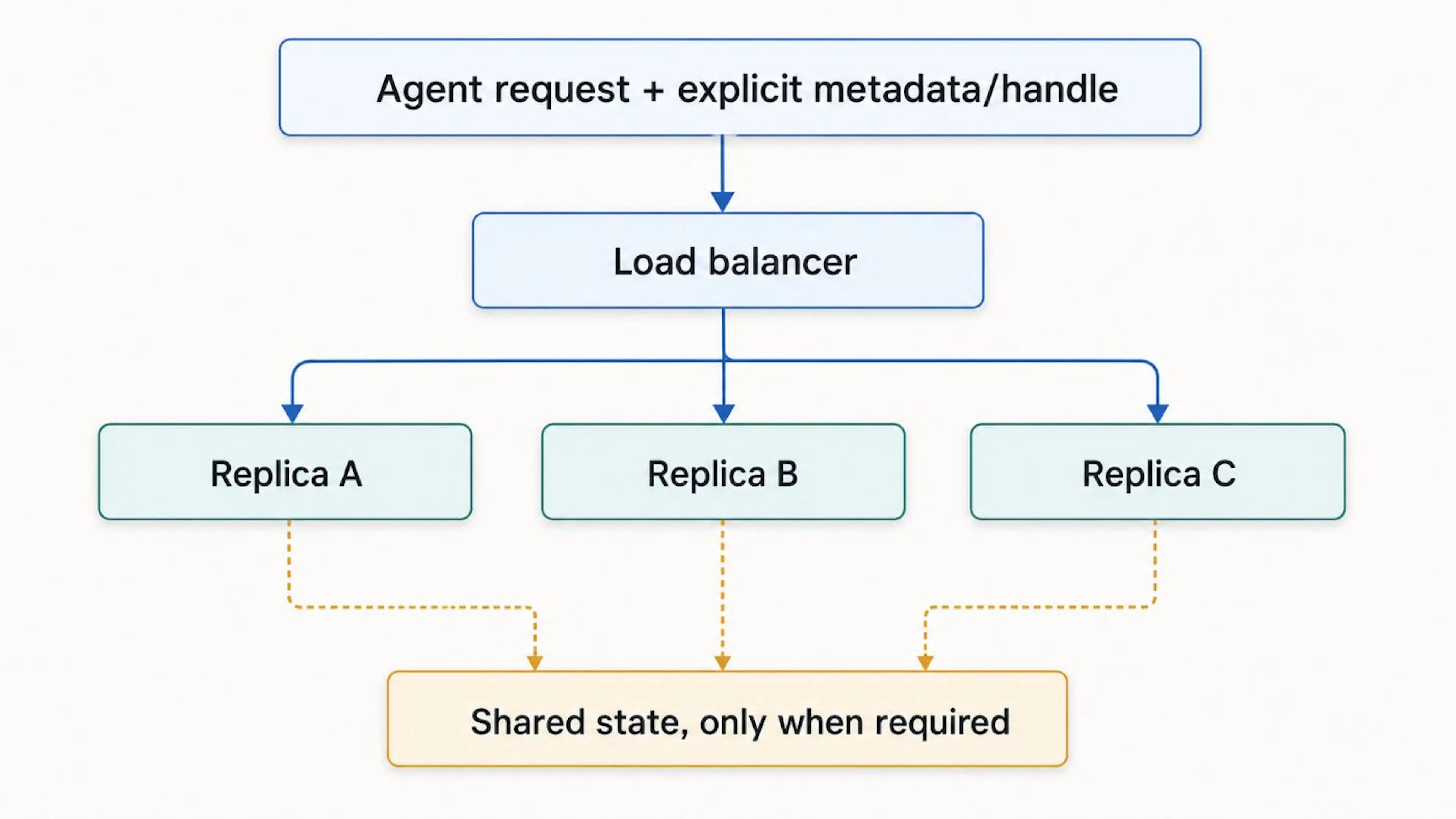 MCP Shared State Inner Workings - Explained
That gives you:
- Horizontally scalable without the overhead of migrating sessions
- Faster failure recovery — there is no need to renegotiate before the next request
- Simpler gateways and serverless services because sticky routing is not necessary anymore in scale-to-zero setups
- Improved caching —
tools/listand similar responses will not vary per session, which is critical for multi-agent setups where currently each sub-agent is forced to fetch the tool definition on every session
Trade-offs worth knowing
-
More metadata is added to the request.
-
There has to be a mechanism of maintaining backward/forward compatibility when moving from the old client side to the new one.
-
Handles have to receive full security treatment: the authenticated server has to verify both the handle and the caller's identity each time; for the unauthenticated server, the handle is essentially a bearer token that needs proper randomness, TTLs, and cleanup.
Agent needs to handle these securely while summarizing or passing control.
The takeaway
Agent owns the workflow. MCP delivers the requests. Tools own application resources. The real power of the stateless MCP comes from its unwillingness to allow those three lifecycles to converge into one fragile session. This assumption becomes false once agents start living for hours rather than seconds.
如有侵权请联系:admin#unsafe.sh