Every large building you have ever walked into was designed twice. An architect designed the part yo 2026-7-31 22:31:29 Author: hackernoon.com(查看原文) 阅读量:24 收藏
Every large building you have ever walked into was designed twice. An architect designed the part you can see, the shape and the rooms and the light. Then a second, far less famous group of engineers designed the part you cannot see: where every wire runs, where every outlet, vent, pipe, fire alarm and light fixture goes, how much power each floor draws and how all of it complies with building codes.
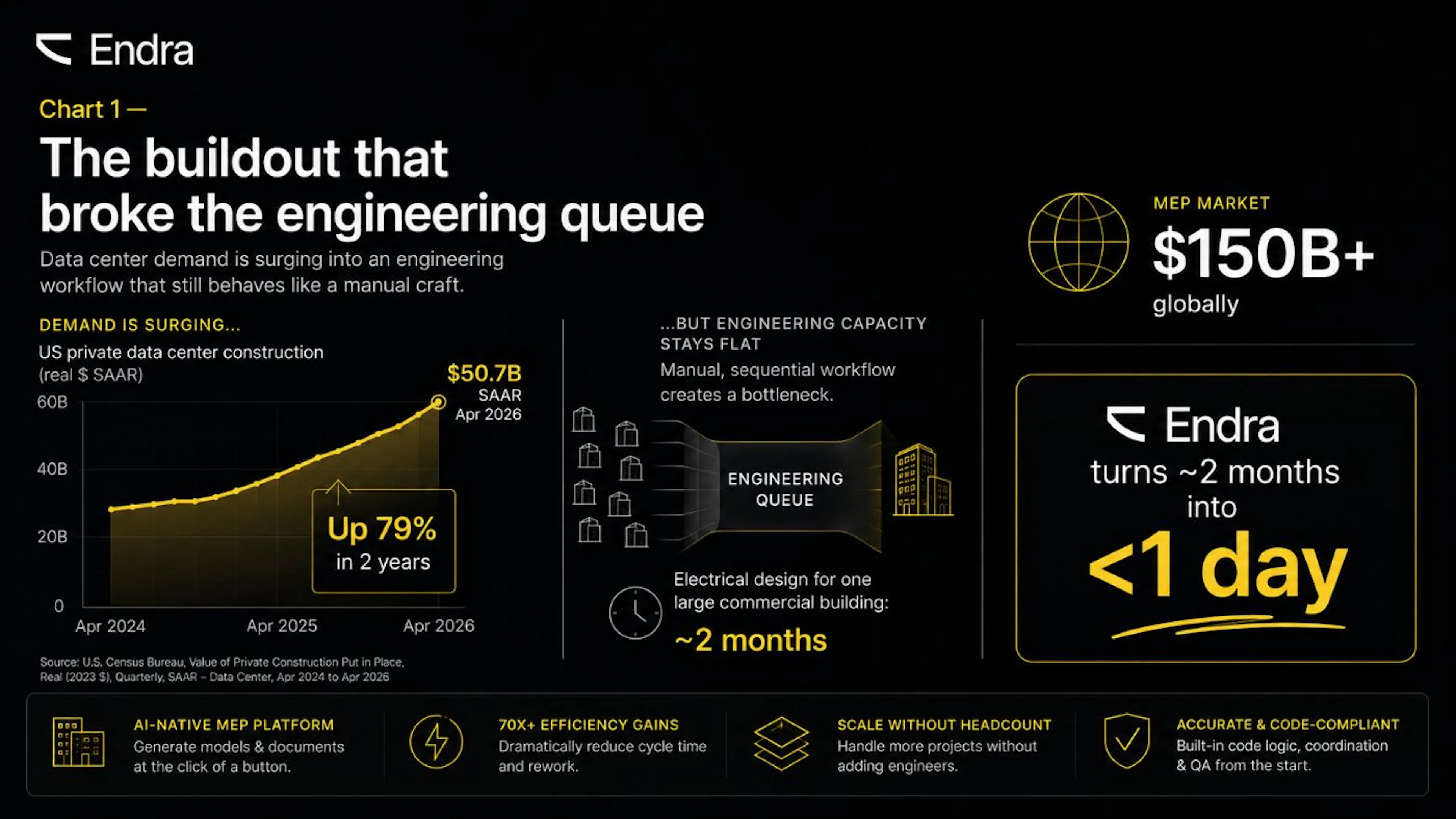
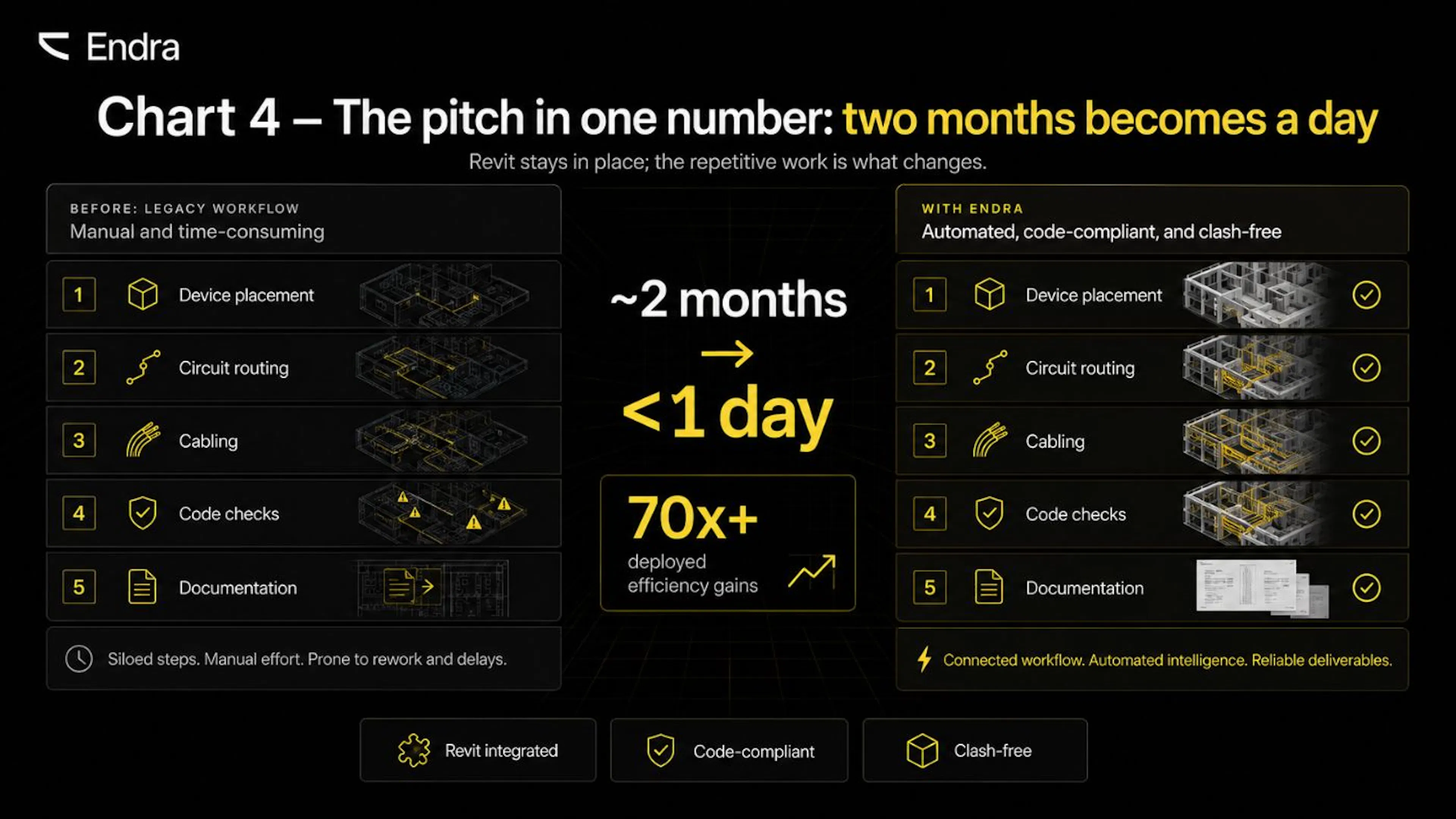
This second discipline is called MEP engineering, short for mechanical, electrical and plumbing and nothing gets built without it. The global market for this work exceeds $150 billion a year, it typically absorbs one to five per cent of the cost of every building on earth and it remains stubbornly manual. A skilled engineer places devices and routes circuits room by room, floor by floor, checks each decision against code and can spend two months producing the electrical design for a single large commercial building, before starting nearly from scratch on the next one.
Endra was built on the observation that most of this work is repetition wearing the costume of expertise. The Stockholm company's platform ingests the standard 3D model files that architects already produce, integrates with Revit, the industry's dominant design tool, rebuilds the building in a detailed 3D environment and then automatically generates the systems inside it: device placement, circuit routing, cabling, documentation, all of it code-compliant and clash-free. The two-month electrical design becomes a task of less than a day and in deployed projects the company reports efficiency gains above 70x. Fresh off a $50 million Series A led by Andreessen Horowitz, with Notion Capital and Norrsken VC participating, Endra is now planting its flag in the world's largest construction market, with a North American headquarters in New York, a West Coast office in San Francisco and a London office serving Europe and the Middle East.
 The buildout that broke the engineering queue
The pitch is unusual for a construction technology company in 2026, because it contains no promise to change how engineers work. Endra does not ask firms to abandon Revit, retrain their staff, or adopt a new workflow religion. It ingests the files they already have, automates the parts of the job nobody went to engineering school to do and hands back deliverables in the formats their clients already expect. The claim underneath is about capacity rather than convenience. Engineering firms cannot hire their way out of the current backlog, so the product sells them the one thing the labor market cannot: more throughput per engineer they already employ.
The Most Expensive Queue in Construction
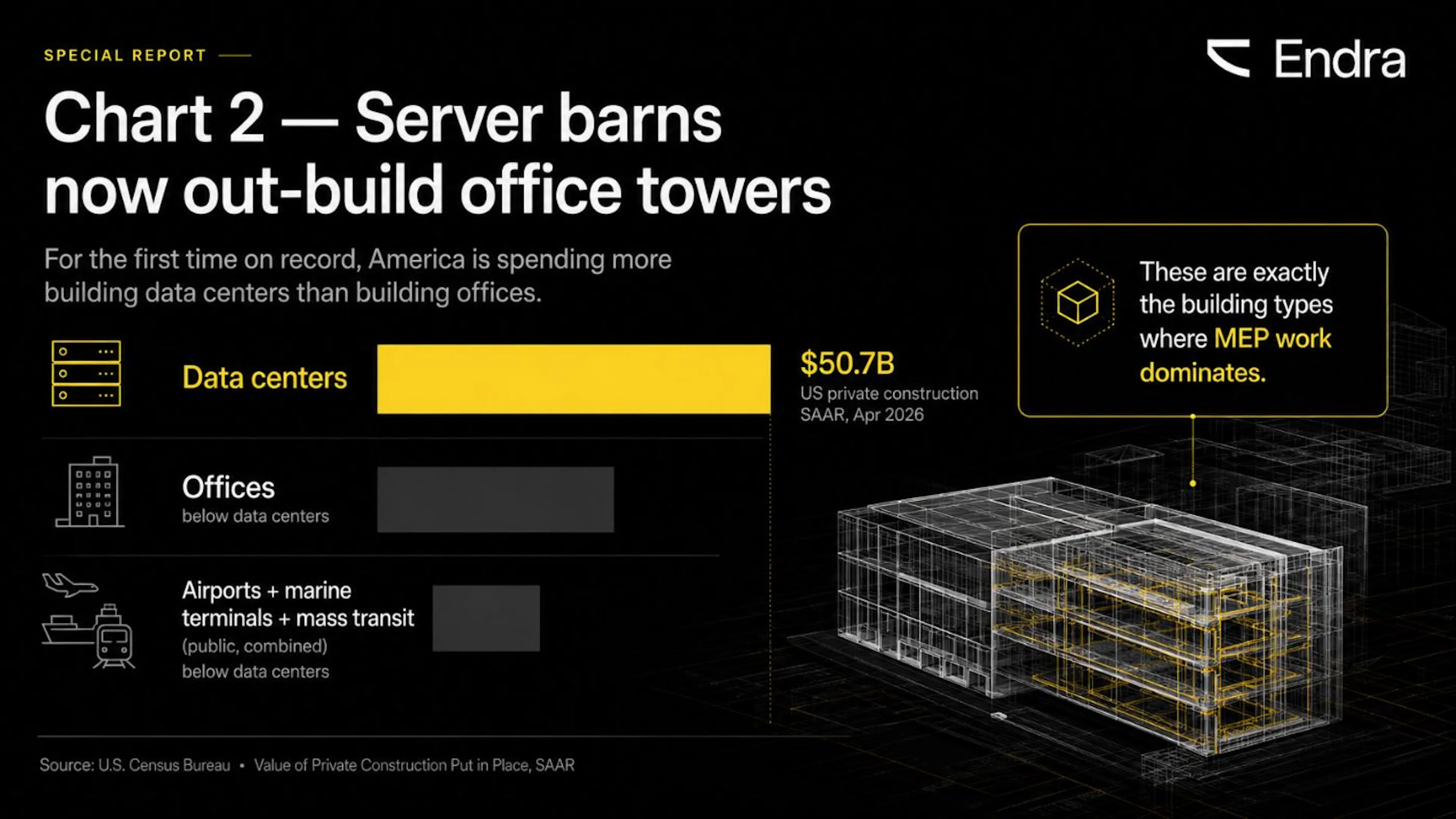
The macro numbers explain why a Swedish design startup suddenly needs three offices in two English-speaking countries. US private data center construction reached a seasonally adjusted annual rate of $50.7 billion in April 2026, according to Census Bureau data, up 79 per cent in two years. For the first time on record, America now spends more building data centers than building offices and more than it spends publicly on airports, marine terminals and mass transit combined. These are precisely the buildings that MEP engineering dominates, because a data center is, in essence, a building-sized electrical and cooling system with some walls around it. Notion Capital estimated at Endra's seed round that data center construction alone is adding roughly $100 billion in annual spending across the US and Europe.
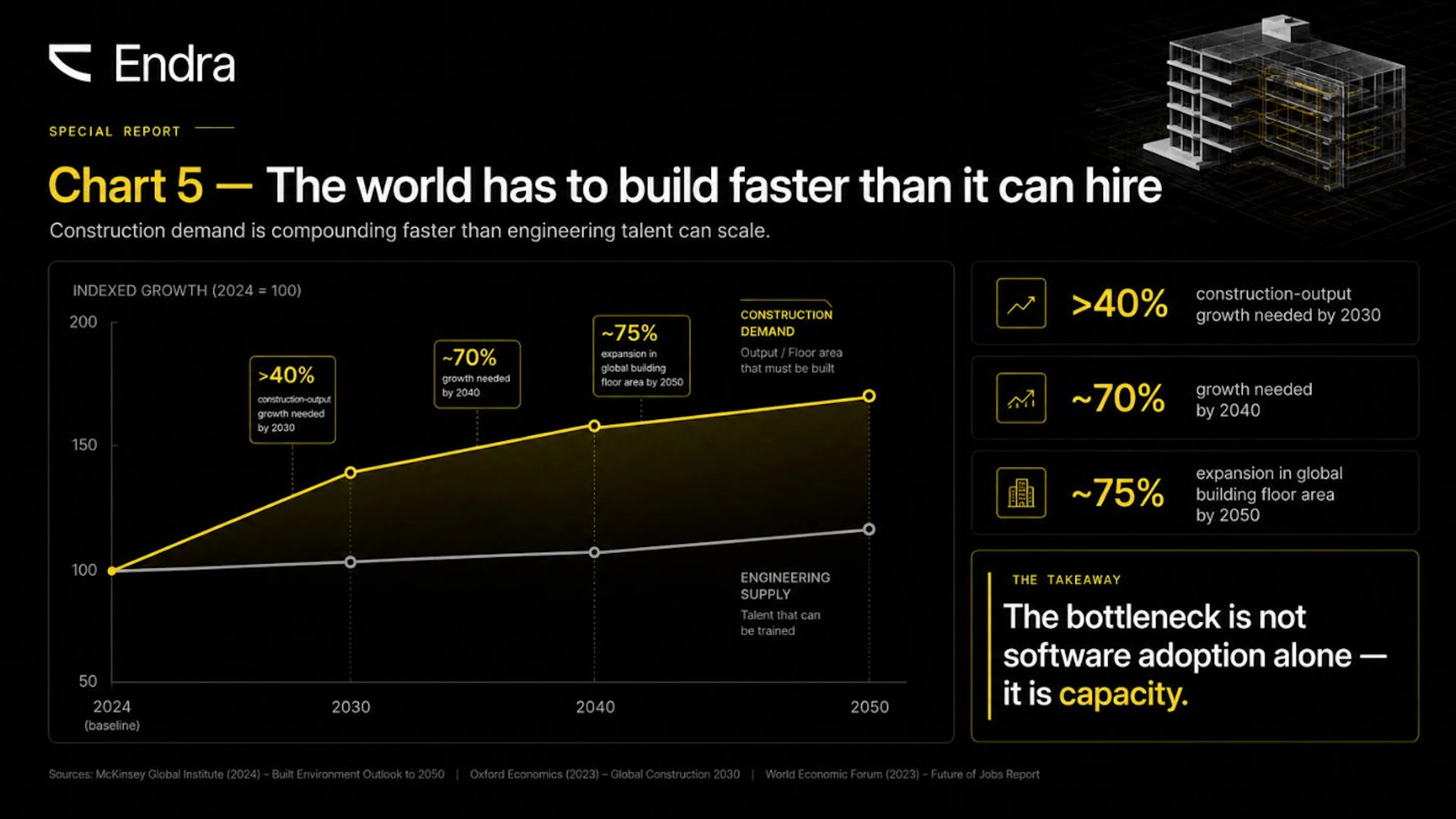
The demand curve then collides with a supply curve that is not moving. Industry estimates cited at Endra's seed suggest global construction output needs to grow more than 40 per cent by 2030 and close to 70 per cent by 2040 to meet projected demand, while the International Energy Agency projects global building floor area expanding roughly 75 per cent by 2050. The engineers who must design all of that do not exist and the industry cannot train them fast enough. The software they use has not rescued them either, because the last structural change in this industry's tooling was the arrival of Revit in the early 2000s, a quarter-century ago. Revit digitized the drawing. It never touched the thinking and the thinking is where the two months go.
Founder-Market Fit, Measured in Capital Velocity
The speed of Endra's rise is unusual even by the standards of the current AI cycle and the sequence is worth laying out precisely because each round was priced by people who had watched the previous one convert. The company was founded in October 2024 by Niklas Lindgren and Anton Juric on the commercial side, with David Rydberg and Gustav Hammarlund as technical co-founders. It raised a 3 million euro pre-seed in May 2025, onboarded its first customers in August 2025 and by December had more than 600 companies across 90-plus countries on its waitlist. That demand closed a $20 million seed led by Notion Capital in December 2025, which Lindgren described as the largest seed round ever raised by a Swedish company. Six months later Andreessen Horowitz led the $50 million Series A, with both earlier institutional investors returning, bringing the total to roughly $74 million inside two years of incorporation.
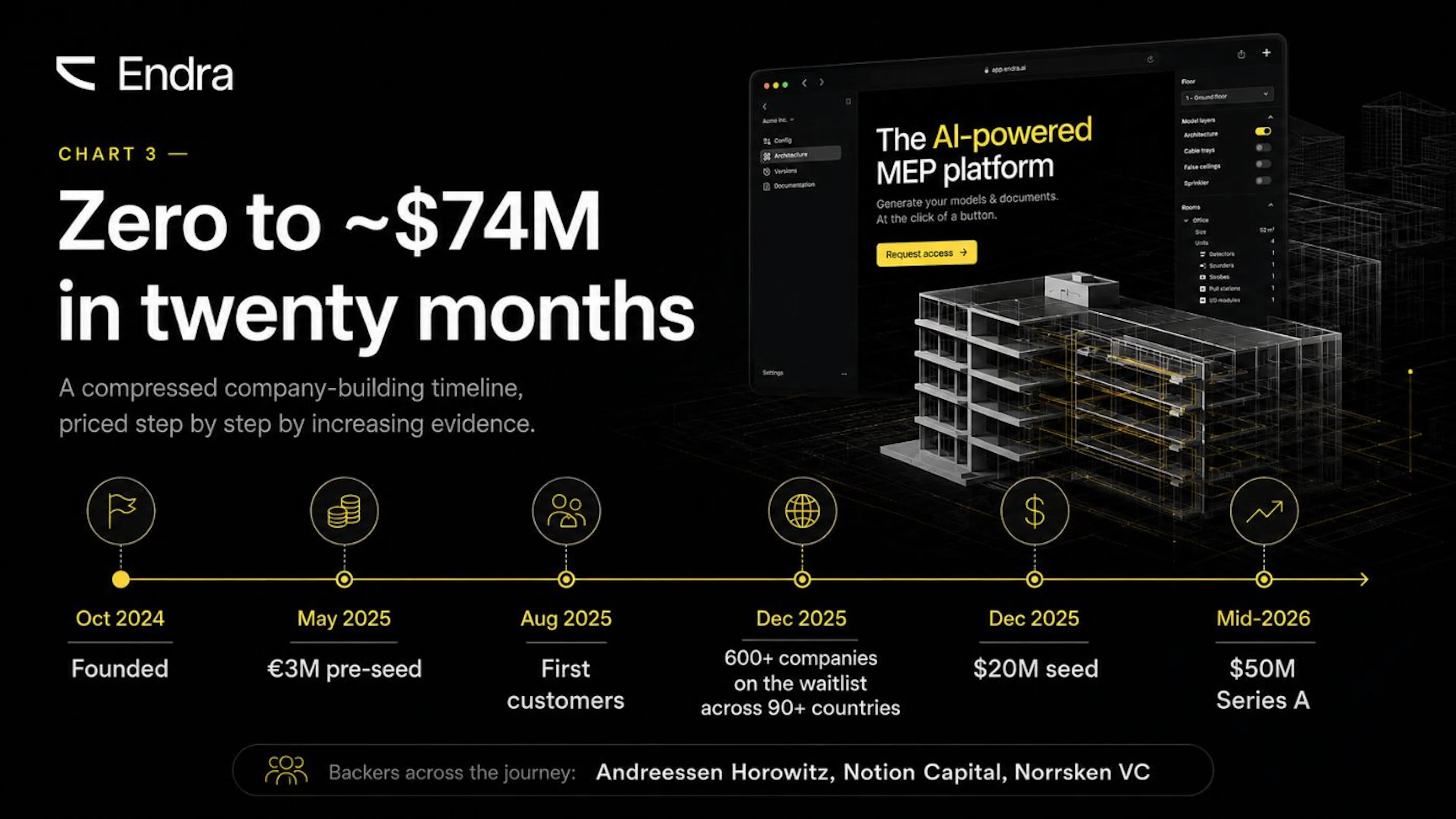
Two details in that sequence carry more analytical weight than the headline numbers. The first is that Notion and Norrsken did not merely return for the Series A; they re-committed at each step while holding inside visibility into deployment data, which is the strongest signal available in private markets, because the investors with the most information had the least excuse to be wrong. The second is the shape of the waitlist. Six hundred firms across ninety countries, accumulated before the company had a US office, is evidence of inbound pull in an industry famous for resisting software and it reframes the expansion as a response to demand rather than a search for it.
The hiring pattern tells the same story from the talent side. The company is pacing toward 100 employees across Stockholm, New York, San Francisco and London over the next twelve months and the profile of who it recruits is instructive. Hadla Bergman joined from Einride, the Swedish autonomous freight company, to lead the unglamorous work that decides whether this product travels: making the platform native to American and British building codes, standards and design workflows. A company that treats code localization as a destination for its best engineers, rather than as an afterthought for its support team, has correctly identified where products like this one usually die.
The Co-Founder: Enterprise Trust Is Won in the Room
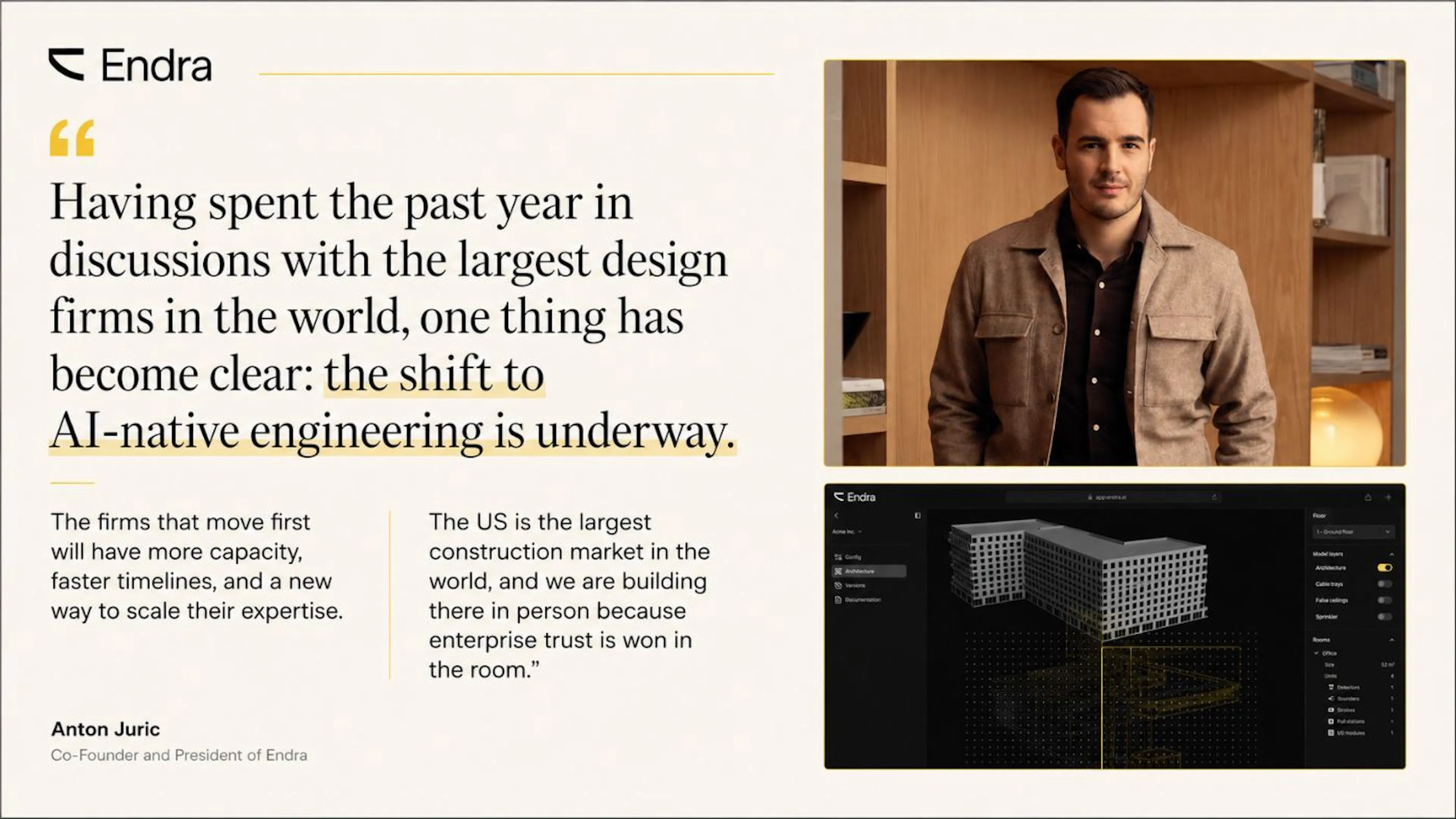
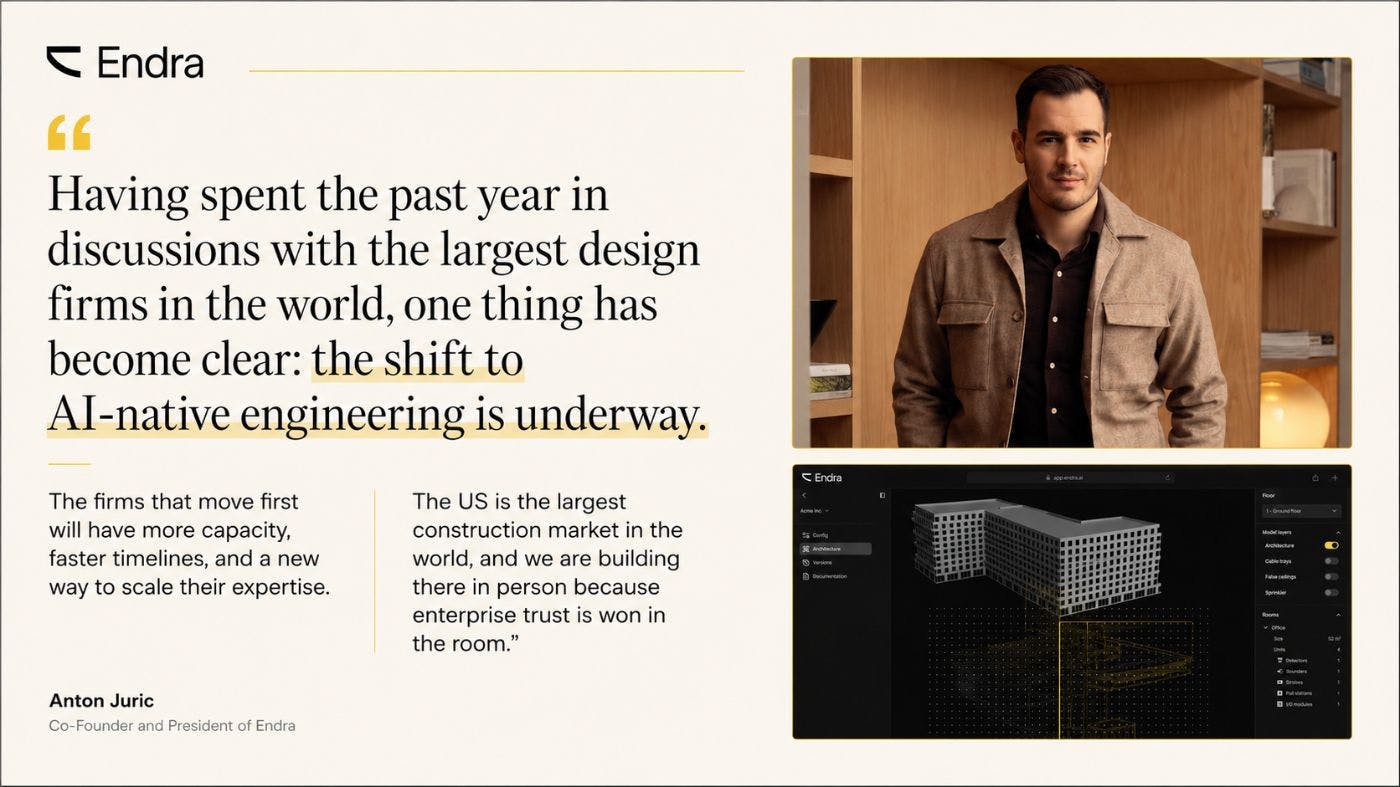
Juric's argument is that the shift to AI-native engineering is already underway among the world's largest design firms and that the winners will be the firms that move first, with more capacity, faster timelines and a new way to scale their expertise. The more revealing half of his position is the operational conclusion he draws from it, which is that the United States must be won in person. He has relocated the company's commercial center of gravity accordingly, leading the US go-to-market from New York himself, with the company already in active engagement with several of the world's largest engineering consultancies.
That choice deserves to be read as strategy rather than as travel preference. Endra sells to enterprise consultancies whose entire business is professional liability, in a discipline where a design error can shut down a hospital and firms of that kind do not adopt automation platforms off a self-serve landing page. They adopt them after long pilots, reference calls and a president who shows up. The decision to put a co-founder physically in the largest market, a year before revenue there could possibly justify it, is what conviction about enterprise sales cycles looks like on an org chart. It is also a familiar playbook executed deliberately: European technical excellence, American commercial altitude, the same sequence that carried Spotify and Klarna west, now applied to the least glamorous software category in the built world.
The Unglamorous Middle of the Stack
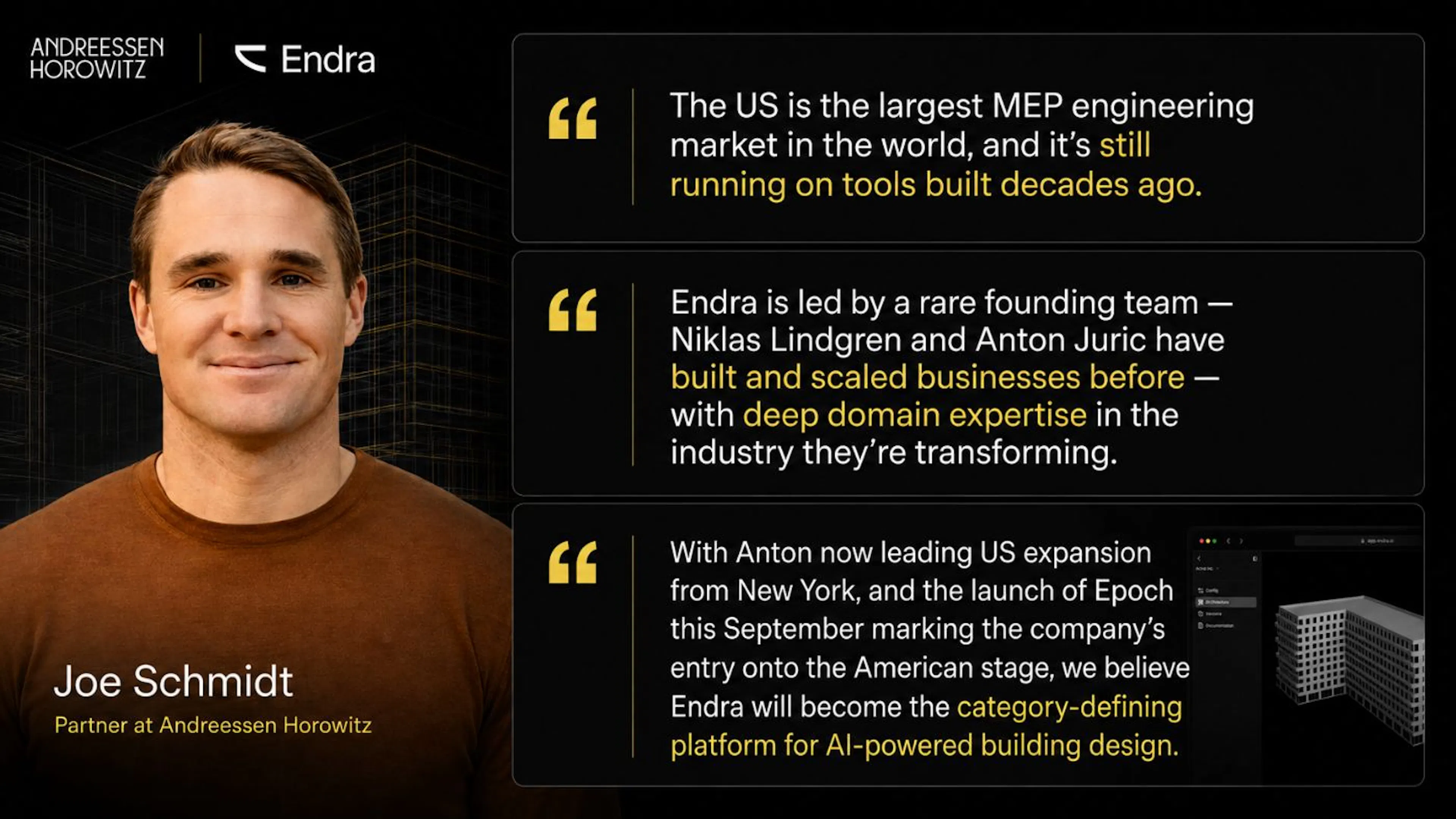
Schmidt's case for the company, rests on three claims: that the US is the largest MEP market in the world and still runs on tools built decades ago, that Lindgren and Juric are a rare founding team with both operating experience and deep domain expertise and that Epoch in September marks the company's real entry onto the American stage. The portfolio logic behind those claims is worth unpacking, because a16z does not usually spend $50 million on European vertical software at Series A.
The firm's own investment memo describes MEP work with unusual candor, as a $150 billion services market constrained by human capacity, where most of what engineers do is rote: place a fire alarm here, run a circuit there, check it against code, floor by floor, project after project. That framing places Endra inside the thesis a16z has been assembling across the physical economy, that the largest AI outcomes will come from automating expensive professional labor rather than from selling another productivity tool and it explains why the check went to the unglamorous middle of the construction stack rather than to its photogenic edges.
Notion Capital, a specialist in European B2B software, led the seed and returned; Norrsken VC, the sustainability fund built by Klarna's co-founder, has been present since the earliest days and returned twice; and the American generalist arrived only once deployment data existed. Capital of increasing ambition, each tranche priced by the previous tranche's evidence, is what a genuine progression looks like, as opposed to a narrative funding itself.
What Has to Go Right
Honest analysis requires naming the hard parts and Endra has four worth naming. The first is liability, which is the quiet governor on every automation claim in this industry. MEP designs are stamped by licensed engineers who carry professional responsibility for them and no AI platform removes that signature. Endra's commercial ceiling depends on senior engineers trusting its output enough to stamp it after review rather than redoing it and that trust is built project by project, jurisdiction by jurisdiction. The two-month-to-one-day claim is a demonstration number until the firms carrying the liability say it survives their review process at scale.
The second is localization, which is where global ambitions in this category historically stall. Building codes differ by country, by state and sometimes by city and a platform trained to Swedish standards earns nothing in Texas. The company knows this, which is why the Bergman hire and the US-native engineering effort exist, but the work is a grind measured in years and the twelve-month sprint to three new offices assumes it goes well.
The third is the incumbent question. Endra's strategy of integrating with Revit rather than replacing it is commercially wise and structurally delicate, because it builds a business on top of a platform owned by Autodesk, a company with every incentive to add generative design to its own product and the distribution to push it to every customer overnight. Endra's defense must be speed and depth in a niche the giant treats as one feature among hundreds, which is a real defense, but one that requires never slowing down.
The fourth is the burn math. Roughly $74 million is generous by European standards and modest against the plan it must fund: four offices on three fronts, a hiring sprint toward 100 people, a Las Vegas launch event with a chess grandmaster on the speaker list and enterprise sales cycles that routinely run a year. The Series B that follows will be priced on US logo announcements and expansion revenue, not on the elegance of the automation and the clock on those proof points started the day the New York office opened.
Final Thoughts
The most valuable software companies of the past two decades were built where a large pool of professional labor performed repetitive work inside a market everyone considered too boring to disrupt. The engineers who decide where every wire and pipe in the world goes have been performing exactly that work, with tools that last changed a quarter-century ago, while the buildings they design became the scarcest resource of the AI economy. Endra's wager is that the bottleneck is now expensive enough and the technology now capable enough, for the boring middle of construction to produce a category-defining company.
Expansion stories are easy to tell and hard to interpret, but this one comes with an unusually clean test and it has a date attached. Epoch on September 14 is where the electrical module ships to the American market and the eighteen months that follow will show either named US consultancy logos and measured design-time reductions on live projects, or they will not. In a construction technology market that has spent a decade rewarding pilots that never convert, a company that puts its product launch, its president and its credibility in the same room, on the record, is making the kind of commitment that is expensive to fake and that is the most honest thing about this expansion.
Don't forget to like and share the story!
Vested Interest Disclosure: HackerNoon has reviewed the report for quality, but the claims herein belong to the author. #DYOR.
如有侵权请联系:admin#unsafe.sh