The cover image on this article was not made by me clicking a button. I typed a description of the s 2026-7-31 07:4:34 Author: hackernoon.com(查看原文) 阅读量:17 收藏
The cover image on this article was not made by me clicking a button. I typed a description of the shot I wanted into a chat window, an agent picked the model, set the resolution, fired the generation, and handed back a file. No dashboard, no export menu, no manual upload. That is what people mean in 2026 when they say an AI agent can “automate video generation,” and if you have never tried it, it is worth knowing exactly what it does and does not do before you hand it your production.
Automating AI video generation with an agent means connecting a chat-based AI to a video model through a protocol called MCP, then describing shots in plain language instead of clicking through a generator’s interface by hand. The agent handles model selection, parameter setup, batch requests, and file retrieval. It does not handle whether the shot is any good.
What Is an AI Agent Actually Doing When It Generates Your Video?
MCP stands for Model Context Protocol. Anthropic introduced it on November 25, 2024, as an open standard for connecting AI models to outside tools, and in December 2025 Anthropic donated it to the Agentic AI Foundation, a Linux Foundation project backed by Anthropic, Block, and OpenAI among others. The pitch is simple: instead of every AI tool needing a custom integration with every other piece of software, MCP gives them a shared plug. One side exposes a “server,” the other side is a “client” (your chat agent), and the two talk the same language.
Video platforms picked this up fast. Higgsfield runs an MCP server that, according to its own documentation, connects an agent to more than 30 video and image models, including Veo 3.1, Sora 2, Kling 3.0, and Seedance 2.0, plus the platform’s own Soul character system. You do not need an API key or a developer account. You connect the agent once, and from then on a request typed in plain English becomes a generation job: model chosen, resolution set, aspect ratio matched, output returned to the conversation.
That is the entire trick. The agent is not smarter about your film. It is faster at filling out the same form you would have filled out by hand.
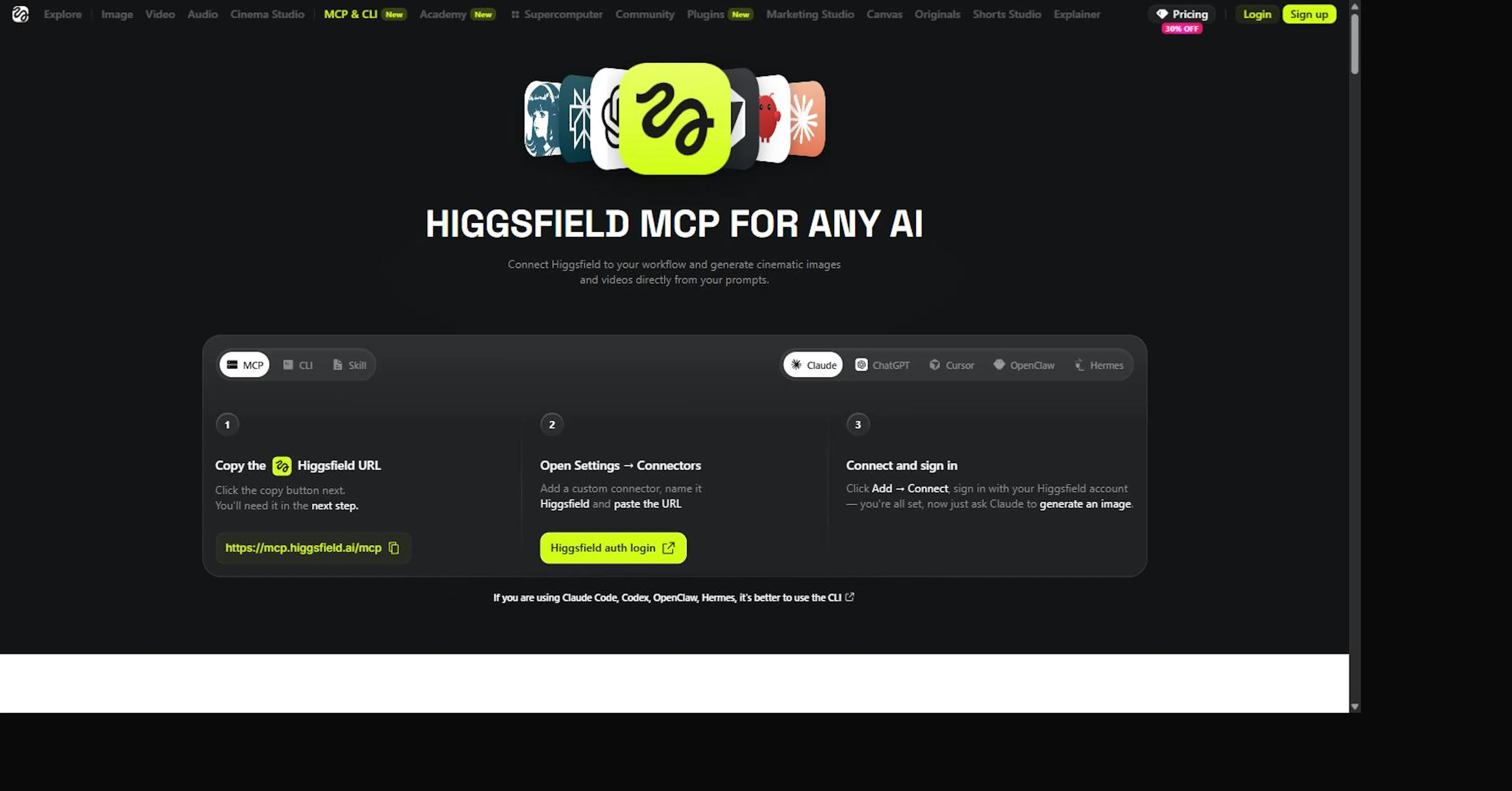 Higgsfield's MCP setup page: copy the server URL, add it as a custom connector, sign in once.
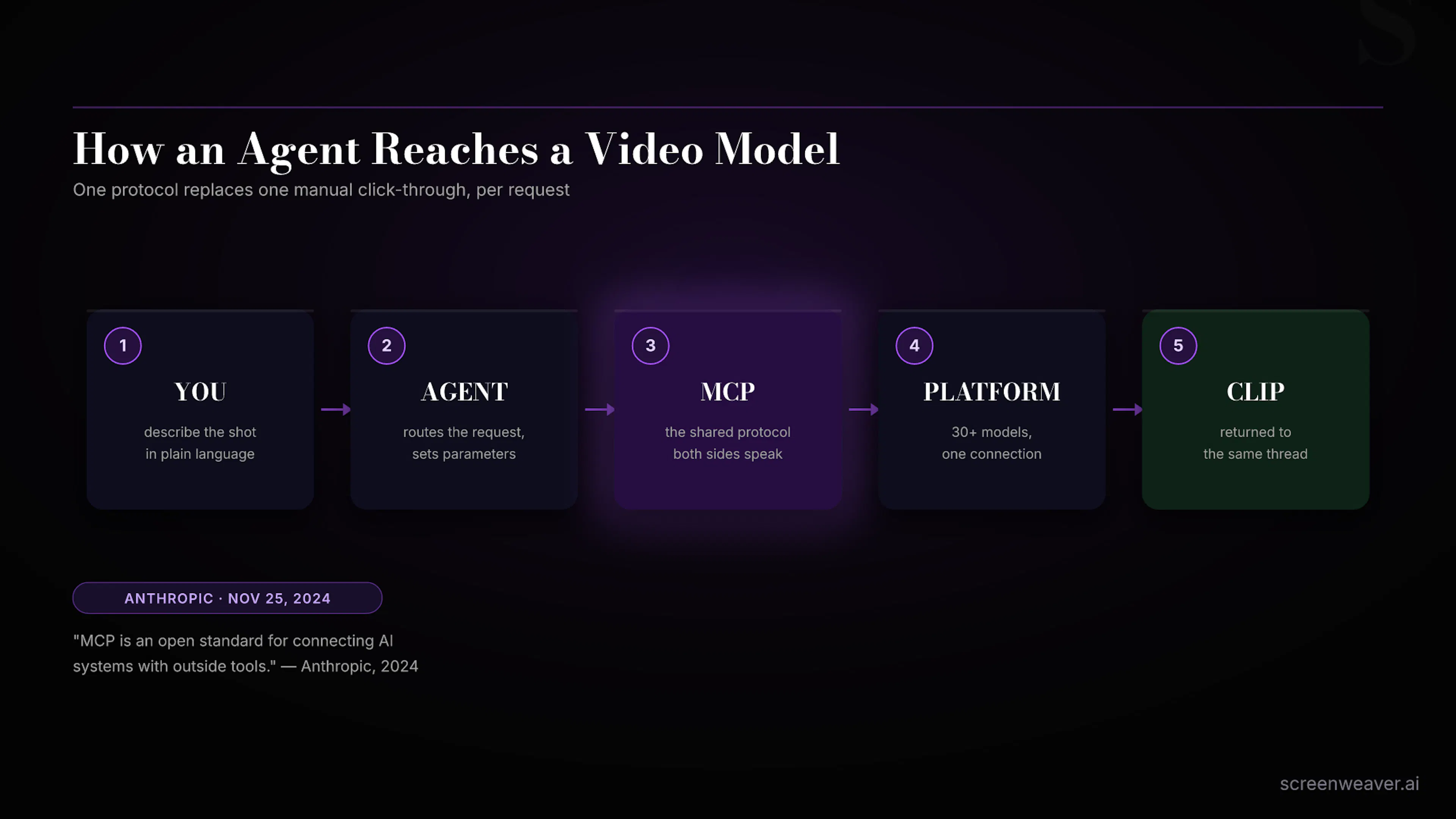 How a prompt travels from you, through an agent and MCP, to a video platform and back.
What Does an Agent Actually Automate in a Pipeline?
Once you strip away the marketing language, an agent connected through MCP is doing a small number of concrete things, repeatedly, without you touching a mouse:
- Model routing. You describe a shot; the agent picks a model that fits the request, or honors a model you named, instead of you comparing five tools’ feature pages.
- Parameter setup. Resolution, duration, aspect ratio, and format get filled in from context rather than re-entered in a form every single time.
- Batch and parallel calls. The same brief can be sent to several models at once for comparison, or fanned out into a run of variations, without repeating the click-type-wait cycle by hand.
- Retrieval and handoff. The finished file comes back into the same thread you are already working in, instead of a separate download you have to go find.
For a solo operator, that last point matters more than it sounds. A one-person crew loses real time just switching contexts: tab to the generator, wait, download, tab back, rename, drop into the project folder, tab back again. An agent collapses that into one thread. It is genuinely useful, and it is also the full extent of what it does.
What Can’t an Agent Decide For You?
Here is the part the platform pages tend to skip past. An agent will run twenty variations of a shot as fast as you can ask for them. It has no opinion about which of the twenty is right for the scene.
I ran a batch of options for a corridor shot in Lost Garden, my AI-animated series, the same way: one brief, several models, a stack of candidates back in minutes instead of the better part of an afternoon. The generation step got dramatically faster. The actual decision, which take held the character’s expression, which one matched the shot before it, which one earned its place in the cut, still took exactly as long as it always has, because that decision was never a generation problem. It is a taste problem, and taste does not automate.
An agent will hand you the whole take pile in a fraction of the time. It still has no idea which take is the film.
This tracks with something worth saying plainly: faster generation does not mean faster filmmaking. It means the bottleneck moves. Selecting, sequencing, and deciding what a shot is for were always the expensive part of the job, long before agents existed, and none of that got automated. It just got more of your day, because the easy 80% now takes minutes instead of hours.
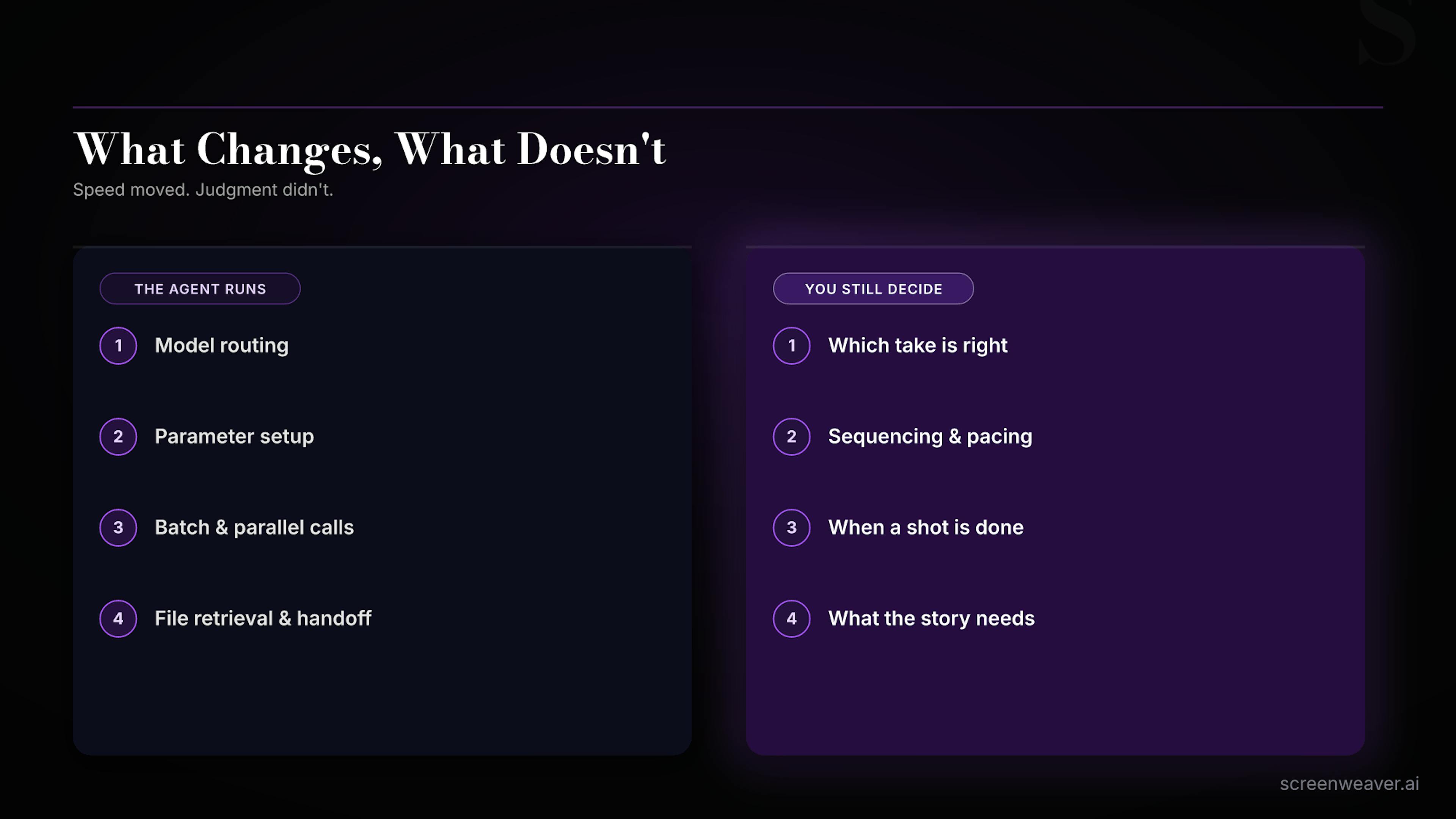
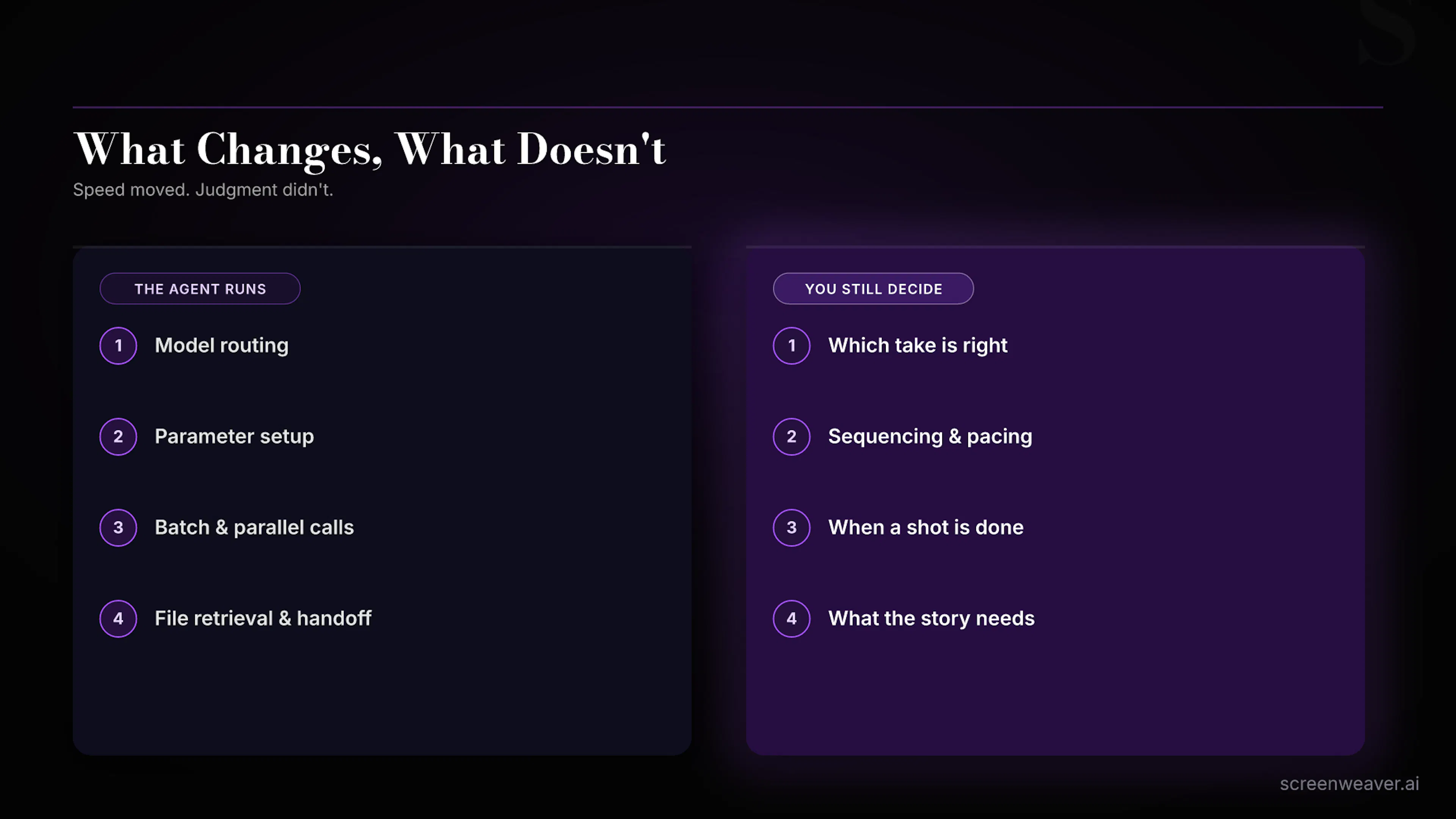 Speed moved. Judgment didn't: what the agent automates versus what you still decide.
How Do You Set This Up Without Losing Control?
If you want to try this on a real project rather than a one-off demo, a few habits keep it from turning into noise:
- Write the brief like a shot, not a wish. “Cinematic 5-second wide shot, neon alley, rain, one figure walking away from camera, handheld” gives the agent enough to route correctly. “Something cool and dark” does not.
- Name the model when consistency matters. Letting the agent pick is fine for a first pass. Once you have a look you like, specify the model so a later batch does not quietly land on something else.
- Review before you queue the next batch. It is tempting to fire five batches back to back because each one is nearly free in your own time. Resist it. Reviewing footage is still work, and stacking unreviewed batches just delays the moment you have to do that work anyway.
- Keep the plan outside the chat thread. An agent remembers what it generated in that conversation, but a project’s continuity, its character notes, its locked references, its shot list, needs a home that survives longer than one thread. That is the actual job description of a tool like ScreenWeaver: not generating the shot, but holding the plan the agent is executing against.
Worth noting the trade-off nobody markets loudly: this path is not the only door into programmatic generation, and it is currently the more open one. Runway, for comparison, moved direct API access to an Enterprise-only tier in January 2026, pricing out solo creators who want to script their own batch runs. The MCP route through a connected agent runs on the same consumer or pro credits you already have, no enterprise contract required. For now, that makes the agent path the more accessible one, not the more powerful one.
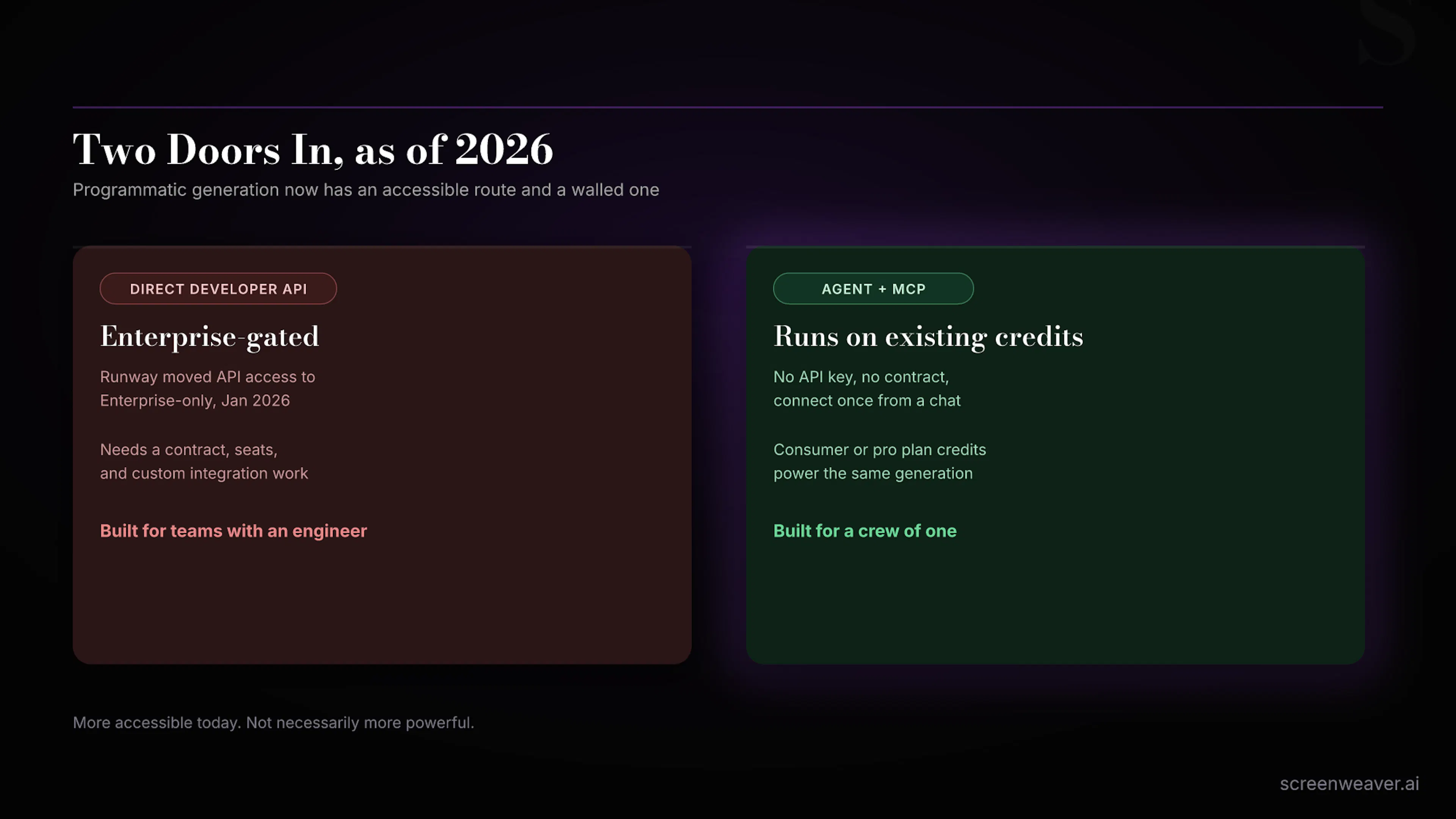 Two doors into programmatic generation in 2026: a gated direct API and an MCP-connected agent running on existing credits.
Frequently Asked Questions
Do I need to write code to use an AI agent for video generation?
No. The setup is a one-time connection between your chat agent and the platform’s MCP server. Every request after that is a plain-language description, not a script.
Does using an agent change the quality of the output?
No. The agent is not a different rendering pipeline, it is calling the same models you would reach through the platform’s own interface. What changes is speed and friction, not the underlying generation.
Can an agent replace a director or editor?
No, and this is the whole point of this piece. It replaces the clicking. Selecting the right take, sequencing shots, and deciding what a scene needs are still entirely a human call.
Is this only useful for large studios or campaigns?
No, if anything the opposite. A solo operator loses the most time to manual context-switching between tools, so collapsing that into one thread tends to help a one-person crew more, proportionally, than a team that already has someone dedicated to operating the generator.

如有侵权请联系:admin#unsafe.sh