There is no single best crypto exchange in 2026: MEXC leads on trading costs and listing speed, Coin 2026-7-30 18:15:17 Author: hackernoon.com(查看原文) 阅读量:18 收藏
There is no single
The right platform depends on where you live, what you trade, and how much fees eat into your returns.
Key Takeaways
- MEXC has the lowest verified base fees of any major exchange: 0% maker / 0.05% taker on spot and 0% / 0.02% on futures (July 27, 2026).
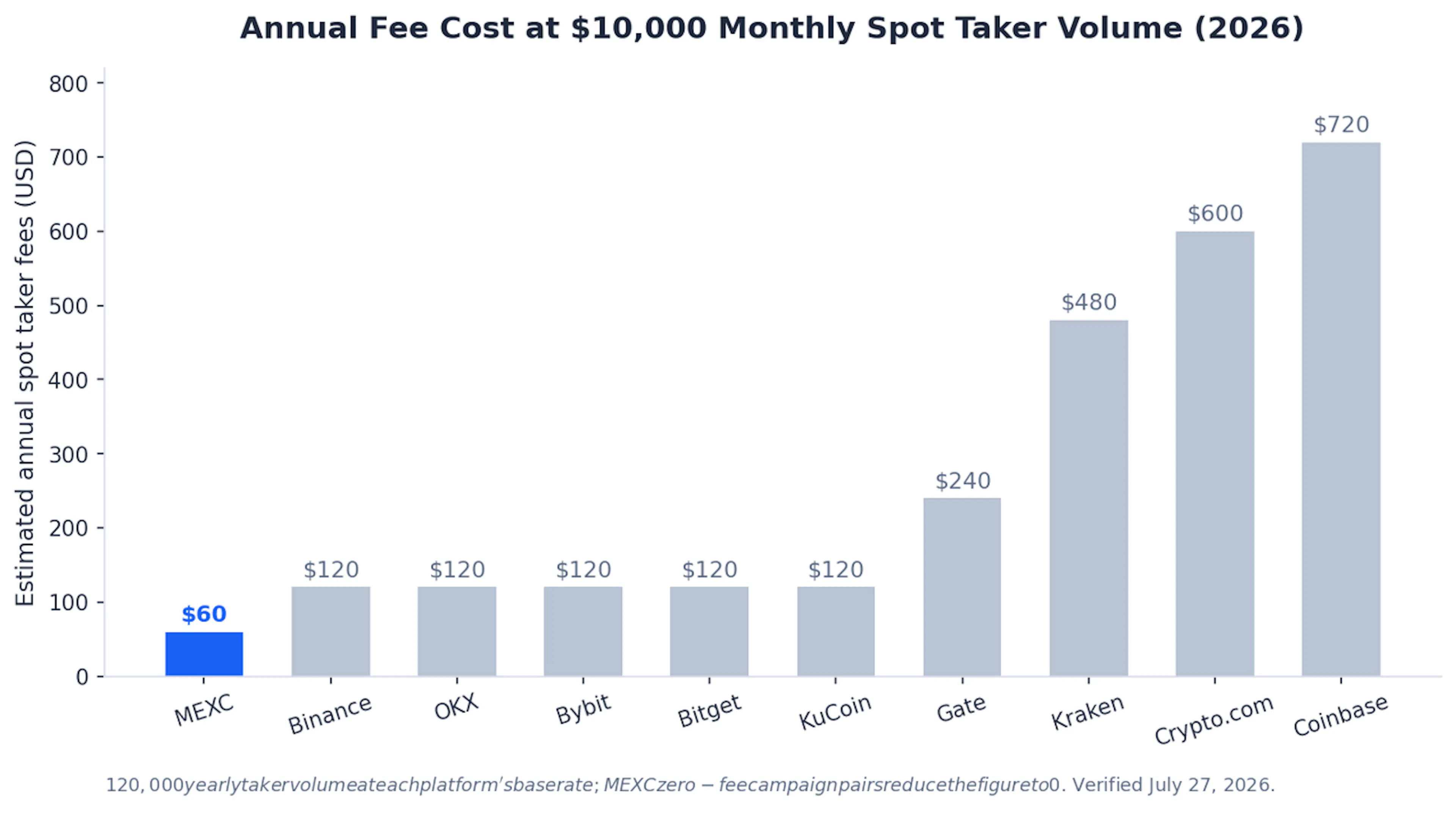
- The same $10,000 in monthly spot taker volume costs about $60 a year on MEXC versus roughly $720 on Coinbase Advanced.
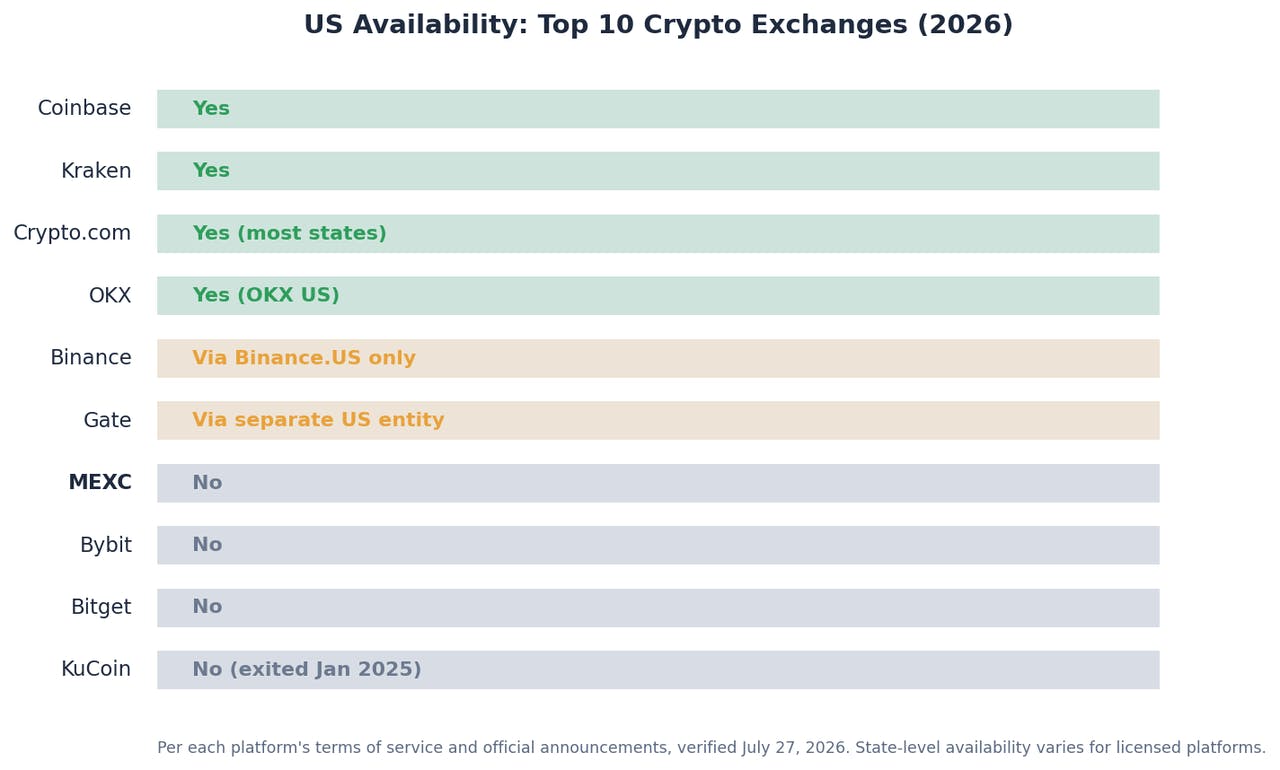
- For US traders the licensed shortlist is Coinbase, Kraken, Gemini, and Crypto.com; MEXC, Bybit, and Bitget do not serve the US.
- Binance still has the deepest liquidity but has suspended most EU services since July 1, 2026 pending a MiCA licence.
- AscendEX, BitMEX, and BitMart all shut down or announced closures in July 2026, so platform strength now matters as much as fees.
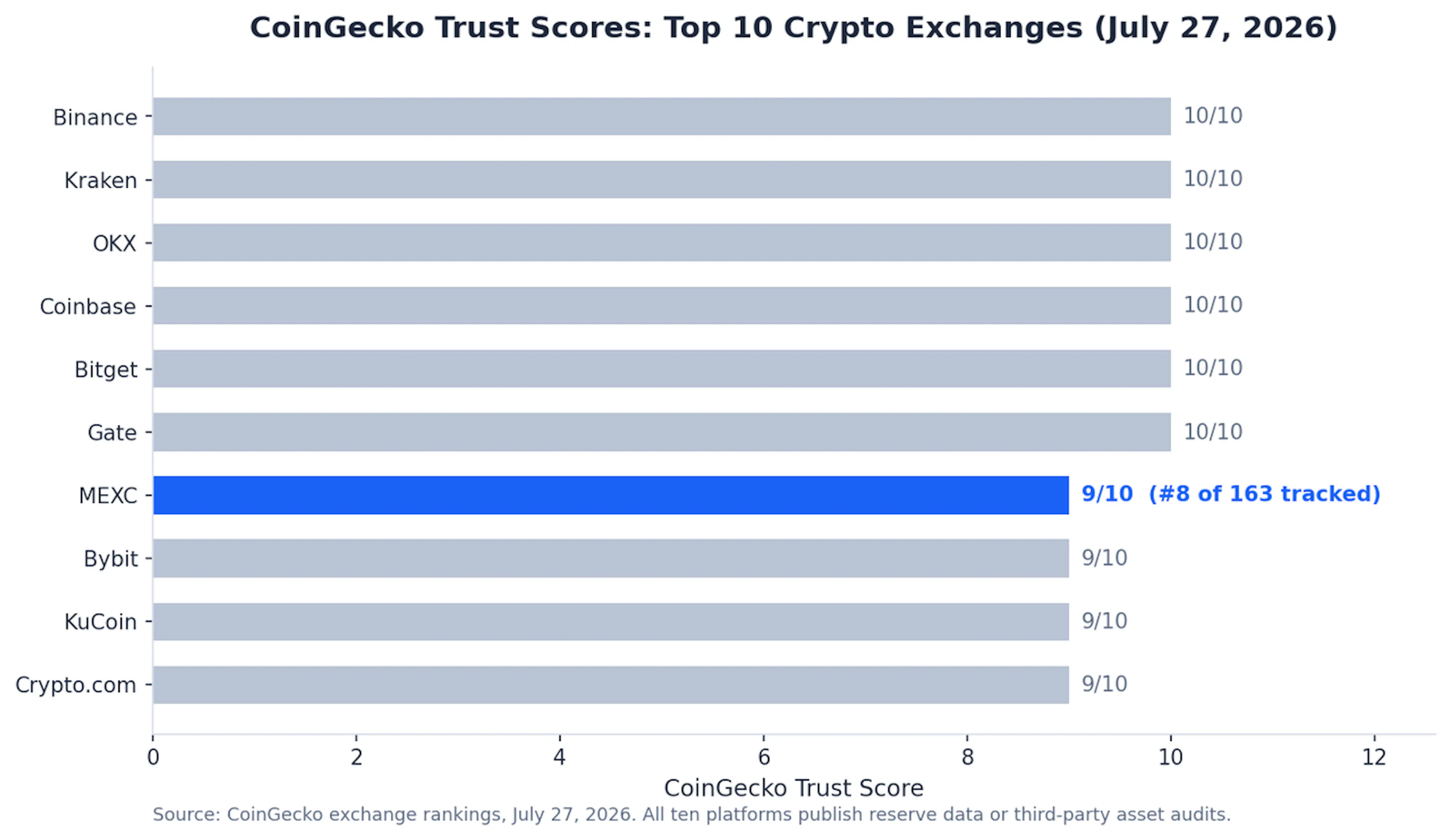
- Six of these ten platforms hold 10 of 10 CoinGecko Trust Scores, and MEXC ranks eighth of 163 tracked at 9 of 10 with public reserve data.
Picking an exchange used to be a question of taste.
In 2026 it is a question of survival math.
In the space of one month, AscendEX closed on July 1, BitMEX announced on July 23 that it will shut down in September, and BitMart followed on July 26 with a wind-down that ends all trading in August.
At the same time, Binance, the largest exchange in the world, suspended most services for EU residents on July 1 after missing the MiCA licensing deadline.
Millions of traders discovered the same thing in the same summer: the platform you choose can disappear from under you, or your country can disappear from its map.
The second problem is quieter but just as expensive.
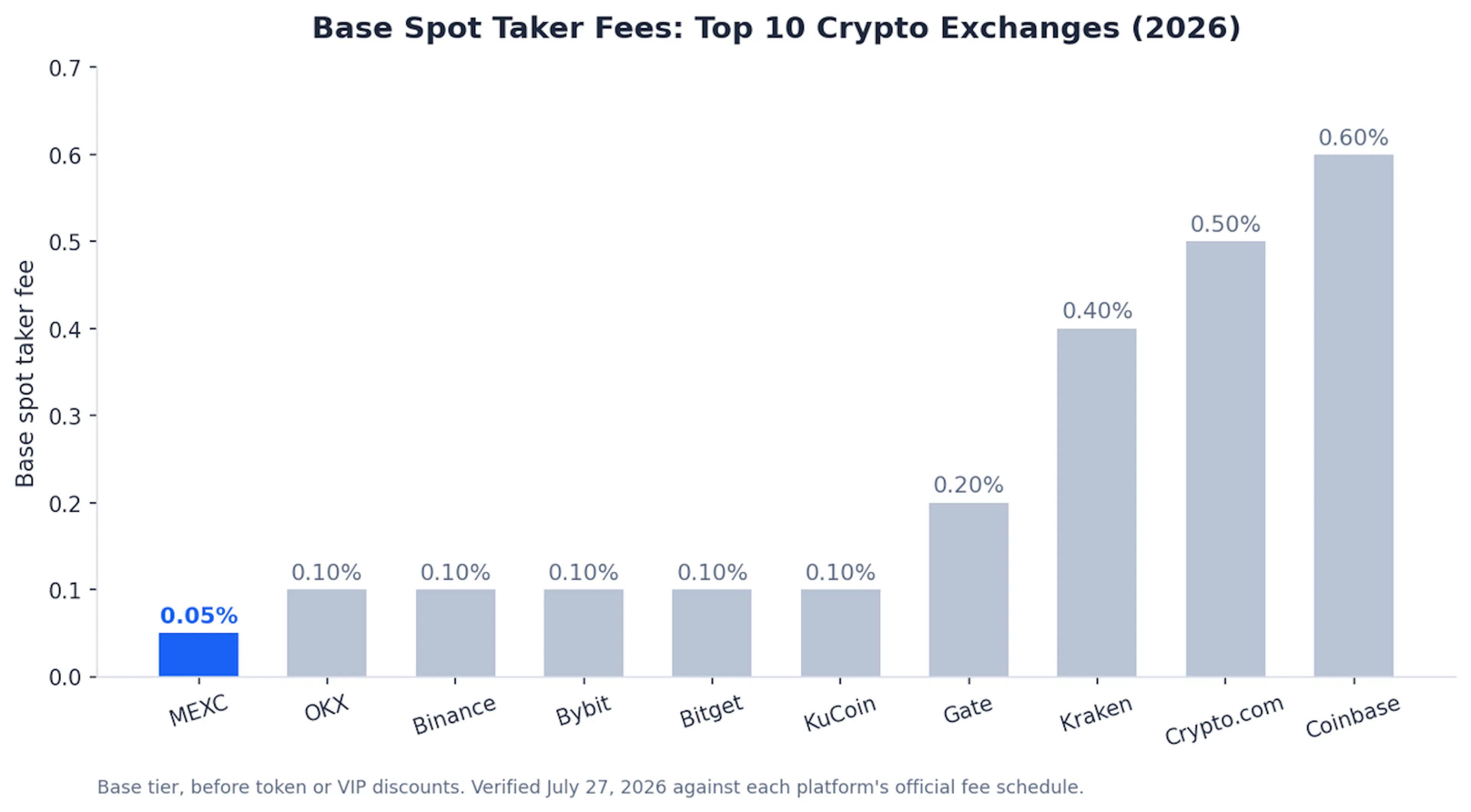
Base taker fees across major exchanges run from 0.05% to 0.60% per trade, a twelvefold spread that compounds with every order you place.
This guide compares the ten leading crypto exchanges of 2026 on verified numbers: fees from official schedules, trust scores and reserve data from CoinGecko, and regional access from each platform's own terms.
Every figure in the tables below was checked against a primary source on July 27, 2026.
How We Ranked These 10 Exchanges
We scored each platform across six dimensions: trading fees, asset selection and listing speed, derivatives capability, security and proof of reserves, regulation and regional availability, and standout features.
These six decide real outcomes: fees determine what you keep, listings determine what you can buy, and reserves plus regulation determine whether your funds survive a bad year for the industry.
Fee data comes from each exchange's published fee schedule at the base tier, before token discounts or VIP levels.
Trust and reserve indicators come from CoinGecko, which tracked 163 spot exchanges as of July 27, 2026.
This guide is published by MEXC Learn, and we hold our own platform to the same test as every rival.
Where MEXC concedes a dimension we say so, and where it leads we show the working.
The numbered order below is a category verdict, not a universal hierarchy: each platform listed is the strongest choice for the trader profile named next to it.
Top 10 Crypto Exchanges in 2026: Comparison Table
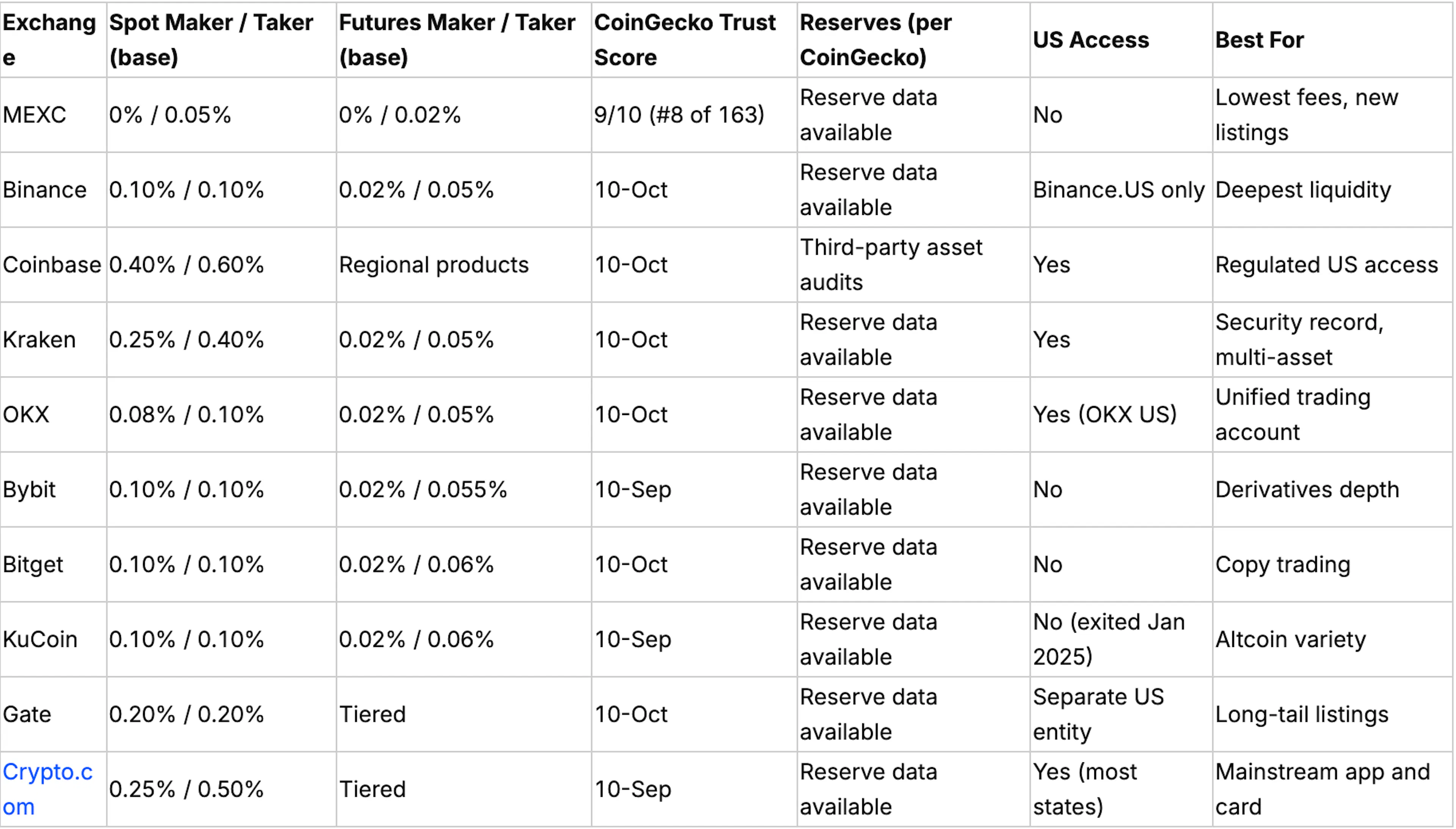
Data verified as of July 27, 2026 against each platform's official fee schedule, help center, and terms, and against CoinGecko's exchange rankings of the same date. Base tiers shown, before token discounts or VIP levels; rates can vary by region and trading pair.
Three things stand out from the table.
MEXC is the only major exchange with a 0% maker fee on both spot and futures at the base tier, and its 0.05% spot taker rate is half the 0.10% industry standard.
The regulated US platforms, Coinbase and Kraken, charge four to twelve times more per taker trade than the offshore leaders, which is the price of their licensing footprint.
Every platform on this list publishes reserve data or third-party audits, and none scored below 9 of 10 on CoinGecko's trust rankings; the exchanges that shut down this year scored 6 and 7.
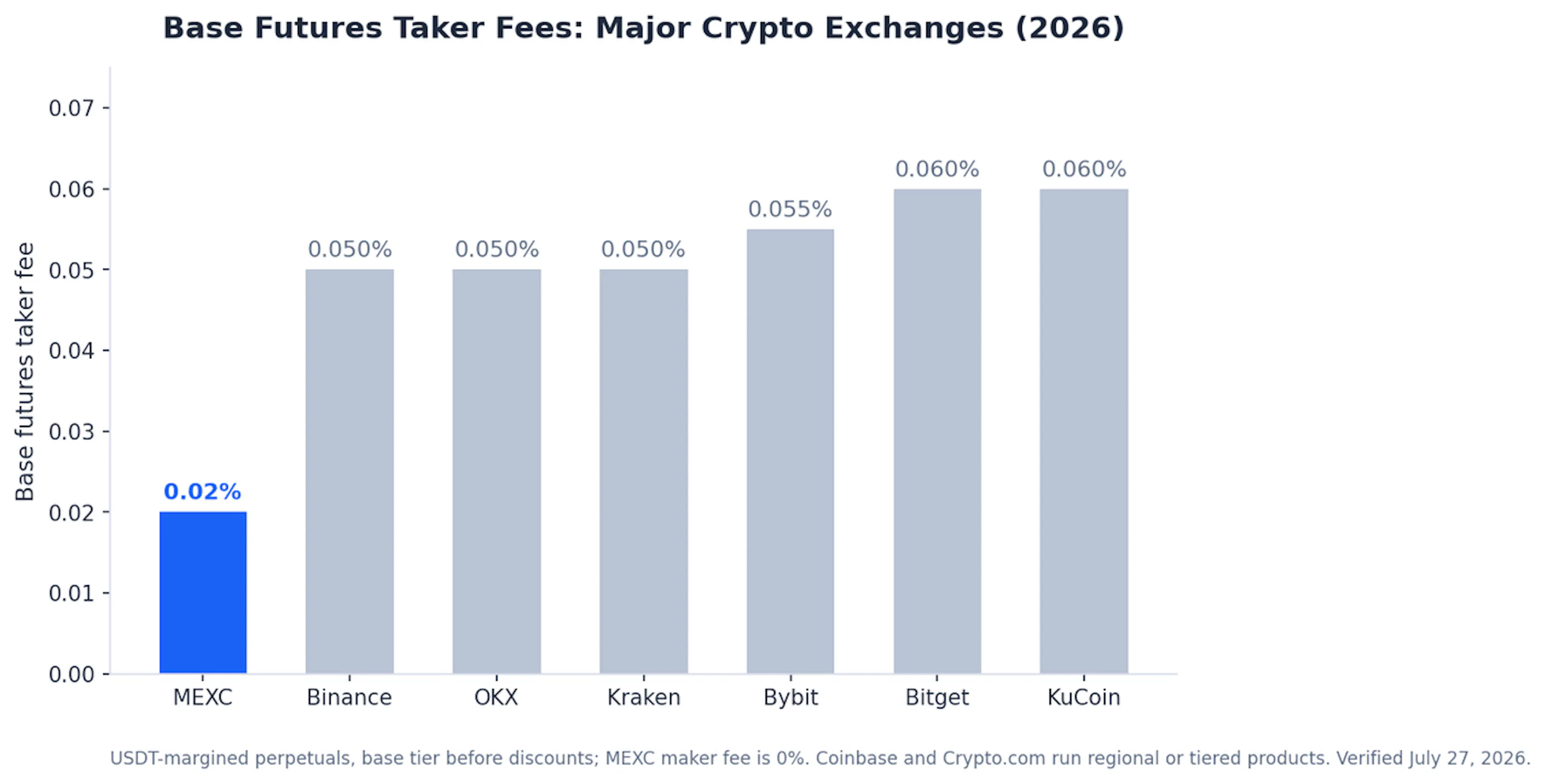
The futures ladder is tighter, but the ordering holds: MEXC pairs a 0% maker rate with a 0.02% base taker fee that undercuts every major rival.
The 10 Best Crypto Exchanges of 2026, Ranked
1. MEXC: Best for Low Fees, Fast Listings, and Multi-Asset Trading
Verdict: the strongest choice for cost-sensitive traders and early token hunters outside the US, UK, and Canada.
Fees are the one trading cost you control completely, and most exchanges quietly charge you ten to sixty basis points per trade.
MEXC attacks that cost directly.
Its published base schedule is 0% maker and 0.05% taker on spot, and 0% maker and 0.02% taker on USDT-M futures, with recurring zero-fee campaigns that cut both sides to 0% on qualifying spot pairs.
No native token holding or volume threshold is required to access those base rates, although holding 500 MX cuts the remaining taker fee by a further 50%.
The listing engine is the second pillar.
MEXC lists more than 3,000 tokens and has built its reputation on carrying new and small-cap assets before larger venues pick them up, which is exactly what early-cycle traders need.
The third-party picture supports the marketing claims.
CoinGecko ranks MEXC eighth of 163 tracked exchanges with a 9/10 Trust Score and live reserve data, in CoinGecko's July 27, 2026 snapshot, and CoinMarketCap reports more than 40 million users across 170+ countries.
MEXC has published an on-chain
For derivatives traders, USDT-M futures run up to
Now the math that decides it.
A trader running $10,000 a month in spot taker volume pays about $60 a year on MEXC at 0.05%.
The same flow costs $120 a year on Binance, Bybit, Bitget, OKX, or KuCoin at 0.10%, around $480 on Kraken at 0.40%, and roughly $720 on Coinbase Advanced at 0.60%.
Against Coinbase, that is $660 a year, or nearly $2,000 over three years, kept in your account instead of paid out in fees, and on zero-fee campaign pairs the MEXC figure drops to $0.
Benefits:
- Lowest verified base fees of any major exchange: 0% / 0.05% spot and 0% / 0.02% futures.
- More than 3,000 listed tokens with a fast pipeline for new and small-cap assets.
- On-chain proof of reserves since 2023, a 9/10 CoinGecko Trust Score, and top-tier spot volume.
- Up to 500x leverage on select USDT-M pairs, plus stock-linked products for multi-asset exposure.
Limitations:
- Not available to residents of the United States or Canada, with partial restrictions in markets such as the United Kingdom and Singapore; check the official
restricted regions list . - Lighter regulatory licence footprint than publicly listed or US-licensed rivals.
- Order-book depth on long-tail pairs is thinner than the BTC and ETH books on Binance.
2. Binance: Best for Liquidity and Market Depth
Verdict: still the deepest order books in crypto, with regional caveats that now matter more than ever.
Binance remains the largest exchange by trading volume, and CoinGecko listed it among the three largest platforms as of July 27, 2026.
For large orders in major pairs, that depth means tighter spreads and less slippage than anywhere else.
Base fees are the industry-standard 0.10% maker and taker on spot and 0.02% / 0.05% on futures, with a 25% discount for paying in BNB.
Two regulatory facts belong in any honest 2026 assessment.
Binance resolved US criminal charges in November 2023 with a settlement of approximately $4.3 billion, per the US Department of Justice's announcement of that date.
And from July 1, 2026, it suspended most services for EU residents after missing the MiCA licensing deadline, while stating that user funds remain safe and that it intends to obtain authorization through another member state.
Benefits:
- Deepest liquidity and tightest spreads on major pairs.
- Broad product range covering spot, futures, earn products, and an extensive ecosystem.
- Competitive 0.10% base fees with BNB discounts and published reserve reporting.
Limitations:
- EU services suspended since July 1, 2026 pending MiCA authorization.
- US residents are limited to the separate Binance.US platform with a reduced feature set.
- Past regulatory history requires ongoing compliance scrutiny.
3. Coinbase: Best for Regulated US Access
Verdict: the default on-ramp for US beginners who value a listed, audited counterparty over low fees.
Coinbase is a Nasdaq-listed public company that joined the S&P 500 in May 2025, which makes it the most transparent large exchange by disclosure standards.
Quarterly filings and third-party audits substitute for the crypto-native proof-of-reserves model.
The cost of that comfort is real: Coinbase Advanced starts at 0.40% maker and 0.60% taker for traders below $10,000 in monthly volume, the highest base rates on this list.
Its curated listing policy also means new tokens arrive later and in smaller numbers than on offshore venues.
Benefits:
- Publicly listed, SEC-reporting company with full US regulatory coverage.
- Clean interface and strong educational resources for first-time buyers.
- Institutional-grade custody trusted by ETF issuers.
Limitations:
- Base fees of 0.40% / 0.60% are four to twelve times higher than offshore leaders.
- Conservative listing policy limits access to early-stage tokens.
- Customer-support wait times are a recurring theme in user reviews.
4. Kraken: Best Security Track Record and Multi-Asset Range
Verdict: the safety-first pick for US and European traders who also want stocks beside their crypto.
Operating since 2011, Kraken states that it has never lost customer funds to an exchange hack, a record almost no major rival can claim.
It pairs that record with licences across the US, UK, EU, Canada, and Australia, published proof of reserves, and support for more than 450 digital assets plus over 11,000 US-listed stocks and ETFs on its own figures.
Fees are mid-pack: Kraken Pro starts at 0.25% maker and 0.40% taker, well above the offshore standard, while its futures tier runs a competitive 0.02% / 0.05%.
Benefits:
- No customer-fund hack losses on record since 2011, per the company.
- Deep licensing footprint across major Western jurisdictions.
- Crypto plus US equities and ETFs in one regulated account.
Limitations:
- Spot base fees of 0.25% / 0.40% are five to eight times MEXC's taker rate.
- Fewer small-cap and meme listings than offshore competitors.
- Instant-buy products carry higher effective costs than Kraken Pro.
5. OKX: Best Unified Trading Account
Verdict: the engineering-led choice for advanced traders who want spot, perps, and options margined together.
OKX's unified account lets one collateral pool margin spot, perpetuals, and options at once, a structure professionals value and most rivals still lack.
Base fees are among the sharpest of the licensed-leaning group at 0.08% maker and 0.10% taker on spot and 0.02% / 0.05% on futures.
Its proof of reserves uses zk-STARK cryptography, a technical step beyond the standard Merkle-tree approach.
OKX entered the US market in 2025 after agreeing to pay just over $500 million in a settlement with US authorities, and now operates a dedicated US platform.
Benefits:
- Unified account with portfolio margin across products.
- 0.08% spot maker fee undercuts the 0.10% industry standard.
- zk-STARK proof of reserves and a 10/10 CoinGecko Trust Score.
Limitations:
- Steeper learning curve than beginner-focused platforms.
- 2025 US settlement sits in its recent compliance history.
- Listing pace for small caps trails MEXC and Gate.
6. Bybit: Best Professional Derivatives Experience
Verdict: a perps-first platform whose 2025 crisis response, paradoxically, strengthened its trust case.
Bybit built its name on perpetual futures and ranks just behind Binance among the largest venues by volume.
In February 2025 it suffered the largest crypto theft on record, roughly $1.5 billion in ETH taken through a compromised third-party wallet workflow.
The part that matters for 2026: withdrawals kept processing, users bore no losses, and the exchange restored full reserves, a stress test most platforms have never faced, let alone passed.
Fees sit at the standard 0.10% / 0.10% on spot and a competitive 0.02% / 0.055% on derivatives.
Benefits:
- Top-two derivatives liquidity with a polished professional interface.
- Full user reimbursement and continuous withdrawals through the 2025 incident.
- USDC options and a strong testnet for strategy development.
Limitations:
- Not available in the US, UK, and several other major markets.
- The 2025 breach itself remains a fair counterargument on custody risk.
- Spot listing breadth trails the listing-focused exchanges.
7. Bitget: Best for Copy Trading
Verdict: the social-trading leader for users who would rather mirror a professional than trade manually.
Bitget turned copy trading into its core identity, letting users automatically replicate vetted traders across spot and futures.
It backs the platform with a self-funded protection fund it values above $300 million and monthly Merkle-tree proof of reserves, and it holds a 10/10 CoinGecko Trust Score.
Standard fees apply: 0.10% / 0.10% spot and 0.02% / 0.06% futures, with BGB token discounts.
KYC has been mandatory for core functions since January 2024.
Benefits:
- The most developed copy-trading ecosystem among major exchanges.
- Monthly proof of reserves plus a large self-insurance fund.
- Growing multi-asset range including stock-linked futures products.
Limitations:
- Not available to US residents.
- 0.06% futures taker is the highest base rate among the offshore leaders.
- Copy-trading outcomes depend entirely on the traders you follow, and losses copy too.
8. KuCoin: Best Altcoin Variety Under New Compliance
Verdict: a broad altcoin shelf now operating under a strict post-settlement compliance regime.
KuCoin has long served altcoin hunters with one of the widest selections among major venues, at standard 0.10% / 0.10% spot fees.
Its recent history is defined by one event: in January 2025 it pled guilty to US charges, paid penalties of about $297 million, and agreed to exit the US market for at least two years.
Since then it has made KYC mandatory platform-wide and rebuilt its positioning around compliance.
Benefits:
- Hundreds of altcoins across niches many exchanges skip.
- Useful built-in trading bots at no extra platform fee.
- KCS token discounts lower the standard fee schedule.
Limitations:
- No US access until at least 2027 under the settlement terms.
- The 2025 guilty plea weighs on its trust profile.
- Liquidity on long-tail pairs can be thin.
9. Gate: Best Long-Tail Listing Catalog
Verdict: a 2013-vintage survivor with one of the broadest token shelves and above-average spot fees.
Founded in 2013 and rebranded from Gate.io to Gate, it is one of the longest-running exchanges still operating, with a listing catalog that reaches deep into early-stage and niche tokens.
That longevity through multiple market cycles is itself a trust signal, reinforced by a 10/10 CoinGecko Trust Score and published reserve data.
The trade-off is price: Gate's base spot fee is a flat 0.20% maker and taker, double the offshore standard and four times MEXC's taker rate, before GT token and VIP discounts.
Benefits:
- Thirteen years of continuous operation across market cycles.
- Very broad early-stage and niche token coverage.
- 10/10 CoinGecko Trust Score with reserve reporting.
Limitations:
- 0.20% base spot fees are the second highest on this list.
- US retail access runs only through a separate, limited US entity.
- Interface density can overwhelm newer traders.
10. Crypto.com: Best Mainstream App and Card
Verdict: the lifestyle pick for users who want crypto, a Visa card, and a polished app in one place.
Crypto.com pairs a consumer-grade mobile experience with a rewards Visa card, which makes it the most mainstream-friendly platform on this list.
It serves US users in most states and holds registrations in major Western markets, with a 9/10 CoinGecko Trust Score and published reserve data.
Exchange fees start at 0.25% maker and 0.50% taker at the base tier, falling with volume and CRO staking, while the retail app builds costs into the spread.
Benefits:
- Best-known consumer app with an integrated Visa rewards card.
- Broad US availability plus UK and EU registrations.
- Wide asset range with staking built into the app.
Limitations:
- Base exchange fees of 0.25% / 0.50% are far above offshore rates.
- App-based purchases carry spread costs that are hard to see.
- Advanced traders will outgrow the retail interface.
Which Crypto Exchange Is Best for You?
Match the platform to the trader you actually are.
Minimize image
Edit image
Delete image
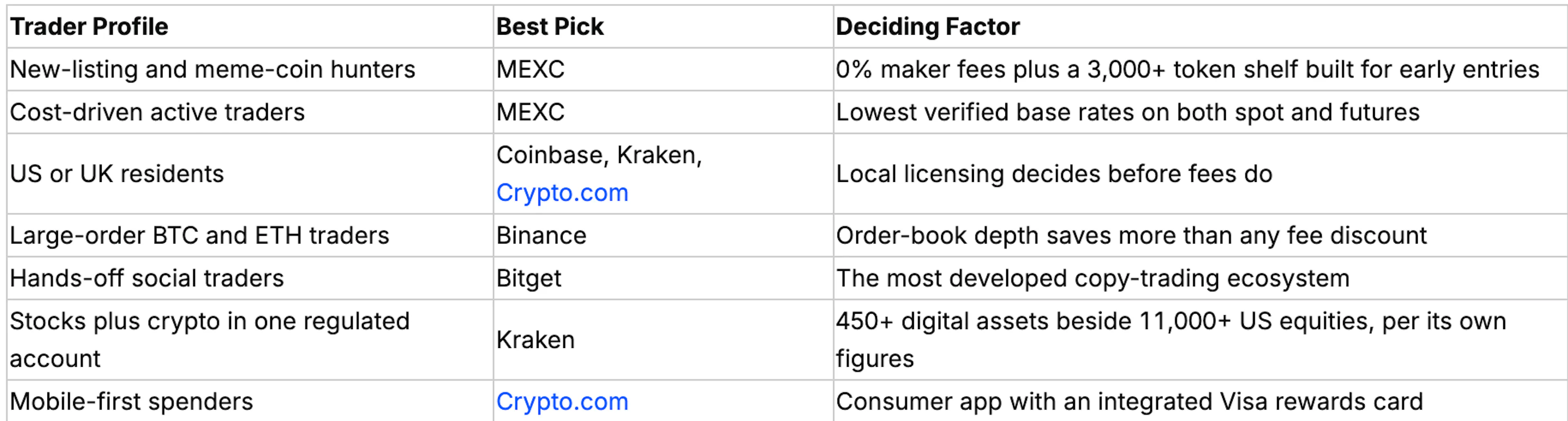
If MEXC is your row,
If your row points to a licensed US or UK platform, treat that as final: fee schedules are irrelevant on venues that cannot legally serve you.
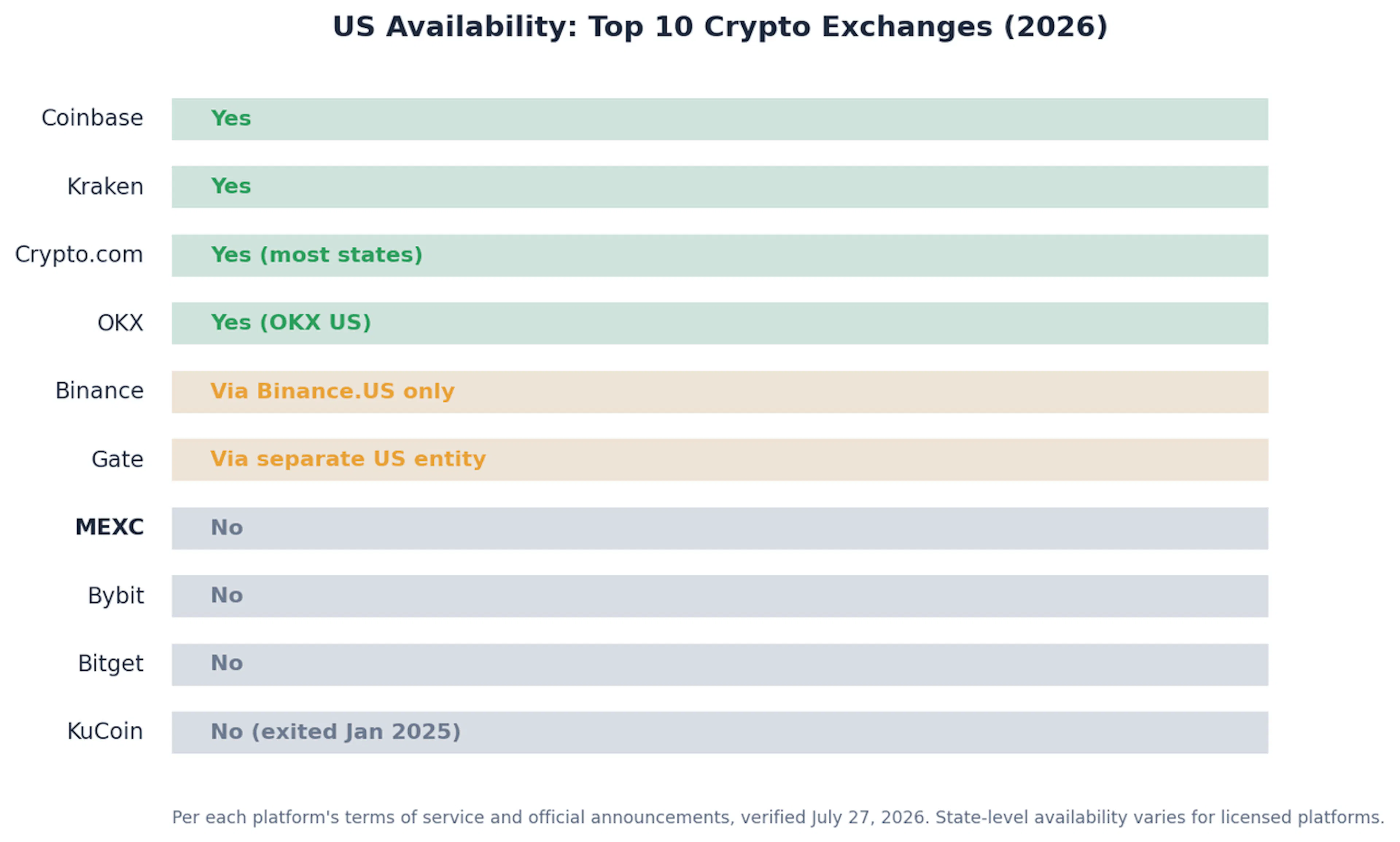
Best Crypto Exchange in the USA (2026)
For US residents the shortlist is fixed by licensing, not by fees.
Coinbase and Kraken are the leading full-service licensed options, Gemini offers a compliance-focused alternative, and Crypto.com serves most states.
Binance is available only through the separate Binance.US entity, and OKX operates a licensed US platform following its 2025 settlement.
MEXC, Bybit, and Bitget do not serve US residents, and KuCoin exited the US market under its January 2025 settlement.
US traders should verify state-level availability directly with each licensed platform before funding an account.
The 2026 Exchange Shake-Out: Why Your Choice Matters More Now
July 2026 compressed a decade of consolidation into four weeks.
AscendEX ceased operations on July 1, citing regulatory and financial pressures.
BitMEX, the venue that invented the perpetual swap, announced on July 23 that it will close on September 23, 2026 after an eleven-year run.
Three days later, BitMart said it would end all trading on August 26 and cease operations on January 31, 2027, and its BMX token fell about 58% within a day.
Meanwhile the EU's MiCA deadline of June 30 reshaped European access, a bar that most exchanges failed to clear in time, Binance included.
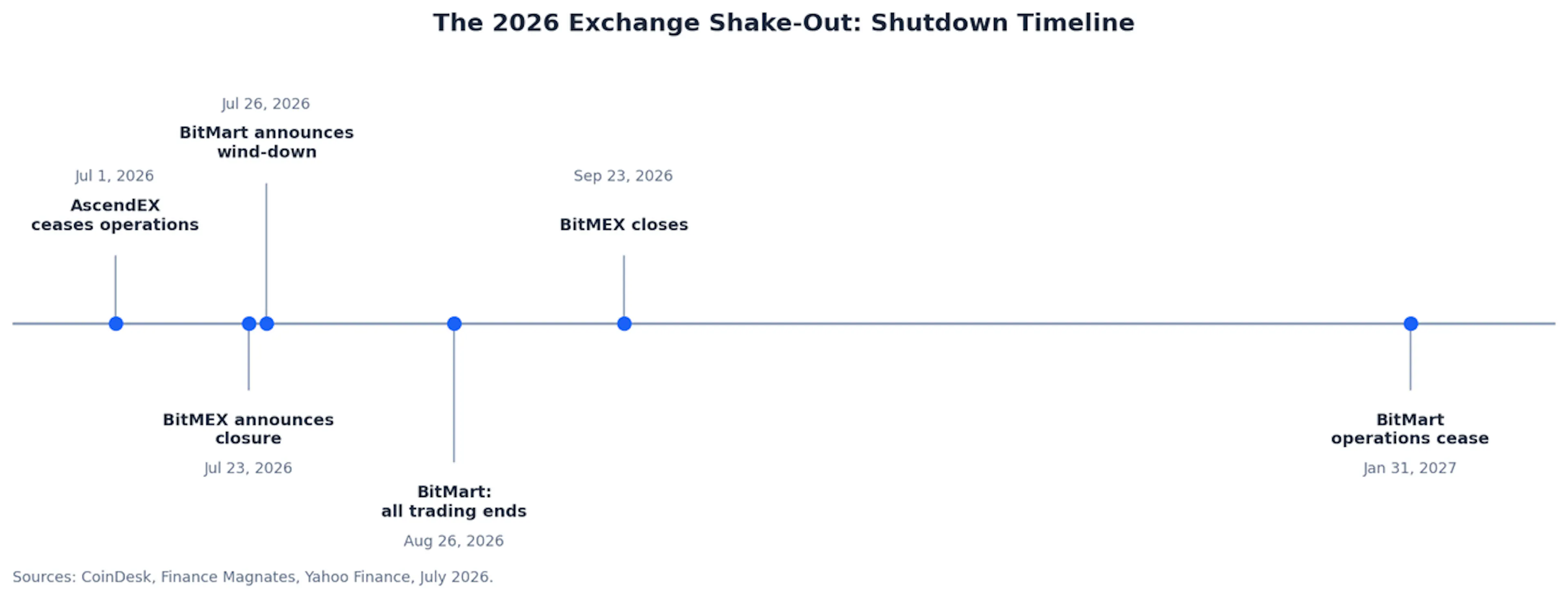
The pattern is consistent: mid-tier venues without durable volume, sustainable economics, or a licensing path are exiting, and their users inherit deadline stress and withdrawal queues.
Before trusting any exchange in 2026, run a three-point check.
First, is its volume real, as reflected in independent trackers like CoinGecko's trust rankings rather than self-reported figures?
Second, does it publish proof of reserves or audited holdings you can inspect?
Third, is the operating entity and its regulatory status transparent enough that you would know who owes you your assets?
All ten platforms in this guide pass that screen today, which is precisely why the list is ten names and not thirty.
From where MEXC sits, the lesson of 2026 is blunt: published reserves, real volume, and survivable economics are no longer differentiators, they are entry requirements.
Frequently Asked Questions
What is the best crypto exchange in 2026?
It depends on your priority: MEXC for the lowest fees and fastest listings, Coinbase or Kraken for regulated US access, and Binance for liquidity.
No single platform wins every category.
What are the top 10 crypto exchanges in 2026?
MEXC, Binance, Coinbase, Kraken, OKX, Bybit, Bitget, KuCoin, Gate, and Crypto.com, each leading a different category from fees to liquidity to copy trading.
What is the best crypto exchange in the USA?
Coinbase and Kraken lead for licensed US access, with Gemini and Crypto.com as alternatives.
MEXC, Bybit, and Bitget do not serve US residents.
Which crypto exchange has the lowest fees?
MEXC, at 0% maker and 0.05% taker on spot and 0% / 0.02% on futures, verified July 27, 2026.
See the
Which crypto exchange is the safest?
No exchange is risk-free; the strongest signals are published reserves, a clean incident record, and regulatory standing.
Six of the ten platforms here hold 10/10 CoinGecko Trust Scores, and Kraken reports no hack losses since 2011.
Are crypto exchanges shutting down in 2026?
Yes: AscendEX closed July 1, BitMEX closes September 23, and BitMart ends trading August 26, 2026.
Withdraw promptly from any platform announcing a wind-down.
Which exchange lists new coins fastest?
MEXC is known for the fastest pipeline among major venues, carrying 3,000+ tokens and listing many assets before larger exchanges.
Gate also covers long-tail tokens broadly.
Do all crypto exchanges require KYC?
Most major platforms now require identity verification for core functions; KuCoin made KYC fully mandatory and Bitget has required it since 2024.
Limits and tiers vary, so check each platform's official verification page.
Risk Disclosure
Crypto assets are volatile and you can lose the money you trade with, so never commit funds you cannot afford to lose.
Leveraged futures magnify both gains and losses and can result in liquidation of your entire margin.
This article is for information only and is not financial, legal, or tax advice; product availability varies by jurisdiction under each platform's user agreement, including the MEXC User Agreement.
如有侵权请联系:admin#unsafe.sh