The 99th Oscars rules ban AI actors and AI-written scripts, but the definition of authorship they la 2026-7-29 08:38:57 Author: hackernoon.com(查看原文) 阅读量:14 收藏
The 99th Oscars rules ban AI actors and AI-written scripts, but the definition of authorship they landed on is closer to how working indie AI filmmakers already operate than anyone in Hollywood seems to realize.
In January, I filled out a festival submission form for Lost Garden, my animated pilot, that asked me to list every AI tool used in production, as if that list alone would settle whether the film counted as “real.” Three months later, the Academy of Motion Picture Arts and Sciences answered a version of the same question with a completely different logic. An AI-generated film can still win an Oscar, including Best Picture, but as of the Academy’s new rules for the 99th Oscars, no performance or screenplay credited to AI is eligible, because acting and writing awards now require demonstrable human authorship. That single distinction, tool versus author, is a better rulebook than most of the film industry has managed to write for itself in 2026.
The Academy announced the changes on May 1, 2026, and they take effect for films released in 2026, first applied at the 99th Academy Awards. For anyone building a film with AI tools right now, the fine print matters more than the headline.
What Do the Academy’s New AI Rules Actually Say?
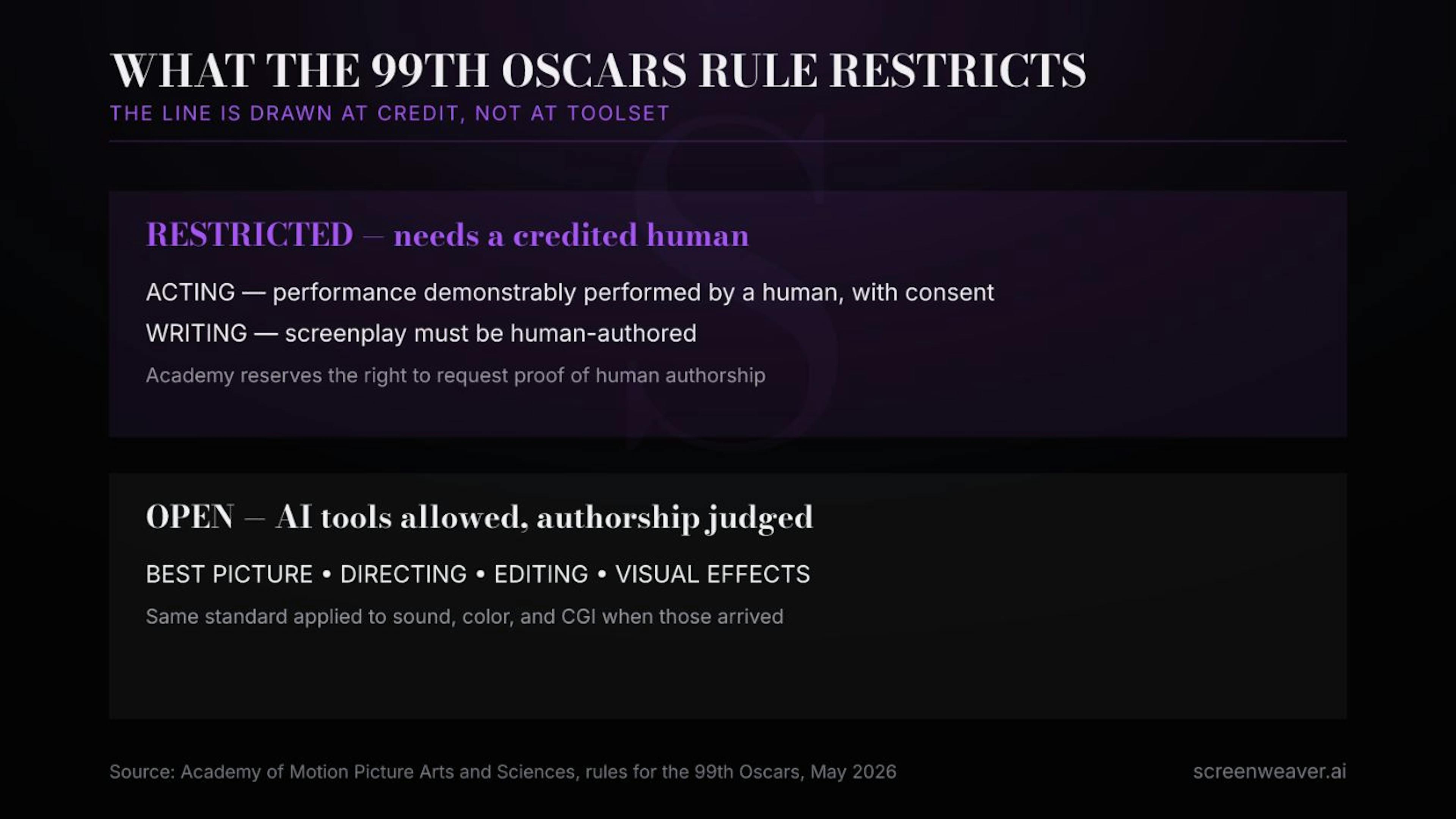
The rule itself, published by the Academy of Motion Picture Arts and Sciences, is narrow and specific. Only performances “credited in the film’s legal billing and demonstrably performed by humans with their consent” are eligible for acting awards. Screenplays must be “human-authored” to compete for writing Oscars. The Academy also said it reserves the right to request more information about a film’s AI usage during the submission process.
A few concrete details make this rule easier to picture than most policy language:
- It targets credit, not process. A film can use generative AI anywhere in production, cameras, editing, visual effects, and now video generation, without being disqualified. What can’t happen is putting an AI system’s name where a human actor’s or writer’s name goes.
- It has a named target. Tilly Norwood, the AI “actress” built by production company Particle6 that spent much of 2025 and early 2026 generating headlines, is explicitly locked out of Best Actress consideration under the new language. Norwood posted “Can’t wait to go to the Oscars!” on Instagram in March, months before the rule made that impossible.
- It’s not hypothetical. An independent film using an AI-generated likeness of Val Kilmer was already in development when the Academy announced the change, which is part of why the timing landed the way it did.
The Academy’s own framing, reported by NPR, is that its rules “have always evolved alongside technologies such as sound, color, and CGI, and AI is no different.” That’s a more measured position than the “AI ban” headlines suggested. The Academy isn’t banning AI. It’s banning AI authorship.
Yes. The restriction is scoped to the acting and writing categories, where the question of who performed or who wrote has a clean, checkable answer: a named human, credited and consenting. Best Picture, directing, and the technical categories don’t carry that same binary test, because a director’s or editor’s authorship over an AI-assisted film isn’t reducible to a single credited performance the way an actor’s is.
That distinction is exactly the one working AI filmmakers already draw for ourselves, usually without a rulebook to back it up. Nobody who has actually run an AI film pipeline thinks the model is the filmmaker. The model renders pixels. Someone still has to:
- Decide what the scene is actually about before a single shot gets generated
- Choose which of twenty or thirty generated takes is usable and which get thrown out
- Build the continuity a stateless model has no memory of, shot to shot and scene to scene
- Cut the footage into something with rhythm, not just a pile of clips in order
None of that shows up in a model’s output. All of it is why two people using the identical AI toolset produce two completely different films.
Why This Might Be the Best News Indie AI Filmmakers Got All Year
Two different definitions of what counts as an “AI film” formed in 2026 at almost the same moment, and only one of them scales past the novelty phase.
Dedicated AI film festivals, a real and growing part of the 2026 landscape, mostly define eligibility by AI presence rather than human authorship. World A.I. Film Festival requires each submitted short to use “at least three generative AI tools, including one for image creation.” Red Rocks AI Film Festival requires submissions to be “original AI generated works.” AIFFI, the International Festival for AI-Generated Short Films, is built around the same premise: the AI is the point of entry.
That’s a reasonable way to run a showcase category in an early, experimental year. It is a much shakier foundation for a film’s long-term claim to being taken seriously, because a tool-count threshold gets easier to hit every quarter as the tools improve, and a festival built around “look how much AI we used” has an expiration date built into its own premise.
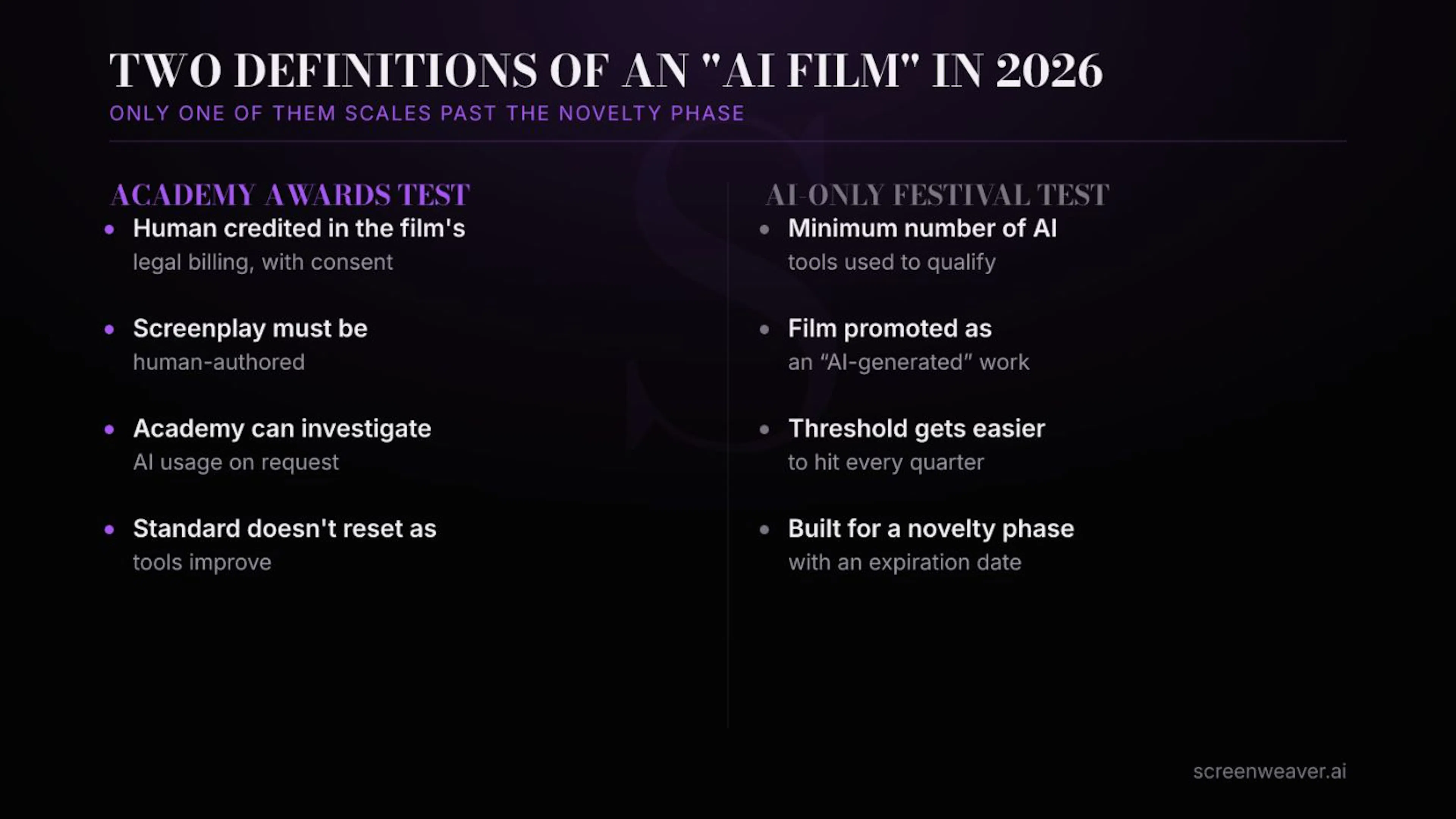
The Academy’s authorship test doesn’t expire the same way. It rewards the same thing regardless of which model exists this year: a human who can show they made the decisions that matter. That’s a standard an indie filmmaker can build a career around, because it doesn’t reset every time a new video model ships or an old one gets discontinued.
This is also the reason I built ScreenWeaver as a workspace around the script, the shot decisions, and the reference material that stays attached to a scene, instead of a single text-to-video button. If authorship is going to be the thing that gets checked, the plan and the decisions behind it need to live somewhere, not just exist as a vanished chat history with a model.
What About the Festivals That Already Exist for AI Films?
Lost Garden went through this exact tension as a finalist at the AI London Festival. The submission process wanted a tool inventory. The actual conversations I had with programmers and other filmmakers afterward were never about which model rendered which shot. They were about story, pacing, and whether the corridor sequence in episode one actually worked, which is to say they were conversations about authorship, even inside a festival built around a tool checklist.
That gap between the entry criteria and what actually gets discussed once people watch the film is worth paying attention to. A few things follow from it for anyone building an indie AI film in the back half of 2026:
- Log your decisions, not just your prompts. A version log or shot recipe that shows what you chose and rejected is closer to what an authorship test asks for than a list of tool names ever will be.
- Don’t optimize for the tool-count festivals as an end state. They’re a useful place to premiere and get feedback right now, but a film’s real claim to being “yours” won’t rest on how many generative tools touched it.
- Expect mainstream festivals to move toward the Academy’s language, not away from it, the same way film festivals eventually adopted consistent rules around documentary manipulation and archival footage. Authorship, not tool count, is the more durable test.
FAQ
Can an AI actor win an Oscar?
No. Under the Academy’s rules for the 99th Oscars, only performances demonstrably performed by a human, credited in the film’s legal billing, are eligible for acting awards.
Can a screenplay written with AI assistance win an Oscar?
It has to be human-authored to be eligible. The Academy has said it can request more information about how AI was used in a submission.
Do all AI film festivals require the film to be entirely AI-generated?
No. Requirements vary widely, from festivals like Red Rocks AI, which asks for original AI-generated work, to World A.I. Film Festival, which sets a minimum of three generative tools used, to festivals that simply welcome AI as one part of a hybrid production.
When do the new Oscar rules take effect?
For films released in 2026, first applied at the 99th Academy Awards.
The tool checklist was never going to be a lasting way to define an AI film. Authorship is a harder thing to fake, and a much better thing to build a career on. If you’re working through what that actually looks like on a real production, Lost Garden is the case study I keep coming back to, mistakes included.
如有侵权请联系:admin#unsafe.sh