At Microsoft, security innovations are purpose-built to help every organization protect end-to-end 2026-5-21 16:0:0 Author: www.microsoft.com(查看原文) 阅读量:53 收藏
At Microsoft, security innovations are purpose-built to help every organization protect end-to-end with the speed and scale of AI. Our vision is simple: security should be ambient and autonomous, just like the AI it protects. As organizations accelerate AI adoption, security teams are navigating new blind spots created by the broad distribution of agents, data, and identities across different tools and platforms. Microsoft Security’s latest updates extend visibility, control, and protection across your expanding ecosystem, from third-party apps like Claude to your cloud environments and multi-cloud infrastructure. Together, these updates help your team secure what matters most—agents, data, and identities—without slowing your own innovation. Here’s what’s new:
Microsoft Purview visibility now extends to Anthropic Claude
Security and compliance teams can now detect and investigate Anthropic Claude usage alongside other cloud applications in the broader AI ecosystem. The new Anthropic Claude connector for Microsoft Purview delivers centralized visibility and oversight for Claude Enterprise and Claude Platform feed activity and chat conversations, enabling Microsoft Purview to provide insights on Claude interactions and audit log signals. This integration will provide visibility across Enterprise Claude.ai, Claude Console and Claude API, extending the Microsoft Purview experience and helping your teams protect sensitive data across your AI estate.
New data security posture management experience in Microsoft Purview
The new Microsoft Purview Data Security Posture Management (DSPM) experience is now generally available. This solution unifies and streamlines DSPM across scenarios, from discovery to protection, all the way to remediation, allowing teams to investigate risks and take actions on the same workflow. The new experience delivers goal-oriented flows, deeper remediation, expanded reporting, and third-party visibility. Your teams can efficiently discover sensitive data, assess risk, and take action at scale.
Microsoft Purview Data Security Investigations extends investigative depth with custom examinations
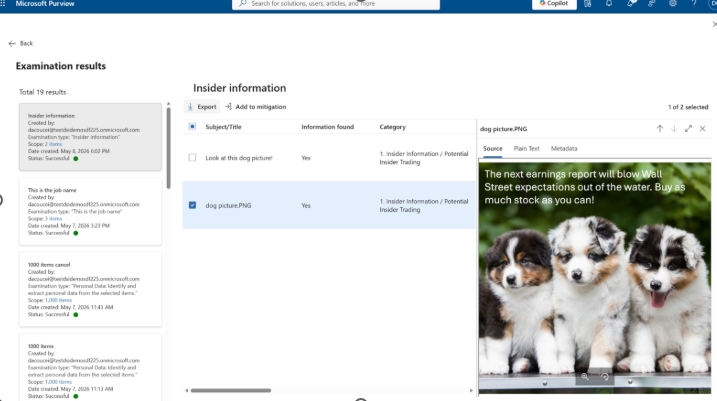
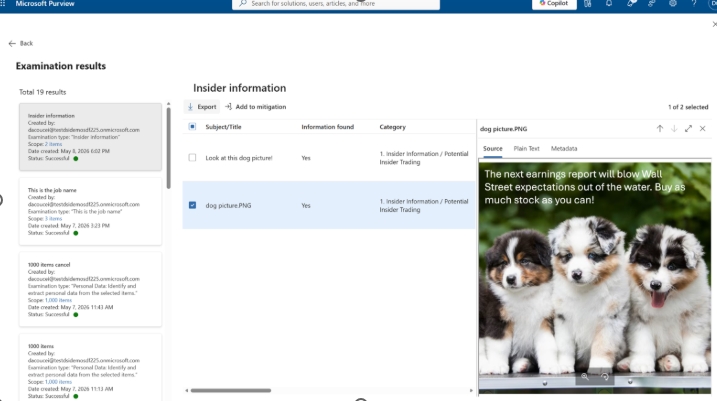
Microsoft Purview Data Security Investigations now includes optical character recognition (OCR) and custom examination capabilities to extend investigative depth. OCR extracts text from images, bringing previously inaccessible visual content into scope for AI-powered deep content analysis. In addition to existing examination types that identify credentials, risk, and personally identifiable data, and help inform mitigation, investigators can define their own analysis with custom examination, enabling more tailored and flexible investigations based on their unique needs.
Microsoft Entra ID Account recovery securely restores account access
Microsoft Entra ID Account recovery is an advanced authentication recovery mechanism that enables users to regain access to their organizational accounts when they’ve lost access to all registered authentication methods. Unlike traditional password reset capabilities, Account recovery focuses on identity verification and trust re-establishment prior to replacement of authentication methods rather than simple credential recovery.
Windows 365 for Agents delivers a secure AI agent execution environment
Windows 365 for Agents, now expanding in public preview, and Microsoft Agent 365 work together to provide a consistent, secure environment to run and govern agents. Agent 365 determines the work an agent is authorized to do, using shared organizational policies and identity to govern agent behavior and access. Windows 365 for Agents defines where an agent executes the work, providing Cloud PCs that enable agents to operate their own desktops and applications within a fully managed and auditable environment. Read our blog for more details.
Stay In the Loop
Microsoft Security continually ships meaningful innovations across our portfolio and research-driven insights and reports for the security community. In the Loop posts are your reliable source of what’s new across Microsoft Security and what it means for your security strategy. Check back for the next drop and connect with us at Microsoft Build, June 2-3, 2026, in San Francisco, to hear directly from Microsoft Security experts and learn more about today’s releases.
To learn more about Microsoft Security solutions, visit our website. Bookmark the Security blog to keep up with our expert coverage on security matters. Also, follow us on LinkedIn (Microsoft Security) and X (@MSFTSecurity) for the latest news and updates on cybersecurity.
如有侵权请联系:admin#unsafe.sh