Executive SummaryNorth Korean cyber operations have evolved from relatively discrete espiona 2026-5-19 21:56:8 Author: krypt3ia.wordpress.com(查看原文) 阅读量:53 收藏
Executive Summary
North Korean cyber operations have evolved from relatively discrete espionage and financially motivated campaigns into a highly interconnected operational ecosystem in which access generation, insider compromise, cryptocurrency theft, supply-chain intrusion, and intelligence collection reinforce one another as components of a broader state-directed strategy. Traditional attribution approaches centered on static APT labels increasingly fail to explain this evolution because the operational boundaries between campaigns have steadily eroded.

Modern DPRK cyber activity is better understood as a linked campaign architecture in which infrastructure, personas, credential ecosystems, and operational tradecraft are continuously reused across multiple mission sets. Campaigns that initially appear unrelated frequently share strategic objectives, operational sequencing, infrastructure dependencies, and monetization pathways. The result is a mature cyber-enabled economic and intelligence system optimized for sanctions evasion, foreign currency generation, strategic intelligence collection, and operational resilience.
The Shift From Isolated Campaigns to Operational Ecosystems
Early DPRK cyber operations were comparatively compartmentalized both operationally and strategically. Espionage-focused campaigns largely concentrated on government ministries, defense contractors, academic institutions, aerospace organizations, and strategic technology sectors in pursuit of political, military, and technological intelligence. Financially motivated operations, by contrast, were initially directed toward banks, international financial systems, and later cryptocurrency exchanges and digital asset platforms as the regime adapted to increasing sanctions pressure. Disruptive or coercive operations generally existed as separate mission tracks associated with retaliation, psychological signaling, or politically motivated demonstrations of capability. Although these operational categories occasionally overlapped, they were still largely distinguishable in terms of targeting priorities, infrastructure, operational tempo, and intended outcomes.
Over time, however, the boundaries separating these activities steadily eroded.
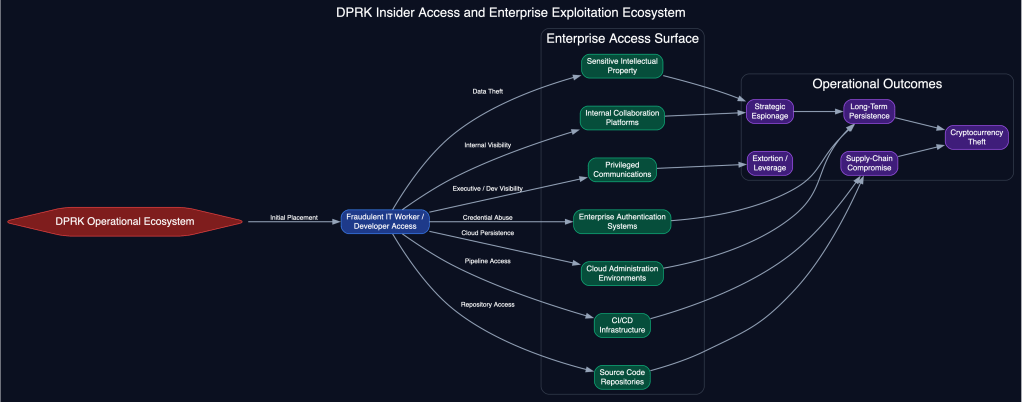
Modern DPRK cyber activity increasingly demonstrates a convergence between espionage tradecraft, cybercrime methodologies, insider-access operations, cloud compromise, and supply-chain intrusion activity. Campaigns that once would have been viewed as operationally distinct now routinely intersect and reinforce one another within a broader access-generation ecosystem. Access obtained during one operation is frequently leveraged to support entirely different mission objectives later in the intrusion lifecycle. Fraudulent remote-employment schemes provide long-term insider persistence within enterprise environments. Developer-targeting campaigns generate access to source-code repositories, CI/CD infrastructure, cloud environments, and authentication systems. Credential theft and cloud compromise enable lateral expansion into enterprise ecosystems and cryptocurrency infrastructure. Supply-chain compromise opportunities emerging from trusted development environments create additional pathways for persistence, intelligence collection, and monetization activity.
Rather than functioning as isolated operational tracks, these activities increasingly operate as interconnected and mutually reinforcing components of a larger strategic framework. The same infrastructure, personas, credential ecosystems, cloud-access mechanisms, and operational tooling may simultaneously support espionage, financial theft, persistence operations, and supply-chain intrusion activity. This convergence allows DPRK operators to continuously recycle access pathways and operational assets across multiple campaigns while reducing operational overhead and increasing strategic flexibility.
The broader evolution reflects a fundamental transition away from short-duration intrusion operations toward the construction of durable access ecosystems designed to generate recurring operational value over extended periods of time. In this model, the objective is not merely to compromise a target and exfiltrate data or steal funds, but to establish reusable and persistent operational footholds capable of supporting intelligence collection, monetization, lateral expansion, and future access generation simultaneously. The result is a far more resilient and adaptive operational architecture in which access itself becomes the central strategic resource underpinning the broader DPRK cyber enterprise.
Fraudulent IT Worker Operations and Insider Access
One of the most significant developments in DPRK cyber strategy has been the industrialization of fraudulent remote IT-worker operations. These campaigns leverage stolen identities, synthetic personas, VPN infrastructure, facilitators, laptop farms, and remote-work platforms to place DPRK-linked personnel inside foreign organizations under the guise of legitimate employees or contractors.

The insider-access model provides DPRK operators with long-term persistence that is considerably more difficult to detect than conventional malware-based intrusions. Legitimate employee credentials, normal remote-work behavior, and access through trusted corporate workflows reduce visibility while simultaneously increasing operational flexibility.
Recent U.S. law enforcement actions revealed the scale and sophistication of this ecosystem, including laptop farms distributed across the United States that allowed DPRK personnel to appear geographically local while remotely operating enterprise-issued systems from abroad. These operations illustrate how DPRK cyber strategy increasingly combines espionage logic, labor fraud, and access persistence into a unified operational model.
Developer Targeting and Recruitment-Themed Intrusions
Parallel to insider-access operations, DPRK-linked actors have aggressively expanded campaigns targeting software developers through fake recruitment processes and technical interviews. These operations rely heavily on social engineering and exploit the trust relationships inherent to modern software development and remote hiring practices.
Victims are typically approached through fabricated recruiter personas or cloned company identities and are invited to complete coding assessments or technical evaluations. Malicious repositories, poisoned dependencies, staged development environments, and automated execution mechanisms hidden within project configuration files are then used to compromise the victim system.
The operational value of these campaigns lies not merely in endpoint compromise, but in the strategic access developers inherently possess. Compromised developers frequently provide indirect access to:

This reflects a major doctrinal evolution in DPRK targeting philosophy. Rather than attacking infrastructure directly, operators increasingly target the trusted humans who administer and maintain critical digital ecosystems.
Cryptocurrency Theft and Financial Operations
Cryptocurrency theft remains one of the defining pillars of DPRK cyber activity, but the operational model behind these campaigns has evolved far beyond the earlier era of direct exchange intrusions and opportunistic financial compromise. Contemporary DPRK financial operations increasingly function as the culmination point of broader access-generation ecosystems in which credential theft, cloud compromise, insider placement, and developer targeting all serve as preparatory stages for eventual monetization activity.
Modern DPRK-linked financial campaigns rarely begin with the theft itself. Instead, operators increasingly establish layered access pathways through prior compromise operations that may initially appear unrelated to cryptocurrency targeting. Fraudulent IT-worker placements provide long-term insider visibility into enterprise environments. Developer-focused social engineering campaigns generate access to cloud infrastructure, CI/CD environments, source code repositories, authentication systems, and privileged communications. Credential harvesting and session theft operations further expand visibility across organizational ecosystems. By the time financial theft occurs, operators frequently possess extensive knowledge of the victim environment, trusted identities, operational workflows, and security controls.
The operational sophistication of these campaigns has increased substantially alongside this shift toward multi-stage access operations. Contemporary DPRK cryptocurrency theft activity now routinely incorporates rapid asset movement, decentralized finance abuse, cross-chain laundering, distributed wallet infrastructure, mixers, blockchain obfuscation techniques, and complex multi-stage financial routing mechanisms designed to complicate attribution and asset recovery. Stolen assets are often fragmented and redistributed across numerous wallets, chains, and intermediary services within extremely short timeframes, reducing defenders’ ability to freeze or recover funds before they disappear into laundering ecosystems.

This operational model reflects a mature understanding of the decentralized financial environment and demonstrates how DPRK operators increasingly exploit the structural characteristics of cryptocurrency ecosystems themselves as part of their tradecraft. Blockchain infrastructure, decentralized exchanges, token-swapping mechanisms, and distributed wallet architectures are no longer simply targets of intrusion activity; they have become integral components of the laundering and obfuscation process.
Importantly, the financial infrastructure supporting these campaigns increasingly overlaps with espionage and access-generation operations, reinforcing the broader convergence visible across modern DPRK cyber activity. Infrastructure used during developer-targeting campaigns may later support credential harvesting or cryptocurrency theft. Personas initially created for recruitment-themed social engineering may later facilitate insider access or cloud compromise. Credential stores, operational tooling, and access pathways are routinely reused across multiple mission sets, blurring the distinction between espionage, cybercrime, insider operations, and financial theft.
The result is an operational ecosystem in which financial operations are no longer isolated criminal events, but interconnected components of a larger state-directed cyber architecture designed to generate revenue, preserve access, and sustain regime objectives under international sanctions pressure.
Supply-Chain Intrusions and Trusted-Platform Abuse
DPRK operators have increasingly shifted toward supply-chain compromise and trusted-platform abuse as a means of achieving DPRK cyber operations have increasingly shifted toward access models designed to maximize scalability and persistence while minimizing operational exposure. Rather than relying exclusively on bespoke malware frameworks or dedicated command-and-control infrastructure, modern campaigns now routinely exploit legitimate digital ecosystems already trusted by enterprise environments. GitHub repositories, software package ecosystems, cloud hosting providers, SaaS platforms, remote management tools, blockchain infrastructure, and enterprise collaboration services have all become recurring components within DPRK operational tradecraft.
This transition reflects a broader strategic understanding that abuse of trusted infrastructure frequently provides greater operational durability than traditional malware-centric intrusion models. Legitimate platforms naturally blend into normal enterprise traffic patterns, making malicious activity substantially more difficult to distinguish from routine user behavior. Connections to cloud providers, collaboration platforms, software repositories, and SaaS environments often appear operationally benign within modern enterprise networks, reducing both detection visibility and attribution clarity. In effect, DPRK operators increasingly weaponize the trust relationships organizations already maintain with widely adopted digital services.

The operational advantages of this approach are substantial. By leveraging trusted ecosystems rather than relying solely on overt malware infrastructure, DPRK campaigns reduce their dependency on fixed command-and-control nodes vulnerable to disruption, sinkholing, or takedown operations. Remote management tools and cloud-hosted environments allow operators to maintain persistence using legitimate administrative pathways, while package repositories and development platforms provide scalable delivery mechanisms capable of reaching developers, enterprises, and downstream software ecosystems simultaneously.
Recent operations involving blockchain-hosted payload delivery mechanisms further illustrate this broader evolution toward decentralized and resilient infrastructure models. Rather than hosting payloads or retrieval logic exclusively on attacker-controlled infrastructure, DPRK-linked campaigns have increasingly embedded delivery mechanisms within blockchain ecosystems and legitimate web services. This approach complicates defensive disruption because the underlying infrastructure itself is distributed, trusted, and often outside the scope of conventional takedown operations. Blockchain-based retrieval mechanisms also reduce reliance on static infrastructure indicators traditionally used in threat hunting and malware attribution.
The cumulative result is an operational model increasingly centered on trust exploitation rather than overt technical intrusion alone. The objective is no longer simply to compromise systems through malicious binaries, but to embed malicious activity inside legitimate digital workflows, trusted enterprise relationships, and widely adopted cloud ecosystems. This evolution reflects a broader maturation of DPRK cyber strategy in which persistence, scalability, deniability, and operational resilience are achieved through the manipulation of trusted technological environments rather than purely through traditional malware deployment.
Espionage Operations and Strategic Intelligence Collection
TraditiTraditional espionage operations remain an enduring and strategically important component of DPRK cyber activity. Government ministries, defense contractors, aerospace firms, policy organizations, academic institutions, and strategic technology sectors continue to be systematically targeted for intelligence collection and long-term access operations. These campaigns are generally characterized by operational patience and persistence rather than rapid disruption or overt monetization. The primary objective is sustained visibility into decision-making environments, technological development, geopolitical planning, and sensitive research ecosystems.
Operationally, these espionage campaigns prioritize long-duration access and low-noise persistence. DPRK operators frequently focus on maintaining mailbox visibility, harvesting credentials, collecting sensitive documents, monitoring communications, and establishing durable access within cloud environments. Rather than immediately exploiting access for disruptive purposes, operators often seek to preserve footholds over extended periods of time in order to continuously collect intelligence and expand operational awareness within the victim environment.

However, even within these more traditional espionage campaigns, the broader convergence trend visible across DPRK cyber operations has become increasingly apparent. Infrastructure originally associated with financially motivated activity now frequently overlaps with intelligence-collection operations, while credential ecosystems, cloud-access mechanisms, and operational tooling are routinely reused across multiple mission sets. Access pathways established during insider-placement operations or developer-targeting campaigns may later support intelligence collection, while espionage-oriented credential harvesting may subsequently facilitate financially motivated operations or supply-chain compromise.
This growing integration between espionage, access generation, and revenue-generation functions reflects a broader evolution in DPRK operational strategy. Rather than maintaining rigid separation between intelligence and financial operations, DPRK-linked actors increasingly appear to operate within a shared access ecosystem in which infrastructure, compromised identities, cloud persistence mechanisms, and operational resources are continuously recycled across campaigns.
The result is a significantly more complex attribution environment. The same operational pathways may simultaneously support espionage objectives, monetization activity, long-term persistence, and access expansion, making it increasingly difficult to distinguish where one mission set ends and another begins. This convergence further reinforces the assessment that modern DPRK cyber activity functions less as a collection of isolated intrusion groups and more as an interconnected operational architecture designed to support regime survival, strategic intelligence collection, and sanctions-resistant revenue generation in parallel.
The Emergence of a Cyber-Enabled State Enterprise
The broader evolution of DPRK cyber operations increasingly resembles the emergence of a vertically integrated cyber-enabled state enterprise rather than a fragmented collection of isolated intrusion groups conducting independent campaigns. Over time, the operational distinctions between espionage actors, financially motivated operators, insider-access schemes, and supply-chain compromise activity have steadily eroded, giving way to a far more interconnected ecosystem in which multiple operational functions reinforce and sustain one another.
Within this ecosystem, social engineering campaigns serve as foundational access-generation mechanisms, creating entry points into organizations through fake recruiters, impersonation, phishing, and developer-targeting operations. Fraudulent remote employment schemes then transform access into persistence by embedding DPRK-linked operators directly within enterprise environments under the guise of legitimate workers or contractors. Developer compromise expands this access further by enabling supply-chain intrusion opportunities through trusted software repositories, CI/CD pipelines, and cloud-based development environments. Cloud compromise facilitates lateral expansion across enterprise infrastructure, while cryptocurrency theft operations convert access into regime-accessible revenue streams capable of bypassing international sanctions constraints. At the same time, intelligence-collection operations leverage many of these same access pathways to support strategic state objectives involving geopolitical awareness, technology acquisition, and long-term visibility into foreign institutions.
Importantly, these operational tracks no longer function independently. Success achieved in one operational area directly contributes to capability expansion in another. Access obtained during recruitment-themed developer targeting may later support cloud compromise or cryptocurrency theft. Fraudulent employees placed within enterprises may provide intelligence collection opportunities or facilitate supply-chain compromise. Credential harvesting conducted during espionage operations may later support financial operations or persistence activities. Rather than discrete campaigns, DPRK cyber operations increasingly function as interconnected operational pipelines in which infrastructure, personas, credentials, tooling, and access pathways are continuously recycled across mission sets.

This operational model provides the DPRK regime with several significant strategic advantages. The interconnected nature of the ecosystem creates resilience against disruption because the loss of a single malware family, infrastructure node, or operational campaign does not fundamentally degrade broader capability. The reuse of infrastructure and access pathways across multiple mission sets also complicates attribution, reducing clarity regarding whether a particular intrusion is primarily espionage-oriented, financially motivated, or intended for long-term persistence. Operational deniability is further enhanced by the regime’s extensive use of intermediaries, fraudulent identities, decentralized infrastructure, and legitimate digital services.
The model also enables recurring access generation and diversified revenue streams. Rather than relying solely on isolated theft operations, DPRK operators continuously cultivate new access opportunities through social engineering, insider placement, trusted-platform abuse, and cloud persistence. This allows the regime to sustain cyber operations even under extensive sanctions pressure while simultaneously supporting strategic intelligence requirements and financial objectives.
Perhaps most importantly, the ecosystem allows for continuous reuse and repurposing of operational assets. Personas developed for recruitment campaigns can later support insider-placement operations. Compromised accounts harvested during espionage activity can facilitate financial theft or supply-chain compromise. Infrastructure originally established for malware delivery may later support credential harvesting, cloud persistence, or operational staging. Development environments, cloud access pathways, and collaboration-platform visibility can all be retained and reused across future campaigns with relatively low operational overhead.
The cumulative effect is the emergence of a durable cyber-enabled state enterprise in which access generation, persistence, monetization, intelligence collection, and operational expansion operate as integrated components of a broader strategic system designed to sustain regime objectives over the long term.
Strategic Assessment
The evolution of DPRK cyber operations reflects far more than incremental improvements in technical sophistication or malware development. What has emerged over time is a broader structural transformation in how the regime conducts cyber-enabled state activity as a whole. Earlier DPRK campaigns could often be categorized into relatively discrete operational buckets such as espionage, financial theft, disruptive operations, or supply-chain compromise. Increasingly, however, these distinctions no longer hold. Modern DPRK cyber activity operates as a deeply interconnected ecosystem in which espionage, cybercrime, insider compromise, supply-chain intrusion, cloud-focused access operations, and financial theft reinforce one another as components of a unified strategic architecture.
Within this evolving model, operational categories that once appeared separate now function as interdependent layers of a broader access-generation and persistence framework. Espionage operations generate credentials and visibility that may later support monetization activity. Fraudulent IT-worker schemes create insider persistence capable of enabling intelligence collection, supply-chain compromise, or financial theft. Developer-targeting campaigns facilitate access into cloud environments, CI/CD pipelines, and cryptocurrency ecosystems, which can then be leveraged across multiple operational objectives simultaneously. Rather than pursuing isolated tactical outcomes, DPRK operators increasingly appear focused on constructing durable access ecosystems capable of supporting revenue generation, intelligence collection, operational persistence, and geopolitical leverage in parallel.
At the core of this operational transformation is a strategic emphasis on the exploitation of trust itself. Modern DPRK operations increasingly weaponize the assumptions embedded within contemporary digital ecosystems and remote-work culture. Trust in remote employees becomes a mechanism for insider access and persistence. Trust in software developers becomes an avenue for supply-chain compromise and credential theft. Trust in cloud platforms and SaaS infrastructure enables operators to blend malicious activity into legitimate enterprise workflows. Trust in collaboration platforms and communication ecosystems provides visibility into internal organizational dynamics, operational processes, and privileged communications. Even trust in legitimate digital infrastructure itself becomes exploitable as DPRK operators increasingly rely on trusted services, decentralized platforms, and widely adopted enterprise tooling to conceal malicious activity within normal operational traffic.
This represents one of the most important strategic evolutions in DPRK tradecraft. The defining characteristic of modern DPRK cyber operations is no longer simply the deployment of malware or the compromise of vulnerable systems. Instead, it is the systematic weaponization of trusted human and technological relationships at scale. The objective is not merely to breach networks, but to embed operational access within the trusted fabric of modern enterprise ecosystems themselves. In this model, persistence is achieved not only through technical compromise, but through the manipulation of the social, organizational, and technological trust relationships upon which contemporary digital infrastructure depends.
如有侵权请联系:admin#unsafe.sh