This post is part of a spotlight series on the organizations defending the free internet.Internet f 2026-5-12 00:0:0 Author: blog.torproject.org(查看原文) 阅读量:41 收藏
This post is part of a spotlight series on the organizations defending the free internet.
Internet freedom has declined for 15 consecutive years. Beyond surveillance, the erosion of privacy and anonymity, and information manipulation, governments are targeting specific sites and services, or attacking infrastructure itself, causing shutdowns and deliberate disruptions for internet users. But how do we know when the internet is censored and how?
OONI, the Open Observatory for Network Interference, born out of the Tor Project, exists to answer that question. Through free software tools and open data OONI makes censorship measurable, verifiable, and actionable. This post is about what that looks like in practice.
Protecting the public record
OONI data is the world's largest open dataset on internet censorship: billions of measurements collected across tens of thousands of networks from 245 countries and territories since 2012. OONI's data exists because people around the world run OONI Probe and contribute measurements from the networks that they are connected to. Every new measurement adds to a shared public record.
Both its scale and methodology contribute to OONI's impact. Internet censorship often works by making interference hard to see. It can make a blocked website look broken, a throttled app look unreliable, or a shutdown look like a technical failure. OONI helps expose these tactics through open measurement methodologies, peer review, expert feedback, and comparison against control measurements, so that censorship claims can be tested, challenged, and verified.
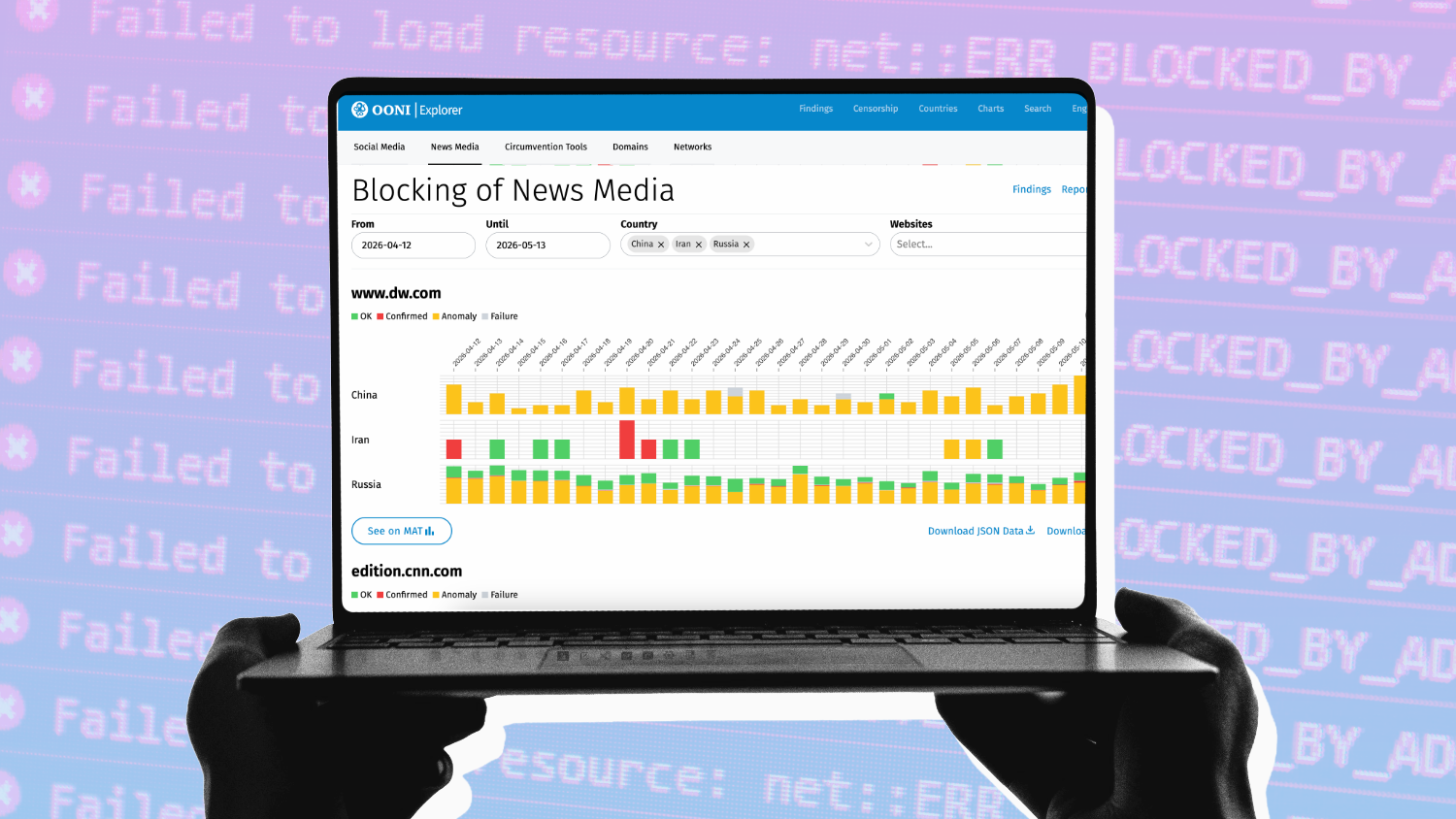
To make this dataset user-friendly, OONI launched thematic pages in OONI Explorer focusing on the areas most frequently targeted: social media and messaging apps, news media, and circumvention tools. Each page includes short reports, longer research reports, and charts with the latest OONI data.
In 2025, a dedicated "Blocking of News Media" page helped surface findings that would otherwise require sifting through billions or raw measurements: the blocking of the independent media outlet Zawia3 in Egypt, the blocking of 12 news media websites in Jordan, and the blocking of The Wire in India during the military conflict with Pakistan.
Think about when censorship events tend to happen: elections, protests, armed conflict, national exams, and periods of political unrest. The moment when access to information matters most. OONI gives affected communities a shared factual basis at those moments to make accountability possible.
How journalists and media organizations use OONI

In 2025, Meduza, one of the most prominent Russian media outlets in exile published an article introducing OONI tools and encouraging readers to use them. It's just one example how a newsroom can effectively use censorship measurement not just to report a story, but as an act of public education: helping audiences understand how network interference works, how it can be documented, and how they can contribute to that evidence base themselves.
When a news website is blocked, that's not just a technical event. It's the public losing access to reporting, communities losing access to timely information, and journalists losing access to their audiences. Documentation that can be cited and analyzed is what turns that event into something actionable.
The most concrete example of that chain in action is Kenya. OONI data served as evidence in a public-interest case challenging the unlawful disruption of internet access. The case was filed by a coalition that included BAKE, ICJ Kenya, Paradigm Initiative, the Kenya Union of Journalists, Katiba Institute, the Law Society of Kenya, and CIPESA. To support the petition before the High Court of Kenya, OONI produced a detailed research report, in the form of an expert opinion, documenting the blocking of Telegram during Kenya's 2023 and 2024 KCSE national exams.
This is a case where a journalists' union, digital rights organizations, legal advocates, and technical researchers were able to work from the same datasets to elevate internet disruption to a public-interest issue. And this case also helped set an important regional precedent: lawyers in Tanzania subsequently reached out to OONI for data to support legal efforts challenging the blocking of Twitter/X there, prompting OONI to publish a research report documenting the block.
Collective action for a collective internet
The Kenya-to-Tanzania ripple effect illustrates how internet censorship works across geographies. But also how we can fight it. A block on messaging apps isn't a standalone event. Journalists may lose access to sources. Activists may lose organizing channels. Circumvention tool developers may need to adapt. Researchers may need to verify what happened. Lawyers may need evidence. But everyone needs documentation.
OONI's open data model is built for exactly these moments. Protecting the free internet requires documenting censorship, sharing evidence, and building the collective capacity to respond.
如有侵权请联系:admin#unsafe.sh