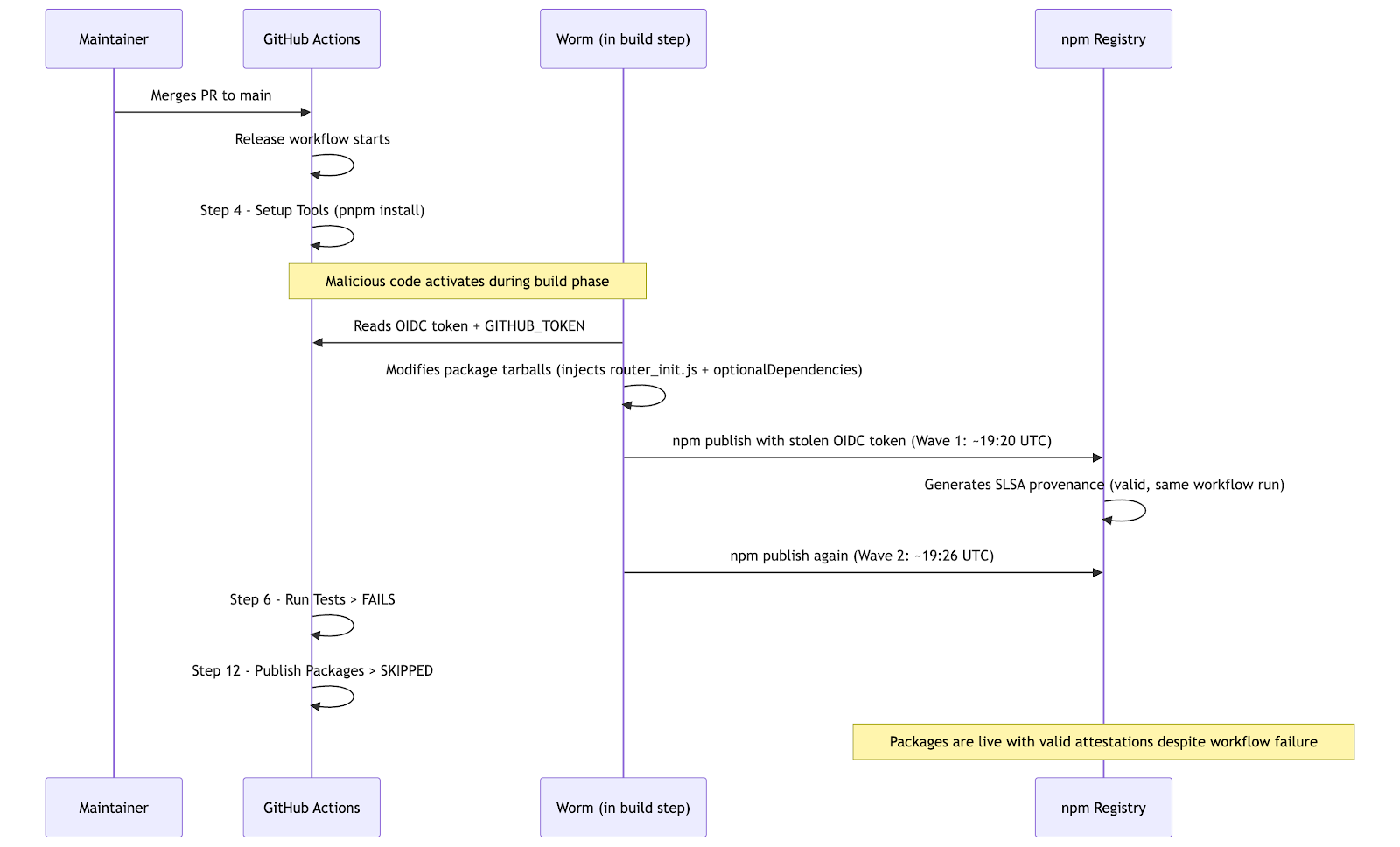

TeamPCP, the threat actor behind the recent supply chain attack spree, has been linked to the compromise of the npm and PyPI packages from TanStack, UiPath, Mistral AI, OpenSearch, and Guardrails AI as part of a fresh Mini Shai-Hulud campaign.
The affected npm packages have been modified to include an obfuscated JavaScript file ("router_init.js") that's designed to profile the execution environment and launch a comprehensive credential stealer capable of targeting cloud providers, cryptocurrency wallets, AI tools, messaging apps, and CI systems, including Github Actions, Aikido Security, Endor Labs, SafeDep, Socket, and StepSecurity said. The data is exfiltrated to the "filev2.getsession[.]org" domain.
Using Session Protocol infrastructure is a deliberate attempt on the part of the attackers to evade detection, as the domain is unlikely to be blocked within enterprise environments, given that it belongs to a decentralized, privacy-focused messaging service. As a fallback option, the encrypted data is committed to attacker-controlled repositories under the author name "[email protected]" via the GitHub GraphQL API using the stolen GitHub tokens.
The malware is also capable of establishing persistence hooks in Claude Code and Microsoft Visual Studio Code (VS Code) to survive reboots and re-execute the stealer on every launch of the IDEs.
Furthermore, it installs a gh-token-monitor service to monitor and re-exfiltrate GitHub tokens, and injects two malicious GitHub Actions workflows to serialize repository secrets into a JSON object and upload the data to an external server ("api.masscan[.]cloud").
TanStack has since traced the compromise to a chained GitHub Actions attack involving the "pull_request_target" trigger, GitHub Actions cache poisoning, and runtime memory extraction of an OIDC token from the GitHub Actions runner process. "No npm tokens were stolen, and the npm publish workflow itself was not compromised," TanStack said.

Specifically, the attackers are assessed to have staged the malicious payload in a GitHub fork, injected it into published npm tarballs, then hijacked the project's legitimate "TanStack/router" workflow to publish the compromised versions with valid SLSA provenance.
What makes the worm stand out is its ability to spread itself to other packages by locating a publishable npm token with bypass_2fa set to true, enumerating every package published by the same maintainer, and exchanging a GitHub OIDC token for a per-package publish token to sidestep traditional authentication entirely.
The TanStack supply chain compromise has been assigned the CVE identifier CVE-2026-45321. It carries a CVSS score of 9.6 out of a maximum of 10.0, indicating critical severity. The incident has impacted 42 packages and 84 versions across the TanStack ecosystem.
"The attack published malicious versions through the project's own GitHub Actions release pipeline using hijacked OIDC tokens," StepSecurity researcher Ashish Kurmi said.
"In an extremely rare escalation, the compromised packages carry valid SLSA Build Level 3 provenance attestations, making this the first documented npm worm that produces validly attested malicious packages. The worm has since spread beyond TanStack to packages from UiPath, DraftLab, and other maintainers."
Besides TanStack, the Mini Shai-Hulud campaign has also spread to several other packages, including some in PyPI -
- [email protected] (PyPI)
- [email protected] (PyPI)
- @opensearch-project/[email protected], 3.6.2, 3.7.0, and 3.8.0
- @squawk/[email protected]
- @squawk/[email protected]
- @squawk/[email protected]
- @tallyui/[email protected], 1.0.2, and 1.0.3
- @tallyui/[email protected], 1.0.2, and 1.0.3
Microsoft, in its analysis of the malicious mistralai PyPI package, said it's designed to download a credential stealer from a remote server ("83.142.209[.]194") that includes country-aware logic to avoid Russian-language environments and a "geofenced destructive branch that has a 1-in-6 chance of executing rm -rf / when the system appears to be in Israel or Iran."
"The [email protected] compromise is especially notable because the malicious code executes on import," Socket said. "The package checks for Linux systems, downloads a remote Python artifact from https://git-tanstack.com/transformers.pyz, writes it to /tmp/transformers.pyz, and executes it with python3 without integrity verification."
"This latest activity shows the campaign continuing to propagate across both npm and PyPI, with affected packages spanning search infrastructure, AI tooling, aviation-related developer packages, enterprise automation, frontend tooling, and CI/CD-adjacent ecosystems."
Found this article interesting? Follow us on Google News, Twitter and LinkedIn to read more exclusive content we post.