
好的,我现在需要帮用户总结一篇文章的内容,控制在100个字以内。用户的要求是直接写描述,不需要特定的开头。首先,我得仔细阅读文章,抓住关键点。 文章主要讲的是一个叫Pack2TheRoot的高危漏洞,CVSS评分3.8.8,影响多个Linux发行版。漏洞存在于PackageKit守护进程中,允许无特权用户获取root权限。发现者是德国电信的红队,在2026年4月22日公开披露,并提供了修复版本和检测方法。 接下来,我需要把这些信息浓缩到100字以内。要确保包括漏洞名称、影响范围、攻击方式、发现者、修复版本和检测方法。同时,语言要简洁明了。 可能会遇到的问题是如何在有限的字数内涵盖所有重要信息而不遗漏关键点。比如,是否需要提到受影响的具体发行版?可能不需要,因为用户只要求总结,不需要详细列表。 最后,组织语言时要确保流畅自然,避免重复或冗余的信息。 </think> 这篇文章披露了一个高危漏洞Pack2TheRoot(CVE-2026-41651),影响多个Linux发行版,默认安装下易受攻击。该漏洞允许无特权用户通过PackageKit守护进程获取root权限或安装/删除系统包。已发布修复版本1.3.5,并提供检测方法以检查系统是否受漏洞影响。 2026-4-22 00:0:0 Author: github.security.telekom.com(查看原文) 阅读量:28 收藏

Today we publicly disclose a high-severity vulnerability (CVSS 3: 8.8) - in coordination with distro maintainers - that affects multiple Linux distributions in their default installations. The Pack2TheRoot vulnerability can be exploited by any local unprivileged user to obtain root access on a vulnerable system.
The vulnerability lies in the PackageKit daemon, a cross-distro package management abstraction layer.
The vulnerability enables an unprivileged attacker to install or remove system packages without authorization. This can be exploited to gain full root access or compromise the system in other ways.
The Pack2TheRoot (CVE-2026-41651) vulnerability was discovered by Deutsche Telekom’s Red Team during targeted research into local privilege escalation vectors on modern Linux systems.
PackageKit as a candidate initially caught our attention when we observed that a pkcon install command could install a system package without requiring a password on a Fedora Workstation.
Starting in 2025, we began investigating whether this behavior could be abused to achieve arbitrary package installation.
By guiding the AI-assisted research into a specific direction (using Claude Opus by Anthropic) we were able to discover an exploitable vulnerability.
The finding was manually reviewed and verified before being responsibly reported to the PackageKit maintainers, who confirmed the issue and its exploitability.
Which versions and systems are vulnerable?
All PackageKit versions between >= 1.0.2 and <= 1.3.4 are vulnerable.
Since PackageKit 1.0.2 was released over 12 years ago, this leaves a broad attack surface across Linux distributions.
Exploitability has been explicitly tested and confirmed on the following distributions in default installations with apt and dnf package manager backends:
- Ubuntu Desktop 18.04 (EOL), 24.04.4 (LTS), 26.04 (LTS beta).
- Ubuntu Server 22.04 - 24.04 (LTS)
- Debian Desktop Trixie 13.4
- RockyLinux Desktop 10.1
- Fedora 43 Desktop
- Fedora 43 Server
It is reasonable to assume that all distributions that ship PackageKit with it enabled are vulnerable. Since PackageKit is an optional dependency of the Cockpit project, many servers with Cockpit installed might be vulnerable as well, including Red Hat Enterprise Linux (RHEL).
The vulnerability is fixed in PackageKit release 1.3.5 and distribution backports. Updates should be available from today 2026-04-22 12:00 CEST.
How to check if your system is vulnerable
It is not sufficient to simply grep through the process list, as PackageKit and Cockpit are not necessarily running as persistent processes as they can be activated on demand through D-Bus.
First check if PackageKit is installed on your system and compare it with vulnerable versions, e.g.
dpkg -l | grep -i packagekitorrpm -qa | grep -i packagekit
Note grep’s -i flag, as the package may be installed in camel case as PackageKit.
To check if the PackageKit daemon is available, run systemctl status packagekit or pkmon.
If systemctl shows it as loaded or running, or pkmon shows transaction output, the daemon is active and your system is potentially exploitable if unpatched.
Indicators of compromise (IOC)
Even though the vulnerability is reliably exploitable in seconds, it leaves traces that serve as a strong indicator of compromise. After successful exploitation, the PackageKit daemon hits an assertion failure and crashes. Systemd recovers the daemon on the next D-Bus invocation, preventing a denial-of-service, but the crash is observable in the system logs:
# journalctl --no-pager -u packagekit | grep -i emitted_finished
Apr 18 09:56:36 Rocky10 packagekitd[2082]: PackageKit:ERROR:../src/pk-transaction.c:514:pk_transaction_finished_emit: assertion failed: (!transaction->priv->emitted_finished)
Apr 18 09:56:36 Rocky10 packagekitd[2082]: Bail out! PackageKit:ERROR:../src/pk-transaction.c:514:pk_transaction_finished_emit: assertion failed: (!transaction->priv->emitted_finished)
Technical Details
We currently do not share technical details on the root cause of the vulnerability. We plan to add them at a later point in time here.
Proof-of-Concept
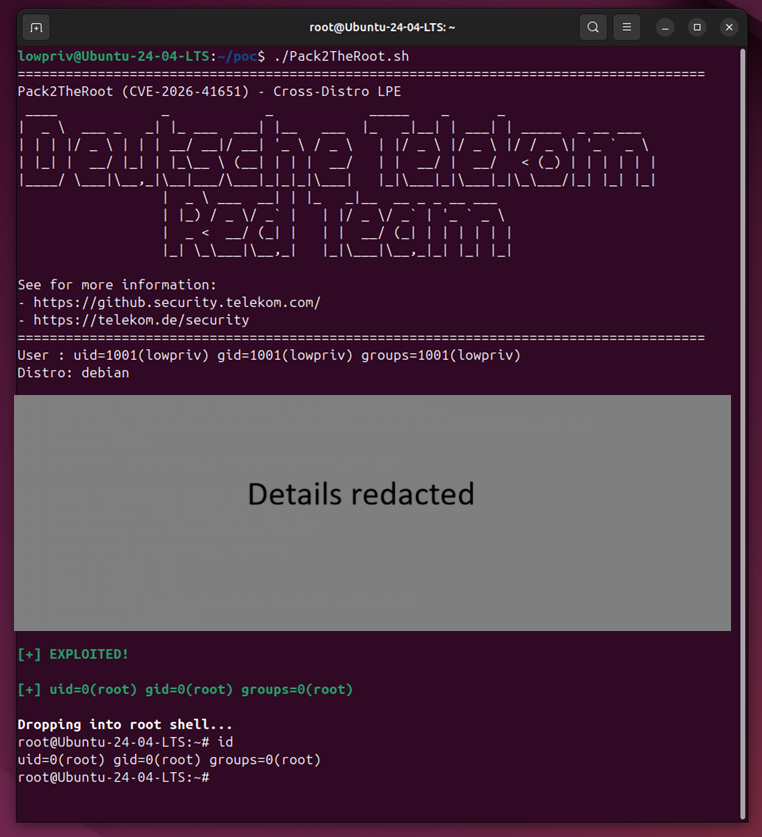
We have developed a working proof-of-concept that reliably exploits this vulnerability to achieve root code execution from an unprivileged local user on default installations of various distributions. However, the PoC code is not being shared publicly at this time for obvious reasons.
Credits
A huge thank you goes to PackageKit maintainer Matthias Klumpp (@ximion), for addressing this vulnerability quickly by creating a patch and for coordinating communication with the distribution maintainers. The vulnerability has been found and reported by Deutsche Telekom’s Red Team. If you have questions regarding the vulnerability or are interested in our security offerings, including Red Team assessments, feel free to contact [loading (JS)…].
Timeline
- 2026-04-08: Private report of the vulnerability to Red Hat (through Fedora) and PackageKit project
- 2026-04-10: Acknowledgement of receipt and plausibility of the vulnerability by PackageKit maintainer
- 2026-04-13: First draft of private patch by PackageKit maintainer Matthias Klumpp (@ximion)
- 2026-04-15: Informed Canonical about the issue
- 2026-04-15: Shared patch with Red Hat and Canonical
- 2026-04-19: Privately informed distribution vendors through distros mailing list, shared patch and publication date
- 2026-04-21: Reaffirmed the publication date with distribution maintainers
- 2026-04-22: PackageKit patch release and public disclosure through oss-security mailing list and this blog post.
- 2026-04-22: Got CVE-2026-41651 assigned
Advisories
- GitHub Security Advisory GHSA-f55j-vvr9-69xv
- CVE-2026-41651
The images in this article are free to use, as long as a reference to this blog post is provided.
如有侵权请联系:admin#unsafe.sh